

Most articles about CMMS for schools are written for American school districts. Canadian school boards, colleges and universities look after the same boilers, roofs and classrooms, but they do it under different funding, different laws and different buying rules. Those differences change what a maintenance system has to record, where its data can live, and how you buy it.
This guide compares Canada and the US in seven areas that matter to facilities teams in education. It covers K-12 schools and post-secondary campuses, and ends with a checklist for choosing a CMMS for schools and universities in Canada.
CMMS for schools: Canada and the US at a glance
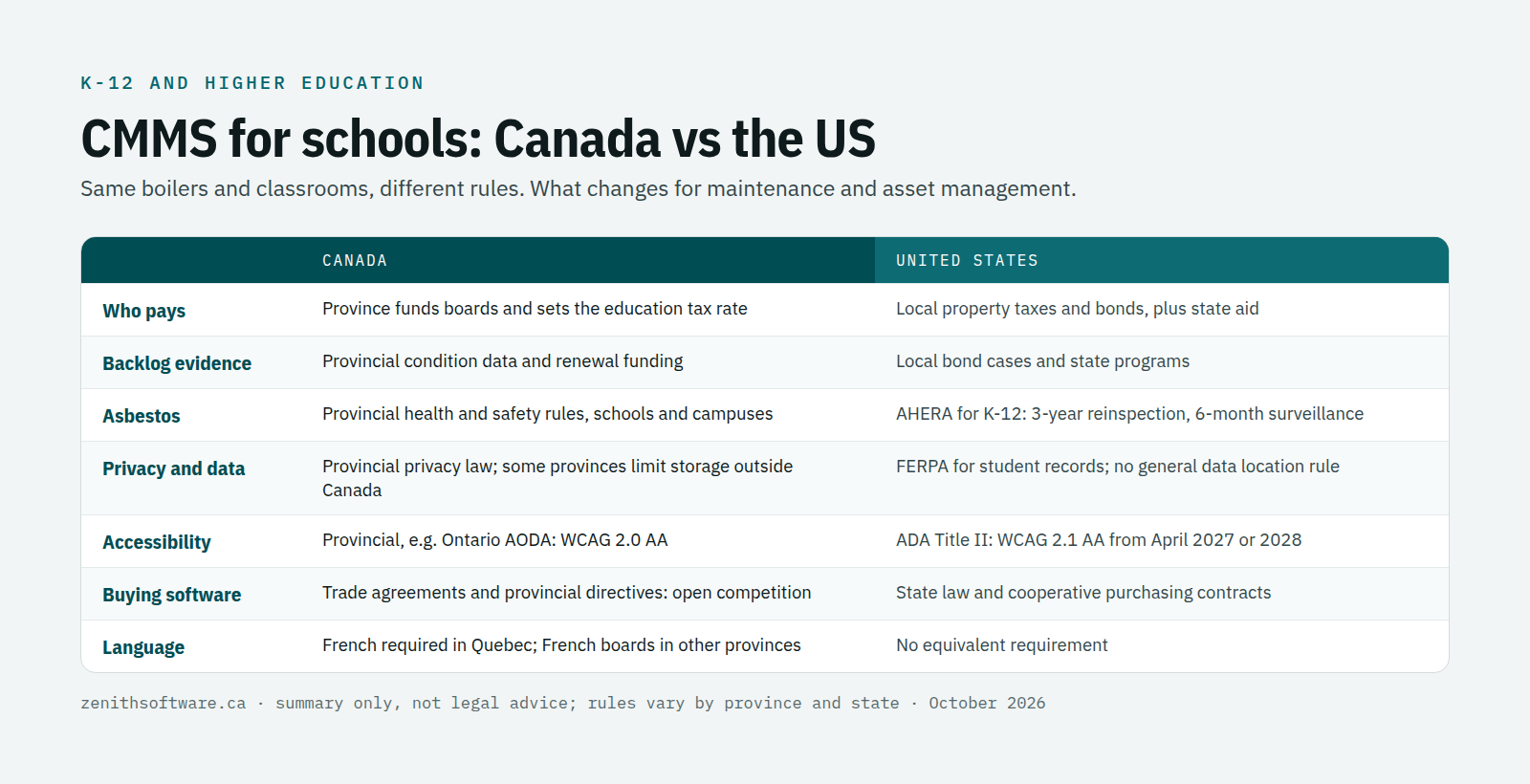
The short version: American districts answer to local voters and federal rules, while Canadian boards and campuses answer to their province. In Canada, a CMMS for schools has to satisfy the ministry that funds the repairs, the provincial privacy law that governs the data, and often a second official language.
1. Who pays for the building
In the US, public schools are funded heavily from local sources. In 2020–21, local revenue made up 44 percent of public school revenue, and about 83 percent of that came from property taxes. Districts also pass local bonds to pay for major repairs and new buildings. When a district needs a new roof, it often makes the case to local voters.
In Canada, education belongs to the provinces. In Ontario, for example, the province sets the education property tax rate and municipalities collect it. School boards then receive provincial funding, including a School Facilities Fund for operating, maintaining and renewing buildings. A Canadian board makes its case for repairs to the ministry, usually with condition data the province already tracks.
What it means for your CMMS: a Canadian school board needs maintenance records that line up with how the province measures building condition and renewal needs. Work order history alone does not make that case. Asset condition, age and planned replacement dates do.
2. The repair backlog a CMMS for schools has to track
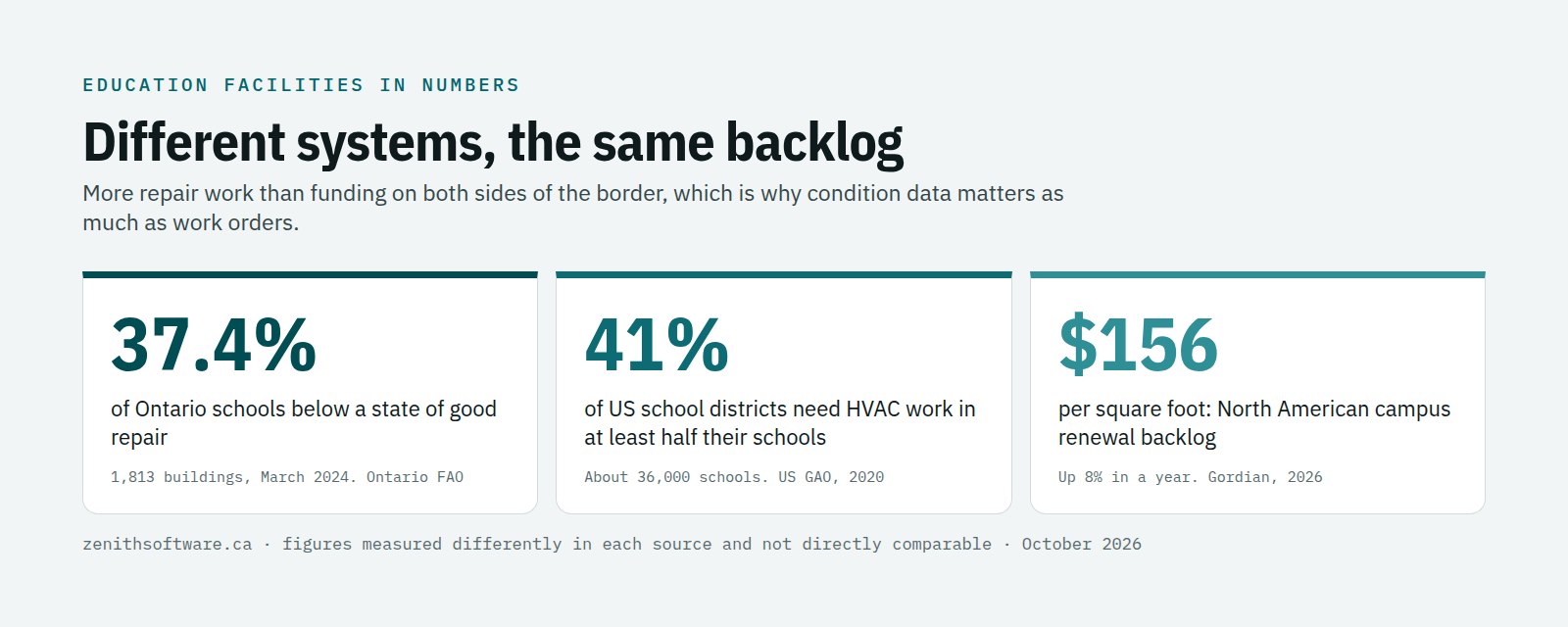
Both countries carry large repair backlogs, measured differently. Ontario’s Financial Accountability Office found that, as of March 2024, 37.4 percent of Ontario schools (1,813 buildings) were below a state of good repair. It put the repair backlog at $6.5 billion, and the 10-year shortfall for repairs and new space at $12.7 billion.
In the US, the Government Accountability Office estimated that 54 percent of public school districts need to update or replace multiple building systems. About 41 percent need HVAC work in at least half their schools, roughly 36,000 schools nationwide.
Campuses are no different. Gordian’s 2026 State of Facilities in Higher Education covers North American campuses. It puts the capital renewal backlog at $156 per gross square foot, up 8 percent in a year. Institutions fund only 73.5 percent of what is needed to stop it growing.
What it means for your CMMS: in either country, the system has to hold condition and lifecycle data for every major asset, not just open work orders. That is what turns a list of repairs into a capital plan. Our guide to a preventive maintenance schedule covers the routine side.
3. Asbestos rules and your CMMS for schools
The US has a single federal rule for schools. Under AHERA, public and private elementary and secondary schools keep an asbestos management plan. A certified inspector reinspects known and assumed asbestos every three years. Between inspections, schools carry out periodic surveillance at least once every six months and record each one in the plan. AHERA does not cover universities.
Canada has no AHERA. Asbestos falls under provincial occupational health and safety law, so the rules differ by province and cover campuses as well as schools. In Ontario, the regulation is O. Reg. 278/05, and institutions such as Brock University run an annual asbestos reassessment as a requirement of the Occupational Health and Safety Act.
What it means for your CMMS: hazardous materials need to sit against the asset and the room, so a technician or contractor sees them before work starts. In Canada, the inspection interval comes from your province, not a national rule. Our guide on how long to keep maintenance records in Canada covers how long to keep the results.
4. Privacy: where a CMMS for schools keeps its data
Maintenance records hold personal information: who reported a problem, who was in a room, who booked a space. In the US, the federal student privacy law, FERPA, covers education records, and facilities data rarely falls under it. There is no general federal rule on where a school’s maintenance data is stored.
Canadian school boards, colleges and universities are public bodies under provincial privacy law, and some provinces go further. Nova Scotia’s PIIDPA requires public bodies, including universities and community colleges, to keep personal information stored and accessed only in Canada unless the head of the institution allows an exception. British Columbia removed its strict data residency rule in November 2021, but public bodies must now assess any system that stores sensitive personal information outside Canada.
In Ontario, from 1 January 2027, institutions under MFIPPA, including school boards, must complete a privacy impact assessment before collecting personal information. Our article on what changes on 1 January 2027 explains what that means for booking and request systems.
What it means for your CMMS: a system hosted in Canada does not remove the need for an assessment, but it makes the assessment far simpler to complete and defend.
5. Accessibility
In the US, the Department of Justice now requires state and local governments, including public school districts and public universities, to make web content and mobile apps meet WCAG 2.1 Level AA. In April 2026, it extended the compliance dates to 26 April 2027 for larger entities and 26 April 2028 for smaller ones.
In Canada, accessibility rules are provincial. Ontario’s AODA sets WCAG 2.0 Level AA as the legal floor for public websites. Our guide to an accessible booking system covers what that means for request forms and floor plans.
What it means for your CMMS: the request form that teachers, staff and students use is public-facing. Check it with a keyboard and a screen reader before you buy, in either country.
6. How the software is bought
American districts and universities often buy through cooperative purchasing contracts. Another public body has already run the competition, so a district can join instead of running its own tender. State procurement law sets the rest.
Canadian schools, colleges and universities are covered by trade agreements. Ontario universities, for example, follow the Canadian Free Trade Agreement and CETA, which require open competition and public posting above set thresholds, plus provincial rules such as Ontario’s Broader Public Sector Procurement Directive. Our guide to the BPS Procurement Directive explains the thresholds and the consulting-services trap.
What it means for your CMMS: Canadian buyers usually run their own evaluation, so clear answers on hosting, privacy, accessibility and language are part of the bid, not an afterthought.
7. Language and energy reporting
Language is a Canadian requirement with no US equivalent. In Quebec, the Charter of the French Language requires software to be available in French. Ontario has 12 French-language school boards, and New Brunswick runs separate English and French school systems. Our guide to French-language maintenance documents in Quebec covers the details.
Energy reporting differs too. Ontario’s O. Reg. 25/23 covers the broader public sector, including universities, colleges, schools and hospitals. They must report energy use and greenhouse gas emissions every year by 1 July, and publish an energy conservation plan every five years. In the US, energy benchmarking is set by states and cities, not by a single federal rule.
School boards and universities need different things
School boards and districts run many small sites with a few caretakers each and hundreds of requesters, mostly teachers. They need a quick request form, one queue per school, and a roll-up for the facilities office. Free requesters matter, because every teacher reports problems. Our guide to a maintenance request system for schools covers the rollout.
Universities and colleges run a campus that behaves like a small city: research labs, residences, central plants, sports facilities and room booking. They need asset hierarchies, planned shutdowns, contractor control, space management and integrations with finance and student systems.
What to look for in a CMMS for schools and universities in Canada
- Condition and lifecycle data for every major asset, to show the ministry what needs renewing and when.
- Hazardous materials recorded against rooms and assets, with inspection intervals you can set to your province’s rules.
- Data hosted in Canada, with a clear answer for your privacy impact assessment.
- Free, unlimited requesters, so every teacher and staff member can report a problem.
- English and French for the people who use it, not just the people who buy it.
- An accessible request form that works with a keyboard and a screen reader.
- Pricing in Canadian dollars and a vendor ready for an open, documented procurement.
- Room and space booking on the same records as maintenance, for campuses and shared school space.
A CMMS for schools and universities in Zenith
Zenith is built in Victoria, British Columbia, for Canadian organizations. Requesters, view-only users and contractors are free on every edition, so a school board can open requesting to every teacher. Data is hosted in Canada, and everything works in English and French. Each asset carries its condition, health score, maintenance cost and repair-or-replace history, which feeds capital planning.
School boards usually start with the Essential edition for preventive maintenance, parts and technician mobile. Universities and multi-campus estates often need the Premium edition, which adds automation, integrations and executive reports, and pair it with room and desk booking. See the editions and prices in Canadian dollars, or our guide on choosing a CMMS edition by industry.
Questions people ask
Does AHERA apply to Canadian schools?
No. AHERA is a US federal law. In Canada, asbestos in schools and on campuses is regulated by each province’s occupational health and safety rules, and the requirements differ by province.
Do Canadian school boards have to keep data in Canada?
It depends on the province. Nova Scotia requires it for public bodies unless the head of the institution approves an exception. British Columbia allows storage outside Canada only after an assessment. Other provinces rely on privacy impact assessments. Hosting in Canada keeps the answer simple everywhere.
Can a US-built CMMS work for a Canadian school board?
Yes, if it meets the requirements above: Canadian hosting where needed, French where needed, an accessible request form, and records that match how your province measures building condition. Check each one in the demo rather than on a slide.
Is this legal advice?
No. Rules differ by province and state and change over time. Use this guide to ask better questions, and confirm requirements with your ministry, regulator or legal advisers.
Where to start
List your ten highest-risk assets in one school or one campus building, with their condition and replacement year. If that list takes more than an afternoon to put together, your records are the place to begin. Talk to us if you would like to see a school board or campus set up in Zenith.
Published by Zenith Software Corp., Victoria, British Columbia · October 2026. Practical guidance, not legal advice. We verified the external references in October 2026.