
How long must you keep maintenance records in Canada? Every buyer asks it, usually in a procurement questionnaire, usually expecting a single number.
There isn’t one. Maintenance records in Canada have no single retention period, and not because the law is vague. Regulators have chosen three different ways of writing the rule, and the one that applies to you depends on what the equipment is, who regulates it, and which province it sits in. A company running a plant in Ontario, a pipeline under federal jurisdiction and a fleet of trucks can be simultaneously subject to a fixed six-year rule, a rolling rule with no end date, and a two-year rule with a conditional tail.
This page sets out what we could verify about maintenance records in Canada from the primary sources, with section numbers, so you can check us. Where a regulation is silent, we say it is silent — that is a finding, not a gap.
This is not legal advice. It is a reading of published regulations as at September 2026, and consolidations change. Verify against the current instrument before you rely on it.
Three ways Canada writes a rule for maintenance records
Read twenty of the provisions governing maintenance records in Canada and they sort themselves into three families. Recognising which family you are in matters more than memorising any single number, because it determines whether your retention policy can be a calendar rule at all.
Fixed
A stated number of years from a stated event. These are the easy ones: you can automate them.
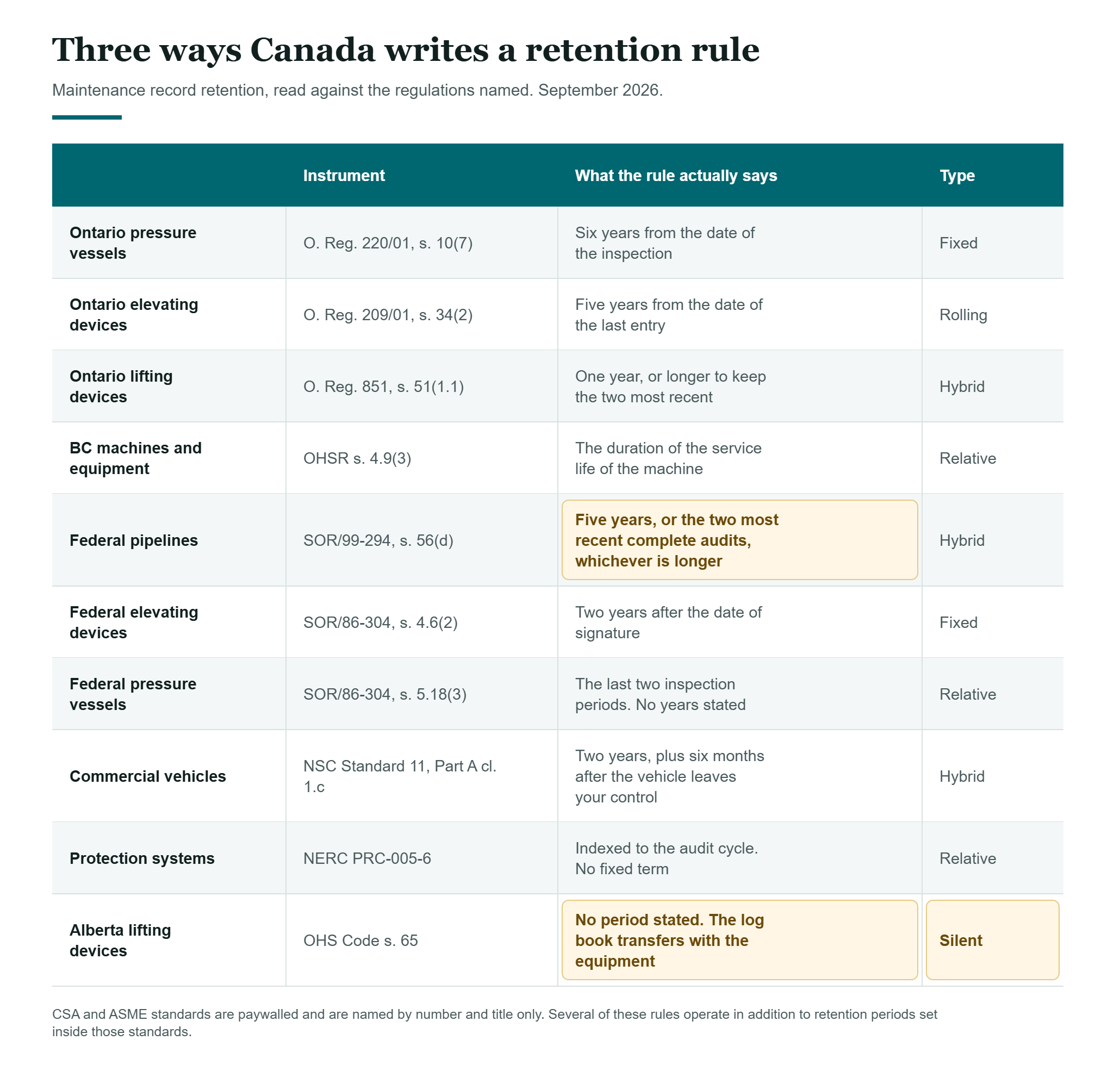
Ontario’s boiler and pressure vessel rule is the cleanest example. Under O. Reg. 220/01, s. 10(7), “the owner and the operator who receive the inspection report and the insurer, if any, who issues it” must each retain it six years from the date of the inspection to which the report relates. Three parties, one period. Subsection 10(8) lets the director request a copy at any point inside that window.
Relative
No number at all. The period tracks the life of the asset, the audit cycle, or the duration of a project. You cannot express these as a retention setting. They need the record to stay linked to the asset’s status.
British Columbia is the purest case. Look at the Occupational Health and Safety Regulation, s. 4.9(3). Where the Regulation requires a machine or piece of equipment to have inspection and maintenance records, detailed reports of inspection, maintenance, repairs and modifications must last “for the duration of the service life of the machine or equipment”. They must also stay reasonably available to the workplace. There is no number of years anywhere in Part 4.
Hybrid
A floor, plus an extension that can push past it. These catch people out, because the floor is the number that gets written into the policy and the extension is the part that gets forgotten.
The federal pipeline rule is the one most often misquoted. We have seen it cited as a flat five years. It is not.
The federal pipeline rule, quoted properly
Under the Canadian Energy Regulator Onshore Pipeline Regulations, SOR/99-294, the retention duty sits in paragraph 56(d) — the section has no subsections, only paragraphs (a) through (g). The opening words of s. 56 matter as much as the paragraph: a company must comply in addition to the record retention requirements in the CSA standards referred to in section 4. Paragraph (d) then reads:
“for the most recent five years of operation or for the period covered by the two most recent complete audits, whichever period is longer, the records for the audits and inspections required by sections 53 to 55”
As a result, three things follow, and people routinely miss all three.
What paragraph 56(d) actually covers
It is not a general records rule. Paragraph (d) covers records of the audits and inspections required by sections 53 to 55 — general compliance, construction inspection, and program audits. Section 53 alone requires an audit of compliance with the Regulations at least once every two years, which is what makes the audit-cycle limb bite. Other paragraphs of s. 56 set quite different periods:
- (a) — one month for the records made under paragraphs 36(c) and 37(b), and six months for leak-detection data.
- (c) — at least a year after a pipeline goes into service.
- (e) — as long as the installations remain on the pipeline, and (f) until buried facilities come out.
- (g) — at least two years after abandonment.
Five years is a floor, not a period. If your two most recent complete audits span seven years, seven years is your obligation.
The real number may be in a paywalled standard. Section 56 is expressly additional to retention requirements in CSA Z662, Oil and gas pipeline systems, incorporated by section 4. We are not going to quote a paywalled standard, and neither should anyone selling you software. We name it so you know where to look.
Where the rules on maintenance records in Canada say nothing
However, this is the part that surprises people. Several rules on maintenance records in Canada set no period at all, and the absence has practical consequences.
Alberta’s OHS Code sets no retention period for equipment log books. Section 65 requires an employer to set up a paper or electronic log book for each lifting device at a work site. The book must stay available for inspection by an officer at any time. The section has one durability mechanism, at s. 65(2)(c): “if ownership of a lifting device is transferred, the log book is transferred with the equipment.” Subsections 65(3) to (5) specify what must be entered and who must sign. No subsection states a duration. Section 65(1.1) exempts manually operated hoists from the log book requirement altogether. Under section 260(5), for powered mobile equipment, the record must likewise stay at the work site and available to the operator, with no period.
Still, we should be careful about how far we take that. Our review covered Parts 6, 11 and 19 of the Code, not all of it, so read this as specific to those sections rather than a Code-wide claim.
Alberta’s energy regulator is silent too
AER Directive 077 states no numeric retention period either. The words “retain” and “retention” do not appear. It ties logs of inspection, assessment and tests to the licensee’s integrity management programme, obliges the licensee to produce them to the AER on request, and pushes overpressure-protection testing intervals to CSA Z662 or to a documented programme. So a standard you have to buy sets the effective retention period for AER-regulated pipeline maintenance records.
Ontario Reg. 854, s. 207 contains no retention rule. It lists the five log books a mine hoisting plant must obtain from the Ministry — Electrical Hoisting Equipment, Hoisting Machinery, Hoist Operator’s, Rope, and Shaft Inspection. That is all it does. Section 248(9) requires entries in the Hoisting Machinery Record Book to be dated and signed by the person who did the work, but sets no period. Under section 228(8), the rope test record must stay readily available at the mine site while the rope is in service — relative, not fixed.
Federal silence on machine guarding records
Federal OHS regulations say nothing about machine guarding records. Part XIII of the Canada Occupational Health and Safety Regulations contains the guarding rules — s. 13.13 requires guards, s. 13.14 requires that guards be operated, maintained and repaired. The Part contains no record-keeping provision at all. Federal OHS documents guarding maintenance only indirectly, for instance through s. 12.21 where the item qualifies as protection equipment.
Federal maintenance records rules with actual numbers
Three worth knowing, all from the Canada Occupational Health and Safety Regulations, SOR/86-304:
- Elevating devices, s. 4.6(2): records kept in the workplace where the device is located for two years after the date of signature.
- Boilers and pressure vessels, s. 5.18(3): no years stated — the employer must keep readily available the record of inspection for the last two inspection periods. Relative, and easy to get wrong if you think in calendar terms.
- Protection equipment, s. 12.21(3): two years beginning the day the equipment is permanently removed from service, or longer if a standard referred to in that Part requires it. A hybrid whose ceiling you cannot know without buying the standard.
Note also s. 14.29(4), on materials handling equipment: an employer must keep a record of repairs, modifications and use restrictions — with no period specified at all.
The Canada Labour Code itself delegates entirely. Section 125(1)(g) of Part II requires an employer to “keep and maintain in prescribed form and manner prescribed health and safety records.” No paragraph of s. 125 states a number of years. (For the avoidance of a common mix-up, s. 125(1)(q) is about information, instruction, training and supervision, not records.)
The halocarbon trap
We have made this mistake ourselves, in an earlier draft of another article, and corrected it before publishing. It is worth flagging because refrigeration maintenance is a large share of many Canadian maintenance programmes and the rule is widely assumed to be general.
The Federal Halocarbon Regulations, 2022, SOR/2022-110 require the owner to retain documents on the site where the system is located for at least five years after the day they are prepared or submitted, under s. 26(1). A second duty is easy to miss. Section 26(2) requires a copy at the owner’s principal place of business in Canada. That covers systems in a means of transportation, on limited-access sites, or on sites where the owner is not regularly present.
But section 2(1) limits the whole instrument. It reaches systems and containers owned by Her Majesty in right of Canada, a board or agency of the Government of Canada, a Crown corporation as defined in s. 83(1) of the Financial Administration Act, or a federal work or undertaking. It also reaches anything on Aboriginal lands or federal lands. Subsection 2(2) excludes foam products.
A grocery chain’s refrigeration racks are almost never caught by these regulations. Provincial halocarbon rules are what apply, and they differ. If a vendor tells you their software makes you compliant with the Federal Halocarbon Regulations, ask them to read section 2 aloud.
Standards adopted rather than enacted
Two of the most quoted rules for maintenance records in Canada are not Canadian law of their own force.
National Safety Code Standard 11 is a CCMTA standard, developed by the member jurisdictions rather than legislated federally. Provinces adopt it by reference or mirror it. Part A, clause 1.c sets the retention rule:
“Every carrier shall retain records required under this section where the commercial vehicle is either housed or maintained for a period of at least two years and for six months after the vehicle leaves the motor carrier’s control”
Clause 1.b.iii defines the record as one of inspection, repairs and maintenance indicating date and nature. A footnote to clause 1.c is unusually candid about the Standard’s own non-uniformity. Many jurisdictions require proof of maintenance for four or five years. The footnote closes by warning that jurisdictional guidelines for record keeping “may vary and should be consulted and followed.” Take the Standard’s own advice. We could find no retention clause in Part B for periodic inspection certificates — that appears to be set provincially.
NERC PRC-005 and the audit cycle
NERC PRC-005 is the cleanest audit-cycle-indexed rule in the whole set. Evidence retention under PRC-005-6 provides that where the maintenance interval is longer than the audit cycle, you keep documentation of the most recent performance of that activity; where the interval is shorter, you keep all performances since the previous scheduled audit date. There is no number of years. Note it is drafted per requirement — R2, R3 and R4 separately — and that it opens with an override: unless the Compliance Enforcement Authority directs you to retain specific evidence longer as part of an investigation.
In addition, two cautions matter here, and the second is the one to act on. NERC standards are US-origin: in Canada they bind only where a province has adopted them through its own reliability-standards regime. And the version matters. PRC-005-7 was adopted by the NERC Board in May 2023, with an effective date set by formula — the first day of the first calendar quarter twelve months after the approving order, or twelve months after Board adoption where no approval is required. Its implementation plan then provides that PRC-005-6 “shall be retired immediately prior to the effective date of PRC-005-7 in the particular jurisdiction in which the revised standard is becoming effective.” Retirement is jurisdiction by jurisdiction, so which version binds you is a question about your own province, not about NERC.
The maintenance records rule that catches people out
Of everything in the table above, the Ontario elevating device rule deserves a second look, because it is the one people most often implement wrongly.
O. Reg. 209/01, s. 34(2) requires the log book to be kept “for a period of at least five years from the date of the last entry in the log book.” Not five years from the inspection. Five years from the last entry. A device still in service collects entries every month, so the clock restarts every month and the log book never becomes disposable.
Set that up as “delete after five years” and you will destroy records you were required to hold. Ontario’s lifting device rule sets a milder version of the same trap. Whatever is necessary to keep the two most recent records extends the one-year floor. Examine a device once in three years, and the three-year-old record still has to be there.
What maintenance records in Canada mean for choosing software
We build maintenance software, so we will be careful here rather than opportunistic.
No CMMS makes you compliant. Your programme carries compliance with the rules for maintenance records in Canada, not your database. What software can do is narrower, and it follows directly from the three families above.
A single global retention setting cannot express Canadian law. If a system offers you one dropdown — “keep records for [n] years” — it cannot represent BC’s service-life rule, Ontario’s rolling five-years-from-last-entry rule, or the federal audit-cycle floor. At minimum, retention has to be set per asset class and per jurisdiction.
Relative rules require the record to know the asset’s status. “Duration of the service life” is only enforceable if the system knows whether the asset is in service, and keeps the history attached when it is not. Detach a record from its asset and it can no longer satisfy a service-life rule.
What maintenance records must capture beyond a date
Several rules turn on who signed and when. Ontario Reg. 854, s. 248(9) requires entries dated and signed by the person who performed the work. BC’s s. 4.9(2) requires a signed entry each shift and for each test, inspection, modification, repair or maintenance. Alberta’s s. 65(4) to (5) require identification of the person who did the work. If your system records only a timestamp and a user ID, ask whether that satisfies a signature requirement in your province — we do not know of authority settling it either way.
Log books that follow the asset on sale. Alberta s. 65(2)(c) requires the log book to transfer with a lifting device when ownership changes. That is an export requirement, and it is unusual enough that most systems have not thought about it.
And the honest point: the hardest retention problems in Canadian maintenance are not technical. They are knowing which regime governs which asset. Software cannot answer that for you.
What we could not verify
Published in full, because on maintenance records in Canada an admitted gap is more useful than a confident guess.
- Whether any other Part of the Alberta OHS Code contains a general retention clause backstopping ss. 65 and 260(5). We examined Parts 6, 11 and 19 only, so read our Alberta finding as specific to those sections.
- Whether the Quebec Act respecting occupational health and safety itself contains a retention provision. We reviewed the RSST, not the Act.
- Retention of NSC Standard 11 Part B periodic inspection certificates. Appears absent from the Standard; provincially set.
- The FERC approval date for PRC-005-7, and which Canadian provinces have adopted which version and by what instrument.
- The individual requirement numbers we read in AER Directive 077. The negative finding — no numeric period — we checked twice and are confident in; the requirement numbers deserve a spot-check.
- Anything inside CSA Z662, CSA B44, CSA B51 or the ASME Boiler and Pressure Vessel Code. These are paywalled and we will not paraphrase them.
Two notes on how we checked this, because a reference page is only worth its method.
Where the automated check disagreed
An automated read of the SOR/99-294 PDF returned different wording for s. 56(d) and reported only paragraphs (a) to (f). Three separate reads of the HTML consolidation — the section page, the full text, and an archived consolidation — agree on paragraphs (a) to (g) and on the wording quoted above. We judge the PDF read to be a transcription error on our side rather than a real divergence, but we would rather say so than pretend the check was clean.
Furthermore, we checked every claim here twice, the second time adversarially against the primary source. That pass caught four errors in our own draft before publication:
- A misquote of the BC provision, dropping “or equipment”.
- A missed second retention duty in SOR/2022-110, s. 26(2).
- An imprecise description of paragraph 56(a).
- PRC-005 versioning treated as settled when it is not.
The same pass also flagged our reading of O. Reg. 851, s. 51(1.1) as possibly wrong — it was not, and the Ontario text confirms “such longer period,” which matters because it makes the rule a floor rather than an either-or. We mention the misses as well as the saves because a page like this is worth exactly what its checking is worth.
Quebec’s RSST, briefly
Worth a note because it is often assumed to mirror Ontario. It does not.
The Regulation respecting occupational health and safety has no general equipment maintenance record retention rule. The retention duties that exist are environmental and exposure-related. Article 43 requires air quality measurement results kept in a register for at least five years. Article 48 requires the same for breathable compressed air analyses, which must themselves happen at least every six months. Usefully, art. 48 also covers the date and the name of the person maintaining the supply equipment, again for at least five years. Art. 69.16 keeps the asbestos register as long as the building or civil engineering work is under the employer’s authority.
Article 48 is the best Quebec citation for an equipment-maintenance retention period, but be precise about its scope: it covers respirable compressed-air supply equipment, not equipment generally.
Frequently asked questions
How long do I need to keep maintenance records in Canada?
There is no single national period. The answer depends on the asset and the regulator. It may be a fixed term, such as six years for Ontario pressure vessel inspection reports. It may be relative, such as the service life of the machine in British Columbia. Or it may be a floor with a conditional extension, such as five years or two complete audit cycles for federally regulated pipelines. Several regulations set no period at all.
Is the federal pipeline retention period five years?
Not exactly. Paragraph 56(d) of SOR/99-294 requires the most recent five years of operation or the period covered by the two most recent complete audits, whichever is longer. It also applies only to the audit and inspection records required by sections 53 to 55, and it operates in addition to retention requirements in CSA Z662.
Does Alberta require maintenance records to be kept for a set number of years?
Sections 65 and 260(5) of the Alberta OHS Code require log books and records to exist and to be available, but state no retention period. Section 65(2)(c) requires the log book to transfer with a lifting device if ownership changes. We did not review all Parts of the Code, so treat this as specific to those sections.
Do the Federal Halocarbon Regulations apply to my refrigeration system?
Probably not, unless your system is owned by the federal Crown, a federal board, agency or Crown corporation, or a federal work or undertaking, or is located on Aboriginal or federal lands. Section 2(1) limits the regulations to those cases. Otherwise provincial halocarbon rules apply.
Is the National Safety Code federal law?
No. It is a set of standards developed by CCMTA’s member jurisdictions. Provinces and territories adopt the standards by reference into their own regulations or mirror them in their own law, which is why the detail differs between provinces.
Can a CMMS make me compliant for maintenance records in Canada?
No, and we would not claim it can. Software can hold records against the right asset, keep them for the right period per asset class and jurisdiction, and produce them on request. Deciding which regime governs which asset is a judgement that stays with you.
What is the longest retention period in Canadian maintenance regulation?
The ones without an end date. British Columbia’s service-life rule and Ontario’s five-years-from-last-entry log book rule both mean that for an asset still in service, the records are effectively permanent.
A note on sources
We read the statutory text from the official consolidations. The Justice Laws website supplied SOR/99-294, SOR/86-304, SOR/2022-110 and the Canada Labour Code. Ontario’s e-Laws supplied R.R.O. 1990 Reg. 854, Reg. 851, O. Reg. 209/01 and O. Reg. 220/01. BC Laws supplied the Occupational Health and Safety Regulation, Alberta’s OHS legislation search the OHS Code, and LegisQuébec the RSST. NSC Standard 11 was read from CCMTA’s published PDF, and PRC-005-6 from NERC. AER Directive 077 was read from the AER’s own PDF.
CSA and ASME standards are paywalled. We have named them by number and title and quoted nothing from them. Where our reading was incomplete or where sources conflicted, we have said so above rather than presenting a clean answer we could not stand behind.
We have written about how these obligations play out sector by sector — in manufacturing, healthcare, retail and grocery, property management, mining and pipelines and utilities.