

The Canadian CMMS that shows its working.
Work orders, preventive maintenance and assets for organizations with real equipment and more than one site, plus room and desk booking on the same platform. Hosted in Canada, in English and French, priced in Canadian dollars.
Bilingual EN / FR · Multi-site · WCAG 2.2 AA · Built and supported in CanadaReceipt 9 + 4 + 1 + 14 + 3 = 31
Receipt
31 rows folded · 17 removed by open = Yes · 6+5+3 = 14
Receipt 26 due = 22 + 2 late + 2 never raised
Ties to the work orders 11 of the 31 came from a schedule
Receipt 71 + 22 = 93 finished · 17 + 5 = 22 corrective
Ranked on hours lost, not on count All 17 coded failures sit on these four machines
The nine jobs it counted 3,940 + 2,610 + 1,880 + 5,950 (6 more) = $14,380
Receipt 8.0 + 19.5 + 14.0 = 41.5 · the same 41.5 the last tab ranked
Where would you like to start?
Most vendors sell these as two licences over one database. We do not — it is a single system, and which page you want depends on which question your organization is currently losing sleep over. The two halves of the tab bar above are the same two halves.
Did the work get done, and is the record worth anything?
Work orders, service requests, preventive and predictive schedules, parts on the shelf and on the van, permits before somebody walks up to a machine — and reporting you can take into a meeting without rehearsing an explanation.
Explore the platform EAM · AssetsWhat do we own, what did we decide, and what will it cost to keep?
The asset over its whole life: what it must do, how it fails, the strategy you chose and why, the reliability figures with their evidence attached, and the repair-or-replace arithmetic with its workings shown.
Explore asset managementThe habit that runs through all of it
Feature lists in this category are near-identical, so the useful way to tell systems apart is to watch what each one does when it is uncertain, when it has to say no, and when somebody asks where a number came from.
“Where did you get that?” has an answer
A figure that nobody can reproduce is how a maintenance programme quietly stops being believed. So every report prints what it started from and what each filter removed, every dashboard section names what it deliberately excluded, and a figure that cannot be computed says why instead of printing a confident zero.
- Computed live, cached never — a stale number with a confident face is worse than a slow one.
- Exclusions named, not dropped — “3 cancelled work orders excluded”, “4 finished jobs had no estimate”.
- Refusals you can act on — never “invalid”: a part to order, a certificate to renew, a step with no instruction, named.
- One definition of everything — “open”, “overdue” and “available” mean the same on a report, a tile and the register page.
Works in the basement. Syncs on the way up.
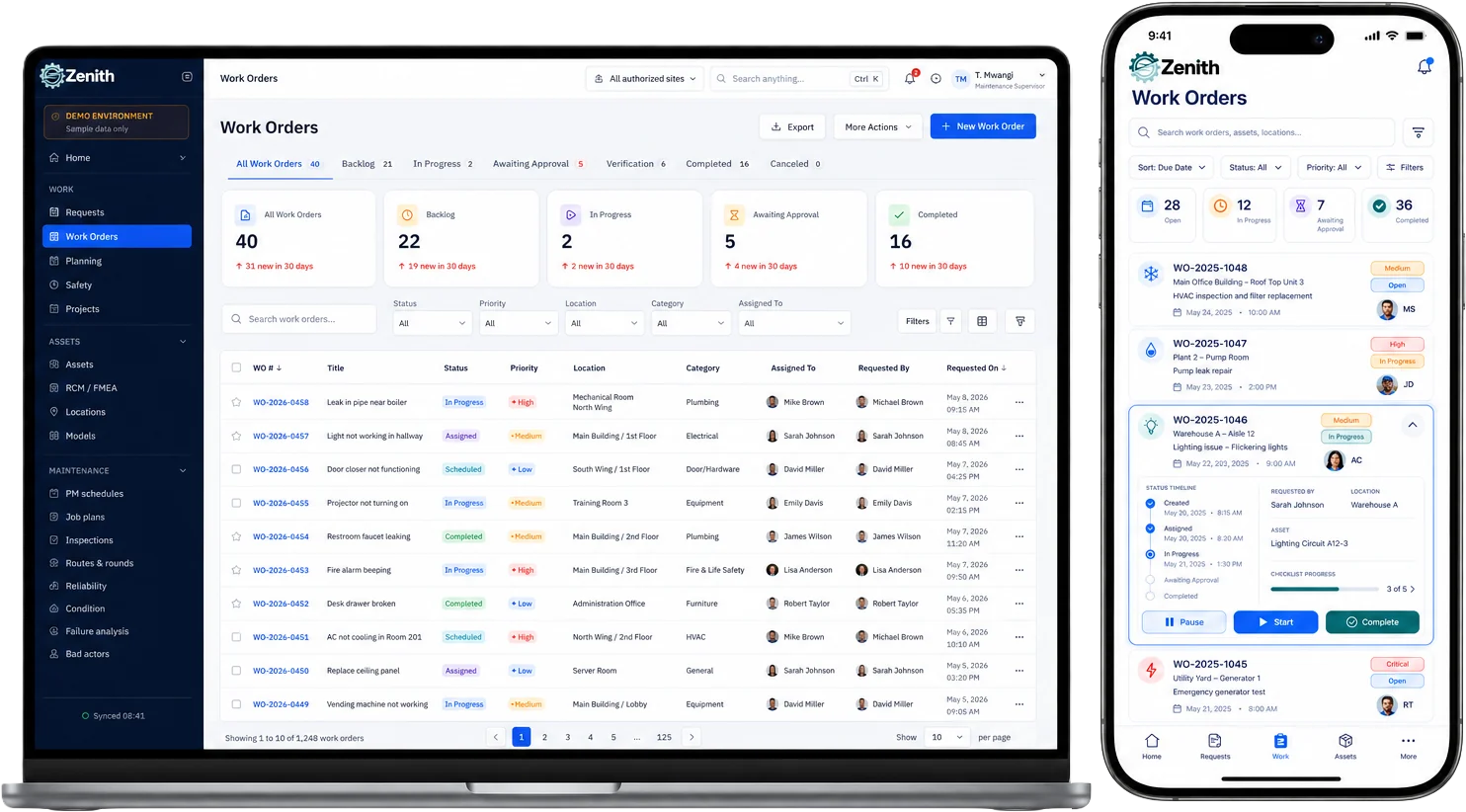
Zenith installs on any iPhone or Android from the browser — one tap, no app store — and opens full screen like any app. The technician gets their day on one screen, and it keeps working without a signal: every action is kept on the phone and sent, in order, the moment the connection returns.
- The day, in order — My work lists the technician's jobs as now, overdue, today and coming up.
- A clock, not a guess — start it when the spanner comes out; Stop & record writes the measured hours, with start and end times, onto the work order.
- Tick, add hours, complete — the job's steps, hours in one tap or typed, and a one-line completion note that goes on the record.
- Scan the label — the asset's QR tag opens its page, fills in a request, or picks the asset on a work order. The code can always be typed instead.
- Photos straight onto the record — "Take a photo" opens the camera on any request or work order.
- One Zenith — the phone and the desk are the same data and the same rules. A job started on the phone is started everywhere.
How offline works
the server stays the single source of truthThe app keeps its pages and the last copy of the technician's work orders, assets, places and people on the phone — not a blank screen.
Starts, hours, ticks and completions happen on the phone first, instantly, and are queued when the server can't be reached.
One at a time, as soon as the connection is back. Then the phone re-reads the records, so what the technician sees is what the office sees.
If the office closed that job in the meantime, the app says so and points to the record. A band at the top shows what is waiting and sending.
What it does not do yet: a photo taken offline stays on the record on the phone, but the file uploads only once the app is back online and still open. It installs from the browser (a PWA), not from the App Store or Google Play. Supported on iPhone with iOS 16.4 or later (17+ for in-app QR reading) and Android with Chrome or Edge; older phones type the code from the label. Signing out clears the phone's copy, so a shared device never shows one person's work to the next.
Twelve modules, one set of records
Each reads the same registers, so a tile on a dashboard and the row a click lands on cannot tell different stories. Every module page also says plainly what that module does not do yet.
Organizations that have to explain themselves
The design bias throughout is toward the manager defending a figure in a meeting and the technician who needs to know what can hurt them before they walk up to a machine. That bias fits some organizations better than others.
Public sector & municipalities
Councils, auditors, unions and residents asking about the same figure for different reasons — with bilingual and accessibility requirements that are scored rather than admired.
Campuses & institutions
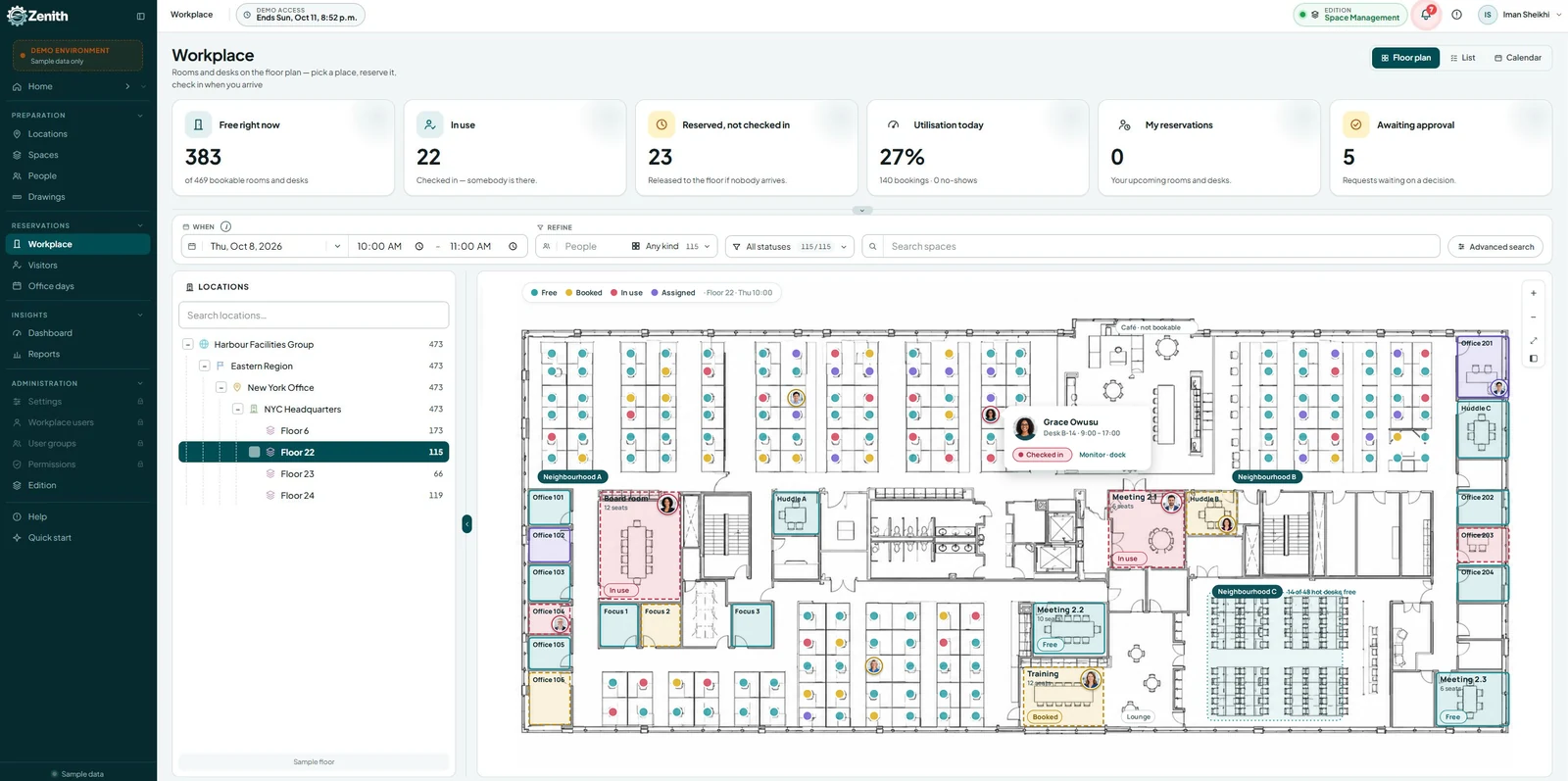
Many buildings, one estate, and a location tree that has to behave — plus floor-plan and space reporting that came from this product's facilities heritage.
Facilities & property portfolios
Multiple sites under one roll-up, cost-centre reporting, and an enterprise figure that is the sum of its parts by construction rather than by reconciliation.
We publish our boundary
Every maintenance system has a line between what it does today and what it is going to do. Most leave you to find it in month four. Ours is written on the product's own screens and on every module page — because a demo that oversells costs far more than it wins.
Built in Canada
Designed, written and supported from Victoria, British Columbia. You will be talking to the people who built it, which matters when the question is “why does it do that?”.
Bilingual by birth
Full en-CA / fr-CA parity on every screen, hint, empty state and refusal — with the known exceptions named on the page rather than found in a demo.
Accessible as a build rule
WCAG 2.2 AA throughout, with no third-party charting library standing between an audit finding and the fix for it.
Nothing faked to demo well
A rule that only counts while a browser tab is open would demo beautifully and lie. We would rather ship the part that is checkable and say so about the rest.
The questions we get first
What does Zenith actually do?
Is it a CMMS or an EAM?
Does it work on a phone — and without signal?
Is the French real, or is it the buttons only?
What isn't built yet?
Can we see it properly before committing?
Where are you, and who would we deal with?
Bring the number you couldn't defend.
The compliance figure that changes depending on who ran it. The backlog that is forty-one in one report and thirty-eight in another. The machine everybody argues about. Bring one of those and we will show you what it looks like when an answer arrives with its evidence attached — and what it looks like when there isn't any.