
Quebec French language law is why someone has probably told you that your maintenance software has to be in French. It is the kind of claim that sounds obviously true, gets repeated in procurement meetings, and is almost right in a way that matters.
There is a provision in the Charter of the French Language requiring software to be available in French. It is section 52.1, and it has been in force since 1 January 1998 — Bill 96 did not touch it. But read who it binds and the picture changes: it is a rule about putting software on the Quebec market, not a rule about what an employer runs internally.
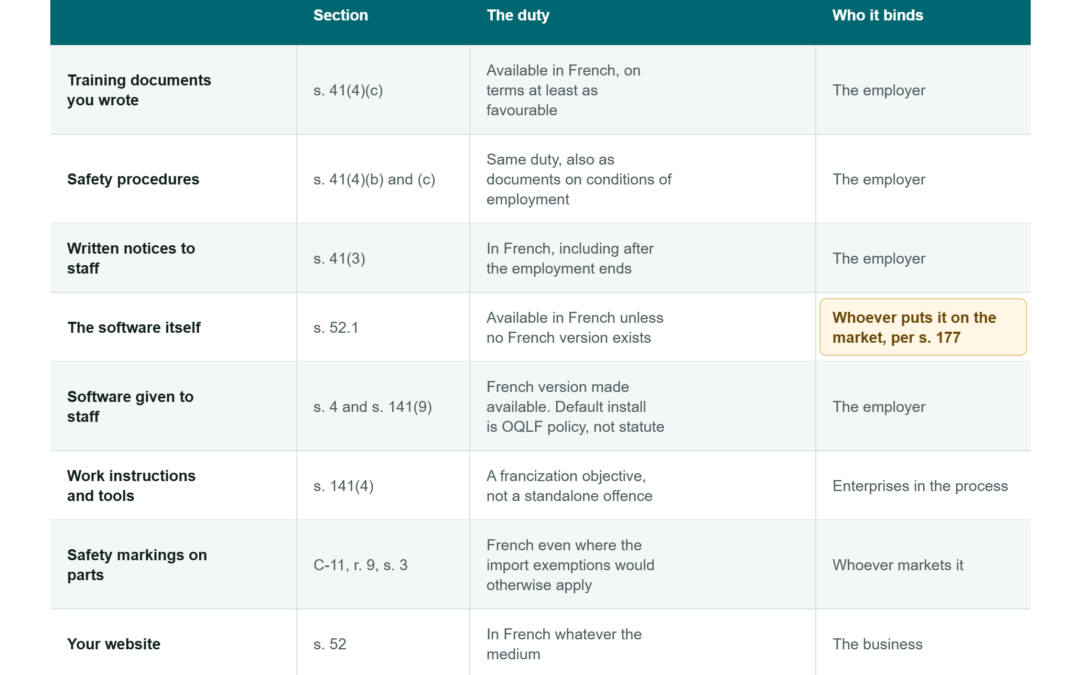
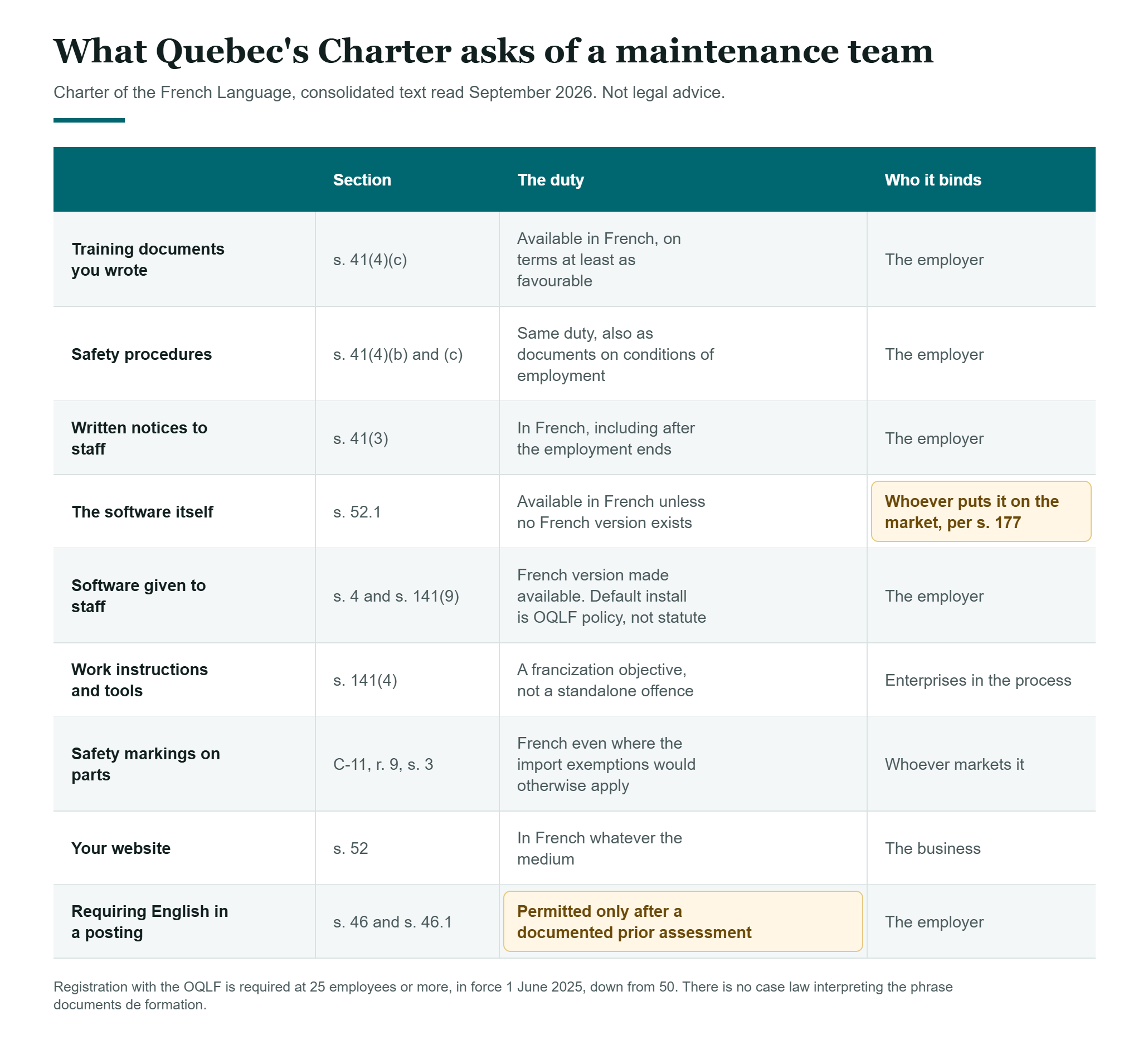
The obligations that actually land on a Quebec maintenance department sit elsewhere, and they are about your documents far more than your software. Here is what we could verify from the statute itself.
This is not legal advice. It is a reading of the consolidated Charter as at September 2026, with section numbers so you can check us. Quebec language law is moving quickly and parts of it are genuinely unsettled — we say so where that is the case.
What Quebec French language law asks of your training documents
Section 41 is the part of Quebec French language law to know. Its current wording came into force on 1 June 2022, via Bill 96. Paragraph 4 covers the documents below. Where an employer makes them available, they must be in French. Where the employer also offers another language, the French version must be accessible on terms at least as favourable:
“(a) employment application forms; (b) documents relating to conditions of employment; and (c) training documents produced for the staff.”
The French is “les documents de formation produits à l’intention de son personnel.”
That third item is the one with teeth for a maintenance team, and the trigger is purpose and provenance rather than format. A document counts if you produced it in order to train your own people. On the text, that plausibly reaches:
- Standard operating procedures you wrote and use to train technicians
- Preventive maintenance work instructions
- Safety procedures — which independently engage paragraph 4(b) as documents relating to conditions of employment
- Onboarding and competency material for the maintenance group
And on the text it does not reach an OEM equipment manual, because you did not produce it for your staff. Manuals are dealt with by a different route, which we come to below.
Two things to be precise about
The duty is to make available in French — “rend disponibles” — not to abolish the English version. We should also be honest about the limit of our own research. We could find no statutory or regulatory definition of “documents de formation”. No OQLF definition goes beyond restating the section. And no reported case interprets paragraph 4(c). Whether an SOP binder that doubles as a training aid is a “training document” is, on the current record, unlitigated. Anyone who tells you it is settled is guessing.
What Quebec French language law says about software, and who it binds
The word logiciel appears three times in the entire Charter — twice in section 52.1, once in section 177. There is no other software provision.
“Tout logiciel, y compris tout ludiciel ou système d’exploitation, qu’il soit installé ou non, doit être disponible en français, à moins qu’il n’en existe aucune version française.”
All software, including game software and operating systems, installed or not, must be available in French unless no French version exists. Broad on its face. Who must fix a breach? Section 177 answers that. The OQLF may order anyone in the supply chain to fix a section 52.1 breach. That covers whoever distributes, retails, rents, offers for sale or rental, or otherwise puts non-compliant software on the market, for consideration or free, or holds it for those purposes.
That enumerated list is a supply chain. It describes a vendor, not an end user. Holding for those purposes means holding in order to sell or distribute, not holding in order to use.
Section 177 goes further still. It contemplates vendors with no Quebec presence at all. Say a non-compliant product reaches Quebec through a technological intermediary, and the seller has no establishment here. The OQLF may then order the platform operator to stop letting people in Quebec contract for it.
So if you are a Quebec buyer evaluating a CMMS, section 52.1 is a stick you hold over your vendor — not a liability you carry for using their product.
But you are not off the hook — you are on a different hook
The OQLF’s own guidance on internally used software is considerably more expansive than section 52.1, and revealingly, it does not cite section 52.1 at all. It relies on sections 4 and 141(9):
“l’employeur est tenu de mettre à la disposition de son personnel la version française de tout logiciel, qu’il s’agisse d’une application maison ou non”
The employer must make the French version of any software available to staff, in-house application or not. The OQLF adds that it should be installed by default on workstations.
Be clear about what that is. Section 4 is a single line, in force since 1977: “Les travailleurs ont le droit d’exercer leurs activités en français.” Workers have the right to carry on their activities in French. Section 141(9) applies within a francization programme. Neither uses the word logiciel. The default-install rule is OQLF administrative policy, not statutory text, and it is worth knowing the difference if you are ever arguing about it.
Francization: where Quebec French language law catches your work instructions
This is the part most maintenance managers have not registered, and the threshold moved recently.
Section 139 now requires an enterprise employing 25 persons or more over a six-month period to register with the OQLF within six months of the end of that period. That wording came into force on 1 June 2025. The previous version, in force from 1 June 2022 until 31 May 2025, said fifty. If you sat between 25 and 49 employees and concluded years ago that francization did not apply to you, that conclusion expired.
A note on counting: section 139 as enacted says “25 persons or more” with no territorial qualifier. The “in Quebec” gloss comes from OQLF guidance, and we could find no regulation governing how you count heads.
Registration leads to a linguistic analysis. If the OQLF does not find French generalised, section 140 then requires a francization programme. Section 141 sets out what that programme must aim at. Two of its nine objectives speak squarely to maintenance documentation:
“4° l’utilisation du français dans les documents et les outils de travail utilisés dans l’entreprise […] 9° l’utilisation du français dans les technologies de l’information.”
The use of French in the documents and work tools used in the enterprise, and in information technologies. That is your work instructions, your procedures, your technical documentation and your CMMS interface — reached as objectives of a francization programme rather than as a standalone offence.
The other thresholds
Section 136 requires a francization committee at 100 persons or more. Once the OQLF approves a programme, section 143 bites. The enterprise must comply with it, keep staff informed, report every twelve months, and circulate the programme and its progress reports to staff. Section 152 requires the OQLF to publish and maintain a public list of enterprises whose certificates it has refused, suspended or cancelled.
One option is closed to you. Section 144 permits special agreements allowing another language as the operating language. But it covers head offices and research centres only, for a maximum of five years. Not for a plant, and not for a maintenance department.
The Quebec French language law detail nobody tells maintenance teams about
This one sits in a regulation rather than the Charter. It is also the single most operationally useful line we found.
The Regulation respecting the language of commerce and business (C-11, r. 9) lists narrow cases where an inscription on a product may appear in another language. Section 3(4) is the one importers rely on. It covers a product that comes from outside Quebec, goes into a finished product or into a manufacturing, processing or repair process, and is not sold at retail here. Useful exemptions if you import components.
Then the sentence that overrides them:
“Cependant, les inscriptions concernant la sécurité doivent être rédigées en français et apparaître sur le produit ou l’accompagner de façon permanente.”
Safety inscriptions must be in French and must appear on the product or accompany it permanently — even where the exemption would otherwise apply.
Section 1 of the same regulation widens this. A rule about an inscription on a product applies equally to an inscription on any document or object accompanying it, including the instructions for use and warranty certificates. That route catches equipment documentation. It binds whoever puts the product on the market, not your maintenance department.
Your website counts, and there is no website provision
Worth a correction here, because we assumed otherwise before checking what Quebec French language law actually says about the web. The word “Internet” appears exactly once in the Charter, and it is in section 88.5, about educational institutions publishing a language policy. There is no dedicated website section.
Bill 96 made section 52 medium-neutral, and that is what catches websites:
“Quel qu’en soit le support, les catalogues, les brochures, les dépliants, les annuaires commerciaux, les bons de commande et tout autre document de même nature qui sont disponibles au public doivent être rédigés en français.”
Whatever the medium. That phrase is the Bill 96 addition, and it puts websites beyond argument. Section 10 of C-11, r. 9 supplies the two-version rule. You may run separate French and other-language versions, provided the French one is available on conditions of accessibility and quality at least equal.
The OQLF enforces this, and — pointedly for this audience — it has done so against a maintenance company. In May 2022, Quality Belt Maintenance ltée of Saint-Eustache pleaded guilty to an offence under section 52 and section 10 of the regulation. It paid a $1,500 fine. The French version of its site was not accessible on conditions at least equal to the English. Fournitures Hermes inc. was convicted a second time in January 2025 on the same basis.
Penalties under Quebec French language law changed, and most commentary has not caught up
This is the finding we were most surprised by, and it corrects something we would otherwise have written incorrectly.
Bill 96 replaced the whole of Title V of the Charter and abolished the general offence. This is the single most misreported part of Quebec French language law. The old section 205 made it an offence for anyone to contravene any provision of the Act, with corporate fines from $1,500 to $20,000. That is why those website convictions carried $1,500 penalties — it was the old corporate minimum, and the Quality Belt offence dates from July 2021, before the new Title V.
Today, section 205 reaches a short list: sections 78.1 to 78.3, section 176, a ministerial order under section 128.3, or an order made by the OQLF under section 177. Nothing else. Fines run from $700 to $7,000 for a natural person and $3,000 to $30,000 otherwise. The phrase “quiconque contrevient” now appears exactly once in the whole Charter, in that section.
How the sequence actually runs
Breaching section 41, 52 or 52.1 is not, by itself, a penal offence today. The sequence runs like this. First an inspection or inquiry under sections 166 and 174. Then an order under section 177, which stays in force for two years. Then a report back under section 179. You have 30 days to contest it before the Tribunal administratif du Québec under section 181. Only if you still do not comply does section 205 bite.
Do not let anyone tell you that you can be fined directly for an English-only procedure manual. Tell them about the order-then-fine sequence instead. Then note the things that make it sting:
- Section 207: minimum and maximum fines double on a first repeat offence and triple on any further one.
- Section 208: where the offence is committed by a director or officer, the fines are double those for a natural person.
- Section 208.0.1: an offence continuing more than one day constitutes a separate offence for each day.
- Section 204.28: the Minister may suspend or revoke a permit or similar authorisation where the holder repeatedly contravenes the Act — independently of any order and any prosecution.
Two civil provisions that should worry you more than the fines
Bill 96 added a chapter of civil sanctions, all in force 1 June 2022, and two of them have sharper teeth than the penal chain.
Section 204.17 gives a private right of action. Where anyone infringes a right under sections 2 to 6.2, the victim may obtain cessation of that infringement. Section 4 — the worker’s right to carry on their activities in French — is inside that range. A technician handed English-only procedures has a statutory route to make it stop, without waiting for the OQLF.
The provision you cannot rely on your own document
Section 204.23 is the sleeper:
“Les dispositions d’un document qui contreviennent aux dispositions de la présente loi […] ne peuvent être invoquées par son auteur; elles peuvent cependant être invoquées contre lui.”
The party that wrote a non-compliant document cannot rely on its provisions. The other side can.
Sit with that for a maintenance context. An English-only lockout procedure, written by the employer, in a jurisdiction where the employer had a duty to make it available in French. After an incident, the employer wants to rely on the procedure to show the worker departed from it. On the face of section 204.23, it cannot. The worker can.
We are not aware of authority applying section 204.23 to a safety procedure, and we are not going to pretend otherwise. But the provision does not carve out safety documents, and the risk is not hypothetical enough to ignore.
Section 204.24 adds a savings clause pointing the same way. Sections 204.18, 204.19, 204.22 and 204.23 do not prejudice the acquired rights of workers and their associations under Chapter VI. The civil sanctions protect the worker’s side of the bargain, not the drafter’s.
Quebec French language law makes requiring English a documented decision
One more that maintenance managers hit directly, because so many maintenance postings ask for English.
Section 46 bars you from requiring knowledge of a language other than French to obtain or keep a position, unless the task demands it. Even then, the employer must first take all reasonable means to avoid imposing the requirement. Where the requirement is imposed, the job posting must state the reasons justifying it.
Section 46.1 then deems the employer to have failed to take all reasonable means unless, before imposing the requirement, it had:
- assessed the actual language needs associated with the tasks;
- satisfied itself that the language knowledge already required of other staff was insufficient for those tasks; and
- restricted as far as possible the number of positions requiring that knowledge.
In substance, this asks you to document a decision. Skip the record of that assessment and the section deems you to have failed. The burden is structural, not evidential. And section 167 requires the OQLF to establish an inspection programme for compliance with sections 46 and 46.1, so this is proactively policed rather than complaint-driven.
The section does add, at the end of 46.1, that it must not be interpreted so as to impose an unreasonable reorganisation of the enterprise.
Who Quebec French language law actually binds
For the language-of-work duties, no. Section 41 binds “the employer” with no threshold. The OQLF says every enterprise carrying on activities in Quebec must respect the language-of-work obligations, whatever its size, and whether it is federally or provincially regulated.
Size matters in only four places. Registration starts at 25 employees under section 139. A francization committee starts at 100 under section 136. The OQLF may offer learning services at five or more under section 149, though that is an offer rather than an obligation. And the consumer-side cessation remedy does not run against enterprises with fewer than five employees, under section 204.17.
The federal-jurisdiction question is the clearest live disagreement in this area. The OQLF asserts that federally regulated enterprises are covered. Commentators disagree. Emond Harnden writes that the law here is far from settled, and that both governments hold strong positions on who governs language of work. Langlois goes further, and suggests a constitutional challenge could follow. If you run a federally regulated railway, airline, port or interprovincial pipeline with Quebec staff, that is a question for counsel, not for us.
What we would actually do about it
We build maintenance software, so here is the narrow, honest version.
Software does not make you compliant with Quebec French language law. What it can do is make French a property of the record rather than a translation project you run once and let rot.
The practical difference is whether procedures, PM instructions and safety documents live in both languages against the same asset and the same work order. A technician then gets the French version by default, and nobody has to remember a parallel folder. A translated PDF from 2023 sitting on a shared drive is not compliance; it is evidence of a lapsed attempt.
Check three things in any system you evaluate for a Quebec site. Is procedure content bilingual per record, rather than per installation? Does the interface language follow the user, rather than the tenant? And can you produce, on request, the French version of the training documents attached to a given asset? That last one is what an inspection actually looks like.
Frequently asked questions
Does Quebec French language law require my CMMS to be in French?
Section 52.1 of the Charter requires software to be available in French unless no French version exists. But section 177 shows who must answer for a breach: whoever puts the software on the Quebec market. That means the vendor and the distribution chain, not the customer using it internally. Your own exposure as an employer runs instead through section 4 (the worker’s right to work in French) and, if you are in the francization process, section 141(9). In practice both vendor and customer are exposed, under different sections with different remedies.
Do maintenance procedures have to be in French in Quebec?
If you produced them to train your staff, section 41(4)(c) requires them to be available in French. Safety procedures also engage section 41(4)(b) as documents relating to conditions of employment. There is no case law interpreting “training documents”, so the boundary is not settled.
What changed on 1 June 2025?
The francization registration threshold in section 139 dropped from 50 employees to 25. Enterprises employing 25 or more persons over a six-month period must now register with the OQLF within six months of the end of that period.
Do OEM equipment manuals have to be in French?
Not under section 41, because you did not produce them for your staff. Section 51 and section 1 of C-11, r. 9 catch them instead. Those extend product-inscription rules to accompanying documents, including instructions for use. The duty falls on whoever puts the product on the market. Separately, safety inscriptions must be in French even where the import exemptions in section 3 of that regulation would otherwise apply.
Can I be fined for having English-only maintenance documents?
Not directly, as the law now stands. Bill 96 abolished the general offence. The OQLF must first order compliance under section 177; failing to comply with that order is the offence under section 205, at $3,000 to $30,000 for a company. Fines double on a first repeat and triple thereafter, and each day a continuing offence persists is a separate offence.
Does Quebec French language law apply to a company based outside Quebec?
For language-of-work duties, Chapter VI takes its reach from the Act respecting labour standards. That turns partly on whether the employer has a residence, domicile, enterprise, head office or office in Quebec. The OQLF says all employers carrying on activities in Quebec are bound. Where exactly the line falls for an out-of-province employer with remote staff in Quebec is genuinely unsettled, and we found no authority resolving it.
Does Quebec French language law apply to federally regulated employers?
The OQLF says yes. Several law firms treat it as an open constitutional question. This is the clearest point of disagreement between the regulator and the commentary, and it is not one we can settle.
A note on sources
Every statutory quotation above comes from the official consolidated French text of the Charter of the French Language on LegisQuébec, which carries official status. Each in-force date comes from that section’s own version history, not from a secondary summary. The Regulation respecting the language of commerce and business is C-11, r. 9. Bill 96 is the Loi sur la langue officielle et commune du Québec, le français, 2022, c. 14, assented 1 June 2022.
Where we have quoted the OQLF, we have labelled it as administrative guidance rather than statute, because on internal software the guidance goes further than the sections it cites. Enforcement examples come from Québec.ca and OQLF press releases. Commentary is attributed to Langlois Avocats and Emond Harnden.
Three cautions on our own research
Taken in order. Translations not attributed to the Éditeur officiel are ours. Two of the OQLF’s older pages now return 410 Gone: its dedicated guidance on websites, and on software. Anything citing them cites something that no longer exists. The live equivalents are the panels on its francization pages for businesses. And its guidance on nullity of legal acts still cites sections 48 and 50 as the only nullity provisions. That is pre-Bill 96 and no longer correct. Nullity now lives in sections 204.18 to 204.23.
We mention that last one for a reason. Even the regulator’s own website can lag the statute. A section number in a blog post is worth checking against the consolidation. Including ours. We read every section quoted above twice. The second pass went against the official French consolidation on LegisQuébec rather than our own notes. That is how we caught the absence of any dedicated website provision, which we had assumed existed before checking.
We have written more on Canadian maintenance compliance in manufacturing, healthcare and utilities.