
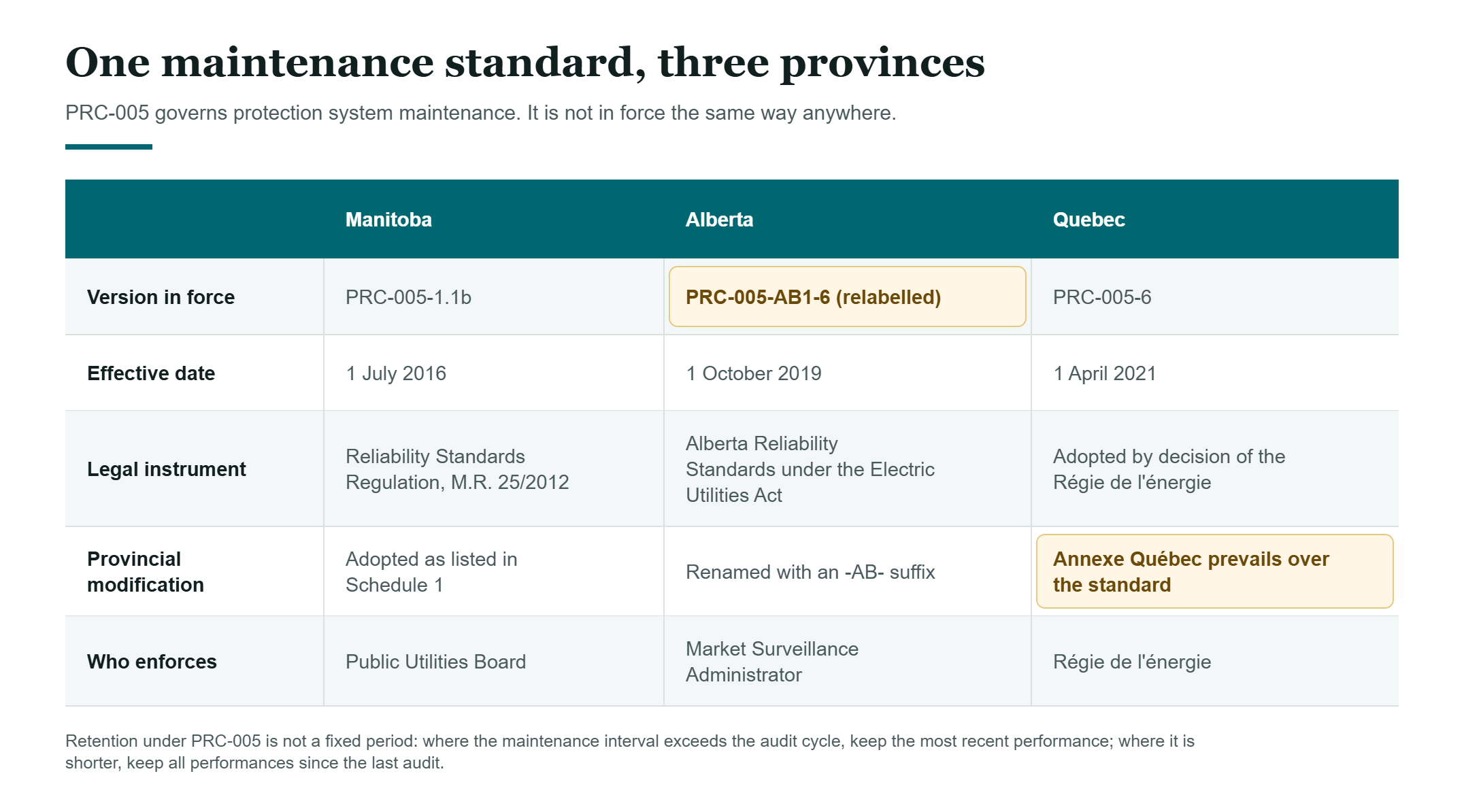
Here is a fact that should decide how you buy a CMMS for Canadian utilities. One North American reliability standard governs the maintenance of protection systems. Manitoba enforces version 1.1b, in force since 1 July 2016. Alberta enforces its own relabelled version, PRC-005-AB1-6, effective 1 October 2019. Quebec enforces version 6, effective 1 April 2021. Same continent, same standard family, three different versions running side by side under three different legal instruments.
Updated September 2026. Every provincial mechanism below was read on the regulator’s or the province’s own site.
There is no federal electric reliability regulator in Canada
American utilities work under a single arrangement: FERC approves a NERC standard and it becomes mandatory across the United States. Canada does not work that way at all.
Natural Resources Canada states the position plainly. “In Canada, regulatory oversight of electric reliability rests primarily within the jurisdiction of the provinces and territories.” NERC is the Electric Reliability Organization for the North American bulk power system. The Northeast Power Coordination Council is the regional entity for northeastern North America. Neither, however, has direct legal authority over a Canadian utility.
Instead, each province adopts standards through its own statute and its own regulator. NERC’s own implementation plans acknowledge this. In NERC’s wording, a standard takes effect “twelve (12) months after the effective date of the applicable governmental authority’s order approving the standard” — or as that authority otherwise provides.
Consequently a utility operating in two provinces is not running one compliance programme with two reporting lines. It is running two programmes. That is the core problem a CMMS for Canadian utilities has to model.
The standard in question is literally a maintenance standard
This matters more than it might sound, because PRC-005 is not a paperwork standard sitting adjacent to maintenance. It is the maintenance requirement.
The current designation is PRC-005-6, “Protection System, Automatic Reclosing, and Sudden Pressure Relaying Maintenance”. Its purpose is to document and implement programs for the maintenance of all protection systems affecting bulk electric system reliability. It applies to transmission owners, generator owners and distribution providers.
What it requires you to keep
The evidence rules are the interesting part for anyone choosing software. An entity must hold its current dated Protection System Maintenance Program, together with the maintenance records themselves. Furthermore, the retention rule bends around the audit cycle:
- Where a maintenance interval is longer than the audit cycle, you keep documentation of the most recent performance of that activity.
- Where the interval is shorter than the audit cycle, you keep all performances since the last audit.
Read that as a data requirement. Retention is not a fixed number of years. It is a function of two variables — your maintenance interval and your audit cycle — computed per activity. A filing system organised by year cannot answer it. A maintenance record with a date, an activity type and an interval can.
The same standard, three provinces, three answers
Manitoba’s Reliability Standards Regulation, M.R. 25/2012, is made under The Manitoba Hydro Act and registered on 26 March 2012. Section 5 is blunt: “A registered entity must comply with each adopted reliability standard in Manitoba”. Schedule 1 then lists the adopted standards with Manitoba effective dates, the earliest being 1 April 2012. For PRC-005 the listed version is 1.1b, from 1 July 2016.
Alberta reaches the same destination by a different road. Under the Electric Utilities Act and the Transmission Regulation, the Alberta Electric System Operator develops Alberta Reliability Standards and recommends them to the Alberta Utilities Commission. Notably, Alberta renames them: standards carry an -AB- suffix, so PRC-005 becomes PRC-005-AB1-6. Enforcement sits with the Market Surveillance Administrator, with administrative penalties running to a million dollars a day.
Quebec adopts standards through the Régie de l’énergie, under the Loi sur la Régie de l’énergie. Each standard arrives with an “Annexe Québec”. Where the two disagree, the annex wins: “En cas de divergence entre la norme et l’annexe, l’annexe aura préséance.” The Régie publishes roughly seventy standards in force, each with its own date and decision number.
Therefore three utilities can each be fully compliant while maintaining the same relay to three different specifications.
How every province makes it stick
British Columbia. Section 125.2 of the Utilities Commission Act gives the BC Utilities Commission jurisdiction to adopt reliability standards, following amendments in 2008. BC Hydro files annual assessment reports and the Commission adopts by order, publishing the standards in force with their British Columbia effective dates.
Saskatchewan. The Saskatchewan Electric Reliability Authority approves standards and monitors compliance. Unusually, SERA is a committee of three SaskPower executives, resting on 2004 amendments to The Power Corporation Act.
Ontario. The IESO enforces NERC standards and NPCC criteria through the Market Rules, with the Ontario Energy Board as reviewing authority under the Electricity Act, 1998. Helpfully, the IESO publishes a public list, Ontario Enforcement Dates for NERC Reliability Standards and NPCC Criteria, governed by Chapter 5 of the Market Rules. If you operate in Ontario, that page is the authority on what applies to you and when.
New Brunswick. The Energy and Utilities Board adopts and enforces standards under the Electricity Act. It may adopt FERC-approved NERC standards filed by NB Power “with or without New Brunswick amendments”, after a sixty-day posting. Responsibility moved from the system operator to the Board on 1 October 2013.
Nova Scotia. Compliance is mandatory under a memorandum of understanding with NERC, with the provincial board holding final approval and enforcement authority. One caution on naming: as of 1 April 2025 the Utility and Review Board’s energy mandate transferred to the Nova Scotia Energy Board. NERC filings in 2025 are captioned accordingly. If your procedures still say NSUARB, they are behind.
Prince Edward Island is the genuine exception. It is not an NPCC member, and per Natural Resources Canada it “generally follows the reliability criteria as set out for NPCC members” without a mandatory regime of the kind described above. We say this because we could not find a primary source establishing one — not because we found one saying otherwise.
Two data problems most software cannot express
The standard’s name changes at the border
Alberta’s -AB- suffix is not cosmetic. A compliance register keyed on “PRC-005-6” will not match an Alberta obligation recorded as “PRC-005-AB1-6”, and a report that silently merges them is worse than one that fails loudly. Accordingly, the standard reference has to be an attribute of the site’s obligation, not a global label.
The provincial annex overrides the standard
Quebec’s Annexe Québec takes precedence over the standard text where they diverge. In other words, knowing which standard applies is not enough. You also need to know which provincial modification applies, and to hold both. A CMMS for Canadian utilities that stores one canonical version of a requirement is describing a country that does not exist.
Below the bulk system, the rules change again
Everything above concerns the bulk electric system. Distribution carries separate obligations, and Ontario is a clear example.
Ontario Regulation 22/04, the Electrical Distribution Safety Regulation, is administered by the Electrical Safety Authority and applies to distribution systems owned by licensed distributors. Section 8 requires construction to be inspected and certified safe before use. Sections 13 and 14 impose an annual audit and a Declaration of Compliance on each distributor.
Notice that this has nothing to do with NERC. It is a Canadian, provincial, distribution-level documentation duty that runs in parallel — and it lands on the same crews, the same assets and the same maintenance system.
What an audit actually asks you for
Strip away the framework and an audit reduces to a narrow question, asked per activity and per asset. Which maintenance activity was due, on what interval, when was it last performed, by whom, and can you show it?
That question is easy when the interval is annual and the audit is annual. It gets awkward when a six-year interval meets a three-year audit cycle, because now the auditor wants the single most recent performance and you must prove no later one was missed. It gets harder again when the same relay model sits in two provinces under two versions of the standard.
We hit the same shape in Canadian mining and pipelines, where federal retention runs from one month to the life of a buried weld. Utilities differ in one respect: the retention rule is not a period at all. It is a comparison between two of your own numbers.
What this means for a utility working across provinces
- Standard version — the same relay maintenance requirement may be version 1.1b, an -AB- variant, or version 6, depending on the province.
- Effective date — set province by province, not continentally.
- Modifications — Quebec’s annex takes precedence; New Brunswick may adopt with amendments; Alberta relabels.
- Retention — computed from your maintenance interval against your audit cycle, per activity.
- Enforcer — a commission, a market operator, a market surveillance administrator or a committee of utility executives, depending where you are.
No single national compliance report satisfies that set. The requirement is per-site regulatory context, with the standard reference, the version, the effective date and any provincial annex carried as data on the obligation itself.
Which modules a CMMS for Canadian utilities actually needs
Not every module earns its place in a utility. These are the ones the standards above actually exercise.
Assets
A CMMS for Canadian utilities starts here. Relays, breakers, batteries, current transformers and communications equipment each become a record in the asset register, with the applicable standard version attached to the asset’s site rather than assumed globally.
Maintenance
Preventive maintenance carries the intervals that PRC-005 requires you to document and implement. Since retention depends on the interval, the interval has to be a field, not a habit.
Work
Each maintenance activity becomes a work order with a date and a performer, which is the evidence an audit asks for.
Analytics
Reporting answers the question an auditor actually asks: for this activity, at this site, under this province’s version, show the performances since the last audit.
Reliability and Automation
Condition monitoring and failure analysis feed the maintenance program itself. Workflow and automation keeps an interval from lapsing quietly between audits.
Workforce, contractors and compliance
Relay technicians carry qualifications, and contractor records hold who attended and under what certification. Safety and compliance is where the obligation register lives.
How and why Zenith works as a CMMS for Canadian utilities
Per-site regulatory context. This is the whole argument for a CMMS for Canadian utilities. A Manitoba substation and an Alberta substation can hold the same equipment under different standard versions, different dates and different enforcers. They still roll into one number for the executive team.
Retention as a computed rule. Because PRC-005 ties evidence retention to the relationship between interval and audit cycle, the system needs both values as data. Then the answer to “what must we still hold” is produced rather than remembered.
Bilingual EN and FR at the platform level. A utility filing in Quebec produces French records natively, which matters when the governing annex is itself in French.
An audit trail that names people and dates. Who did the work, when, against which asset, under which version of which standard.
One caution we would rather state than sell around. Software does not make you compliant. Your maintenance program does, and the standard says so explicitly by requiring you to document and implement it. What a system does is make the programme evidenceable, and stop the answer depending on which engineer still remembers.
Frequently asked questions
Are NERC standards mandatory in Canada?
Not automatically. Regulatory oversight of electric reliability rests primarily with the provinces and territories, and each province adopts standards through its own statute and regulator. NERC’s own implementation plans state that a standard takes effect after the applicable governmental authority’s approving order, or as that authority otherwise provides.
Can the same standard be in force on different dates in different provinces?
Yes, and it is. For protection system maintenance, Manitoba lists version 1.1b from 1 July 2016, Alberta’s PRC-005-AB1-6 took effect 1 October 2019, and Quebec’s PRC-005-6 took effect 1 April 2021.
What does PRC-005 actually require?
PRC-005-6 requires transmission owners, generator owners and distribution providers to document and implement programs for the maintenance of protection systems affecting bulk electric system reliability. It covers protection systems, automatic reclosing and sudden pressure relaying.
How long do we have to keep maintenance evidence?
It depends on the relationship between your maintenance interval and the audit cycle. Where the interval is longer than the audit cycle, keep documentation of the most recent performance. Where it is shorter, keep all performances since the last audit. There is no single number.
Why does Alberta rename the standards?
Alberta Reliability Standards are developed by the AESO and approved by the Alberta Utilities Commission, and they carry an -AB- suffix to mark that they are Alberta instruments. Practically, that means a register keyed on the NERC name will not match the Alberta obligation.
What is an “Annexe Québec”?
Quebec adopts each standard together with a provincial annex. Where the standard and the annex diverge, the annex prevails. So the applicable requirement is the standard as modified, not the standard alone.
Where can I find Ontario’s effective dates?
The IESO publishes Ontario Enforcement Dates for NERC Reliability Standards and NPCC Criteria, governed by Chapter 5 of the Market Rules. It is public, and it is the authority for Ontario rather than any vendor’s summary.
Is compliance voluntary in Nova Scotia?
No. Compliance is mandatory under a memorandum of understanding with NERC, and the provincial board approves standards and enforces them. Note also that the Utility and Review Board’s energy mandate moved to the Nova Scotia Energy Board on 1 April 2025.
What about Prince Edward Island?
PEI is not an NPCC member and, per Natural Resources Canada, generally follows NPCC reliability criteria without the mandatory regime other provinces operate. We could not verify a mandatory PEI scheme from a primary source, so we do not assert one.
Who actually enforces, province by province?
It varies by design. In the west: the BC Utilities Commission, Alberta’s Market Surveillance Administrator, the Saskatchewan Electric Reliability Authority and Manitoba’s Public Utilities Board. Further east: the IESO in Ontario, the Régie de l’énergie in Quebec, the Energy and Utilities Board in New Brunswick, and the Nova Scotia Energy Board.
Does any of this apply to distribution rather than transmission?
The NERC framework concerns the bulk electric system. Distribution carries separate provincial duties — in Ontario, for example, O. Reg. 22/04 requires construction to be inspected and certified before use, plus an annual audit and a Declaration of Compliance from each licensed distributor.
We operate in three provinces. Do we need three systems?
No. One system, with per-site rules, is what a CMMS for Canadian utilities is for, because the differences are configuration — version, date, annex, enforcer, retention formula — rather than different kinds of maintenance work.
A note on sources
The provincial mechanisms above were read on the regulators’ own sites. Those were the BCUC, AESO, SERA, the IESO, the Régie de l’énergie and the New Brunswick Energy and Utilities Board, plus the Manitoba Reliability Standards Regulation on the province’s own legislation site and NERC’s jurisdictional summaries. PRC-005-6 was read from NERC’s published standard. Natural Resources Canada is the source for the Canadian framework and for the PEI position. We have deliberately published no Statistics Canada figure for the utilities sector’s share of GDP or employment, because we could not pull those tables directly and would rather omit a number than print an unverified one.