

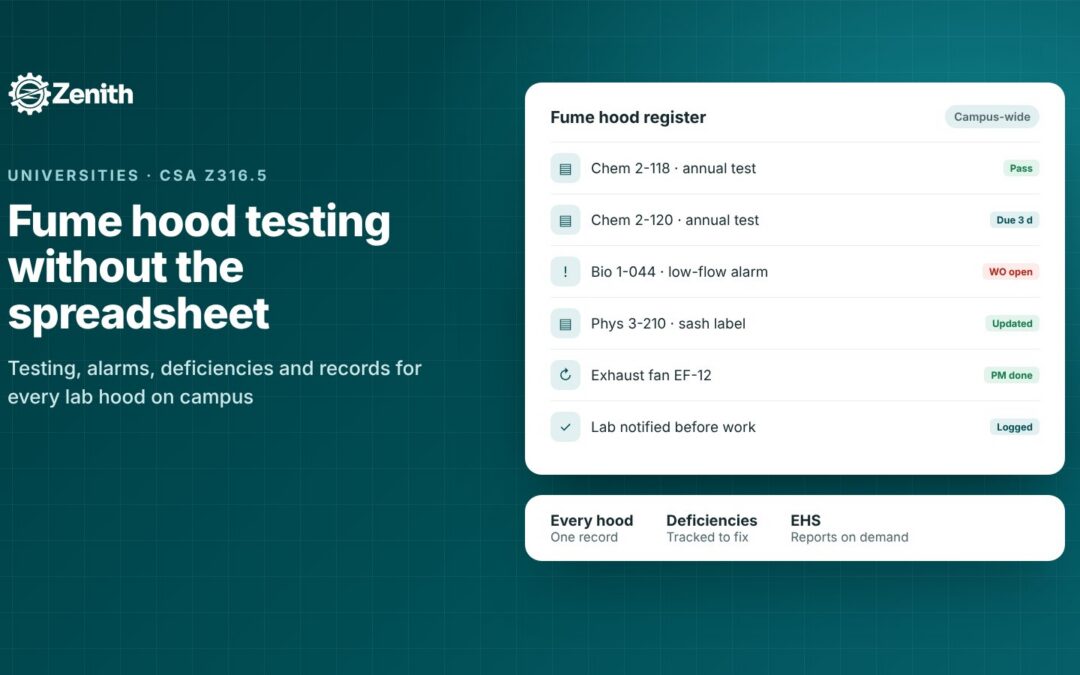
The list lives in a spreadsheet. One row per fume hood, a few hundred rows across chemistry, biology, engineering, pharmacy and a research building that opened last fall. Fume hood testing season starts, and the problems surface in the first week: a hood that was moved during a renovation and never re-tested, an airflow alarm someone silenced with tape, a test sticker from two years ago, and a researcher who wasn’t told the hood would be out of service on the morning of a synthesis.
Then the environmental health and safety (EHS) office asks for a list of every hood that failed last year and proof that each one was fixed. The answer is spread across emails, a contractor’s PDF reports and a column called “Notes 2”. This guide explains what CSA Z316.5 expects, what a campus testing program needs to include, and how to run it so the records are ready when someone asks.
What CSA Z316.5 actually covers
CSA Z316.5, Fume hoods and associated exhaust systems, is the Canadian standard for laboratory fume hoods. The current edition is CSA Z316.5:25, the fifth edition. The Standards Council of Canada lists it as published on March 31, 2025, superseding the 2020 edition. Earlier editions were published in 2015, 2004 and 1994.
According to CSA’s own summary, the standard applies to all types of laboratory fume hoods, including ductless hoods, and specifies:
- Safety requirements for fume hoods, their users and service personnel.
- Design and construction requirements for fume hoods and their supply and exhaust systems.
- Fume hood placement in the lab.
- Test methods for assessing performance.
- Selection, use and maintenance requirements.
- Education and training for users and maintenance personnel.
- Information exchanged between suppliers and users.
- Commissioning requirements.
It does not cover detailed design such as fan selection or duct velocities, and it does not cover biological safety cabinets. CSA’s summary also states that ductless fume hoods should not be considered acceptable substitutes for ducted hoods, although they may be suitable with an application-specific risk assessment and written approval from the manufacturer.
For facilities teams, the important words are in the title: “and associated exhaust systems”. A hood only works if the exhaust fan, ductwork, dampers, controls and supply air behind it work. A testing program that looks only at the sash opening misses half the system.
Check your references. Many campus SOPs and manuals still cite the 2015 or even the 2004 edition. CSA standards are voluntary unless a regulation, code, contract or your own policy adopts them, but if your policy names an edition, it should name the current one. CSA standards are paid documents, so buy the current edition and confirm the specific test methods and maintenance requirements with your EHS office.
How often does fume hood testing need to happen?
The answer comes from three places: your provincial occupational health and safety rules, the current edition of CSA Z316.5, and your institution’s own policy. They don’t always say the same thing, so your program should meet the strictest one that applies to you.
Some provinces are very specific. British Columbia’s OHS Regulation Part 30, Laboratories is a good example of what a regulator can require:
| BC OHS Regulation (Part 30) | What it requires |
|---|---|
| Face velocity, s. 30.8 | Average face velocities of 0.4 m/s (80 fpm) to 0.6 m/s (120 fpm) across the operational face opening |
| Measurement, s. 30.9 | Face velocity measured and recorded; containment assessed and recorded with a smoke tube or other suitable qualitative method |
| When, s. 30.9 | After installation and before use, at least once in each 12-month period, and after any repair or maintenance that could affect airflow |
| Low readings, s. 30.9 | Immediate corrective action if average face velocity is below 90% of the required value |
| Monitoring, s. 30.9 | Continuous airflow monitoring where loss of airflow would put a worker at risk; an alarm on newly installed hoods |
Other provinces handle laboratory ventilation more generally, so check your own regulation and any guidance from your provincial regulator.
Canadian universities commonly test every hood at least once a year, after installation, and after repairs or modifications. One Ontario university’s fume hood SOP, for example, requires testing after new installation, after repairs or modifications to the hood or exhaust system, and at least once per year. The University of Toronto’s EHS office states that it audits fume hood performance and recalibrates airflow alarm monitors annually.
Where ASHRAE 110 fits
ANSI/ASHRAE 110-2016 (reaffirmed 2025), Methods of Testing Performance of Laboratory Fume Hoods, is a containment test method. It sets out quantitative and qualitative procedures and is aimed mainly at laboratory and factory testing, though it can also help evaluate installed hoods. Universities often require new hoods to have been performance-tested to it, and BC’s regulation refers to the ASHRAE 110 method (1995 version) for demonstrating hood containment. It complements your annual face-velocity program rather than replacing it.
What a campus fume hood testing program includes
Think of the program as a loop: know every hood, test it on time, fix what fails, prove it was fixed, and train the people who use it.
1. A complete inventory
Every hood needs a unique ID that appears on the hood, in your records and on the test report. For each one, record the building, room, hood type (constant volume, variable air volume, ductless, perchloric, walk-in), manufacturer and model, the exhaust fan that serves it, and the responsible lab supervisor. Walk the buildings once to confirm it: hoods get added in renovations and removed in decommissioning, and the spreadsheet rarely hears about either.
2. The scheduled performance test
A typical campus test, as described in one Ontario university’s SOP, includes:
- A physical inspection of the hood, sash, baffles and work surface.
- Average face velocity, measured across the opening.
- The sash height at which the hood meets the target face velocity.
- Cross drafts at the hood face.
- Response time for variable air volume hoods.
- Smoke tests to show airflow and containment.
Your pass criteria come from your provincial rules, the current CSA edition, the manufacturer and your EHS office. Write them into the test procedure so every technician and contractor applies the same ones.
3. Alarms and airflow monitors
The airflow monitor is the user’s only warning that the hood has stopped protecting them. Build three checks into the program: users confirm the monitor is working before they start work, technicians test the alarm during the scheduled test, and the monitor is calibrated on a set schedule. A silenced or disconnected alarm should be treated as a deficiency, not a nuisance.
4. Labels and sash markings
After each test, the hood should carry a label showing the hood ID, the test date, the result, the maximum safe sash height and who tested it. Some campuses also show the next due date and the exhaust fan that serves the hood, which helps when a fan goes down. A clear “Do not use” label for failed hoods is just as important as the pass label.
5. Exhaust fans and the rest of the system
Exhaust fans, belts, bearings, motors, variable-speed drives, dampers and stack discharge all need their own preventive maintenance. Link each fan to the hoods it serves. When a fan is shut down for service, you then know exactly which labs to notify and which hoods to re-check when it restarts.
6. Deficiencies and return to service
When a hood fails, the sequence should be the same every time:
- Label the hood “Do not use” and close the sash.
- Notify the lab supervisor, the departmental safety contact and facilities.
- Open a work order with a priority that matches the risk.
- Diagnose and repair (sash, baffle, damper, controls, fan, supply air balance).
- Re-test, record the result and remove the label only after a pass.
7. Commissioning, moves and changes
New hoods, relocated hoods and hoods affected by HVAC or exhaust changes need testing before use. Make “re-test the hood” a standard closing task on any work order that touches the exhaust system, so it isn’t left to memory.
8. Training
CSA Z316.5 includes education and training for users and maintenance personnel. Track who has been trained, including the trades who service exhaust fans on the roof.
Sample record fields for each test
These fields give EHS what it needs and make the next year’s planning easier:
| Field | Example |
|---|---|
| Hood ID | CHEM-B-214-03 |
| Location | Chemistry Building B, room 214 |
| Hood type | Variable air volume, bench-top |
| Serving exhaust fan | EF-B-07 |
| Lab supervisor | Name and department |
| Test date and tester | Date, technician or contractor |
| Procedure and criteria used | Campus procedure version, criteria |
| Average face velocity and sash height | Measured values |
| Smoke test result | Pass or fail, notes |
| Alarm test and calibration date | Pass or fail, date |
| Result | Pass, fail, or pass with conditions |
| Deficiency work order | Work order number |
| Re-test date and result | Date, result |
| Next due date | Date |
An example annual schedule
Testing every hood in the same month overwhelms the team and the labs. Spreading the work by building smooths the load. For example, a campus with 400 hoods might plan it like this:
| Period | Buildings | Approximate hoods | Notes |
|---|---|---|---|
| January to March | Chemistry A and B | 150 | Avoid exam periods for teaching labs |
| April to June | Life sciences, pharmacy | 110 | Coordinate with research groups before summer |
| July to August | Teaching labs, engineering | 80 | Labs are quieter, good time for exhaust fan PM |
| September to October | Research centre, satellite sites | 60 | Leave buffer before winter weather on the roof |
| November to December | Re-tests and catch-up | As needed | Close out deficiencies before year end |
Once a hood’s date is set, keep it in roughly the same month every year. That makes the next due date predictable for labs and keeps you well inside any 12-month limit.
Coordinating with labs
Researchers will put up with testing if they know about it and it doesn’t wreck an experiment. A short checklist helps:
- Give notice. Tell each lab the week and the hoods affected, with a contact name.
- Ask for a clear work surface. The hood should be emptied, or at least cleared enough to test safely.
- Confirm hazards. Perchloric acid, radioisotope or highly toxic work may need extra precautions before anyone touches the hood or ductwork.
- Plan exhaust fan shutdowns. Fan work affects every hood on that fan, so schedule it with all affected labs at once and confirm the hoods are not in use.
- Report back. Tell the lab the result the same day, especially a failure.
Common mistakes
- Relying on a single spreadsheet that only one person updates.
- Testing the hood but not the system. Fans and supply air cause many failures.
- No re-test after repairs. A closed work order is not proof the hood works.
- Failed hoods left in use because the label came off or nobody told the lab.
- Outdated references to older editions of CSA Z316.5 in SOPs.
- Contractor reports filed as PDFs with no link to the hood record, so trends are invisible.
- Alarm calibration forgotten because it isn’t on any schedule.
How Zenith helps with fume hood testing
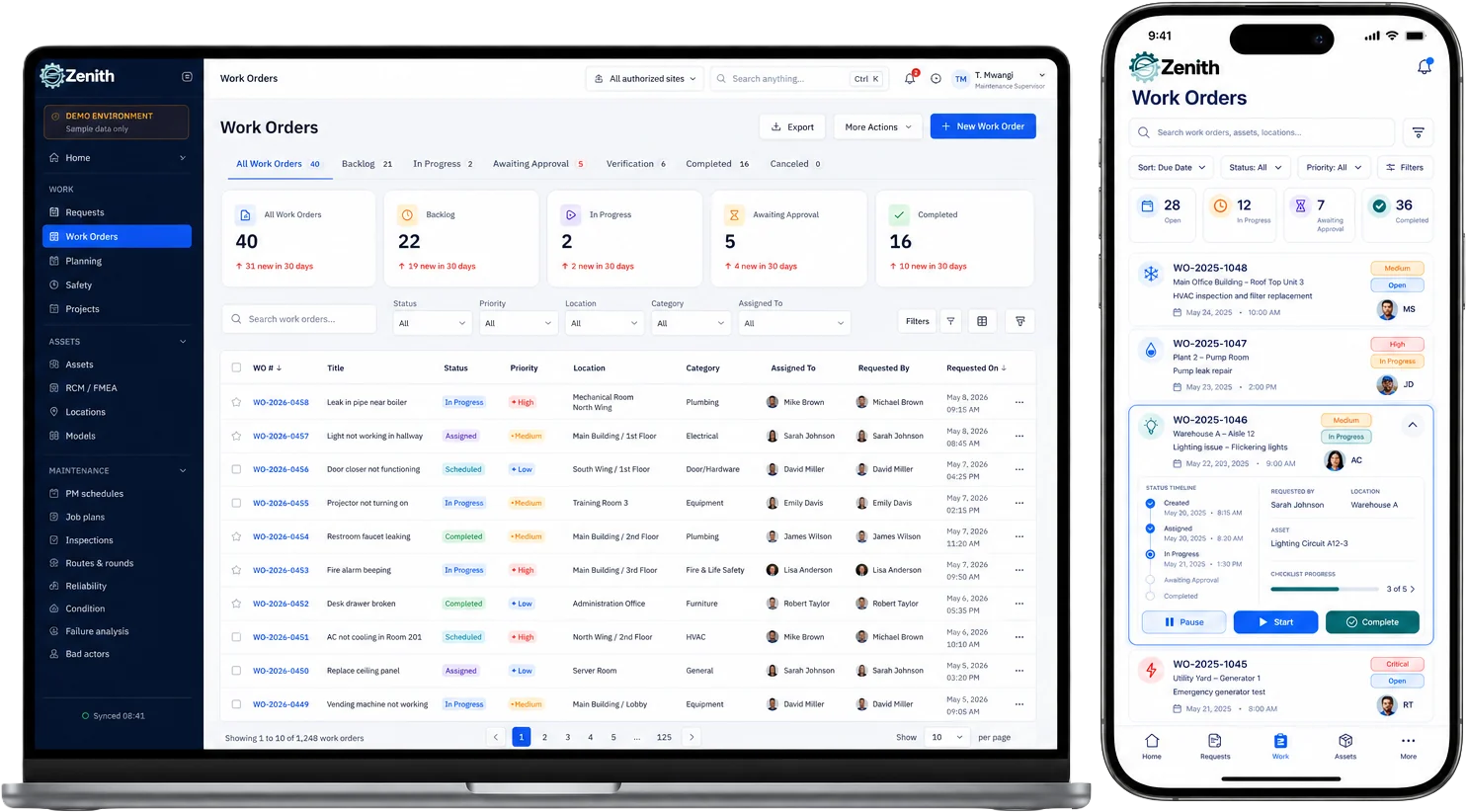
Zenith is a CMMS (computerized maintenance management system) built in Canada. It doesn’t replace your EHS office’s judgment or your test procedure. It helps teams schedule the work, keep the records and show the evidence that CSA Z316.5 and your provincial rules expect.
- Every hood and fan as an asset. Hoods and exhaust fans sit in an asset hierarchy by site, facility and location, with criticality, condition, documents such as commissioning reports and manuals, spare parts, and full work order and PM history.
- Testing on schedule. Preventive maintenance schedules generate the annual test work order a set number of days before it’s due, with fixed or floating dates and an on-time tolerance window. If you need help setting intervals, see our guide to building a preventive maintenance schedule.
- The same test every time. Job plans and task checklists hold your procedure steps (face velocity, sash height, smoke test, alarm test, label), with the skill required and sign-off per task. Technicians use their phones in the lab, scan the hood’s QR code or barcode and attach photos of labels and readings.
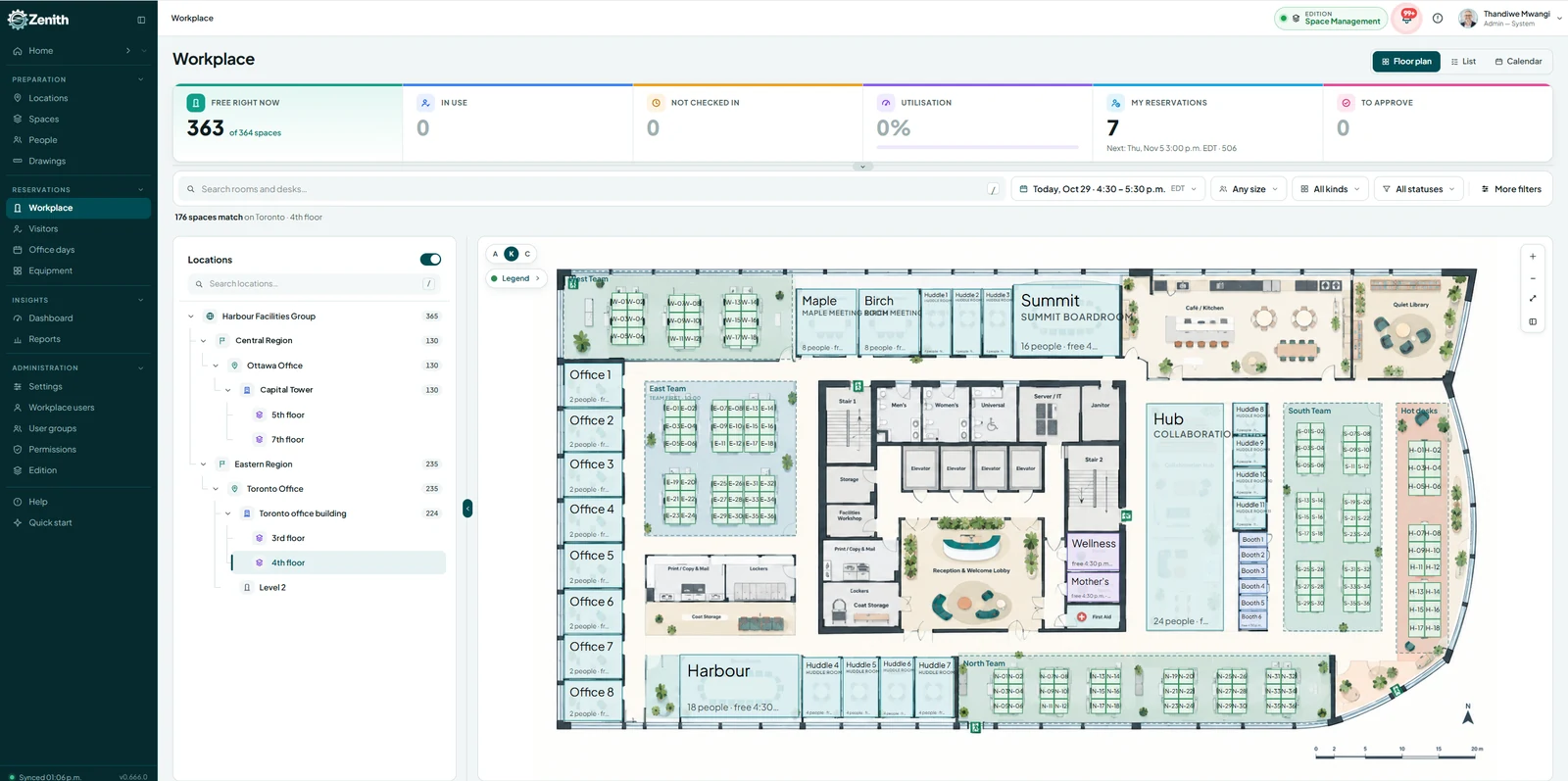
- Planning around labs. The “What’s due” view shows the next 4 weeks, 13 weeks or year, and the planner shows crew capacity by day, so you can group hoods by building and give labs real notice.
- Deficiencies that close properly. A failed test becomes a work order with priority and assignment. On Hold takes a reason from the delay register, such as waiting for lab access, and statuses such as Verification support a re-test before the job is closed. Every step stays in the history trail.
- Safety steps tied to the work. Hazards, permits and safety steps can be attached to exhaust fan and roof work through safety and compliance features.
- Contractors in the same record. If an outside firm does your testing, vendor and contractor tracking keeps their work against the same hood records.
- Evidence for EHS. PM history shows whether each test ran and ran on time, with PM compliance %. Dashboards, scheduled email reports and Excel or CSV exports give EHS what it needs, and Zenith Assist answers questions such as “which hoods in the chemistry buildings failed this year?” See analytics and reporting.
- Lab users can report problems. An alarm going off becomes a request through the request portal, with an urgent switch, and turns into a work order.
Zenith is available in English and French, hosted in Canada, and supports single sign-on. For how universities use it more broadly, see our page on CMMS for schools and universities.
FAQ
How often should fume hoods be tested in Canada?
It depends on your province, the current edition of CSA Z316.5 and your institution’s policy. BC’s OHS Regulation, for example, requires testing after installation and before use, at least once in each 12-month period, and after repairs or maintenance that could affect airflow. Many Canadian universities test at least annually. Confirm your requirement with your EHS office.
What is the current edition of CSA Z316.5?
CSA Z316.5:25, Fume hoods and associated exhaust systems, published in 2025. It is the fifth edition and supersedes the 2020 edition.
What face velocity should a fume hood have?
There is no single national number. BC’s regulation requires average face velocities of 0.4 to 0.6 m/s (80 to 120 fpm) across the operational face opening. Elsewhere, your target comes from your provincial rules, the current CSA edition, the hood manufacturer and your EHS office. Face velocity alone doesn’t prove containment, which is why smoke tests matter too.
Does CSA Z316.5 cover biosafety cabinets?
No. Biological safety cabinets are excluded from its scope. They are certified to a separate field certification standard, and labs that work with human or animal pathogens follow the Canadian Biosafety Standard.
Who should do fume hood testing: EHS, facilities or a contractor?
Any of them, as long as the tester is qualified, uses a written procedure and the results land in one record. On many campuses EHS runs the program, facilities fixes deficiencies and maintains the exhaust system, and contractors test some or all hoods.
What should happen when a fume hood fails?
Stop using it, label it, notify the lab, open a work order, repair it and re-test before returning it to service. Record each step so you can show the hood was fixed, not just that a work order was closed.
Are ductless fume hoods acceptable under CSA Z316.5?
CSA’s summary of the standard says ductless hoods should not be considered acceptable substitutes for ducted hoods, but may be suitable with an application-specific risk assessment and written manufacturer approval. Check the full standard and your EHS office before installing one.
Next step
Start by putting every hood, its exhaust fan and its last test date in one place. Then set the next due dates, write down your test procedure, and make re-testing a required step after every repair.
If you’d like to see how that looks in Zenith with your own hood list, book a demo and we’ll load a building’s worth of hoods for you.