

Canada builds many of its hospitals, courthouses and transit facilities as P3s, or public-private partnerships. In most of them, a private partner maintains the building for decades. It is paid monthly, minus deductions for every failure. That turns an ordinary maintenance record into something much more important: the evidence that decides the payment. This guide explains what a CMMS for P3 work has to do, using the language of real Canadian project agreements.
It covers how the payment mechanism turns work orders into deductions and what each work order must record. It also covers the handback years at the end of the contract. Finally, it lists what to look for in software, for the private partner and the public owner alike.
What a P3 means for maintenance
In a design, build, finance and maintain (DBFM) model, a private consortium, usually called Project Co, builds the facility and then maintains it for a fixed term. Ontario’s Auditor General describes the classic model as covering design, construction, financing and maintenance, with an initial 30-year operating and maintenance period that starts once the building is in use.
During those years, the public owner, usually called the Authority, pays a monthly service payment. The project agreement sets out what the building must do, how fast problems must be answered and fixed, and how much is deducted when they are not. The maintenance team does not just fix things. It has to prove, every month, when each problem was reported, how it was classified, and when it was fixed.
How the P3 payment mechanism turns work orders into money
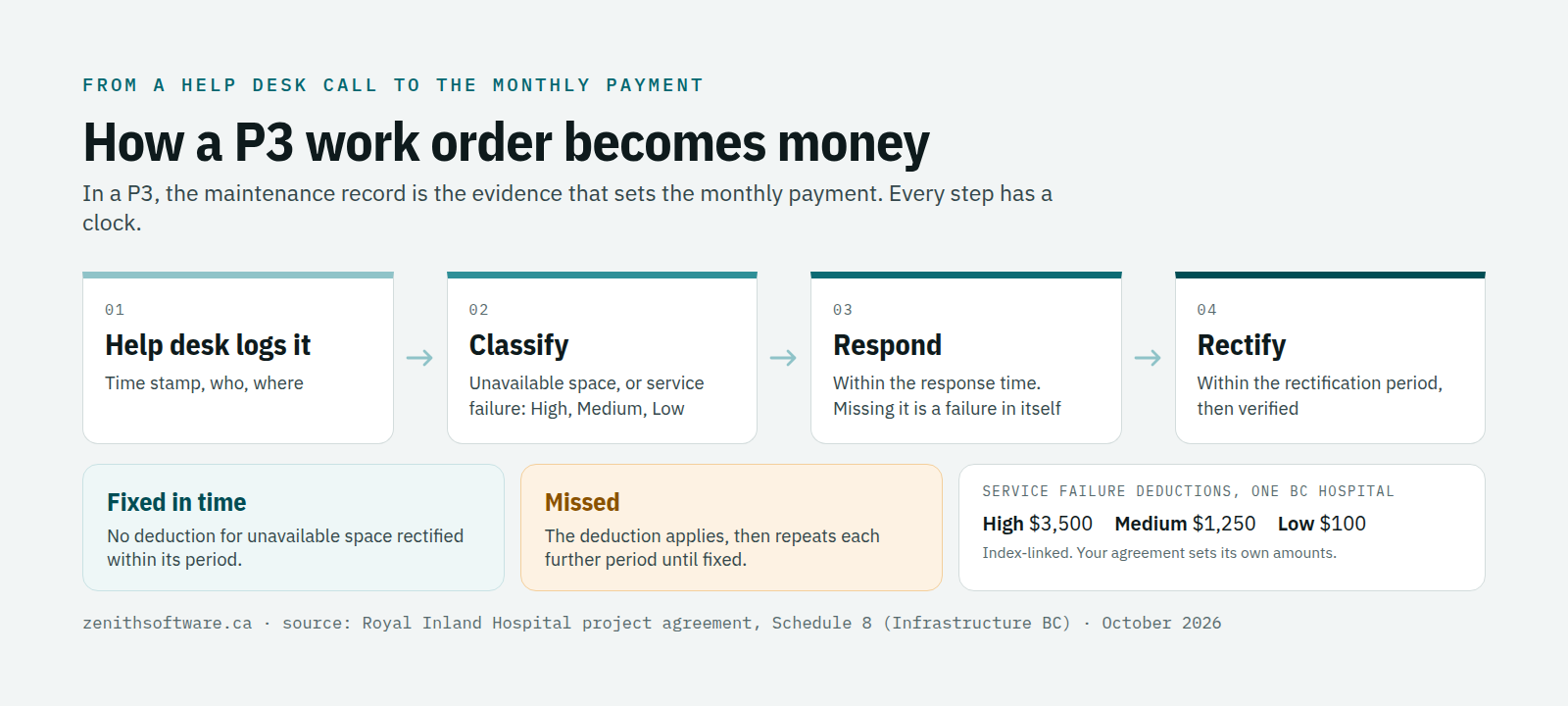
Payment schedules differ between projects, but most follow the same pattern. The payment schedule for the Royal Inland Hospital patient care tower in Kamloops, published by Infrastructure BC, is a clear example:
- Two kinds of failure. An Unavailability Event takes space out of use, such as a room, an operating theatre or a whole functional unit. A Service Failure is any other failure to perform, classed High, Medium or Low.
- Fixed deductions for service failures. In this agreement, $3,500 for High, $1,250 for Medium and $100 for Low, all index-linked.
- Rectification periods. An unavailable unit fixed within its rectification period carries no deduction. Miss the period and the deduction applies, then repeats each further period until someone fixes it.
- Response times. Missing the required response time is itself a Low Service Failure, and the clock starts again.
- Repeat problems. A third event with the same root cause in a day, or a fourth in seven days, counts as a Medium Service Failure.
- Help desk first. The help desk logs and classifies every event. Failing to issue the required work request is a Low Service Failure.
- Monthly reporting. Project Co submits a draft Performance Monitoring Report within 10 business days after each payment period. Misreporting an event counts as a new failure.
Read that list as a maintenance manager and every line is a field in a work order. The timestamps, the classification and the root cause are not paperwork after the fact. They decide the month’s payment. Our article on which clock MTTR really measures shows how easily two people can time the same repair differently. In a P3, that difference has a dollar value.
What a CMMS for P3 work must record
For each request, the system should capture these without relying on anyone’s memory:
- When someone reported it, to the minute, and who, as the help desk logged it.
- Where: the room or functional unit, from the same location register the agreement uses.
- The classification: unavailability or service failure, the priority, and any later change with the reason.
- Response: when someone attended, against the target for that priority.
- Temporary repair, if one made the space usable again, and its expiry.
- Rectification: when the team fully restored the space or service, and who verified it.
- Root cause, so you can group repeat events and catch them before they become a pattern.
- Evidence: photos, readings and notes that survive a dispute.
- Excusing events, such as a failure the occupant caused. Record them at the time rather than argue about them later.
Most of these are the same fields any good work order needs. Our guide to what to record on a work order in Canada covers the legal minimums. A P3 adds two things: every timestamp must be trustworthy, and every change must leave an audit trail.
Lifecycle work and handback: why a CMMS for P3 matters
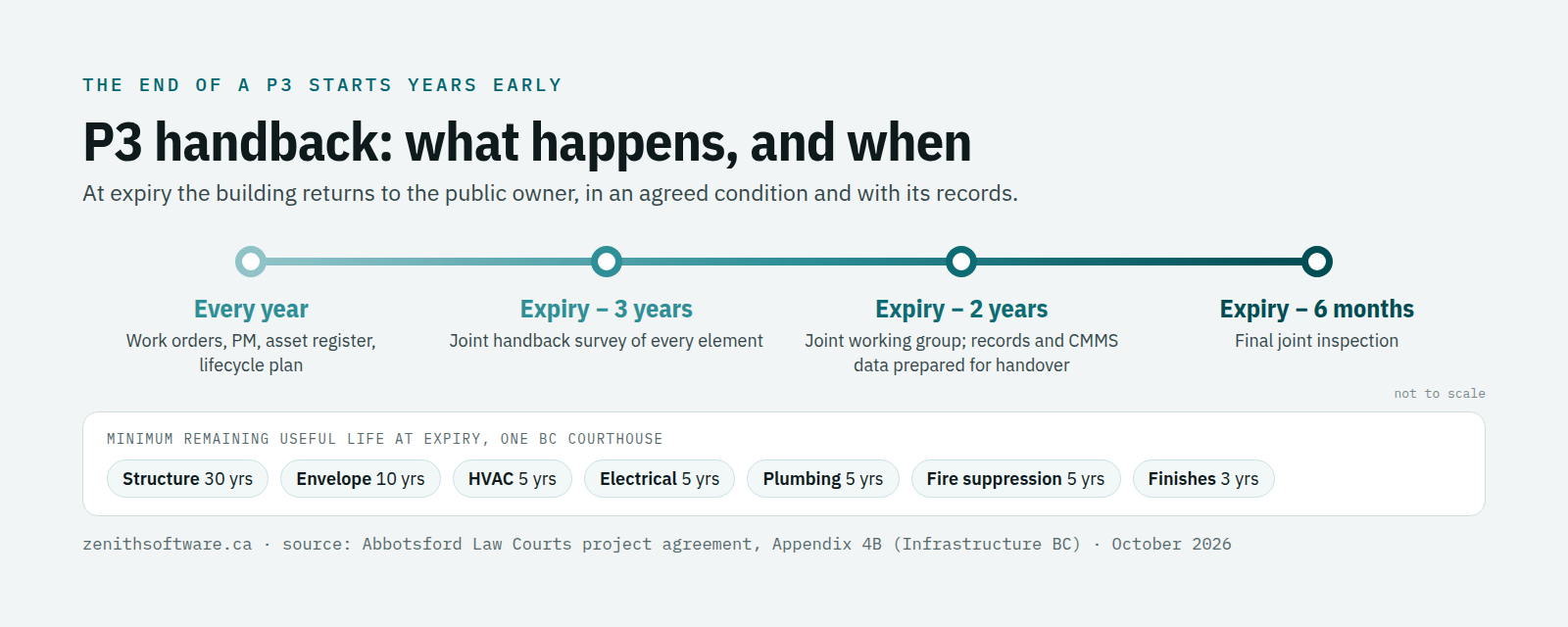
P3 contracts end with a handback, when the building returns to the public owner in an agreed condition. The handback requirements for the Abbotsford Law Courts, another Infrastructure BC project, show how far ahead this starts:
- Three years before expiry, a joint handback survey checks every element against the handback requirements. Project Co must plan, cost and secure any work needed to close a gap.
- Two years before expiry, a joint working group starts the transition.
- Six months before expiry, a further joint inspection confirms whether the facility meets the requirements.
- Remaining useful life: the agreement sets a minimum per system. For example, at least five years for HVAC, electrical, plumbing and fire suppression, ten years for the building envelope, and 30 years for the structure.
- Records go with the building. Project Co must hand over maintenance records, the asset registry and manuals, and must provide all CMMS and building management system data in an electronic format the Province’s systems can use.
That last point is worth reading twice. The records you keep in year three are the evidence you need in year 27. They must also leave in a format someone else can import. Our guide on how long to keep maintenance records in Canada explains why the record often has to outlive the person who wrote it.
Both sides need a CMMS for P3 work
Project Co and its facility management provider run the help desk, the work orders, preventive maintenance and lifecycle replacement, and produce the monthly reports. For them, the CMMS is the payment engine.
The Authority, such as a hospital, health authority or ministry, needs its own view to check those reports and track the requests its staff raise. It also manages work outside the agreement: its own equipment, minor works and areas Project Co does not maintain. In healthcare, that sits alongside the standards in our article on maintenance management for Canadian healthcare.
What to look for in a CMMS for P3 projects
- Help desk intake that timestamps every call, email and portal request in one queue.
- Priorities and target times you can configure to match the agreement, per priority and per area.
- A location register that matches the agreement’s rooms and functional units, so you report availability the way the contract does.
- Status history from reported to verified and closed, with who changed what and when.
- Repeat-event visibility: the same root cause in the same place, flagged early.
- Lifecycle planning: install dates, expected life and planned replacement for every major asset.
- Monthly reporting that an auditor, a lender or the Authority can reconcile.
- Your data, portable: hosted in Canada, and ready to hand over at the end of the term.
Bring one real month into the demo: ten help desk calls, two of them disputed. Ask the vendor to show how each one would appear in the monthly report. Our guide on how to choose work order software has more demo questions.
A CMMS for P3 work in Zenith
Zenith tracks every work order through nine stages, from reported to verified and closed, with the time and the person at each step. Requests come in from staff through one portal and are tied to the building, floor and room they concern. Supervisors set priorities, approve and verify work before it closes, and the equipment register keeps install dates and full maintenance history for lifecycle planning.
Every edition includes an audit trail and export to Excel, so the history can be checked and handed over. The Advanced edition adds planning and scheduling, vendors and contracts with each vendor’s work history, and safety permits. Premium adds automation, workflows and integrations. Everything works in English and French, with data hosted in Canada. Our guide on choosing a CMMS edition by industry helps you pick the level. The pricing page lists each edition in Canadian dollars.
Questions people ask
What does P3 mean?
A public-private partnership: a long-term contract in which a private partner designs, builds, often finances, and maintains public infrastructure, and is paid over the contract term against performance standards.
Who owns the maintenance data in a P3?
The project agreement decides. The Abbotsford Law Courts agreement requires Project Co to hand the CMMS and building management system data to the Province in a usable electronic format at the end of the term. Check your own agreement, and make sure your system can export everything it holds.
Does the hospital need its own CMMS if Project Co already has one?
Usually, yes. The Authority must check Project Co’s reports and track its own requests. It also maintains whatever sits outside the agreement. Many Authorities also want their own history for the day the building comes back to them.
Is this legal advice?
No. Every project agreement is different. Use this guide to ask better questions, and rely on your own agreement and your legal advisers for the answers.
Where to start
Pull last month’s help desk log and check three things for every event: the time it was reported, the time it was rectified, and who verified it. If any of those came from memory, that is where to begin. Talk to us if you would like to see a P3 month run through Zenith.
Published by Zenith Software Corp., Victoria, British Columbia · October 2026. Practical guidance, not legal advice. Examples are from publicly released Infrastructure BC project agreements; amounts, periods and definitions vary by project. We verified the external references in October 2026.