
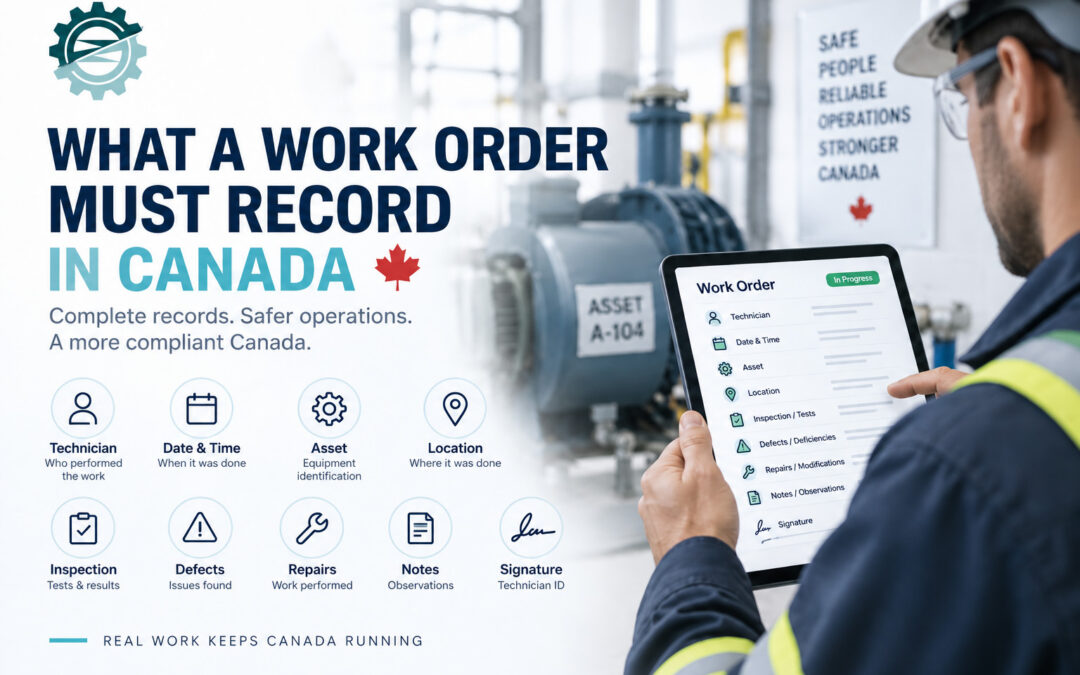
What must a work order actually contain? Not how long you keep it — what has to be in it. It is the second question every procurement questionnaire asks about work order records in Canada, and the one almost nobody answers with a section number.
We went looking. The short version: Canadian regulators very rarely ask for “a maintenance record.” They ask for specific fields; the fields required of work order records in Canada differ enormously between instruments, and the differences are not random — they follow three drafting patterns that are worth recognising before you design a form.
This page sets out what we could verify from the primary sources, with section numbers, so you can check us. Where a provision names no fields at all, we say so — that is a finding, not a gap. Anything we could not verify appears at the end.
This is not legal advice. It is a reading of published regulations as at September 2026, and consolidations change. Verify against the current instrument before you rely on it.
Three ways Canada specifies work order records
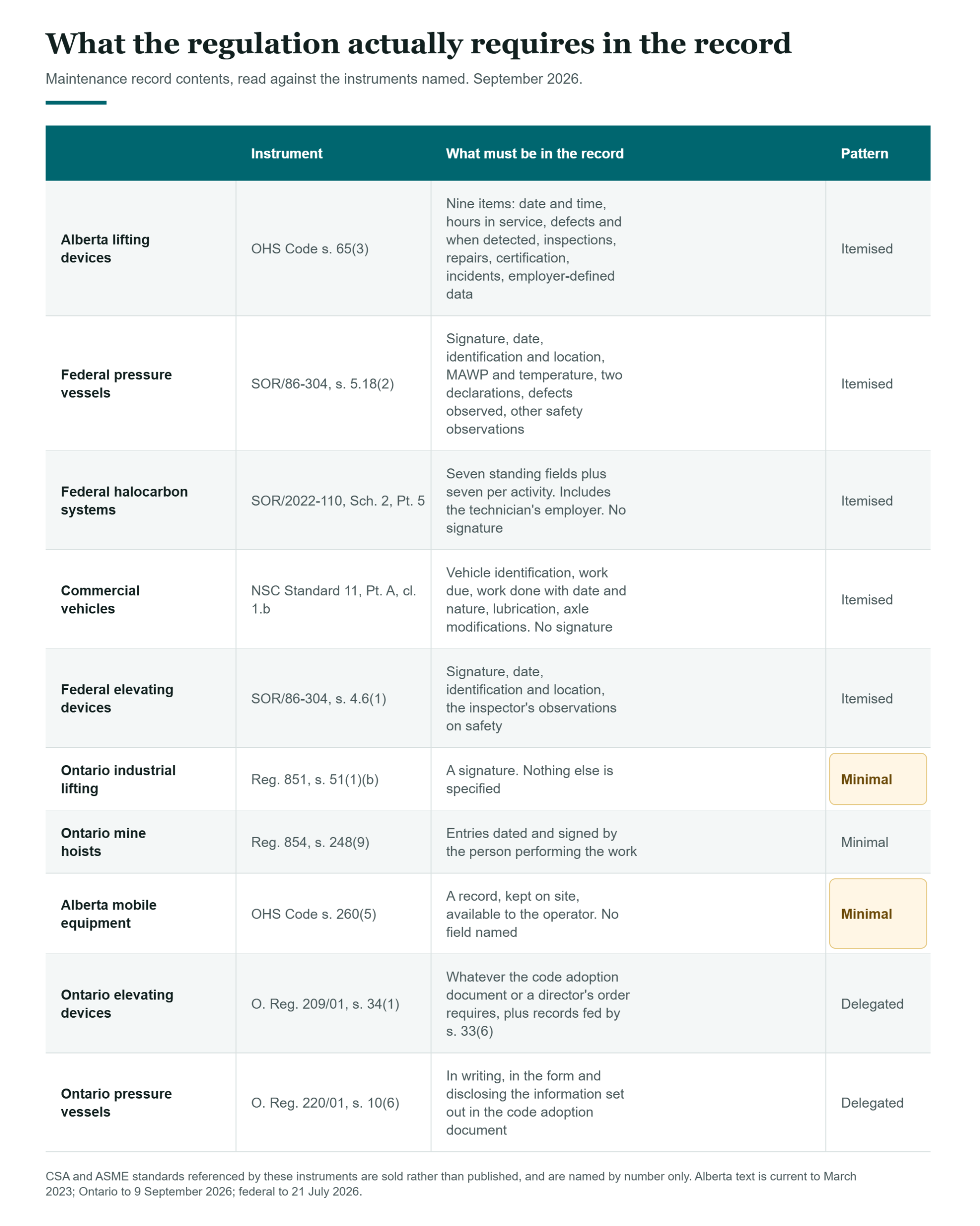
However, read twenty of these provisions and they sort themselves into three families. Which family you are in decides whether you can build a form from the regulation alone, or whether you have to go and buy a standard first.
Work order records in Canada itemised on the face of the regulation
The regulation lists the fields. You can build the form from the text. Alberta’s lifting device log book is the clearest example in the country — nine enumerated items, in the regulation itself, no standard to purchase.
One field, and nothing else
The regulation requires a record but names exactly one thing that must be in it — almost always a signature. Ontario’s industrial lifting device rule is the extreme case: the regulation demands a signed record and then says nothing whatsoever about what that record should say.
Delegated to a standard you have to buy
The regulation says the record must contain what a code adoption document or a CSA standard says it must contain. The fields exist, but they are behind a paywall. This is the dominant pattern in the newer Ontario instruments, and it is the reason a lot of compliance advice online is vague — the people writing it could not read the source either.
The two fields almost all work order records in Canada require
Across the work order records in Canada that we read, two fields recur far more than any other, and they recur together: who did the work, and when.
We counted. Six instruments require identity — a signature, or a named person: Ontario’s Reg. 851, Reg. 854, O. Reg. 213/91, Alberta’s OHS Code, and two federal ones. Six require a date as well. It is a tie, and the honest reading is that Canadian regulators treat the pair as the irreducible minimum.
The two exceptions are more interesting than the rule. Reg. 851 requires a signature and no date — the only instrument we found that wants to know who without wanting to know when. And NSC Standard 11 requires a date and no signature — the only one that goes the other way. Everything else asks for both.
If you are designing work order records in Canada and you can only get two things right, get those two right.
Who signed it, across five instruments
Under R.R.O. 1990, Reg. 851, s. 51(1)(b), a lifting device must be thoroughly examined by a competent person, “and a record shall be kept, signed by the competent person doing the examination.” That is the entire content requirement. Not a date, not a device identifier, not a single finding. Just a signature.
Under R.R.O. 1990, Reg. 854, s. 248(9), records of examinations, servicing and repairs go in the Hoisting Machinery Record Book, “and the entries in the Record Book shall be dated and signed by the person performing the examination, servicing or repairs.”
Under O. Reg. 213/91, s. 145(3)(c), the permanent record for an elevating work platform “shall include the signature and name of the person who performed the inspection, test, repair, modification or maintenance.”
And federally, under SOR/86-304, s. 4.6(1)(a), the record of an elevating device inspection “shall be signed by the person who made the inspection and test.”
Identity is also the field that software gets subtly wrong most often, by crediting the person who pressed the button rather than the person who did the job. Every provision above names whoever performed the examination, the work, or the inspection — not whoever filed the paperwork.
Where the regulator itemises work order records in Canada
Alberta’s nine-item lifting device log
Alberta’s OHS Code, AR 191/2021, s. 65(3) is the most explicit record-contents provision we found anywhere in Canadian maintenance law. The employer must ensure the following are entered in the log book:
“(a) the date and time when any work was performed on the lifting device; (b) the length of time in lifting service … (c) all defects or deficiencies and when they were detected; (d) inspections, including examinations, checks and tests, that are performed, including those specified in the manufacturer’s specifications; (e) repairs or modifications performed; (f) a record of a certification under section 73; (g) any matter or incident that may affect the safe operation of the lifting device; (h) any other operational information specifically identified by the employer; (i) in the case of a tower crane, whether or not the weight testing device was lifted for that working day, before the work of lifting loads began.”
Three items generic software has no field for
As a result, three things in that list are worth pausing on, because they are the ones generic software tends to have no field for.
Paragraph (c) asks for two dates, not one. The defect, and when somebody detected it — which is not the moment the work order was raised, and certainly not the moment somebody fixed it. If your only timestamp is the record’s creation date, you cannot answer (c).
Paragraph (b) asks for hours of service, conditionally. The full text is “the length of time in lifting service (i) recorded as hours of service if the lifting device is equipped by the manufacturer with an hour meter, or (ii) if required by the manufacturer’s specifications.” So it bites only where there is an OEM hour meter or an OEM specification calling for it — but where it does bite, it wants a meter reading captured as part of the job record. Most maintenance systems can hold a meter reading against an asset; far fewer capture it against the job.
Paragraph (h) is a delegation to yourself. “Any other operational information specifically identified by the employer” means your own configured fields become part of the legal record once you have identified them. That is a good reason to be deliberate about custom fields rather than accumulating them.
The log book follows the equipment
Section 65 also does something unusual with ownership. Under s. 65(2)(c), if ownership of a lifting device is transferred, “the log book is transferred with the equipment.” The record follows the asset out of your organisation. Section 65(1.1) exempts manually operated hoists from the log book requirement altogether. Section 65 also states no retention period at all — a point we covered in our companion piece on how long maintenance records must be kept in Canada.
The federal pressure vessel report
SOR/86-304, s. 5.18(2) is the most detailed federal example. The inspector who carried out the inspection must sign the report, and it must include the date; the identification and location of the equipment; the maximum allowable working pressure and maximum temperature; a declaration as to whether it meets the standards prescribed by the Part; a declaration as to whether it is safe for its intended use; “a list of any defects or deficiencies the inspector has observed in the condition or operating and maintenance practices”; and “any other observation that the inspector considers relevant to the safety of employees.”
Notice, therefore, what those last two do. They require a professional judgement, in prose, and they require it about practices as well as equipment. No dropdown satisfies s. 5.18(2)(b)(vi). If your inspection form has no free-text field that survives into the permanent record, it cannot produce a compliant report.
The federal elevating device rule at s. 4.6(1) follows the same shape in miniature: signature, date, identification and location of the device, and “the observations of the person inspecting and testing the elevating device and safety device on the safety of the devices.”
The halocarbon activity log
The Federal Halocarbon Regulations, 2022, s. 23, require an activity log — but s. 23 itself names no fields. It points at Schedule 2, Part 5, and that is where the enumeration lives. Seven standing items about the system: equipment type; owner name and address; name of the responsible person; specific location at the time of service; serial number or unique identifier; halocarbon type; and charging capacity in kilograms. Then, for each activity: date; type of activity; description of service; “name of certified person or other person who performed activity and name of their employer”; certificate number; quantity recovered in kilograms; and type and quantity charged in kilograms.
Two observations. First, the log demands the technician’s employer, not just the technician — a field almost no maintenance system has, and one that matters the moment contractors are involved. Second, and unusually, Schedule 2, Part 5 nowhere requires a signature. The one field the rest of Canadian maintenance law agrees on simply drops out. Instead, name and certificate number carry the identity.
Scope matters before you act on any of this. Section 2(1) applies these regulations only to systems owned by the federal Crown, a federal board, agency or Crown corporation, or a federal work or undertaking, or located on Aboriginal lands or federal lands. If you are a provincially regulated manufacturer, this is not your rule — your province’s halocarbon regulation is.
Commercial vehicles under the National Safety Code
NSC Standard 11, Part A, clause 1.b is the most operationally specific list of the lot, and it is freely downloadable — no paywall, which makes it unusual among the standards in this field. Every carrier must maintain, for each commercial vehicle, five things:
“i) an identification of the vehicle, including licence plate number, unit number or company number, if so marked, make, serial number, year and tire size … ii) a means to indicate the nature and due date of the various inspection and maintenance operations to be performed; iii) a record of inspection, repairs and maintenance indicating their date and nature … iv) a lubrication record; and v) a record of modifications involving axles or suspensions that affect a manufacturer’s gross vehicle weight rating or gross axle weight rating.”
Clause 1.b.ii is the interesting one, and it is routinely missed. It does not describe a record of work done — it requires a record of work due. A carrier with a perfect history and no forward schedule does not satisfy clause 1.b. In software terms, your PM schedule is not a convenience feature here; it is part of the required record set. Clause 1.b.i also reaches outside your own fleet: where the vehicle is not owned by the carrier, “the record shall identify the name of the person furnishing said vehicle.”
Like the halocarbon log, clause 1 requires no signature.
Where work order records in Canada need almost nothing
The counterweight to Alberta’s nine items is how little several rules ask for.
Ontario’s Reg. 851, s. 51(1)(b) we have already quoted: a signed record, and no specified content. We should be precise about a related point, because we have seen it stated wrongly elsewhere. Reg. 851 contains no log book provision for lifting devices. The phrase does not appear in the regulation. The obligation is a signed record under s. 51(1)(b), retained under s. 51(1.1); if you have read that Ontario requires a lifting device log book in an industrial establishment, that is Alberta’s rule, not Ontario’s.
Availability is not contents
Alberta’s own powered mobile equipment rule is similarly bare. Section 260(5) requires “a record of the inspections and maintenance carried out” to be kept at the work site and readily available to the operating worker. It names no field, no signature and no date. It wears the clothes of a records rule while doing the work of a location-and-availability rule.
Ontario’s Reg. 854, s. 228(8) reads the same way — “The record shall be kept readily available at the mine site while the rope is in service” — and the actual contents sit in the two subsections above it: s. 228(6) requires the date of each electromagnetic test and the results obtained, entered in the Rope Record Book, and s. 228(7) requires a competent person to interpret the test and sign “the record consisting of the test, the graphs and the interpretation.”
If you are quoting a subsection to a regulator, quote the one that carries the duty you are describing. Availability, contents and retention are frequently three different subsections of the same section, and they are not interchangeable.
Work order records in Canada that point at a paywalled standard
In general, the newer the instrument, the more likely it is to delegate.
O. Reg. 209/01, s. 34(1) requires a log book for every elevating device containing up-to-date data on “all maintenance functions required to be recorded in the log book by the applicable code, standard or requirement referred to in the code adoption document or any applicable director’s order,” and on “such other data as are required to be kept in the log book by this Regulation.”
Read that second limb, because it does real work. Section 33(6) of the same regulation requires that “a record of inspections and tests carried out under subsections (1), (2) and (3) shall be kept in the log book referred to in section 34.” So the contents are not entirely behind a paywall — the regulation feeds some of its own. But s. 34 itself specifies no date field, no signature and no technician identity, and the bulk of the answer is in the code adoption document or a director’s order.
Pressure vessel reports, delegated further still
O. Reg. 220/01, s. 10(6) delegates more completely for boiler and pressure vessel inspection reports: they must “be in writing, subject to subsection (9),” be “prepared in the form and manner set out in the code adoption document,” and “disclose the information, if any, set out in the code adoption document.” Only the first of those three is actionable without buying the document.
O. Reg. 213/91, s. 140(1)(a) and s. 141.4(6)(a) point at clause 13 (Equipment Log) of CSA Standard Z271-10 for suspended work platform systems and fixed supports respectively — though both also state a content requirement on the face of the regulation, s. 140(1)(b) requiring the log to “include a record of the inspections, tests, repairs, modifications and maintenance performed on the components.”
Crane logs, partly stated and partly delegated
The crane provisions are a hybrid rather than a pure delegation, and we originally filed them wrongly. Section 152(1) states contents plainly: the owner must keep “an owner’s crane log consisting of a record of all inspections of, tests of, repairs to, modifications to and maintenance of the crane or similar hoisting device.” Section 152(2) is a gap-filler that engages only “if the owner’s crane log does not include all the information required under subsection (1),” and it then points at inspection requirements in CSA Z248-17 clause 6.4.7 for tower cranes and CSA Z150-16 clause 5.3.5 for mobile cranes.
We did not read any of those standards, because they are sold rather than published, and we will not paraphrase a document we have not opened. What we can tell you is the practical consequence: for elevating devices and pressure vessels in Ontario, the regulation will not tell you what your record must contain. Budget for the standard, or ask the inspecting body what they expect to see.
What electronic work order records in Canada change
Drafters wrote most of these provisions for paper, and most have never been updated. Alberta’s has, and the way it did it is instructive.
Section 65(4) requires that “each entry in a paper log book is signed by the person doing the work.” Section 65(5) requires that “each entry in an electronic log book identifies the person doing the work.” Same duty, two mechanisms — and the electronic one asks for identification rather than a signature, which an authenticated user account satisfies and a typed name in a text box does not.
Section 65(1) is explicit that the log book may be “paper or electronic.” Section 65(6) adds a daily confirmation duty for tower cranes: a senior representative of the employer at the work site must confirm the entries are correct every day the crane is in operation.
Where a drafter has not modernised a provision this way, the safer reading takes it to mean what it says. Reg. 851’s “signed” and Reg. 854’s “dated and signed” were written for a book. Whether an authenticated electronic entry satisfies them is a question we cannot answer from the text, and we have not found Ontario case law that settles it. If you are relying on electronic records for those two, that is a question for your own counsel, not for a software vendor.
Two Ontario provisions that disappear on 1 January 2027
This one has a date on it, so it is worth flagging plainly.
O. Reg. 213/91, ss. 145 and 146 — the two richest record-contents provisions in Ontario’s construction regulation — are both revoked effective 1 January 2027 by O. Reg. 116/26, s. 1. Section 145 is the permanent record for elevating work platforms; s. 146 is the maintenance and inspection record tag, which currently requires the date of the last maintenance and inspection, the signature and name of the person who performed it, and “an indication that the maintenance has been carried out in accordance with the manufacturer’s recommendations.”
We have not traced what replaces them, and we are not going to guess. If elevating work platforms are in scope for you, that is worth watching between now and the end of next year.
A citation that does not exist
Meanwhile, while checking the federal side, we found a phantom.
Third-party compliance pages circulate a clause numbered “13.4.2” of the Canada Occupational Health and Safety Regulations, quoted as requiring that “a record shall be kept of all inspections and maintenance work performed under the plan.” That text does not exist in SOR/86-304. Section 13.4 is about grounding portable electric tools.
More broadly: Part XIII of the federal regulations, which governs tools and machinery across sections 13.1 to 13.22, contains no inspection, maintenance or testing record requirement at all — the word “record” does not appear in the Part.
It does contain documentation duties, but they are of a different kind. Section 13.12 requires a manual of operating instructions for each type of tool and machine. Section 13.16 requires a written lock-out procedure, and where an alternative to lock-out is used, written safety instructions — and, at s. 13.16(2)(b)(i), that the person doing the work “obtains a written authorization from the employer each time the work is performed.” Section 13.17 requires a copy of those s. 13.16 instructions to be kept readily available to people performing repair and maintenance work.
The s. 13.16 written authorisation is the closest thing in the Part to a per-job document, and it is a permission to work, not a record of work done. None of these tell you what happened to the machine.
If a consultant has told you that federal law requires maintenance records for your machine guarding, ask them for the section number.
What this means for how you design work order records in Canada
Finally, pulling the verified provisions together, five design conclusions about work order records in Canada survive.
Identity is the load-bearing field. Six of the instruments we read require the person who did the work to sign it or be identified in it. Attribution to the account that closed the record is not the same thing, and that difference is exactly what an inspector checks.
One timestamp is not enough. Alberta wants the date and time of the work and the moment somebody detected each defect. NSC 11 wants the date and nature of the work and the due date of what is coming. A single “completed on” field cannot carry that.
Some records have to leave with the asset. Alberta s. 65(2)(c) transfers the lifting device log book with the equipment on a change of ownership, and Ontario’s O. Reg. 209/01, s. 33(7) does the same for elevating device records. A record that cannot be extracted for one asset, cleanly and completely, is a problem you discover on the day you sell a crane.
Two conclusions people find inconvenient
Free text is a compliance requirement, not a convenience. SOR/86-304 s. 5.18(2)(b)(vi) and (vii) require observed defects and any other safety-relevant observation, in the inspector’s own words. Structured-only forms cannot satisfy that.
The contractor’s employer is sometimes a required field. The halocarbon log wants the name of the person’s employer; NSC 11 wants the name of the person furnishing a vehicle you do not own. If contractors are just names in a text box, those fields are not really there.
None of this requires particular software. Work order records in Canada need to know who, when, on what, and what was found — and you need to have read the provision that applies to your equipment, rather than a generic checklist.
What we could not verify
In the interests of being checkable, here is what remains open.
We did not read CSA Z271-10, Z248-17, Z150-16, or the code adoption documents referenced by O. Reg. 209/01 and O. Reg. 220/01. Publishers sell all of them rather than publishing them freely. Where a regulation delegates to them, we have said so rather than describing contents we have not seen.
The Alberta text is the weakest link here, and you should know it. The Alberta OHS legislation pages we read carry the note “This material is current to March 2023.” That is three and a half years before this page was written. Everything we quote from AR 191/2021 was accurate as at that consolidation, and we have not been able to confirm from a free source that it is accurate today. If Alberta matters to you, check the current Code.
Currency of the texts we read
Ontario e-Laws showed a currency date of 9 September 2026 across the regulations we read. The federal regulations state they are current to 21 July 2026, SOR/86-304 last amended 26 March 2025. NSC Standard 11 Part A is the January 2020 edition.
We did not confirm what replaces O. Reg. 213/91 ss. 145 and 146 after 1 January 2027.
We found no case law interpreting whether an authenticated electronic entry satisfies “signed” in Reg. 851 s. 51(1)(b) or Reg. 854 s. 248(9). We looked; we did not find; that is not the same as there being none.
Our survey covered the Ontario, Alberta and federal instruments listed above. British Columbia, Saskatchewan, Manitoba, Quebec and Atlantic Canada are outside its scope, so nothing here should be read as a national census of record-contents rules.
Frequently asked questions
Do work order records in Canada have required fields by law?
Not generally. There is no single rule governing work order records in Canada. What exists is a set of equipment-specific and jurisdiction-specific provisions, some of which itemise fields (Alberta OHS Code s. 65(3), SOR/86-304 s. 5.18(2), Federal Halocarbon Regulations Schedule 2 Part 5, NSC Standard 11 cl. 1.b), some of which require only a signature, and some of which delegate the question to a purchased standard.
Is a signature legally required on work order records in Canada?
It depends entirely on the instrument. Ontario Reg. 851 s. 51(1)(b), Reg. 854 s. 248(9), O. Reg. 213/91 s. 145(3)(c), SOR/86-304 ss. 4.6(1)(a) and 5.18(2)(a), and Alberta OHS Code s. 65(4) all require a signature. The Federal Halocarbon activity log and NSC Standard 11 clause 1 do not — they identify the person by name instead.
Can a work order log book be electronic in Alberta?
Yes. Alberta OHS Code s. 65(1) says the employer must set up “a paper or electronic log book,” and s. 65(5) requires each entry in an electronic log book to identify the person doing the work, in place of the signature required for paper entries under s. 65(4).
What must a commercial vehicle maintenance record contain in Canada?
Under NSC Standard 11, Part A, clause 1.b: vehicle identification (plate, unit or company number if marked, make, serial number, year, tire size, and the name of the person furnishing the vehicle if the carrier does not own it); a means to indicate the nature and due date of upcoming inspection and maintenance; a record of inspection, repairs and maintenance with date and nature; a lubrication record; and a record of axle or suspension modifications affecting GVWR or GAWR.
Does the federal government require maintenance records for machinery?
Not under Part XIII of SOR/86-304. Sections 13.1 to 13.22 govern tools and machinery and contain no requirement to record inspections, testing or maintenance; the word “record” does not appear in the Part. The documentation duties there are operating instructions (s. 13.12), a written lock-out procedure and alternative-to-lock-out instructions with a written authorisation each time the work is performed (s. 13.16), and keeping a copy of those instructions available (s. 13.17). Other Parts of the same regulation do impose record duties, for elevating devices (s. 4.6) and pressure vessels (s. 5.18).
Which rule specifies the most detailed work order records in Canada?
Of the provisions we read, Alberta OHS Code s. 65(3), with nine enumerated items for lifting device log books. The most detailed federal one is SOR/86-304 s. 5.18(2) for pressure vessel inspection reports, with seven required elements plus a signature.
Do work order records in Canada transfer when equipment is sold?
Sometimes, yes, and in more than one jurisdiction. Alberta OHS Code s. 65(2)(c) requires that if ownership of a lifting device is transferred, the log book is transferred with the equipment. Ontario has an equivalent for elevating devices: O. Reg. 209/01, s. 33(7) provides that “where the ownership of an elevating device changes, the records referred to in subsection (6) shall be transferred to the new owner.” O. Reg. 213/91, s. 152(5)(b) does something similar within a project, requiring the operator’s crane log to be transferred to the owner for addition to the owner’s log after the crane leaves.
A note on sources
Every provision quoted here was read from the primary source and quoted verbatim: Ontario e-Laws for the Ontario regulations, the Alberta OHS legislation search site for AR 191/2021, the Justice Laws website for the federal instruments, and CCMTA’s own PDF for NSC Standard 11 — cross-checked against the copy hosted by Nova Scotia, which matched word for word.
Corrections made before publication
The federal texts were retrieved twice by different methods and compared. Three assumptions we started with turned out to be wrong and were corrected before drafting: Alberta’s field list is in s. 65(3) rather than s. 65(2); the Federal Halocarbon activity log has no lettered paragraphs in s. 23 because the enumeration lives in Schedule 2; and Reg. 851 contains no lifting device log book provision at all.
The draft was then checked adversarially against the primary sources a second time, and that pass caught five more of our own errors, which are corrected above. We cited a non-existent “s. 141(6)” for the fixed-support equipment log, which is s. 141.4(6). We closed a quotation of O. Reg. 209/01, s. 34(1) before the words “or any applicable director’s order”, which materially changed its meaning. We claimed no Ontario equivalent to Alberta’s transfer-on-sale duty when s. 33(7) of the same regulation is one. We stated that the Alberta pages showed no currency date when they show March 2023. And we described the identity field as having broader agreement than the date, when a count makes it a tie.
We list those because a page about record-keeping ought to keep a record of its own corrections.
If you find an error, we would like to know about it.