

Today is Labour Day in Canada. For most of us it means the last long weekend of summer, a barbecue, and the quiet dread of September. Very few people know that the holiday has a specifically Canadian origin story. It began with a strike over working hours. And one sentence written in 1872, to protect the workers who struck, is still on the federal statute book today.
It is worth twenty minutes of your day off.
Labour Day in Canada started in Hamilton, in the middle of winter
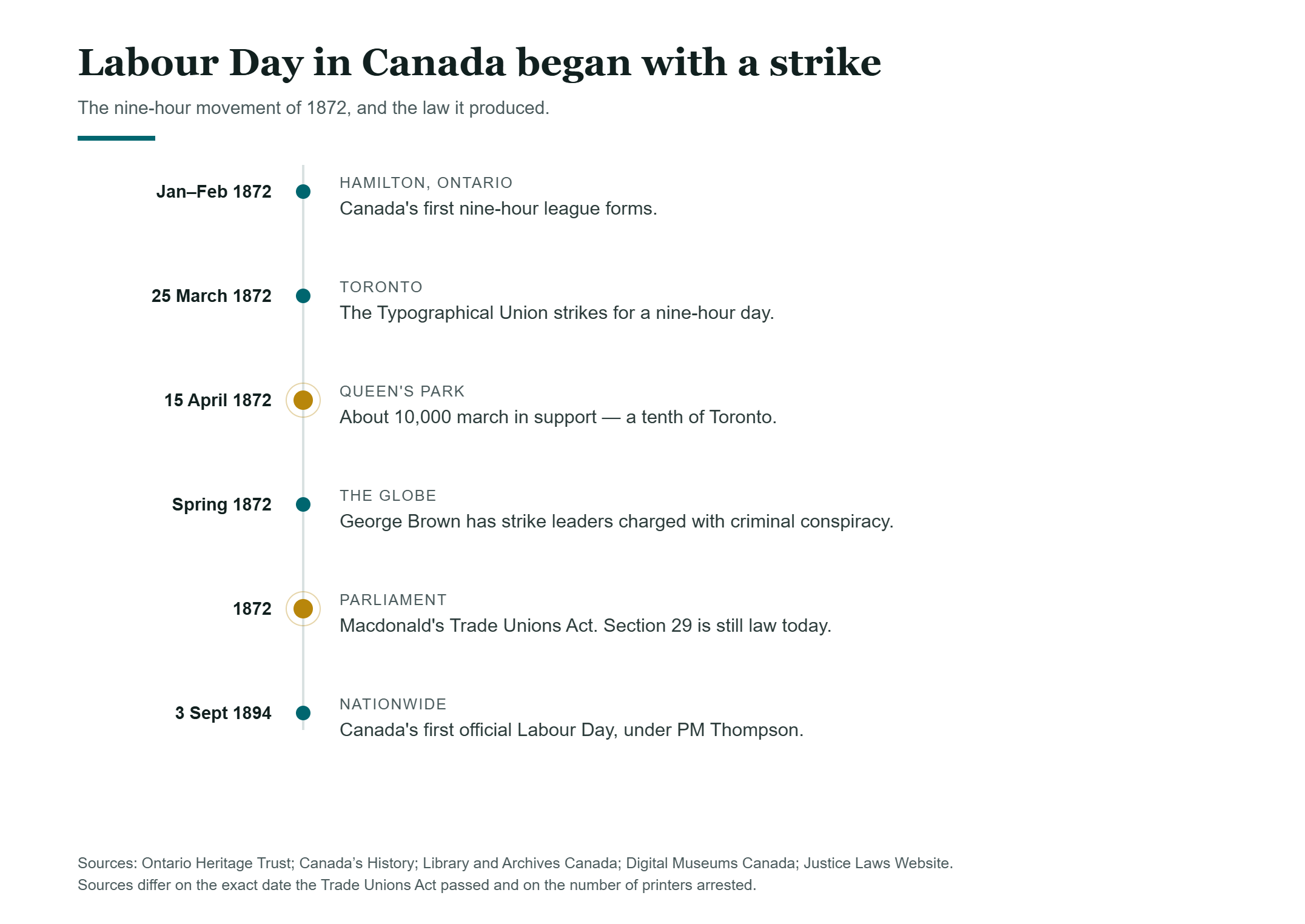
In January and February of 1872, workers in Hamilton, Ontario formed Canada’s first nine-hour league. The demand was simple and, at the time, radical: a nine-hour working day. The movement had a president, John Pryke, and a secretary, James Ryan, and it spread by correspondence.
Ryan wrote to the Toronto Trades Assembly. That correspondence, according to the Dictionary of Canadian Biography, prompted Toronto to launch its own nine-hour movement — which led directly to what happened next.
The printers walked out on 25 March 1872
The Toronto Typographical Union struck for the nine-hour day. Printers were skilled tradespeople, and the newspapers they printed belonged to some of the most powerful men in the country.
On 15 April, a solidarity parade marched to Queen’s Park. The crowd was around ten thousand people — roughly one tenth of Toronto’s entire population at the time. Try to picture the modern equivalent in your own city.
Then the publisher had them arrested
George Brown owned the Globe. He was also a Father of Confederation. He brought in replacement printers from nearby towns, and he had the strike leaders charged — not with breaking a strike law, because there wasn’t one, but with criminal conspiracy.
That was the legal position in Canada in 1872. A union was an unlawful combination at common law, a conspiracy in restraint of trade. Organising to ask for shorter hours was, in itself, a criminal act. Canadian Geographic puts the number of arrests at 27; the Ontario Heritage Trust plaque records only “strike leaders”, so treat the precise figure as reported rather than settled.
The sentence that is still in force
Prime Minister John A. Macdonald’s government responded with the Trade Unions Act of 1872. Sources disagree on the exact date of passage, so we will not print one.
What we can print is the law itself, because it survives today as section 29 of the Trade Unions Act, RSC 1985, c. T-14:
“The purposes of any trade union shall not, by reason merely that they are in restraint of trade, be deemed to be unlawful so as to render any member of the trade union liable to criminal prosecution for conspiracy.”
One hundred and fifty-four years later, you can still read that sentence on the Government of Canada’s own website. It exists because printers in Toronto were arrested for asking to work nine hours.
What actually happened, honestly
It is tempting to end the story there, with a victory. The record is more mixed.
The Toronto printers gained ground, and the political fallout produced the Trade Unions Act. But the broader Nine-Hour Movement did not win its general goal in 1872. Digital Museums Canada suggests the printers’ gain may have come at the expense of the wider movement. The Act itself, as the same source notes, had a scope that was “relatively limited” in practice, and restrictions on union activity remained.
Progress arrived, but it arrived partially, and it took decades more. That is usually how it goes.
Labour Day in Canada became official twenty-two years later
The holiday became statutory in 1894, under Prime Minister Sir John Sparrow David Thompson. Union leaders met him that April, and legislation followed in the summer, fixing the first Monday of September. Canada’s first official Labour Day was Monday 3 September 1894.
Two corrections worth making, because both are commonly repeated and neither is quite right.
Canada did not get there first. The United States made the first Monday in September a federal holiday on 28 June 1894 — about three and a half weeks before Canada. What is true is that Canadian labour demonstrations in 1872 predate the first American Labor Day parade in 1882. You will sometimes see the claim that an American labour leader watched a Toronto parade and took the idea home. The Canadian Labour Congress makes it. It does not appear in the US Department of Labor’s own history, which says the founder is disputed. Attribute it; do not assert it.
The holiday did not begin in 1894 either. Workers had been marking labour days for years. Library and Archives Canada records Nova Scotia miners in 1880, Toronto in 1882, Hamilton and Oshawa in 1883, Montreal in 1886, Halifax in 1888, Ottawa and Vancouver in 1890. The Globe reported that at the 1882 Toronto parade, “at least 3 000 people marched in the parade and 50 000 watched from the sidewalks.”
One more detail worth knowing: early September was chosen partly to avoid the overtly political associations of May Day. The date is itself a piece of history.
The fight was about hours. Hours are scarce again.
Here is what connects 1872 to a Canadian maintenance shop in 2026. The nine-hour movement was an argument about how many hours a person should be asked to give. Today the argument has inverted: there are not enough people to give the hours at all.
Statistics Canada compared the 2016 and 2021 censuses and found the tradespeople population shrinking, not merely ageing:
- 1,620,680 tradespeople in 2021, down 97,940 — a fall of 5.7% — from 1,718,620 in 2016.
- Around 339,520 were aged 55 or over, roughly one in five.
- The 65-and-over group grew by 11.8%. The 15-to-24 group fell by 12.2%.
Employment and Social Development Canada projects that Canada will need more than 1.4 million new trades workers, citing a 21% retirement rate in the existing workforce. BuildForce Canada expects roughly 245,100 construction retirements over ten years against about 237,800 expected new entrants — a gap, not a surplus.
In the first quarter of 2026, Statistics Canada counted 506,700 job vacancies across the economy, with vacancies in trades, transport and equipment operator occupations up 4,900, a rise of 5.3%.
What that means for the people who keep things running
We build maintenance software, so we will be careful here rather than opportunistic.
A CMMS does not solve a labour shortage. It does not train an apprentice. It does not persuade a nineteen-year-old that the trades are a good life. Above all, it does not replace a millwright with thirty years of judgement about how a machine sounds before it fails. Anyone who tells you otherwise is selling.
What software can do is narrower and worth stating plainly: it can stop skilled hours being wasted. Think of the hours that go on hunting for a manual, or driving back for the right part. Add redoing work because nobody recorded that it was already done. Add reconstructing a service history that walked out of the door with a departing contractor. That is trade time spent on administration, and when the people are scarce, the waste costs more.
And there is a second thing, which matters more than efficiency. When an experienced technician retires, what they knew about your equipment leaves with them unless it was written down against the asset. A maintenance record is a form of institutional memory. In a workforce losing more people than it gains, that is not a filing preference. It is succession planning.
We have written about how this plays out in specific Canadian sectors — in manufacturing, in healthcare, in retail, in mining and pipelines and in property management. There is also a companion piece on Canadian labour and maintenance teams.
Today, though
Labour Day in Canada is a day off, and it exists because people who set type for a living decided that twelve hours was too many. They were arrested for saying so.
To everyone spending today on shift — in hospitals, on pipelines, in plants that cannot stop, in the grocery store keeping the refrigeration running so the rest of us can have a barbecue — thank you. The holiday was built by people doing exactly what you are doing.
Frequently asked questions
Why is Labour Day in Canada on the first Monday of September?
It was fixed by federal legislation in 1894 under Prime Minister John Thompson. Early September was chosen partly to avoid the overtly political associations of May Day, which is marked internationally on 1 May.
When was the first official Labour Day in Canada?
Monday 3 September 1894. Unofficial labour days had been held for years before that — Nova Scotia miners in 1880 and Toronto in 1882 among them.
Did Labour Day start in Canada?
Partly. Canadian labour demonstrations in 1872 predate the first American Labor Day parade in 1882. But the United States made it a federal holiday on 28 June 1894, roughly three and a half weeks before Canada did. Saying Canada’s holiday came first is not accurate.
What was the Nine-Hour Movement?
A campaign in 1872 for a nine-hour working day. Canada’s first nine-hour league formed in Hamilton, Ontario in January and February of that year, and the movement spread from there.
Why were the Toronto printers arrested?
For criminal conspiracy. In 1872 a trade union was treated at common law as an unlawful combination in restraint of trade, so organising a strike was itself a criminal act. George Brown, owner of the Globe and a Father of Confederation, brought the charges.
Is the 1872 Trade Unions Act still law?
It survives as the Trade Unions Act, RSC 1985, c. T-14. Section 29 still provides that a union’s purposes are not unlawful merely because they are in restraint of trade, so members cannot be prosecuted for conspiracy on that basis alone.
Is Canada actually short of skilled trades workers?
The government’s own figures say so. Statistics Canada recorded 1,620,680 tradespeople in 2021, down 5.7% from 2016, with the over-65 group growing and the under-25 group shrinking. Employment and Social Development Canada projects a need for more than 1.4 million new trades workers.
Can software fix the trades shortage?
No, and we would not claim it can. Software can reduce the share of a skilled worker’s day spent on administration, and it can keep an experienced technician’s knowledge of your equipment after they retire. Those are real but modest things, and they are not the same as having enough people.
A note on sources
The historical account here draws on the Ontario Heritage Trust’s plaque for the Printers’ Strike of 1872, Canada’s History, Library and Archives Canada, Digital Museums Canada’s Nine Hour League exhibit, the Dictionary of Canadian Biography and Canadian Geographic. The text of the Trade Unions Act was read on the Justice Laws website. Workforce figures come from Statistics Canada, Employment and Social Development Canada and BuildForce Canada. Where sources conflict — the date the Trade Unions Act passed, the number of printers arrested, whether an American organiser took the idea home from Toronto — we have said so rather than pick the version that reads best.