
A CMMS for Canadian mining runs into something no American product anticipates. In Ontario, the law does not merely require you to keep maintenance records for a mine hoisting plant. It names five specific log books, and it tells you where to get them: from the Ministry. Mining, quarrying and oil and gas extraction contributes roughly $125 billion to Canadian GDP, about 5.3% of the total. It is also the sector where maintenance records are most tightly prescribed, and where the prescription differs most between one province and the next.
Updated September 2026. Ontario’s Regulation 854 was read on e-Laws against the consolidation in force from 1 July 2025. The federal pipeline regulations were read on the Justice Laws website.
Who actually regulates you
Before any discussion of records, settle the jurisdiction question. In short, it decides everything that follows.
Mining is provincial. Ontario runs Regulation 854 under its Occupational Health and Safety Act. British Columbia runs a standalone code under its Mines Act. Alberta has its own regime again. However, uranium is the exception: the Canadian Nuclear Safety Commission licenses uranium mining and milling federally, though provinces still regulate exploration and CNSC inspections are often carried out alongside provincial agencies.
Pipelines split by geography. A pipeline crossing a provincial or international boundary is federal, regulated by the Canada Energy Regulator. By contrast, a pipeline lying entirely inside one province is that province’s business — the Alberta Energy Regulator in Alberta, the BC Energy Regulator in British Columbia.
We found the same shape in Canadian manufacturing and again in Canadian retail. Consequently a single company can hold assets under three or four regimes at once. Moreover, those regimes do not agree on what a record is, who signs it, or how long it lives. That is the problem a CMMS for Canadian mining has to solve, and it is a data problem before it is a scheduling problem.
Ontario prescribes the log books themselves
This is the provision that surprises people. Section 207 of R.R.O. 1990, Reg. 854 reads:
“The following log books shall be obtained from the Ministry and used for each mine hoisting plant: 1. Electrical Hoisting Equipment Record Book. 2. Hoisting Machinery Record Book. 3. Hoist Operator’s Log Book. 4. Rope Record Book. 5. Shaft Inspection Record Book.”
Read that again. The regulation does not describe a category of record and leave the format to you. Instead, it names five books, and you obtain them from the Ministry.
What has to go in them
Section 248(9) requires a record of the examinations that section demands, together with any servicing and repairs, entered in the Hoisting Machinery Record Book. Furthermore, the entries must be dated and signed by the person who performed the examination, servicing or repair. Subsection (10) requires a failure or accident involving a mechanical part of the hoisting plant to be recorded by the supervisor in charge.
Meanwhile section 228(6) requires the results of an electromagnetic rope test to be recorded in the Rope Record Book. In addition, a competent person interprets the test and graphs and signs the record.
The retention rule is the asset’s life, not a number of years
Section 228(8) is short and unusual: the record “shall be kept readily available at the mine site while the rope is in service.”
Notice what that does. Retention is not two years or five years. It runs for as long as that rope remains in service, and the record has to be readily available at the mine site — not in a head-office archive. By contrast, section 127(3) gives explosives magazine inspection reports a plain six-month retention. So within one regulation you already have two entirely different retention models.
What this means for software
A statutory paper log book does not disappear because you bought a maintenance system. Rather, the two have to coexist. In practice that means your electronic record carries the same entries, with the same dates and the same named signatories, so that the book and the system never disagree.
Above all, that is a design requirement, not a preference. A system that cannot reproduce who signed what, on which date, against which rope, is not usable as the parallel record. This is precisely where a CMMS for Canadian mining earns its place: the book satisfies the regulator, and the system makes the history searchable, trendable and impossible to lose when the book fills up.
British Columbia: a standalone code
British Columbia does it differently again. The Mines Act applies, in the words of section 2, to all mines “during exploration, development, construction, production, closure, reclamation and abandonment.” Section 34 provides for a code covering all aspects of health, safety and reclamation, approved by the Lieutenant Governor in Council.
Accordingly, the result is the Health, Safety and Reclamation Code for Mines in British Columbia. Its current consolidation is June 2026, brought into force by Order in Council 255 on 19 June 2026. If your compliance binder still references the April 2024 revision, it is out of date.
One caution, because this point is widely overstated — including by us, in an earlier draft of this article. It is often said that the mines code “replaces” the general Occupational Health and Safety Regulation at mine sites. We could not verify that as a general proposition. What we can verify is narrower: OHS Regulation Part 22, on underground workings, expressly applies only to underground workings that are not mines within the meaning of the Mines Act and the Code. That is a part-specific exclusion. Treat any broader claim with suspicion until you have read the provision yourself.
Federal pipelines: the integrity management program
The Canadian Energy Regulator Onshore Pipeline Regulations, SOR/99-294, govern federally regulated pipelines. Several provisions describe, almost line by line, what a maintenance system has to hold.
- Section 27. A company must “develop, regularly review and update as required, operation and maintenance manuals”, and submit them to the Regulator on request. Note the standing duty to review, not merely to have.
- Section 40. A company must “develop, implement and maintain an integrity management program”, covering the pipeline from design through abandonment.
- Section 41(1). Where a defect is found in excess of what CSA Z662 allows, the company documents the particulars, the likely cause and the corrective action taken.
- Section 53(1). Inspections on a regular basis, and audits “with a maximum interval of three years”.
- Section 55. Audits of the emergency management, integrity, safety, security, environmental protection and damage prevention programs, again on a maximum three-year interval.
- Section 54(1). Construction is inspected by the company “or an agent independent of any construction contractor”.
- Section 6.5. The management system must include a data management system for monitoring and analyzing trends in hazards, incidents and near-misses.
Section 6.5 deserves a second look. A regulation requiring you to trend your near-misses is a regulation requiring structured data. In other words, you cannot trend a filing cabinet.
Four retention clocks in a single section
Section 56 sets retention, and it does not set one period. Instead, it sets several, each tied to a different event.
- Paragraph (a). Certain operating records for at least one month; leak detection data for six months.
- Paragraph (c). Quality-assurance information for at least one year after the pipeline or part of it is placed into service. The clock starts at commissioning, not at the moment the record was created.
- Paragraph (d). Audit and inspection records for the most recent five years of operation, or for the period covered by the two most recent complete audits, whichever period is longer.
- Paragraphs (e) and (f). Installation records — location, type, date, welding procedure, carbon equivalent, non-destructive testing results, planned removal date — kept for as long as the installations remain. Location records for all buried facilities, “until they are removed”.
- Paragraph (g). A defined list of records for at least two years after the pipeline has been duly abandoned.
Paragraph (d) is the one most often stated wrongly, ourselves included in an earlier pass. “Five years” alone is incomplete. If your last two complete audits span seven years, seven years is the answer.
Paragraphs (e) and (f) are the harder ones operationally. A weld record from 1998 must still exist while that weld is in the ground. That is a retention obligation measured in decades, attached to a physical component, and it is exactly what gets lost when a company changes maintenance systems or is acquired.
CSA Z662 and the moving target
Section 4 requires pipelines to be designed, constructed, operated and abandoned in accordance with the regulations and with several CSA standards, CSA Z662 among them. At present the current edition is Z662:23, the ninth, covering design, construction, operation, maintenance, deactivation and abandonment of oil and gas pipeline systems.
Here is the subtlety. Section 1 defines the standard “as amended from time to time”. That is an ambulatory incorporation by reference: when CSA publishes a new edition, it becomes the applicable standard without the regulation being rewritten. The CER confirmed Z662:23 came into force on 30 June 2023.
Therefore a compliance programme built against a specific edition has a shelf life. The standard is paywalled, so we name it by number, title and scope only — read it before relying on any summary, ours included.
Alberta: logs, and produce them on request
Alberta’s approach differs again. Under the Alberta Energy Regulator’s Directive 077 on pipelines, licensees maintain logs of inspection, assessment and tests in accordance with their integrity management program. In addition, they keep a log of operational activities — pumping times, suspensions and restarts, maintenance, repairs — plus a log of surveillance activities to be provided to the AER on request, and a log of incidents, near misses and identified hazards.
Notably, Directive 077 sets logging duties rather than numeric retention periods. The retention figures that inspectors cite come from elsewhere: the AER’s Manual 001 on facility and well site inspections, dated February 2025, lists non-compliances including documentation not retained for a minimum of five years, and inventory records not retained on site or at the local field office for two years.
Alberta’s Pipeline Rules took effect on 15 November 2023, alongside new editions of Directive 077 and Directive 056. If your procedures cite the older Pipeline Regulation, they need revisiting.
What this means for an operator working in more than one province
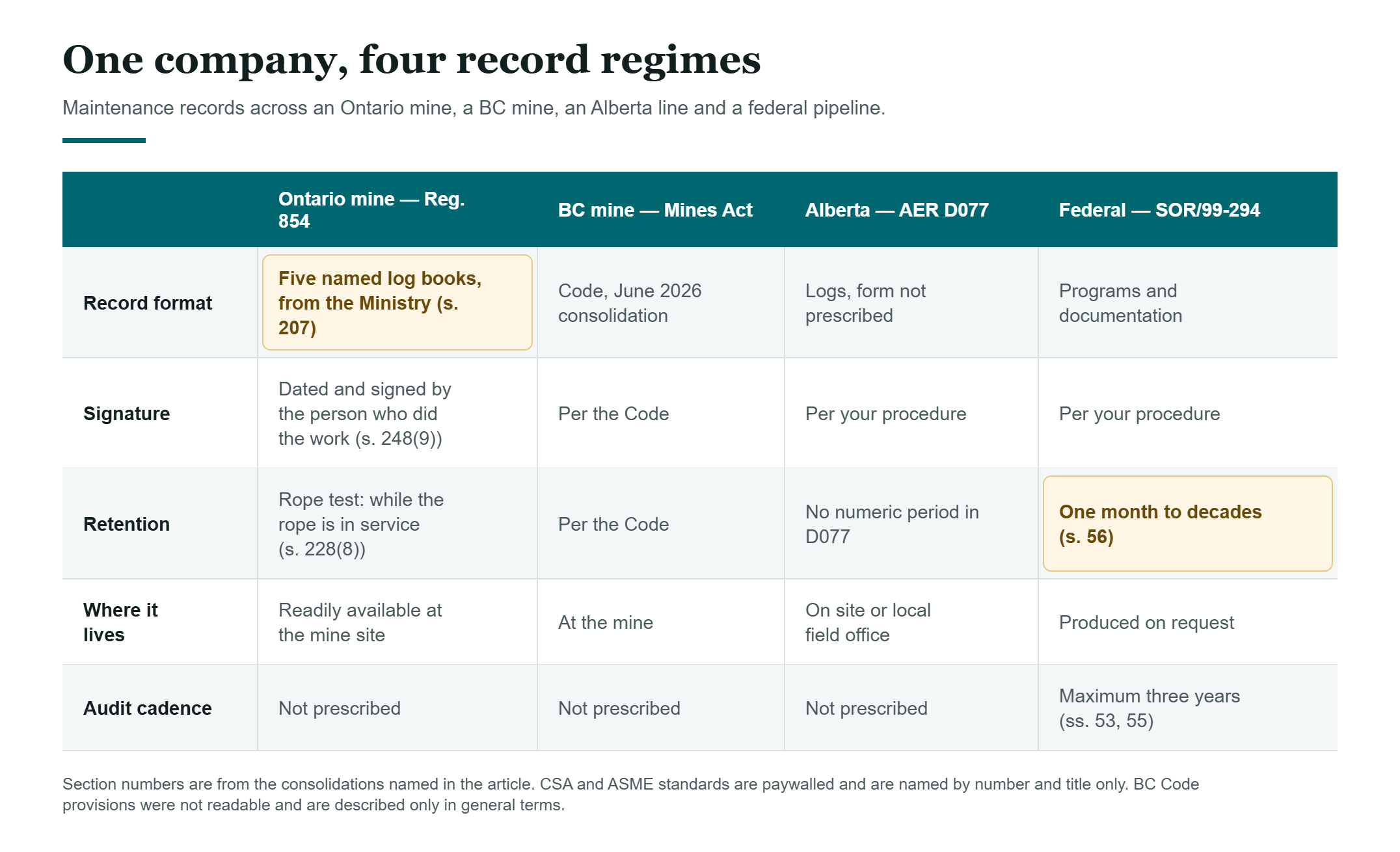
Picture a company with an Ontario underground mine, a BC open pit and an Alberta gathering system feeding a federally regulated line. This is the ordinary case a CMMS for Canadian mining has to handle, not an edge case. On maintenance records alone:
- Format — Ontario prescribes five named log books from the Ministry. Alberta prescribes logs but not their form. The CER prescribes programs and documentation.
- Signature — Ontario requires entries dated and signed by the person who did the work. Elsewhere, attribution is a matter of your own procedure.
- Retention — six months for Ontario explosives reports; the rope’s service life for rope tests; one month, six months, one year, five years or two-audits, and decades, across a single federal section.
- Location — Ontario wants the rope record readily available at the mine site. Alberta wants some inventory records on site or at the local field office.
- Audit cadence — a hard three-year federal maximum; nothing equivalent in the provincial mining codes.
No single national report satisfies that. Accordingly, the requirement is not a reporting template but per-site data scope, so that the same asset type can carry different rules in different places and still roll into one number.
Which modules a CMMS for Canadian mining actually needs
Assets
The asset register is where a rope, a hoist, a weld and a buried valve each become a record with its own history. Documents attach to the component, so a 1998 weld record lives on the weld, not in a folder named 1998.
Maintenance
Preventive maintenance carries the examination cadences and the audit clock. The federal three-year audit maximum is a schedule with a hard date, not a diary note.
Work
Every examination, servicing and repair becomes a work order with a date and a named person — which is the literal content section 248(9) requires in the Hoisting Machinery Record Book.
Reliability
Condition monitoring, failure analysis and bad actors. Section 6.5 requires trending of hazards, incidents and near-misses. That is a reliability function, expressed as a regulation.
Workforce and contractors
Section 54(1) requires construction inspection by the company or an agent independent of the construction contractor. Notably, independence is a fact about a person, recorded against the inspection. Contractor records carry it.
Spatial
Shaft, level, heading; kilometre post, valve site. Buried facility location records are required until removal, so location is a permanent attribute of the asset. Spares for that equipment sit in parts and inventory.
Analytics and Administration
Reporting covers audit due dates and defect trends. Administration carries per-site rules, plus the audit trail that turns a maintenance record into evidence. Safety and compliance is where most of this lands day to day.
How and why Zenith works as a CMMS for Canadian mining
Per-site regulatory context. This is the property a CMMS for Canadian mining stands or falls on: one register, rules that differ by site. An Ontario hoisting plant and an Alberta pipeline segment can sit in the same system under different retention clocks and different signature requirements.
Records that outlive the equipment change. Federal paragraphs (e) and (f) require records to survive as long as the installation does. Therefore attaching them to the asset is the only structure that survives a system migration or an acquisition.
Signature and date as first-class data. Ontario requires entries dated and signed by the person who performed the work. That is a field, not a formatting convention.
Bilingual EN and FR at the platform level, because Quebec operations produce French records natively rather than through a translation layer.
Finally, a caution we would rather state than sell around. Software does not make you compliant, and it does not replace a statutory log book. What it does is make the programme evidenceable, and stop your history walking out of the door with a contractor or a filing cabinet.
Frequently asked questions
Does Ontario really make you buy log books from the government?
Section 207 of Reg. 854 requires five named log books to be obtained from the Ministry and used for each mine hoisting plant: Electrical Hoisting Equipment Record Book, Hoisting Machinery Record Book, Hoist Operator’s Log Book, Rope Record Book and Shaft Inspection Record Book.
Can an electronic system replace those books?
Nothing we read in Reg. 854 says so, and we would not advise assuming it. Treat the books as the statutory record and your system as the parallel one that makes the same information searchable and durable. If you want to move to electronic-only, ask the Ministry rather than a vendor.
How long must a mine keep rope test records in Ontario?
Section 228(8) requires the record to be kept readily available at the mine site while the rope is in service. In effect, retention tracks the asset’s service life rather than a fixed number of years.
And explosives magazine reports?
At least six months, under section 127(3). Two different retention models inside one regulation.
Which version of the BC mines code is current?
The June 2026 consolidation, in force by Order in Council 255 dated 19 June 2026. The April 2024 revision is superseded.
Does the BC mines code replace the general OHS Regulation at a mine?
We could not verify that as a general statement, and we would not publish it. What is verifiable is narrower: OHS Regulation Part 22 on underground workings applies only to workings that are not mines under the Mines Act and the Code. Read the specific provision before relying on a broader claim.
How often must a federally regulated pipeline be audited?
Section 53(1) sets inspections on a regular basis and audits at a maximum interval of three years. The same three-year maximum reappears in section 55, covering audits of the emergency management, integrity, safety, security, environmental protection and damage prevention programs.
How long do pipeline audit and inspection records have to be kept?
Section 56(d) requires the most recent five years of operation, or the period covered by the two most recent complete audits, whichever is longer. Quoting “five years” alone understates it.
Is there anything a pipeline operator keeps effectively forever?
Yes. Under paragraphs (e) and (f), installation records are kept as long as the installations remain, and location records for buried facilities until they are removed. In practice that is decades.
Which CSA standard applies to pipelines, and which edition?
CSA Z662, incorporated by section 4 and defined in section 1 “as amended from time to time”. The current edition is Z662:23, in force from 30 June 2023. Because the incorporation is ambulatory, a new edition applies without the regulation changing.
Are Alberta’s requirements the same as the federal ones?
No. AER Directive 077 sets logging duties — inspection, assessment and test logs, operational activity logs, surveillance logs and incident logs — and asks you to produce them on request, rather than setting numeric retention. Retention figures cited in AER Manual 001 come from other directives.
We work in three provinces. Do we need three systems?
No. A CMMS for Canadian mining should run as one system with per-site rules, and three systems is how portfolio numbers stop reconciling. The differences are configuration differences — intervals, formats, signatures, retention clocks — rather than different kinds of maintenance.
A note on sources
Ontario’s Regulation 854 was read on Ontario e-Laws in September 2026, against the consolidation in force from 1 July 2025, last amended by O. Reg. 481/24. The Canadian Energy Regulator Onshore Pipeline Regulations were read on the Justice Laws website. The BC Mines Act was read on BC Laws, and the code consolidation date comes from the province’s own publication. Alberta directives and Manual 001 come from the AER’s own published documents. CSA Z662 is paywalled and is named here by number, title and scope only. Where we could not verify a claim — notably the widely repeated assertion that BC’s mines code displaces the general OHS Regulation — we have said so rather than repeat it.