

Every few years somebody in facilities gets asked to “look at IWMS software”, and the search goes sideways within a week. The products in the results do not do the same job. Some book desks. Some hold leases. A few do both, and cost more than the floor they manage.
The labels cause the trouble. Four of them get used interchangeably — booking tool, space management, CAFM and IWMS software — and they describe four very different sizes of commitment. Pick the wrong one and you either pay for capability you never switch on, or you buy a tool that cannot answer the question that made you look in the first place.
This guide sorts the four out, names the single question that decides which one you need, and says plainly what each mistake costs.
The four labels, in plain words
A booking tool
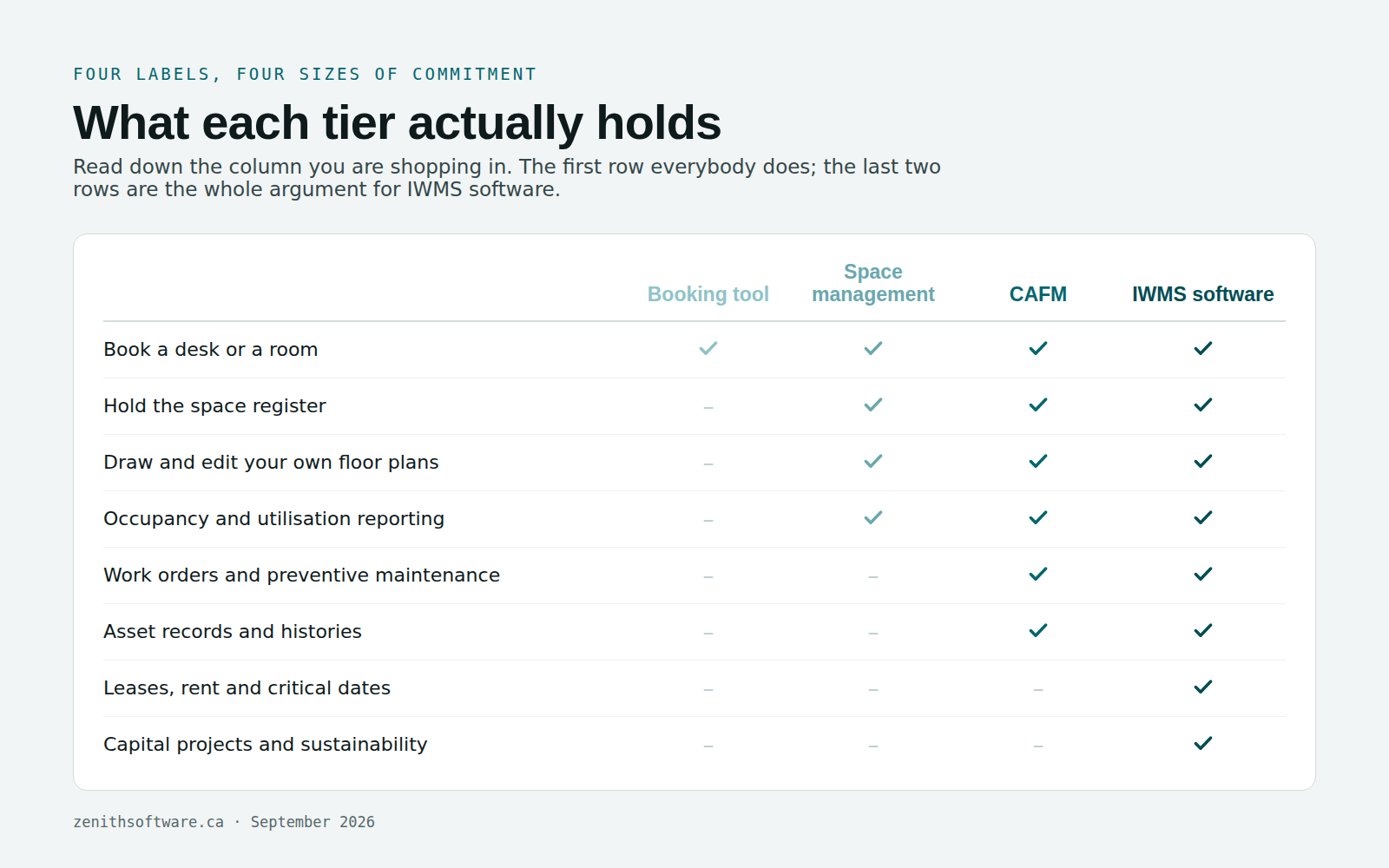
A booking tool lets staff reserve a desk or a room. It often lives inside Slack or Teams, or behind a simple plan. It rolls out in days and costs little per head. It also assumes somebody else keeps an accurate list of spaces, because it does not hold one itself.
Ask where the list of rooms lives. If the answer is a spreadsheet you import, you now own two versions of your own building. Only one of them gets updated after a fit-out. A register that drifts also makes every utilisation figure suspect, which is why how to calculate space utilisation starts with the register rather than the arithmetic.
Space management
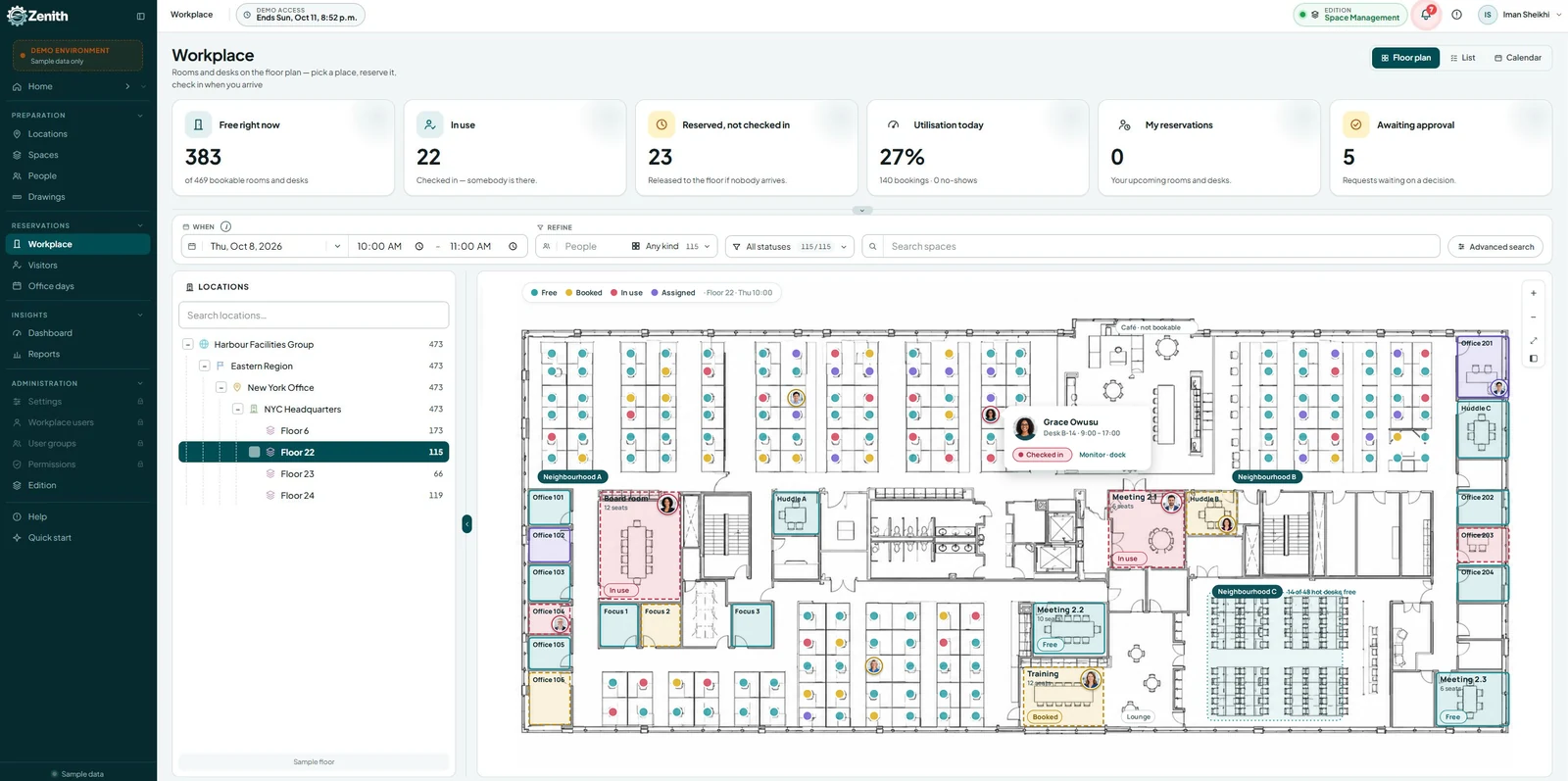
Space management puts the register underneath the booking. Every site, building, floor and space, with its type, capacity and amenities. Floor plans your own people can draw and redraw. Occupancy records that name who holds which desk, and since when. Utilisation counted off the bookings rather than typed in.
Most organisations need this tier. Most organisations skip it, buy a booking tool, and rediscover the need about nine months later.
CAFM
CAFM — computer-aided facility management — adds maintenance to the same records. A broken desk becomes a work order against the space you booked. Assets carry histories. Preventive schedules run on their own. The workplace side and the maintenance side stop disagreeing about how many rooms the building has.
IWMS software
IWMS software wraps all of the above and adds the property business. Leases, rent and critical dates. Capital projects with budgets and phases. Energy and sustainability reporting. It sits at the enterprise end of the market, and it is the most common over-purchase in this category.
What IWMS software actually contains
Gartner defined the category, and the definition is useful because it is strict. A true IWMS covers five functional areas:
- Real estate and lease management — the leases themselves, rent, options, break clauses and critical dates.
- Facilities and space management — the register, the drawings, occupancy and utilisation.
- Asset and maintenance management — work orders, preventive schedules, asset histories.
- Capital project management — fit-outs and moves run as projects, with budgets and phases.
- Environmental sustainability — energy, emissions and the reporting that goes with them.
That list is the honest test. A product without lease management and capital projects is not IWMS software, whatever the website says. It is CAFM with good marketing, and CAFM might be exactly what you want.
The one question that decides whether you need IWMS software
Here it is. Do you manage leases and capital projects, and do you want them in the same system as your floor plans?
If you hold a portfolio, track rent and break clauses, and run fit-outs as funded capital projects, IWMS software earns its keep. The integration is the product, and you have the work to integrate.
If you occupy two to five buildings, and the lease sits with finance in a spreadsheet nobody has asked you to replace, it does not. You would buy an integration between things you do not do. Our guide to workplace software in Canada compares the products sitting in each tier.
Everything else in the comparison is detail.
Five questions that place you in a category
All five take a yes or a no. Answer them honestly, then count.
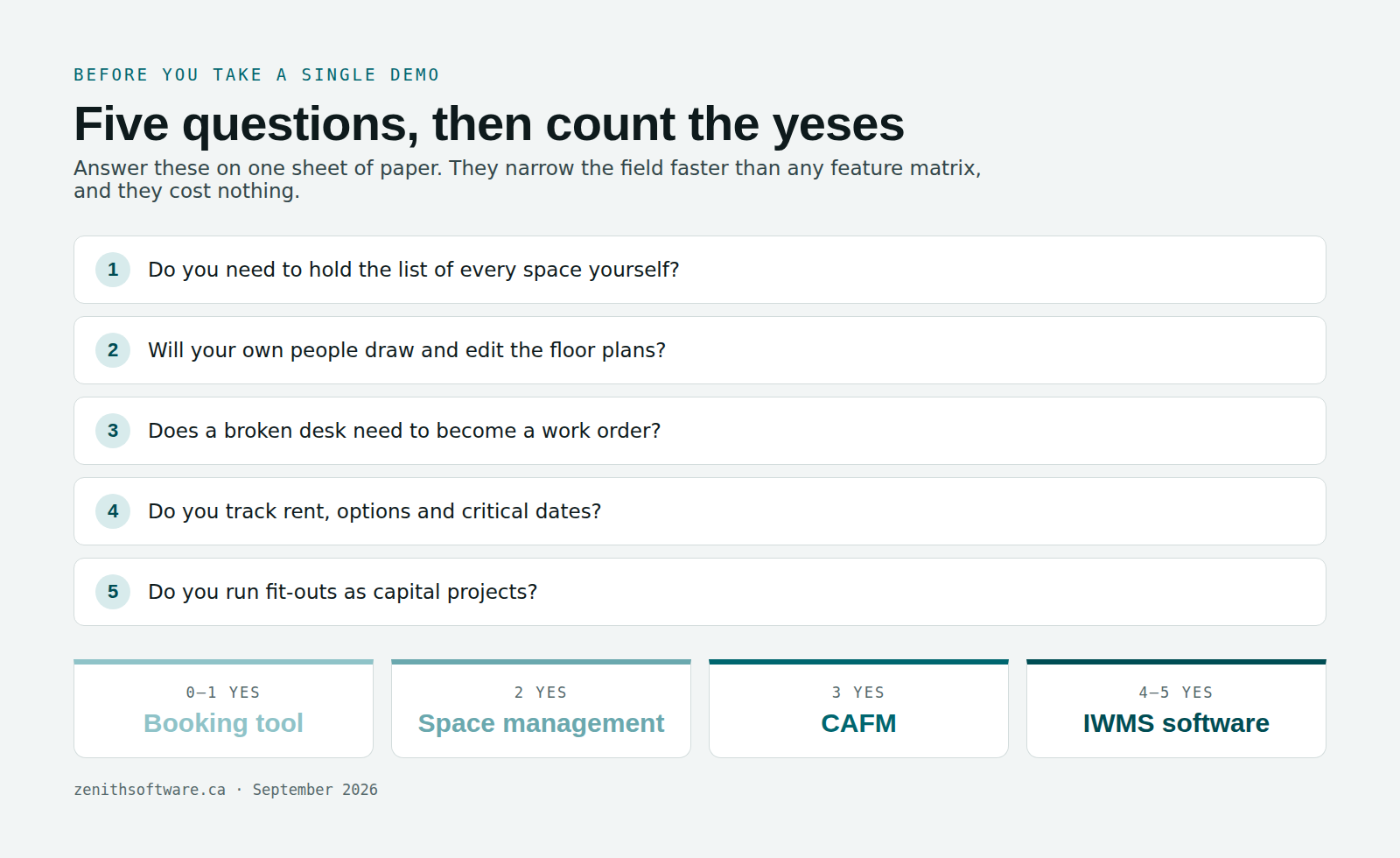
- Do you need to hold the list of every space yourself? A spreadsheet somebody imports is not a register.
- Will your own people draw and edit the floor plans? If only a vendor can, budget for every future fit-out.
- Does a broken desk need to become a work order? This is the maintenance line.
- Do you track rent, options and critical dates? This is the first real IWMS signal.
- Do you run fit-outs as capital projects with budgets and phases? This is the second.
None or one yes: a booking tool will do. Two: space management. Three: CAFM. Four or five: now look at IWMS software, and expect the procurement to take a year.
What buying one tier too high costs you
- Time. Enterprise implementations run in quarters, not weeks. The floor you were trying to account for changes twice before go-live.
- Modules you never switch on. You pay for sustainability reporting and lease administration while using the desk booking screen.
- A consultant between you and every change. Configuration that needs a statement of work is configuration that stops happening.
- Adoption. Staff judge the tool by how fast they can book a desk. Enterprise suites rarely win that comparison.
The failure is almost never the software. It is that nobody staffed the operating model the software assumed.
What buying one tier too low costs you
- Two sources of truth about one building. The register and the booking tool drift apart within a quarter, and nothing forces them back together.
- A number you cannot defend. Utilisation computed off an imported spreadsheet inherits every error in it. Somebody will ask what the divisor was.
- A maintenance disconnect. A room out of service for a repair still shows as bookable, because the two systems never met.
Where a CMMS with a workplace module fits
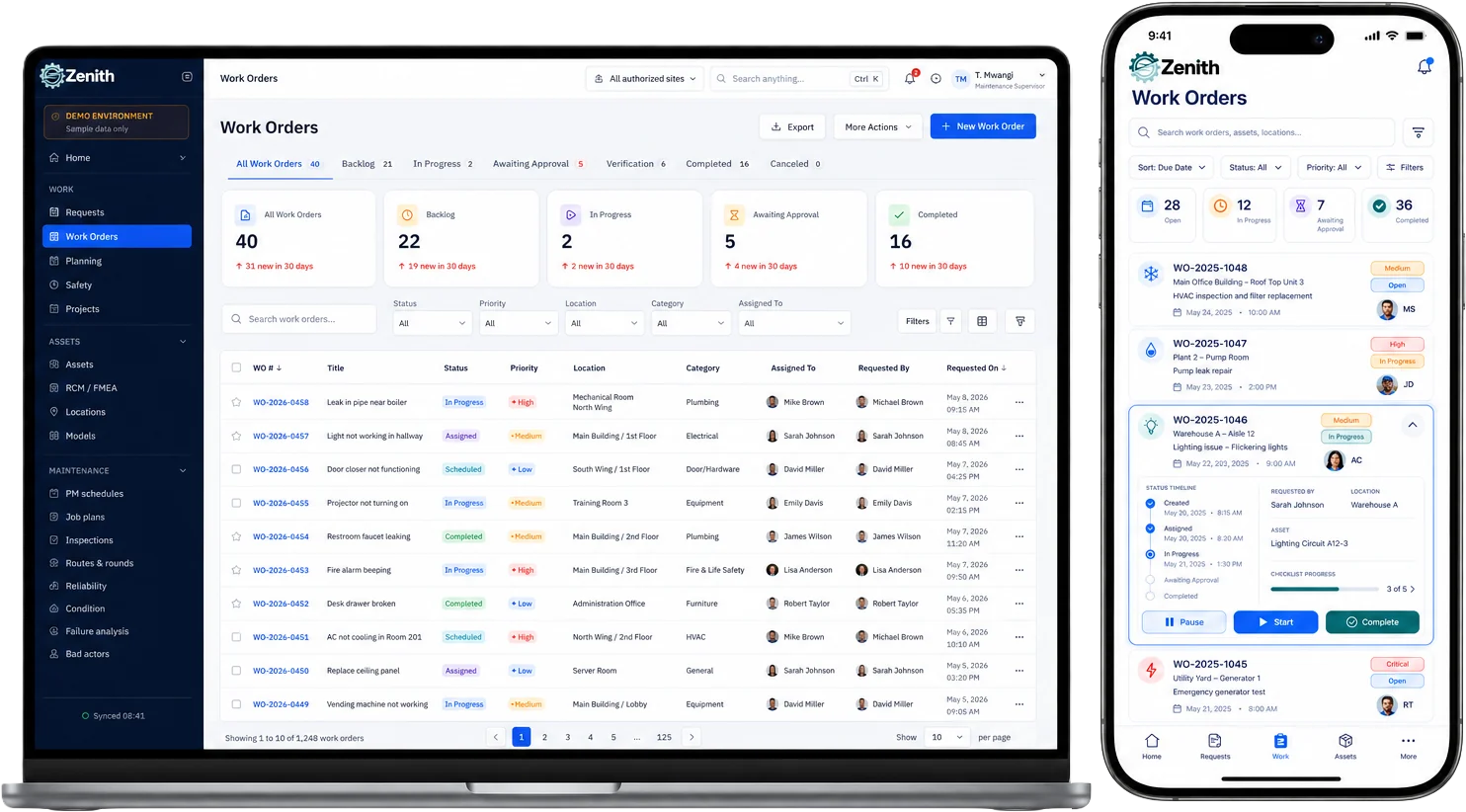
There is a fifth shape the four labels miss. A maintenance-first platform can add workplace booking on top of the records it already holds. Spaces, assets and work orders live in one place from the start, and desks and rooms become another thing those records support.
For an organisation with real maintenance work and a handful of buildings, this often beats both neighbours. It is more joined-up than a booking tool bolted to a spreadsheet, and far lighter than IWMS software bought for two of its five parts.
It is also worth separating tooling from discipline. Facility management has its own international standard, ISO 41001, and it says nothing about software. It describes the processes the software has to serve. If your processes are unclear, no tier fixes that, and the bigger the purchase the more expensive the lesson.
Canadian public bodies have a further reference point. Programmes like GCworkplace have pushed activity-based and unassigned workspace into the mainstream, which raises the bar on occupancy evidence without requiring anybody to buy an enterprise suite.
Questions people actually ask
What is IWMS software?
IWMS stands for integrated workplace management system. It is a single platform covering real estate and leases, space and occupancy, maintenance and assets, capital projects, and sustainability reporting. The integration between those five is the point. A product that covers two of them is something else with a bigger label.
What is the difference between IWMS software and CAFM?
CAFM covers the building operation: space, assets, maintenance and work orders. IWMS software adds the property business on top, meaning leases, capital projects and sustainability. In practice the line blurs, because CAFM products keep adding modules. Judge by the five areas above rather than by the acronym on the pricing page.
What is the difference between a CMMS and an IWMS?
A CMMS manages maintenance: work orders, preventive schedules, parts and asset histories. An IWMS includes that and four other domains. A CMMS with a workplace module gives you maintenance and space on shared records, without the lease and capital-project machinery you may not need.
Is IWMS software worth it for a small estate?
Usually not. The value comes from integrating functions that a small estate either does not perform or performs elsewhere. If finance already handles the leases and fit-outs happen once every few years, you would pay for integration you cannot use. Revisit the question when either fact changes.
Do I need IWMS software just to book desks?
No. Desk and room booking sits in the lowest tier that can also hold an accurate space register. If booking is genuinely the whole problem, and somebody reliable maintains the list of spaces, a booking tool is the correct answer and the cheapest one.
Can we start small and move up later?
Yes, and the register is what makes it possible. Whatever you buy, insist that your space data stays yours and exports cleanly — sites, buildings, floors, spaces, types, capacities and the drawings. A clean register moves between tiers. Two years of bookings inside a proprietary tool mostly does not.
How long does each tier take to implement?
Rough and honest: days for a booking tool, two to six weeks for space management on a small estate, one to three months for CAFM, and two to four quarters for IWMS software at enterprise scale. The variable is rarely the software. It is how many floors need drawing and how settled your policies are.
Where to start
Answer the five questions on one sheet of paper before you take a single demo. Then run every demo against the same floor — ideally the one nobody can account for — and make each vendor show you that floor rather than their own.
Most organisations that set out to compare IWMS software discover they were shopping one tier too high. That is a good outcome, and a much cheaper one to reach in week one than in month four.
If a Canadian-owned, Canadian-hosted option belongs on your list, ours is a workplace module on a maintenance platform: Zenith Workplace shares its records with work orders, assets and space management. We do not sell lease administration or capital projects, and we will tell you on the call if that is what you actually need.
Published by Zenith Software Corp., Victoria, British Columbia · September 2026. External references verified in September 2026.