

Most Canadian offices now have fewer desks than people. Desk booking software is how you run a floor like that without a daily scramble for seats. It also tells you, months later, whether you still need the floor at all. This guide explains what desk booking software does, why 2026 made it urgent in Canada, the Canadian rules that apply to booking data, and the questions to ask in a demo.
What desk booking software does
Desk booking software lets people reserve a desk before they come in, usually from a floor plan, a list or their phone. The same system shows who holds which desk today, releases desks nobody turned up for, and reports how the floor was really used.
It sits between two older ways of working. Assigned seating gives everyone a desk, which wastes space when people come in two or three days a week. Pure first-come hot desking saves space, but it fails on the busiest day. Good desk booking software lets you run both on the same floor: some desks assigned, the rest bookable.
Why desk booking software matters more in Canada in 2026
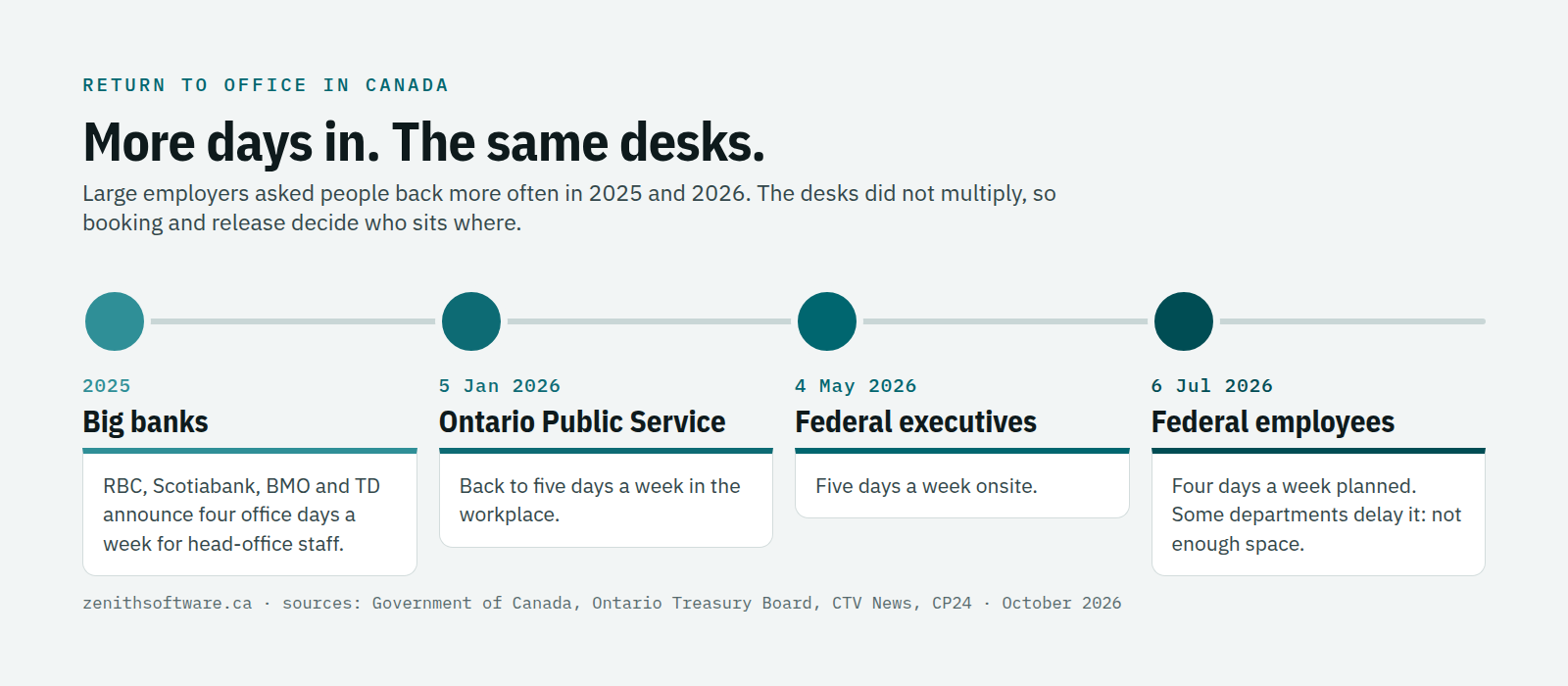
Large Canadian employers spent 2025 and 2026 asking people back to the office more often:
- The big banks. TD and BMO announced four office days a week in 2025, in line with RBC and Scotiabank.
- The Ontario Public Service returned to five days a week on January 5, 2026.
- The federal public service. Executives moved to five days onsite by May 4, 2026, and the stated plan for other hybrid-eligible employees was four days a week from July 6, 2026.
The federal rollout shows the problem clearly. At least two departments delayed the four-day rule because they did not have enough office space. Immigration, Refugees and Citizenship Canada kept most staff at three days until it finds more room. Global Affairs Canada cited a multi-year renovation.
More days in the office does not mean more desks. It means the same desks, shared by more people, on the same busy Tuesday to Thursday. Without a booking system, someone arrives to find nowhere to sit near their team. Meanwhile, Friday’s floor sits nearly empty and still costs full rent.
Features that matter in desk booking software
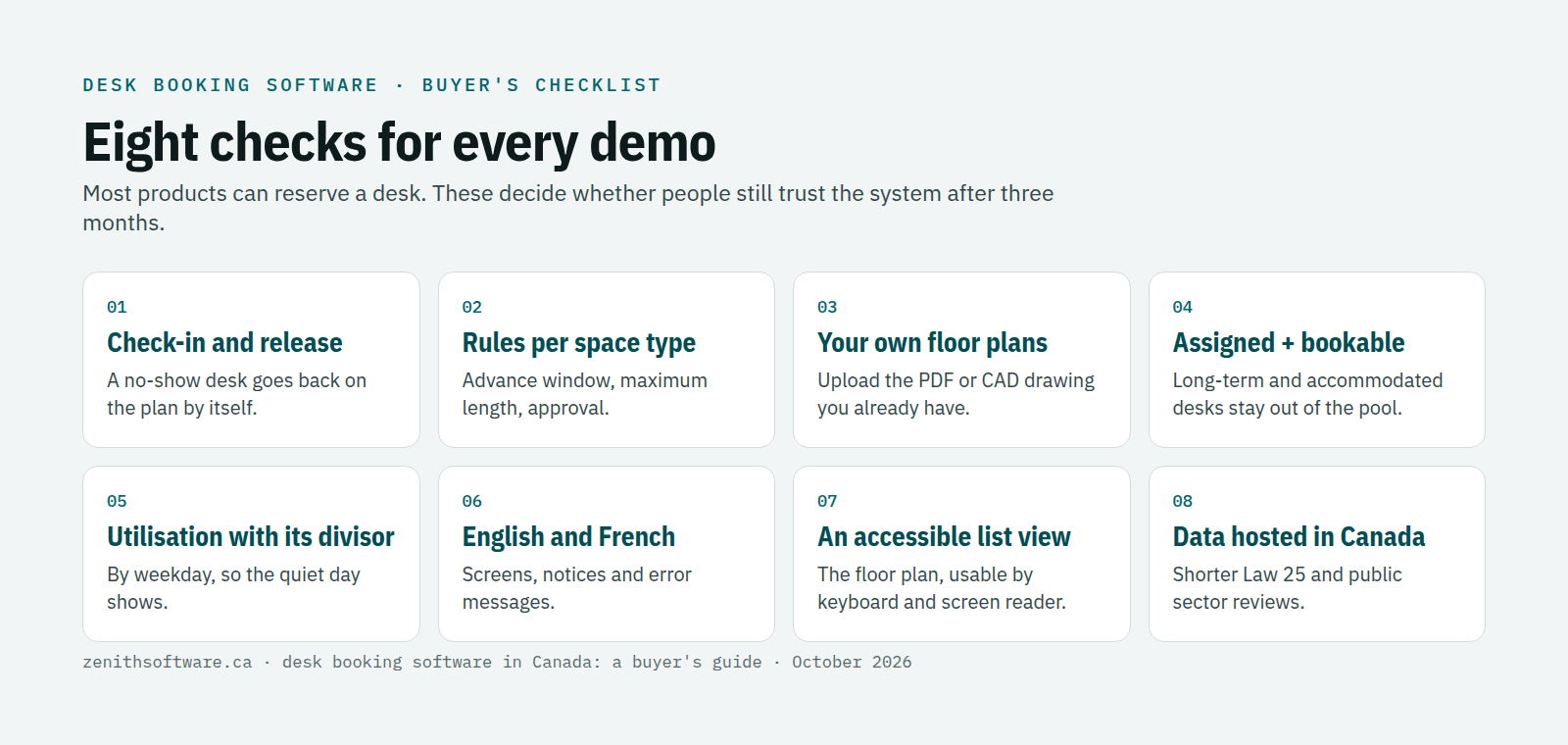
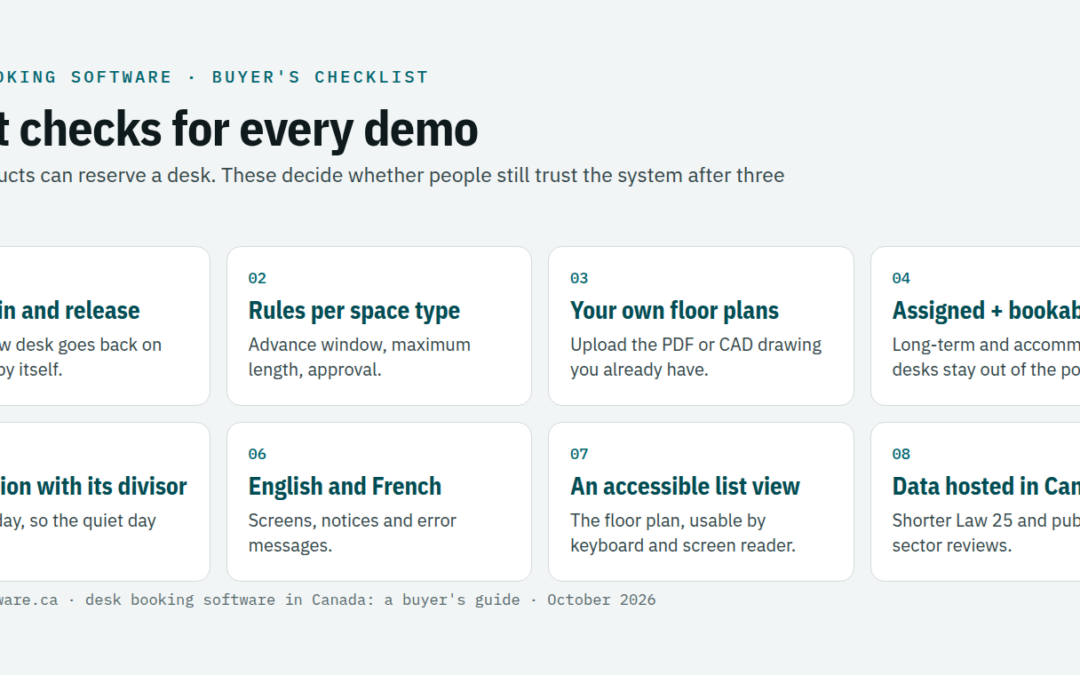
Most products can reserve a desk. These are the features that decide whether people still trust the system after three months:
- Check-in and automatic release. If nobody confirms within a grace period, the desk goes back on the plan. Without this, the screen says the floor is full while half of it sits empty. Our guide to meeting room no-shows shows how much space this hands back.
- Rules per space type. A desk, a focus booth and a board room need different limits: how far ahead people can book, how long one booking can run, and whether it needs approval.
- Your own floor plans. Upload the PDF or CAD drawing you already have and draw the desks onto it, rather than waiting for the vendor to redraw your building.
- Assigned and bookable desks on one plan. Accommodated desks and long-term assignments stay out of the pool, but still show on the plan.
- Booking for a colleague, and for a team that wants to sit together on the same day.
- Microsoft 365 or Google calendar and single sign-on, so people book where they already work.
- Utilisation you can defend, with the divisor printed next to the percentage. Our guide on how to calculate space utilisation explains why the divisor is the whole argument.
- Rooms and visitors in the same system, so a guest, a room and a desk can be part of one booking. See our visitor management software buyer’s guide.
Canadian rules that apply to desk booking software
A desk booking record says who was in the building, where they sat and when. That is personal information about employees, so Canadian privacy, language and accessibility rules apply to it.
Privacy and where the data lives
- Quebec. Since September 22, 2023, Law 25 requires a privacy impact assessment before personal information leaves Quebec, including to another province. The assessment must show the information will be adequately protected, and the parties need a written agreement.
- Nova Scotia public bodies must keep personal information in Canada, accessed and disclosed only in Canada, unless the head of the body approves an exception and reports it.
- Everywhere else, federal or provincial private-sector privacy law applies, depending on the employer. Collect only what you need, explain why, and set a retention period.
The practical test is simple: ask the vendor where booking data is stored, who can see it, and how long it is kept. A vendor hosted in Canada makes the Law 25 assessment and most public sector reviews much shorter.
English and French
In Quebec, workers can ask their employer for French work tools, including software. Federal and bilingual employers face similar expectations. Check that the booking screens, the notices and the error messages all work in French, not just the menus.
Accessibility
A floor plan is the hardest part of a booking system to make accessible. People who use a keyboard or a screen reader need a list view with the same information. Our article on accessible booking systems and the AODA lists eight checks to run.
Desk booking needs a policy, not just software
Desk booking software enforces whatever rules you give it. Decide them first: who gets an assigned desk, how far ahead people can book, how long a no-show holds a desk, and how accommodated desks stay out of the pool. Our hot desking policy template has thirteen clauses you can adapt.
Keep the first version short. A policy that fits on one page gets read. A policy that only lives in an onboarding binder gets ignored, and then the software looks arbitrary.
How to tell if desk booking is working
Look at three numbers after the first full quarter:
- Utilisation by weekday. An average of 47% can hide a Tuesday at 69% and a Friday at 19%. The quiet day is the evidence for right-sizing a floor.
- No-show rate. The share of bookings released because nobody checked in. If it stays high, shorten the grace period or the advance window.
- Turned away. How often someone wanted a desk and found none. If this rises on peak days, you have a scheduling problem, not a space problem.
Do you need occupancy sensors for this? Usually not at first. Booking and check-in data answers most questions. Our comparison of occupancy sensors and booking data covers when sensors earn their cost.
Questions to ask in a desk booking software demo
- Show me what happens at 10 a.m. when someone booked a desk and never arrived.
- Try to book a board room for six hours where the rule caps it at four. What does the person see?
- Load our floor plan. How long until people can book from it?
- Where is our booking data stored, and can you show us the retention setting?
- Switch the screen to French. Do the notices and error messages switch too?
- Use the booking screen with a keyboard only.
- How is the price counted: per desk, per employee, per site or per administrator?
Bring one real week of your own: the desks, the teams and the busiest day. A vendor that can run your week in the demo can probably run your floor. Our guide to the best workplace software in Canada helps you decide which kind of product you are shopping for.
Desk booking software in Zenith
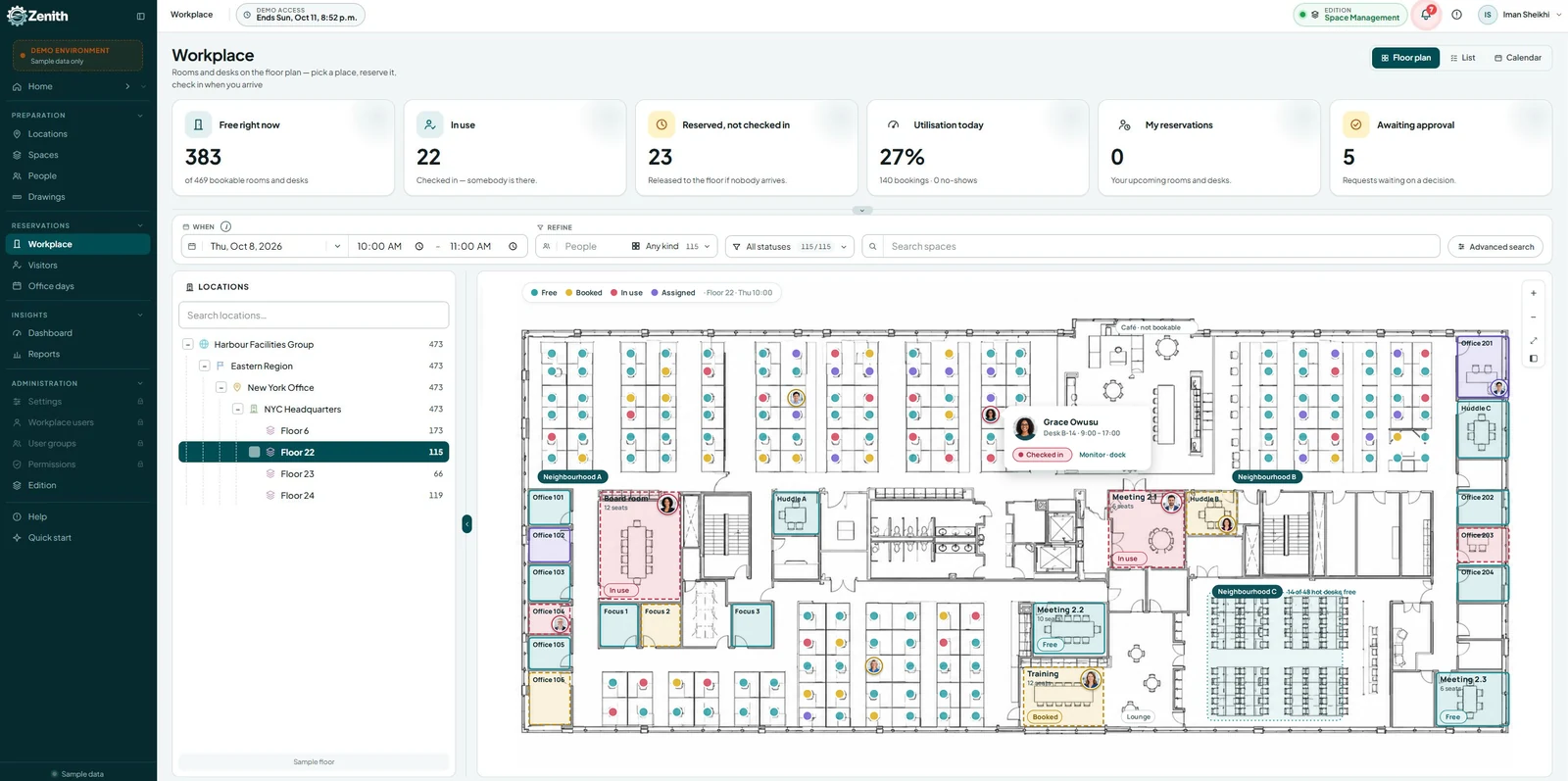
Zenith Workplace lets people book desks and rooms straight from your own floor plan. You upload the PDF or CAD drawing and draw the spaces onto it in the browser. Each desk shows one of five states: free, reserved, in use, assigned or not bookable.
If nobody checks in within the grace period, the desk is released and goes back on the plan by itself. Rules are set per space type and per site, including maximum duration, advance window, approval, buffers and capacity. Utilisation, peak and quiet days, and no-shows come from the bookings themselves. Visitor management is part of the same platform.
Zenith runs in English and French, meets WCAG 2.2 AA with a list view beside the floor plan, and is hosted in Canada on Microsoft Azure. It connects to Microsoft 365, Outlook and Teams, with single sign-on through SAML or Microsoft Entra ID. Pricing counts administrator seats, not desks, sites or employees. See the pricing page for editions in Canadian dollars.
Where it stops: Zenith does not plan which days a team comes in together, does not book parking or lockers, and does not bundle sensors or room panels. If those are central to your plan, say so on the first call.
Questions people ask
What is the difference between hot desking and desk booking?
Hot desking means nobody has a fixed desk. Desk booking is the system that lets people reserve one of those shared desks ahead of time. You can run hot desking without booking, but it tends to break on the busiest day.
Does Quebec’s Law 25 apply to desk booking software?
Booking records are personal information, so yes for Quebec employers. If the data is stored or processed outside Quebec, Law 25 requires a privacy impact assessment and a written agreement first.
How many desks do we need for a hybrid team?
Plan for your busiest regular day, not the average day, then check it against three months of booking data. Our guide to space management software in Canada covers the wider planning question.
Is this legal advice?
No. Privacy and language rules depend on your province, your sector and your contracts. Use this guide to ask better questions, and check the answers with your privacy officer or legal adviser.
Where to start
Pick one floor. Count the desks, the people who use it, and how many come in on the busiest day. Then run four weeks of desk booking with check-in turned on, and read the weekday numbers. Talk to us if you would like to see your own floor plan in Zenith.
Published by Zenith Software Corp., Victoria, British Columbia · October 2026. Practical guidance, not legal advice. We verified the external references in October 2026; office attendance rules change often, so check the current position before you rely on it.