

Every maintenance team has a preventive maintenance schedule somewhere: a wall calendar, a spreadsheet, a list in someone’s head. The trouble is rarely writing one. It is keeping it, month after month, when repairs keep jumping the queue and the person who knew the schedule is on holiday.
This guide shows how to build a preventive maintenance schedule you will actually keep. It covers which equipment to include, how often to service it, the Canadian inspections that belong on every list, and why schedules slip.
What a preventive maintenance schedule is
A preventive maintenance schedule is a list of recurring tasks, each tied to a piece of equipment, with an interval and a next due date. Change these filters every 90 days. Test this generator every month. Service this boiler every autumn, before the heating season.
It is not a list of everything you own, and it is not a promise to service every item as often as the manual suggests. A good schedule is selective: it protects the equipment that would hurt most if it failed, and it keeps you on the right side of the inspections you must pass.
How to build a preventive maintenance schedule in six steps
1. Start with the equipment that matters
List the equipment whose failure would stop work, put people at risk or cost the most to replace. Think heating plant, rooftop units, generators, fire and life-safety systems, elevators, production lines and vehicles. Rate each one high, medium or low. Begin your schedule with the high items only.
2. Gather the requirements
For each item, collect four sources: the manufacturer’s manual, any code or regulation that applies, your insurer’s conditions, and your own repair history. Where they disagree, follow the strictest one that applies to you.
3. Choose how each task is triggered
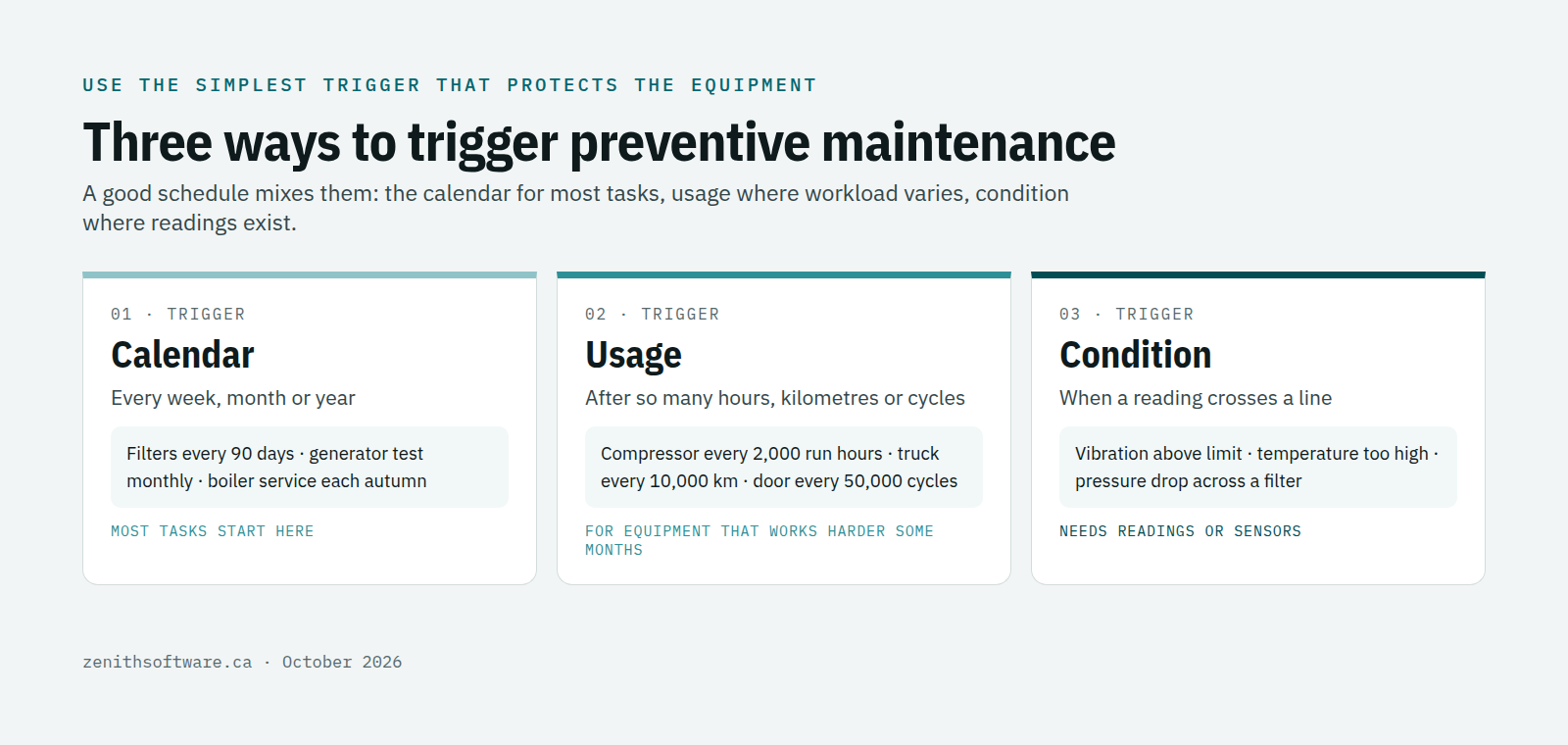
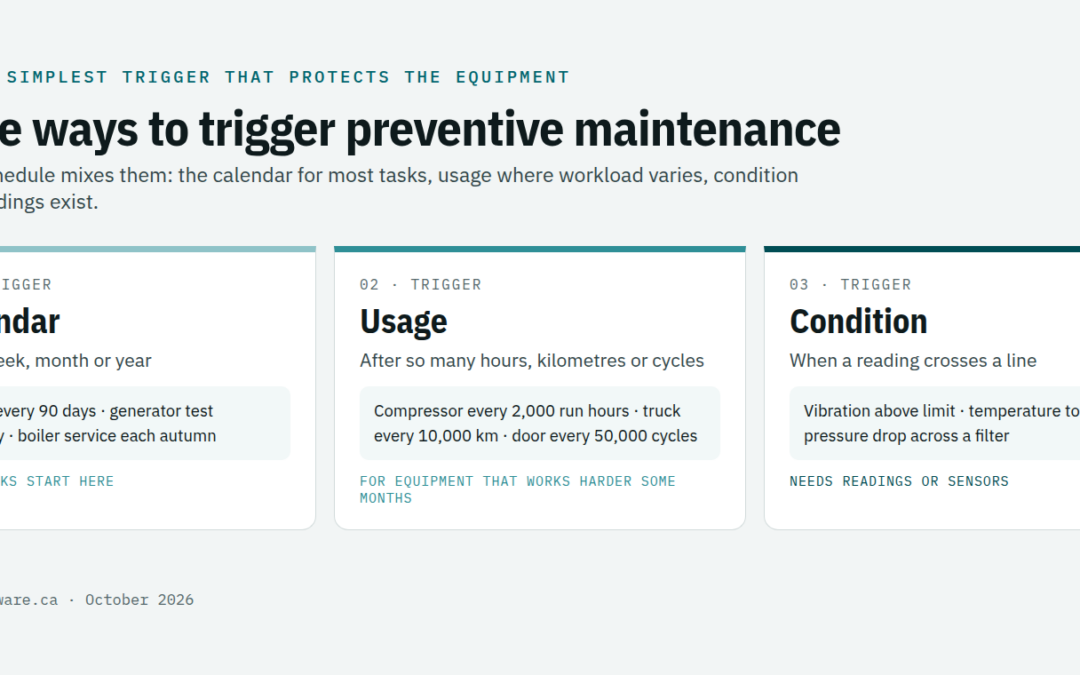
Most tasks run on the calendar: weekly, monthly, yearly. Equipment that works harder some months than others is better served by usage: run hours on a compressor, kilometres on a truck, cycles on a door. Other tasks respond to condition: a vibration reading, a temperature, a pressure drop. Use the simplest trigger that protects the equipment.
4. Write each task so anyone can do it
A task called “service AHU” means different things to different technicians. Write a short checklist instead: isolate, replace filters, check belt tension, inspect drain pan, record readings. Add the expected time and parts so a planner can schedule the job.
5. Spread the load across the year
The classic mistake is to start every annual task in January. Spread them across the year, and keep seasonal work in its season: heating checks in early autumn, cooling checks in spring. A schedule that piles forty tasks into one week will slip in that week.
6. Assign it and track completion
Every task needs an owner and a due date. Then track one number: the share of preventive maintenance done on time each month. Many teams aim for 90% or better. If the number falls, look for the cause before adding more tasks.
Canadian inspections to put on your preventive maintenance schedule
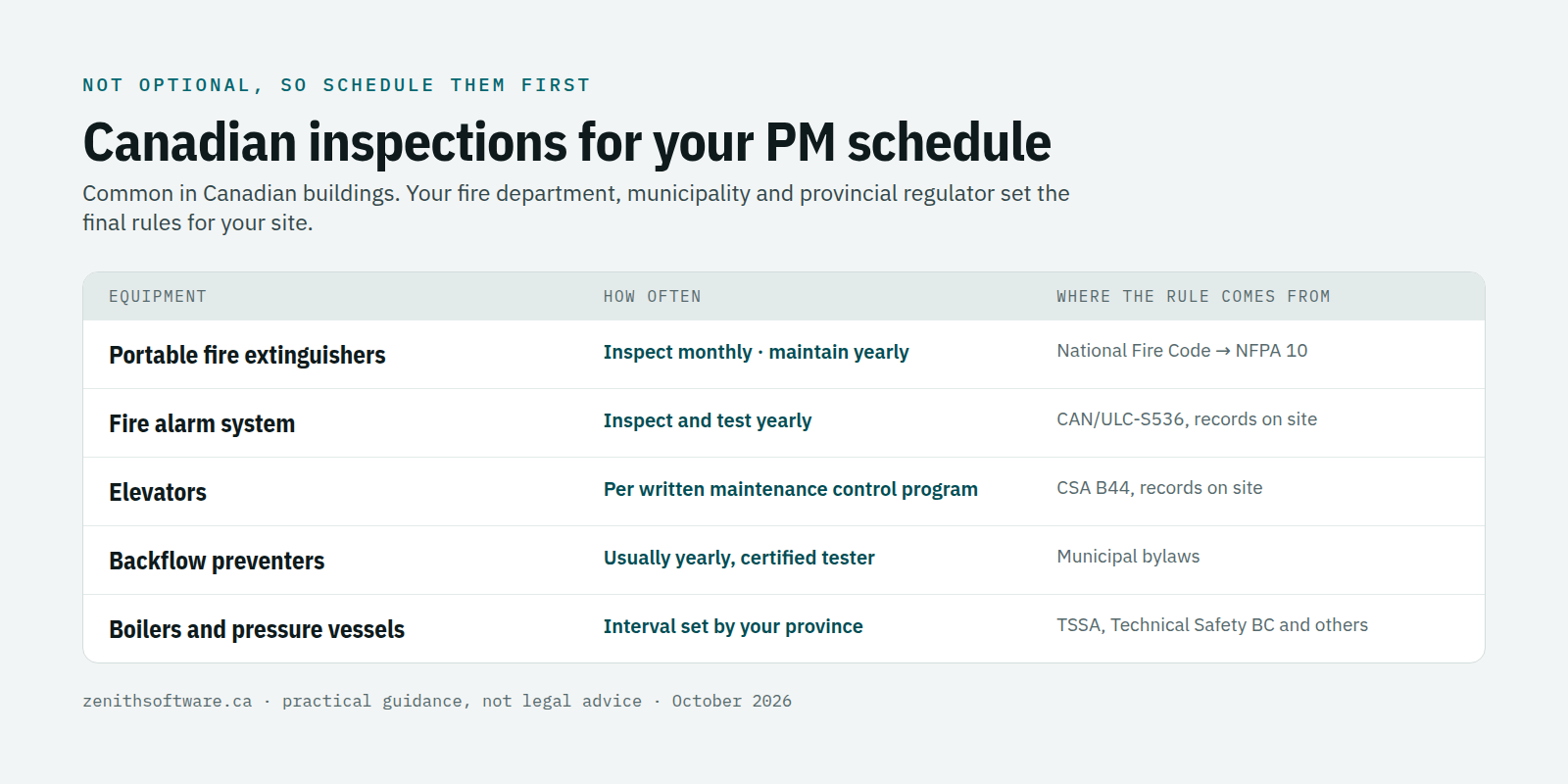
Some tasks are not optional. These are common in Canadian buildings; check the exact rules with your fire department, municipality and provincial safety regulator.
- Portable fire extinguishers. Under the National Fire Code, as Alberta explains it, extinguishers follow NFPA 10: inspected monthly and maintained at least once a year.
- Fire alarm systems. An annual inspection and test to CAN/ULC-S536 by a qualified technician, with records kept on site.
- Elevators. Each unit needs a written maintenance control program under CSA B44, with tasks, intervals and completion records available on site.
- Backflow preventers. Many municipalities require an annual test by a certified tester; Brantford, Ontario is a typical example.
- Boilers and pressure vessels. Your provincial safety authority sets the inspection intervals, such as TSSA in Ontario or Technical Safety BC.
Put each one on the schedule with its interval, the contractor who does it and where you file the certificate. Our guide to how long to keep maintenance records in Canada covers what to keep and for how long.
Why a preventive maintenance schedule slips
- Repairs always win. Without protected time, urgent work eats planned work. Set aside fixed hours each week for preventive tasks.
- The reminder lives in one inbox. When that person is away, nothing happens. Reminders should go to a shared queue, not a person.
- Tasks are too big. People postpone a four-hour task; they finish four one-hour tasks. Break large jobs down.
- Findings go nowhere. A technician spots a worn bearing during PM and writes it on the checklist. Make sure every finding becomes a follow-up work order.
- The schedule never changes. If a task never finds anything after two years, stretch the interval. If equipment keeps failing between visits, shorten it.
From a spreadsheet to preventive maintenance software
You can run a small schedule in a spreadsheet. Our free equipment maintenance tracker includes a PM tab that calculates the next due date and flags overdue tasks. Once several people share the schedule, or inspections start slipping, preventive maintenance software takes over the reminders and keeps the evidence.
In Zenith, preventive maintenance starts in the Essential edition, with daily, weekly, monthly, yearly and nth-weekday patterns, meter readings, and technician mobile pages. The Advanced edition adds job plans, inspection rounds and triggers that combine time and usage. Your spreadsheet imports directly, and every edition works in English and French with data hosted in Canada. Our guide on choosing an edition by industry helps you pick the level.
Questions people ask
How often should preventive maintenance be done?
As often as the manufacturer, the regulations and your own failure history justify, and no more. Start with the manual and the code, then adjust each interval once you have a year of results.
Can I keep a preventive maintenance schedule in Excel?
Yes, for a small team with a short list. It stops working when several people edit it or when nobody opens it to see what is due. That is the point to move to software.
What is the difference between preventive and predictive maintenance?
Preventive maintenance runs on a schedule, by time or usage. Predictive maintenance runs on evidence, such as vibration or temperature readings that show a failure coming. Most teams get the preventive schedule right first.
Where to start
List your ten most critical pieces of equipment and the inspections you must pass, then put both on one schedule this month. If you would like to see that schedule running in Zenith, talk to us or start a free trial from the pricing page.
Published by Zenith Software Corp., Victoria, British Columbia · October 2026. Practical guidance, not legal advice — confirm inspection requirements with your fire department, municipality and provincial safety regulator. We verified the external references in October 2026.