


Definition, Key Modules, Industry Trends, Top Solutions Compared & Why Zenith Deserves a Top-10 Spot
Facility management software (FMS) has become one of the most crucial categories in modern operational technology for organizations of all sizes and sectors. Facility management software helps organizations efficiently manage buildings, assets, work orders, preventive maintenance, space utilization, and compliance, all within a unified digital platform. These solutions reduce costs, improve uptime, optimize space, and give facility teams real-time operational insights at scale.
Why Facility Management Software Matters More in 2025
By 2025, facility management is no longer a reactive, back-office support function — it has become a central part of enterprise strategy. Traditional paper logs and isolated spreadsheets can’t keep pace with:
- Hybrid work models that demand dynamic space planning and reservation systems.
- Sustainability and ESG mandates, requiring systems to track energy use and emissions.(
- Smart buildings connected through IoT sensors and AI predictive insights.
- Greater demand for analytics and automation for preventive maintenance and compliance.
These forces make modern facility management platforms essential for optimizing operations and achieving organizational goals.
What Is Facility Management Software (FMS)?
Facility management software (sometimes called FM software, CAFM, CMMS, or IWMS depending on scope) centralizes and digitizes the core tasks facility teams must perform. These platforms typically include:
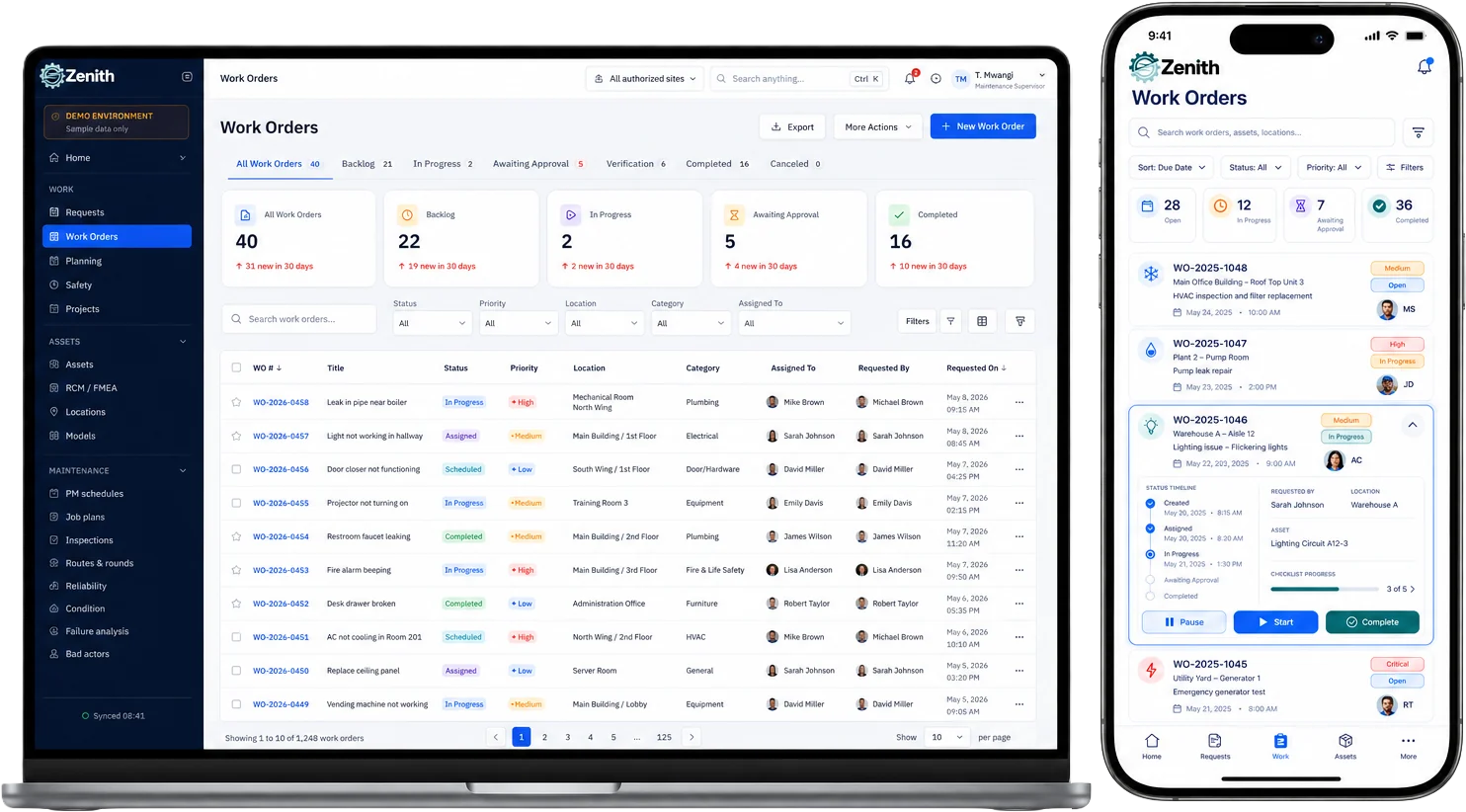
- Work Order Management & Scheduling
- Asset & Equipment Management
- Preventive & Predictive Maintenance
- Space Planning & Utilization
- Energy & Sustainability Tracking
- Compliance & Regulatory Reporting
- Analytics & Dashboards
- Mobile Access for Technicians
This breadth helps teams move from reactive maintenance to data-driven decision-making, reducing downtime and costs.
Key Modules Every FM Software Should Include (2025 Checklist)
To select the best FM platform in 2025, ensure the following modules are supported:
1. Work Order & Service Request Management
Automates task logging, assignment, status tracking, and closure. Essential for operational efficiency.
2. Asset Lifecycle & Inventory Management
Tracks assets from installation through retirement — critical for planning budgets and replacements.
3. Preventive & Predictive Maintenance
Schedules regular upkeep and, increasingly, uses AI to predict failures before they occur.
4. Space & Workplace Management
Manages desks, rooms, occupancies, and bookings to support hybrid work strategies.
5. IoT & Smart Building Integration
Leverages real-time data from connected devices for energy optimization and preventive actions.
6. Analytics & Reporting
Custom dashboards that tie operational performance to strategic outcomes.
7. Compliance & Safety Tracking
Ensures regulatory adherence and audit-ready documentation.
8. Mobile & Cloud Access
Technicians and managers must access data from smartphones and tablets. Cloud systems also improve scalability and data security in distributed teams.
Why 2025 Is a Turning Point in Facility Management
For decades, facility management software was designed with a narrow goal: keep buildings running. Systems focused on reactive maintenance, basic work orders, and asset lists. While functional, these tools treated facilities as static infrastructure rather than dynamic business assets.
2025 represents a fundamental shift. Facility management has moved from a cost center to a strategic function that directly impacts employee experience, sustainability goals, risk management, and financial performance.
This shift is driven by several converging forces.
1. Human-Centric Work Experiences Are Now a Core Requirement
In 2025, buildings are no longer just physical spaces — they are experience platforms.
The rise of hybrid work, flexible schedules, and shared spaces has changed how facilities are used. Offices are no longer occupied 5 days a week by the same people, and space demand fluctuates daily. As a result:
- Facility managers must understand how spaces are actually used, not just how they were designed.
- Employees expect seamless access to desks, rooms, equipment, and services.
- Poor facility experiences now directly impact employee retention, productivity, and satisfaction.
Modern FM software must support:
- Space utilization analytics
- Desk and room reservations
- Move management and churn tracking
- Real-time occupancy visibility
Instead of asking “Is the building operational?”, organizations now ask:
“Is this space supporting how people work today?”
👉 Why this matters for Zenith:
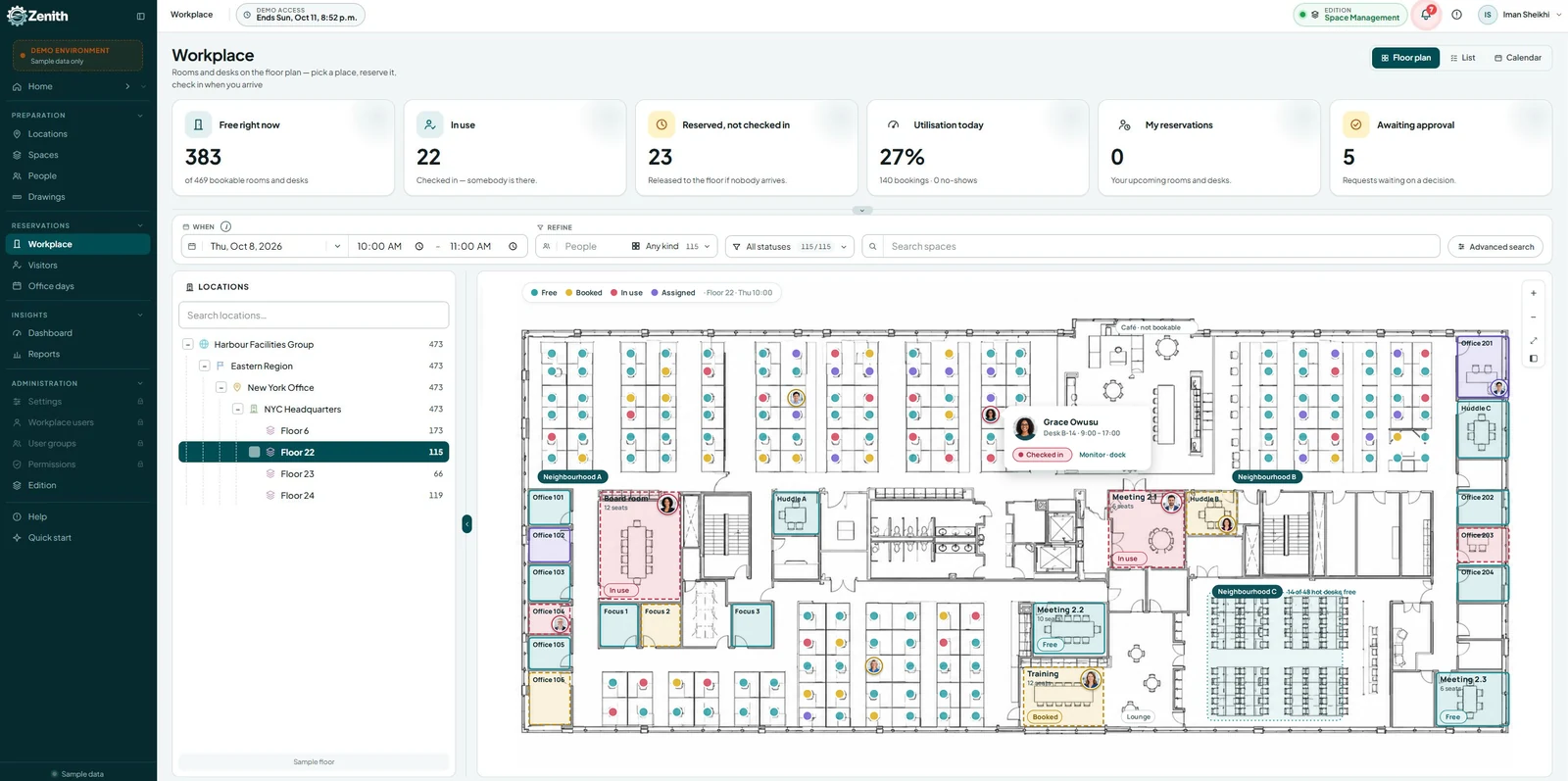
Zenith’s integrated space management, floor plan visualization, and reporting tools allow organizations to align facilities with real human behavior — not assumptions.
2. Sustainability and ESG Reporting Have Become Non-Negotiable
Sustainability is no longer optional or “nice to have.” By 2025, organizations face:
- Government regulations and reporting requirements
- Investor-driven ESG mandates
- Internal corporate sustainability targets
- Rising energy and utility costs
Facility teams are now responsible for a significant portion of:
- Energy consumption
- Carbon emissions
- Water usage
- Waste management
Traditional FM systems were never built to support environmental accountability. Modern platforms must now:
- Track energy usage at building, floor, or asset level
- Support sustainability KPIs and benchmarking
- Provide audit-ready documentation
- Feed ESG dashboards and executive reports
Facility management software must answer questions like:
- Which buildings are underperforming environmentally?
- How does space utilization impact energy waste?
- Where can we reduce operational emissions?
👉 Why this matters for Zenith:
Zenith’s reporting, asset data structure, and analytics foundation allow organizations to layer sustainability tracking into everyday operations — without requiring separate systems.
3. AI-Powered Decision Support Is Replacing Reactive Maintenance
Historically, facility management was reactive:
- Something breaks → ticket is created → technician responds
By 2025, this approach is too slow, too expensive, and too risky.
Advances in:
- AI
- Machine learning
- IoT sensors
- Historical asset data
have enabled predictive and condition-based maintenance.
Modern FM platforms now:
- Analyze work order history and asset performance
- Identify patterns that predict failures
- Recommend optimal maintenance schedules
- Reduce downtime and emergency repairs
This transforms facility teams from firefighters into strategic planners.
Instead of asking:
“What broke today?”
Facility leaders now ask:
“What is likely to fail next month — and how do we prevent it?”
👉 Why this matters for Zenith:
Zenith’s structured asset data, maintenance history, and reporting capabilities create the foundation for AI-driven insights — without locking customers into expensive, rigid enterprise systems.
4. Integration with Enterprise Systems Is Now Mandatory
Facilities no longer operate in isolation.
In 2025, facility data must integrate seamlessly with:
- ERP systems (financial planning, asset depreciation, budgeting)
- HR systems (headcount, hybrid schedules, space demand)
- IoT platforms (sensors, meters, smart devices)
- Business intelligence tools (dashboards, forecasting, executive reporting)
Siloed FM software creates:
- Duplicate data
- Manual work
- Inconsistent reporting
- Poor strategic decisions
Modern organizations require a connected ecosystem, where facility data flows across departments.
Facility management software must:
- Expose APIs
- Support structured data models
- Integrate with existing enterprise platforms
- Act as a reliable “source of truth” for facilities data
👉 Why this matters for Zenith:
Zenith is designed as a flexible, integration-friendly platform that fits into broader enterprise architectures — rather than forcing organizations to adapt to rigid, closed systems.
5. Facility Software Must Now Support Strategic Business Goals
The most important shift in 2025 is how facility success is measured.
In the past, success meant:
- Fewer complaints
- Faster work order completion
- Lower maintenance costs
In 2025, success also includes:
- Space efficiency and utilization optimization
- Support for hybrid work strategies
- ESG and sustainability performance
- Risk mitigation and compliance
- Data-driven capital planning
Facility management software must now support executive-level decision making, not just day-to-day operations.
Facilities are no longer just “maintained” — they are actively managed assets that influence:
- Financial performance
- Workforce strategy
- Corporate reputation
- Long-term resilience
👉 Why Zenith Fits the 2025 Reality:
Zenith bridges the gap between operational execution and strategic insight, giving organizations the tools they need to operate smarter today and plan better for tomorrow.
Summary: Why 2025 Changes Everything
2025 marks the moment when facility management software evolves from:
“Fixing buildings”
to
“Enabling people, sustainability, and strategy.”
Platforms that fail to support this shift will quickly become obsolete.
Modern FM software — including Zenith by Zenith Software — must now deliver:
✔ Human-centric experiences
✔ Sustainability and ESG readiness
✔ Predictive, data-driven insights
✔ Enterprise-level integration
✔ Strategic decision support
This is why 2025 is not just another year — it’s a turning point for facility management.
Top Facility Management Software Solutions in 2025 — Ranked & Reviewed
Below are the most influential FM platforms shaping the industry in 2025, with analysis of their strengths and weaknesses.
1. IBM Maximo
Ideal for: Large enterprises, industrial operations.
Overview: A comprehensive suite that blends asset lifecycle management with real-time IoT performance monitoring and predictive maintenance.
Strengths:
- Very powerful analytics and predictive maintenance
- Excellent for complex asset environments
Weaknesses:
- Can be expensive and complex to implement
- Steep learning curve compared to lighter tools
Why It Matters: Excellent choice at enterprise scale where deep integration and customization are priorities.
2. Planon
Ideal for: Global real estate and multi-site campus operations.
Overview: A longstanding leader in CAFM/IWMS solutions with a full suite of space and facilities tools.
Strengths:
- Mature, scalable platform
- Strong space, lease, and asset management
Weaknesses:
- More rigid interface compared to some modern UI/UX-centric tools
Why It Matters: Great for organizations managing complex portfolios and real estate strategies.
3. FMX
Ideal for: Mid-to-large facilities focusing on real-time operations.
Overview: Known for intuitive interfaces and strong data insights.
Strengths:
- Easy to adopt
- Real-time operational analytics
Weaknesses:
- May require add-ons for advanced predictive maintenance
Why It Matters: Excellent balance of power and usability.
4. AkuBox
Ideal for: Asset mapping and visualization.
Overview: Focused on rich asset data and visual floor plans.
Strengths:
- Excellent visual asset tools
- Useful for facilities with complex layouts
Weaknesses:
- Not as strong in predictive maintenance
Why It Matters: Valuable where spatial context and floor plans are key.
5. MaintainX
Ideal for: Mobile-first small/medium operations.
Strengths:
- Great mobile experience
- Easy task coordination
Weaknesses:
- Limited advanced analytics
Why It Matters: Best for teams that want mobile-centric task management.
6. UpKeep
Ideal for: Maintenance teams adopting mobile work orders.
Strengths:
- Strong mobile maintenance workflows
- Excellent for reactive and preventive maintenance
Weaknesses:
- Less robust space management
Why It Matters: Great for organizations focused on maintenance first.
7. MyFieldAudits
Ideal for: Inspections and quality assurance across sites.
Strengths:
- Strong inspection workflows
- Real-time compliance tracking
Weaknesses:
- Not a full FM suite
Why It Matters: Complementary to broader FM platforms.
8. eMaint
Ideal for: Maintenance-heavy environments.
Strengths:
- Strong work order and maintenance tracking
- Easy to document tasks
Weaknesses:
- Less full-featured in space planning and analytics
Why It Matters: Workhorse maintenance solution.
9. Exact Comms
Ideal for: Organisations needing real-time monitoring and compliance workflows.
Strengths:
- Real-time operational visibility
- Automation features
Weaknesses:
- Feature set may be narrower than enterprise IWMS
Why It Matters: Good all-around solution for mid-sized facilities.
10. Zenith
Overview: A unified CMMS + CAFM platform built to manage assets, maintenance schedules, work orders, space, and infrastructure efficiently across industries and multiple sites.
Key Modules:
- Work order management
- Asset tracking
- Preventive maintenance
- Space & move management
- CAD floor plan & space visualization
- Document repository & reporting
- Analytics & scheduled reports
Strengths:
🔹 All-in-one platform: Combines CMMS and CAFM features into a single system, avoiding multiple subscriptions.
🔹 Industry flexibility: Serves diverse sectors from healthcare to manufacturing.
🔹 Mobile & cloud: Enables real-time access for technicians on the go.
🔹 Scalability: Suitable for mid-size organizations up to large portfolios.
🔹 Competitive cost: Positioned as a cost-effective solution compared to legacy enterprise systems.
Weaknesses:
⚠️ Brand awareness: Not as globally established as IBM Maximo or Planon yet.
⚠️ AI/ML features: May offer fewer advanced predictive analytics than some enterprise competitors.
Why Zenith Belongs in the Top-10:
Zenith delivers a modern, integrated facility management experience with powerful CMMS and CAFM capabilities — a rare combination at its price point. Its focus on usability, space, maintenance, and analytics makes it an excellent fit for a wide range of industries in 2025.
Emerging Trends Shaping FM Software in 2025
Facility management technology continues to evolve rapidly, with several themes dominating the landscape:
AI & Machine Learning
Platforms increasingly adopt AI to forecast maintenance needs and optimize schedules.
IoT & Smart Buildings
Connected sensors provide real-time insights into energy, occupancy, and environmental performance.
Cloud & Mobile First
Remote access and cross-device functionality have become essential.
Sustainability & ESG
Tools now include energy tracking and emissions reporting features.
Human-Centered Design
Software is now evaluated not just for efficiency but for user experience and workplace impact.
How to Choose the Right Facility Management Software in 2025
When selecting FM software, ask these questions:
✔ Does it support both maintenance and space management?
✔ Are analytics and reporting built in?
✔ Does it integrate with your ERP, HR, or IoT systems?
✔ Is it mobile and cloud-ready?
✔ Does the pricing scale with usage, not just square footage?
Strong vendors deliver ROI through uptime, reduced costs, better space utilization, and compliance peace of mind.
Conclusion
Facility management software in 2025 is no longer optional — it’s a strategic enabler that drives operational excellence, sustainability goals, and workplace experience. From enterprise-grade systems like IBM Maximo and Planon to versatile and user-friendly platforms like Zenith, organizations have more choice than ever to match software to their specific needs.
Among these, Zenith stands out as a top-10 contender, thanks to its unified CMMS and CAFM design, flexible modules, and cost-competitive value. Whether you’re a mid-sized property portfolio or a growing enterprise looking to future-proof your facilities, choosing the right FM software can transform operations and outcomes in 2025 and beyond.