

Introduction
In Canada’s dynamic manufacturing landscape, unplanned equipment failures translate directly into lost production and ballooning repair costs. As factories embrace automation and IoT, maintenance teams are inundated with work orders, sensor alerts, and compliance tasks that outgrow spreadsheets and whiteboards. A modern CMMS turns this overload into an organized, digital workflow—automating preventive schedules, centralizing asset histories, and dispatching work orders the moment a fault is detected.
Addressing Bilingual and Regulatory Requirements
Canadian manufacturers face added complexity from bilingual operations and strict data-residency rules under PIPEDA. From Québec’s aerospace hubs to Alberta’s remote oilfields, teams need maintenance instructions and safety checklists in both English and French, while knowing that sensitive maintenance records stay on Canadian soil. Harsh winters, coastal humidity, and intermittent network coverage further heighten the risk of equipment downtime, making real-time visibility and offline mobile access critical.
Empowering Data-Driven Decisions
By delivering live dashboards on MTBF, MTTR, maintenance spend, and inventory levels, a CMMS empowers decision-makers to shift from reactive firefighting to predictive upkeep. Technicians benefit from QR-tagged assets and mobile work-order updates, while managers gain the data-driven insights needed to extend asset lifecycles and optimize budgets across multiple sites.
Introducing Zenith
Zenith elevates standard CMMS capabilities with integrated CAFM features, bilingual templates, and Canadian-hosted or on-premise deployments. Its drawing-based web platform and mobile-responsive design ensure that whether you’re in a downtown plant or a remote facility, your maintenance team has the right information, in the right language, at exactly the right time.
Why Canadian Manufacturers Need a CMMS
Canadian manufacturers operate under a unique set of pressures that make manual or spreadsheet-based maintenance processes untenable. As production lines become more automated and equipment more sophisticated, maintenance teams must handle increasing volumes of work orders, complex compliance requirements, and real-time data from sensors—all while controlling costs and minimizing downtime. A modern CMMS addresses these challenges head-on by digitalizing workflows, centralizing records, and automating routine tasks.
1. Combat Rising Downtime and Maintenance Costs
Canadian plants often run lean crews and tight budgets. Unplanned equipment failures can halt entire lines and trigger premium emergency repairs.
- Automate preventive schedules based on meter readings and usage thresholds.
- Generate work orders instantly when a sensor detects anomalies.
- Track labor hours and parts usage to identify cost-saving opportunities.
2. Meet Bilingual and Privacy Requirements
With workforces split between English and French, and stringent PIPEDA regulations on data residency, manufacturers must ensure clarity and compliance at every step.
- Create bilingual checklists, reports, and safety procedures to reduce miscommunication.
- Host CMMS data on Canadian servers to simplify audits and safeguard employee information.
3. Thrive in Harsh Climates and Remote Locations
From Alberta’s oilfields to the Maritimes’ coastal facilities, environmental extremes and network gaps complicate maintenance.
- Deploy mobile-responsive CMMS apps that work offline and sync when connectivity returns.
- Schedule cold-weather inspections and lubrication tasks before freeze–thaw cycles.
4. Leverage Data for Continuous Improvement
Without centralized analytics, it’s impossible to spot recurring failure patterns or optimize maintenance strategies.
- Monitor KPIs like MTBF and MTTR on customizable dashboards.
- Use trend analysis to shift from reactive to predictive maintenance and extend asset lifecycles.
Key CMMS Features for Canadian Plants
Standardized Bilingual Operations
Canadian manufacturing teams often include English- and French-speaking technicians. A CMMS with built-in bilingual support ensures every work order, checklist, and report is accurate and accessible to all users.
- Dual-language templates: configure forms and instructions in English and French side by side.
- Role-based language settings: technicians see only their preferred language on mobile and desktop interfaces.
- Consistent training materials: streamline onboarding with unified, translated SOPs and safety procedures.
Local Data Residency and Compliance
Adhering to PIPEDA and provincial privacy laws means your maintenance data must stay within Canada’s borders. A CMMS that guarantees Canadian-hosted storage simplifies audits and keeps sensitive information under local jurisdiction.
- Canadian data centers: store asset histories, work-order logs, and vendor contracts on servers located in Canada.
- Audit-ready access controls: track who viewed or edited records, with time-stamped logs for compliance reviews.
- Encryption and backup policies: inline encryption at rest and during transfer, with automated nightly backups to Canadian vaults.
Predictive Insights for Harsh Climates
From freezing winters in Manitoba to the humidity of Nova Scotia, environmental extremes accelerate wear on assets. Integrating IoT sensor data into your CMMS lets you anticipate failures before they occur.
- Sensor-driven triggers: set alerts based on temperature spikes, vibration thresholds, or lubrication levels.
- Seasonal maintenance plans: automatically generate cold-weather inspection work orders as temperatures drop.
- Trend analytics: visualize historical climate impacts on critical assets to refine inspection intervals.
Automated Spare-Parts Management
Unplanned downtime often stems from part shortages. A CMMS that links parts inventory to maintenance workflows prevents bottlenecks and carries optimal stock levels.
- Dynamic reorder points: adjust thresholds based on usage rates and lead-time variability.
- Vendor integration: send automated purchase orders when inventory dips below predefined levels.
- Parts reservation: assign spares to specific work orders to eliminate last-minute searches on the plant floor.
Real-Time Dashboards & Reporting
Without visibility, maintenance decision-making defaults to guesswork. Live dashboards provide actionable KPIs and support data-driven strategies across multiple sites.
- Custom KPIs: track MTTR, MTBF, maintenance cost per unit, and overdue work orders in real time.
- Cross-site comparisons: benchmark performance across facilities to identify best practices and areas for improvement.
- Drill-down reporting: click through summary charts to see the underlying work orders, parts usage, and labor logs.
Each of these features addresses the specific operational and regulatory demands of Canadian manufacturing, ensuring that your plant runs smoothly, compliantly, and cost-effectively.
How Zenith Elevates CMMS for Canadian Manufacturing
Zenith combines CMMS and CAFM (Computer-Aided Facility Management) into one flexible, drawing-based web platform. Key modules include:
| Module | Description |
|---|---|
| Asset Management & Tracking | Tag, categorize, and monitor equipment lifecycle across multiple sites. |
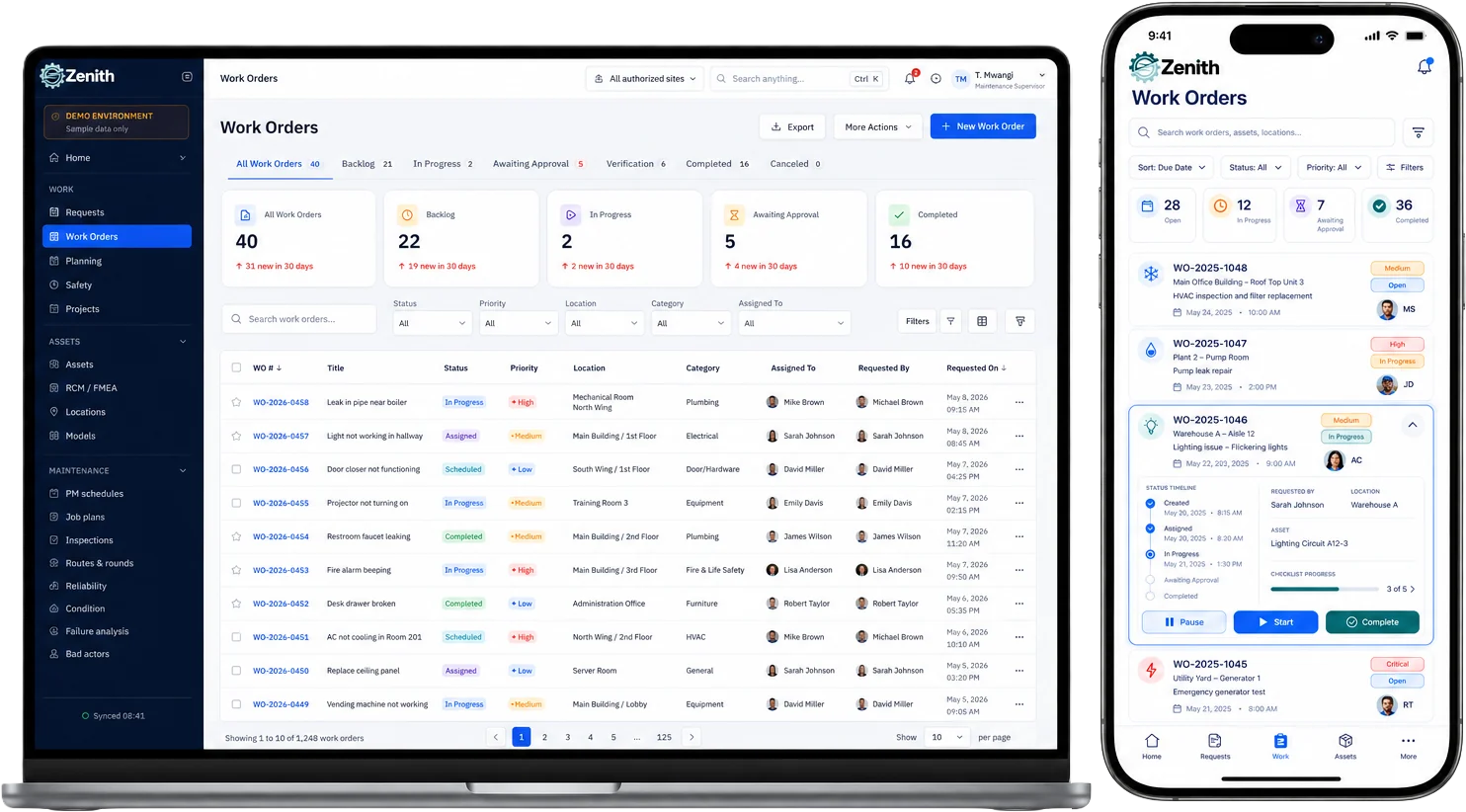
| Work Order Management | Create, dispatch, and close orders with mobile field access. |
| Preventive & Predictive Maintenance | Automate schedules using meter readings, IoT metrics, and rule-based triggers. |
| Inventory & Vendor Management | Centralize parts data, set reorder points, and link vendors to procurement. |
| Reporting & Analytics | Custom dashboards, KPI tracking, and audit-ready logs. |
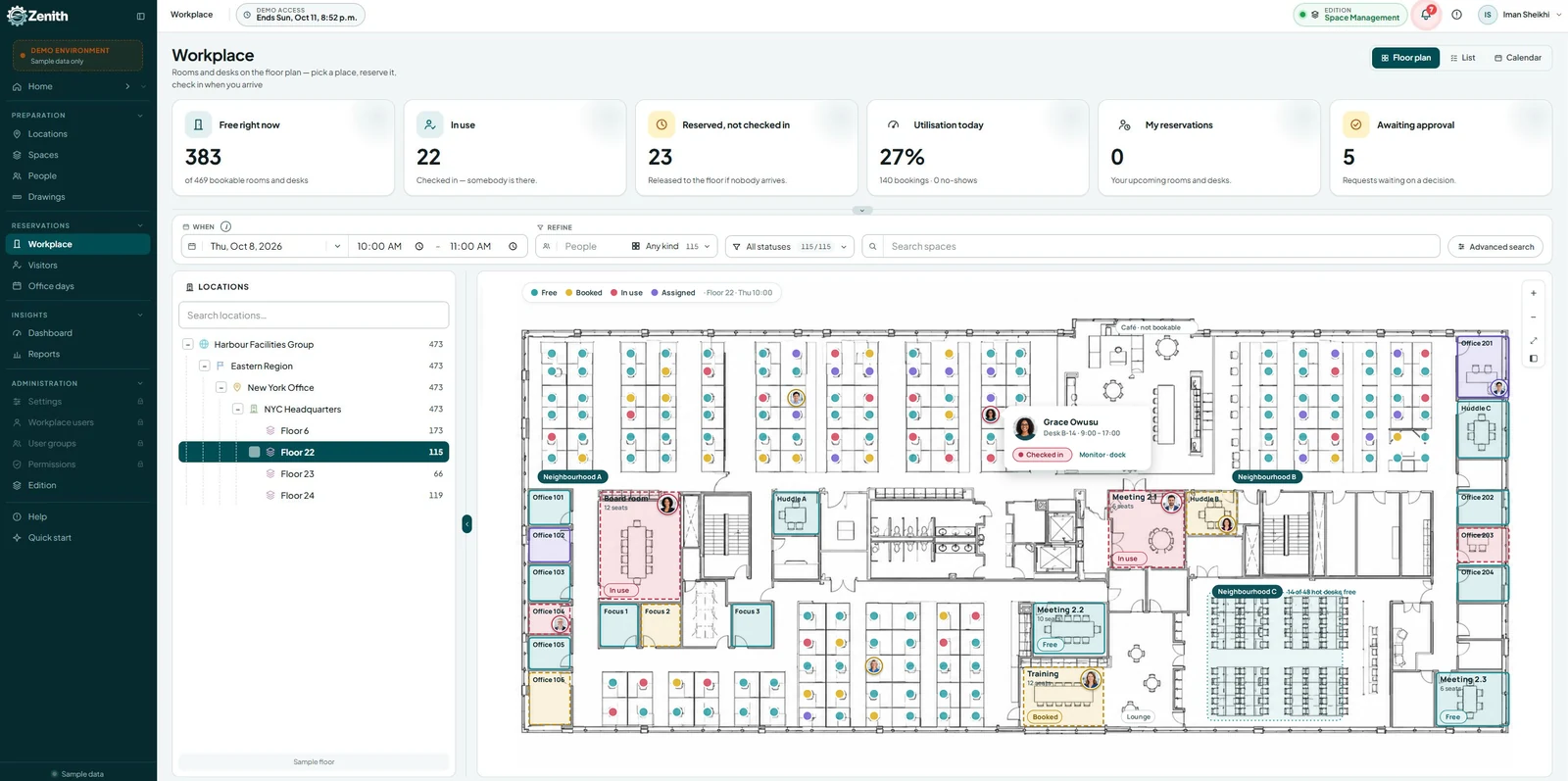
| Space & Lease Management | Optimize floor plans, occupancy, and move-management workflows. |
| Energy & Compliance Management | Track utility usage, carbon targets, and regulatory requirements. |
Zenith’s multi-site, multi-language architecture supports both cloud-hosted and on-premise deployments. Mobile-responsive design and QR-code tagging empower technicians to update asset status and close work orders on the go.
Asset Management & Tracking
This module provides a centralized, visual record of every asset in your manufacturing operation—from production machinery to HVAC systems. With Zenith, each asset can be tagged, categorized, and linked to its full maintenance history, warranty details, and technical documentation. This makes it easy to locate equipment information instantly, track lifecycle costs, and plan replacements before failures occur. For multi-site Canadian manufacturers, it ensures consistent asset data across all locations.
Work Order Management
Work Order Management streamlines the entire maintenance request process. Supervisors can create and assign work orders in seconds, attach photos or schematics, and set priority levels. Technicians receive these orders on mobile devices, update progress in real time, and close them out on-site. This eliminates paper trails, reduces delays, and ensures that urgent repairs—especially in high-output manufacturing environments—are addressed without bottlenecks.
Preventive & Predictive Maintenance
This module automates maintenance schedules based on time intervals, meter readings, or IoT sensor data. Preventive maintenance ensures that routine inspections and servicing happen before breakdowns occur, while predictive maintenance uses real-time analytics to forecast potential failures. For Canadian plants, this means fewer costly shutdowns, better resource allocation, and the ability to adapt schedules for seasonal climate impacts.
Inventory & Vendor Management
Inventory & Vendor Management keeps your spare parts and supplier relationships organized. The system tracks stock levels, sets automated reorder points, and links parts directly to work orders. Vendor details, pricing, and lead times are stored in one place, making procurement faster and more accurate. This prevents downtime caused by missing parts and helps reduce carrying costs by maintaining optimal inventory levels.
Reporting & Analytics
With Reporting & Analytics, managers gain a clear view of maintenance performance through customizable dashboards and KPI tracking. Metrics like Mean Time to Repair (MTTR), Mean Time Between Failures (MTBF), and maintenance spend are available at a glance. These insights help identify trends, justify budget requests, and support continuous improvement initiatives—critical for staying competitive in the Canadian manufacturing sector.
Space & Lease Management
This module extends beyond equipment to manage your facility’s physical space. It allows you to visualize floor plans, track occupancy, and plan moves or reconfigurations. For manufacturers with leased facilities, it also manages lease agreements, renewal dates, and associated costs. This ensures optimal use of space, compliance with lease terms, and better long-term planning for expansion or consolidation.
Energy & Compliance Management
Energy & Compliance Management helps manufacturers monitor utility consumption, track carbon reduction targets, and maintain compliance with environmental and safety regulations. It centralizes inspection records, certifications, and audit documentation, making it easier to pass regulatory checks. For Canadian manufacturers, this is especially valuable for meeting provincial energy efficiency programs and federal environmental standards.
Implementing Zenith in Your Plant
Here’s a deeper, section-by-section explanation of the “Implementing Zenith in Your Plant” process so it’s ready for your blog in a clear, reader-friendly way.
1. Audit Your Current Maintenance Processes
Before introducing any new system, it’s essential to understand where you stand today. This means mapping out your existing workflows, identifying bottlenecks, and quantifying the cost of downtime. Look at how work orders are currently created, tracked, and closed. Review compliance records to spot gaps that could lead to failed audits. This baseline assessment ensures you choose Zenith features that directly address your plant’s most pressing needs.
2. Define Bilingual Requirements
In Canadian manufacturing, bilingual communication isn’t just a courtesy—it’s often a necessity. Zenith allows you to configure English and French templates for work orders, safety checklists, and training materials. This ensures that every technician, regardless of language preference, receives clear, consistent instructions. It also reduces the risk of errors caused by misinterpretation and supports compliance with workplace language policies.
3. Run a 60-Day Pilot Test
Rather than rolling out the system plant-wide immediately, start with a focused pilot. Select a critical production line or a set of high-value assets. During the 60-day period, monitor how Zenith handles work orders, preventive maintenance schedules, and reporting. Gather feedback from technicians and supervisors, and track key metrics like Mean Time to Repair (MTTR) and Mean Time Between Failures (MTBF). This trial run helps refine your setup before full deployment.
4. Integrate with ERP and IoT
Zenith’s value multiplies when it’s connected to your other business systems. Linking it to your ERP ensures maintenance costs, purchasing, and inventory data flow seamlessly into your financial records. Integrating IoT sensors allows for real-time monitoring of equipment health—triggering predictive maintenance alerts before breakdowns occur. This creates a unified, data-driven maintenance ecosystem.
5. Train and Roll Out
A successful implementation depends on user adoption. Provide hands-on training sessions in both English and French, supported by clear documentation and quick-reference guides. Identify “internal champions” within your maintenance team—people who can answer questions, encourage best practices, and help colleagues adapt. Continue to monitor performance post-rollout, making adjustments as needed to keep processes optimized.
Conclusion
By deploying a CMMS tailored to Canada’s regulatory and operational nuances—and choosing a platform like Zenith—you position your manufacturing operation to run smarter, safer, and more efficiently. With bilingual capabilities, Canadian-hosted data, and powerful preventive and predictive maintenance tools, Zenith helps you reduce unplanned downtime, streamline audits, and empower your maintenance teams to perform at their peak.
In an industry where every minute of uptime counts, the right CMMS isn’t just a software upgrade—it’s a competitive advantage.
Ready to modernize your maintenance program?
Contact us today for a free demo of Zenith and see how a Canadian-hosted CMMS can transform your plant’s reliability, compliance, and long-term performance.
Frequently Asked Questions (FAQ)
1. What is a CMMS and how does it benefit Canadian manufacturers?
A CMMS (Computerized Maintenance Management System) is software that centralizes maintenance data, automates work orders, and tracks asset performance. For Canadian manufacturers, it helps reduce downtime, improve compliance, and manage bilingual operations efficiently.
2. How is Zenith different from other CMMS solutions?
Zenith combines CMMS and CAFM (Computer-Aided Facility Management) in one platform, offering bilingual templates, Canadian-hosted data storage, and a drawing-based interface for visual asset management—features tailored to Canada’s operational and regulatory needs.
3. Does Zenith support both English and French?
Yes. Zenith allows you to create and manage work orders, safety checklists, and reports in both English and French, ensuring clear communication across bilingual teams.
4. Is Zenith compliant with Canadian data privacy laws?
Absolutely. Zenith can host all maintenance records on Canadian servers, helping you meet PIPEDA and provincial privacy requirements while simplifying audits.
5. Can Zenith integrate with my existing ERP or IoT systems?
Yes. Zenith integrates with ERP platforms for seamless financial and inventory data flow, and with IoT sensors for real-time equipment monitoring and predictive maintenance alerts.
6. How does Zenith help with preventive and predictive maintenance?
It automates maintenance schedules based on time, usage, or sensor data, and uses analytics to predict potential failures—reducing unplanned downtime and extending asset life.
7. Will Zenith work for multi-site manufacturing operations?
Yes. Zenith is designed for multi-site management, allowing you to standardize processes, share asset data, and compare performance across different facilities.
8. Can technicians use Zenith on mobile devices?
Yes. Zenith is mobile-responsive, enabling technicians to receive, update, and close work orders from smartphones or tablets—even in offline mode for remote locations.
9. How long does it take to implement Zenith?
Implementation time varies by plant size and complexity, but many manufacturers start seeing results within 60–90 days, especially when beginning with a focused pilot project.
10. How can I get a demo of Zenith?
You can request a free demo directly from the Zenith team. They’ll walk you through the platform’s features, answer your questions, and show how it can be tailored to your plant’s needs.