
Canada’s National Energy Code for Buildings (NECB 2020) sets stringent performance requirements for new construction and major renovations, aiming to reduce greenhouse gas emissions and lower operating costs. Businesses must demonstrate compliance through energy modeling, ongoing monitoring, and regular reporting. Facility managers face pressure to streamline operations, optimize building systems, and maintain documentation that proves they meet or exceed NECB 2020 benchmarks.
Key Challenges in NECB 2020 Compliance
- Data Silos and Disconnected Systems
Many organizations rely on spreadsheets, legacy CAFM systems, and manual logs, making it hard to consolidate energy data and track performance trends. - Reactive Maintenance Culture
Without foresight into equipment health, businesses often respond to failures rather than prevent them, leading to inefficiencies and higher energy consumption. - Limited Visibility into Space Utilization
Underutilized or overcrowded spaces can drive up energy use per occupant, yet traditional tools lack real-time occupancy analytics. - Complex Reporting Requirements
NECB 2020 compliance demands detailed records of energy models, modifications, and monthly or annual performance reports—tasks that become error-prone when handled manually.
How Facility Management Software Drives Energy Efficiency
A modern Computerized Maintenance Management System (CMMS) or Computer-Aided Facility Management (CAFM) platform transforms compliance from a paperwork chore into a strategic advantage:
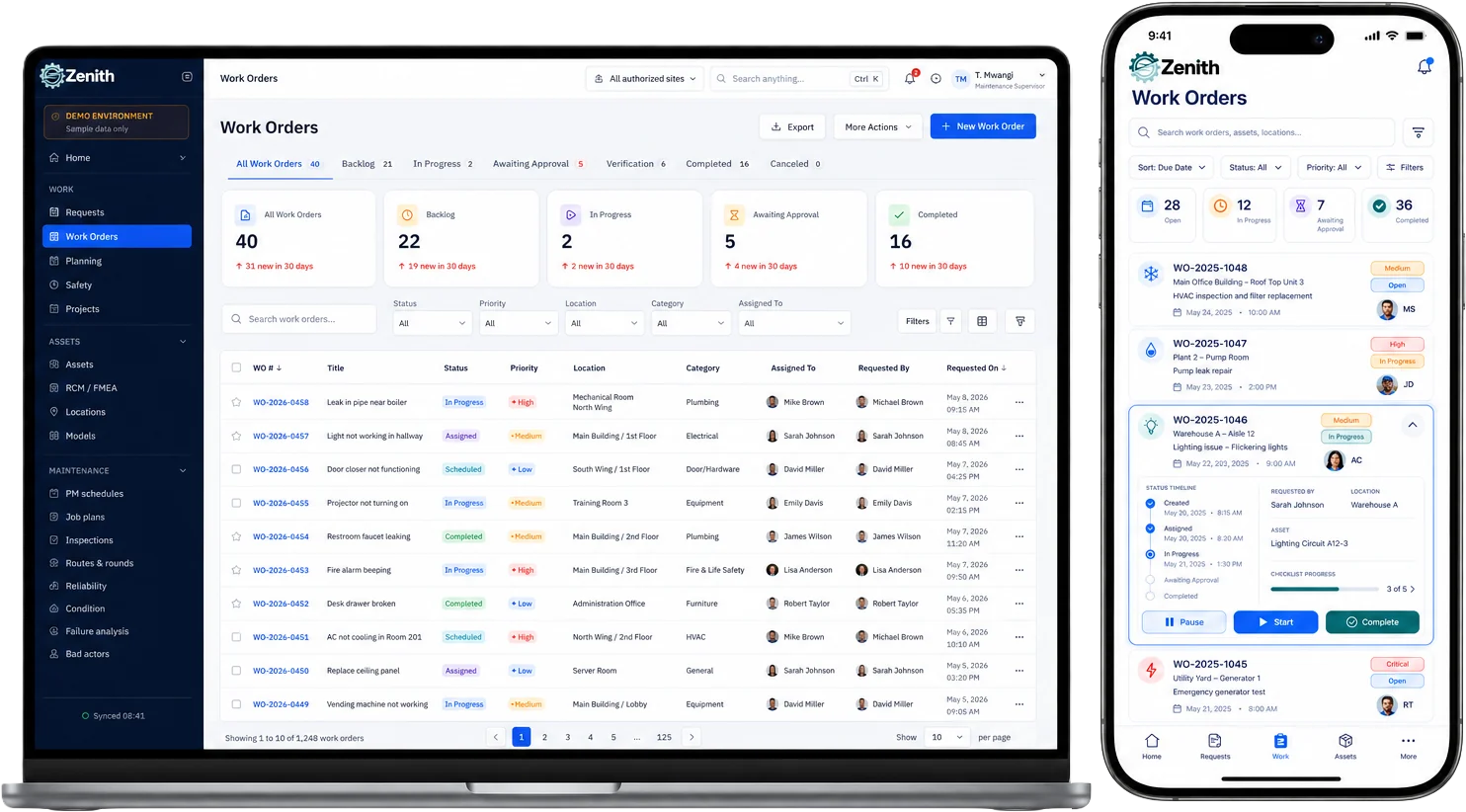
- Real-Time Monitoring and Dashboards
Centralize data from HVAC, lighting, and metering systems into intuitive dashboards that highlight anomalies and track energy KPIs against NECB targets. - Preventive Maintenance Scheduling
Automate work orders based on runtime, sensor inputs, or calendar intervals to ensure equipment operates at peak efficiency and avoids energy-wasting breakdowns. - Asset Lifecycle Optimization
Track depreciation, runtime hours, and maintenance history to make informed replacement or retrofit decisions that support long-term energy goals. - Space and Occupancy Analytics
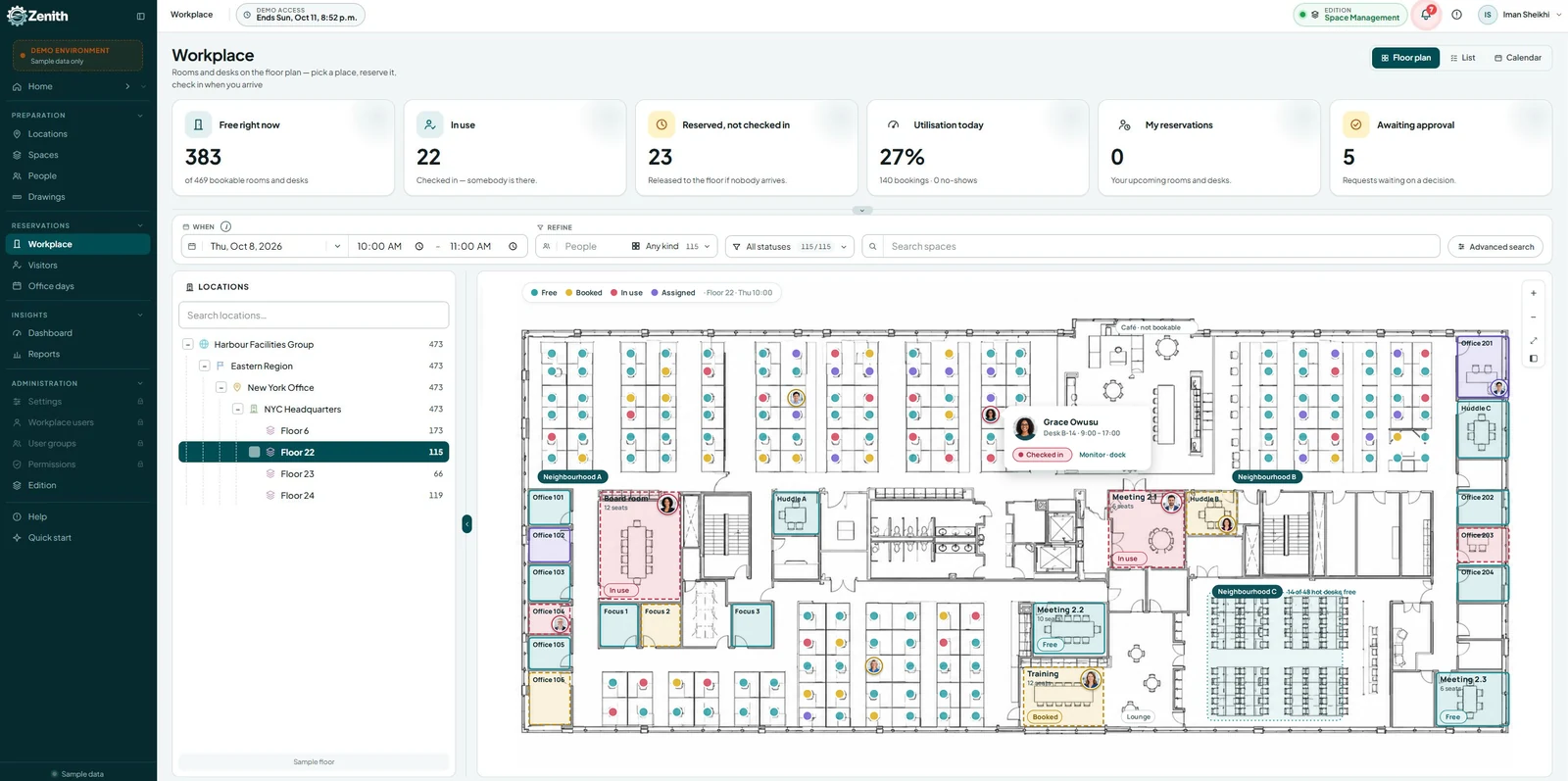
Use integrated space management tools to identify under-utilized areas, consolidate resources, and adjust HVAC or lighting schedules according to real-time occupancy data. - Automated Compliance Reporting
Generate NECB-aligned reports at the click of a button, complete with audit trails that document every maintenance activity, retrofit, and energy reading.
Why Zenith Is the Ideal Solution for NECB 2020
Zenith combines CMMS and CAFM capabilities in a single, browser-based platform designed for Canadian facility managers:
- Unified Data Hub
Zenith integrates asset, space, and infrastructure data into one management center, eliminating siloed spreadsheets and speeding up compliance workflows. - Advanced Preventive Maintenance
Smart scheduling and automated alerts help you perform maintenance before equipment performance degrades, reducing energy waste from under-performing machinery. - Comprehensive Asset and Space Management
From CAD drawing updates to real-time occupancy dashboards, you gain full visibility into how space utilization impacts energy consumption. - Robust Analytics and Reporting
Built-in KPI tracking and enterprise-level report generation make it easy to prove NECB 2020 compliance and identify further efficiency gains. - Mobility and Accessibility
The responsive HTML5 interface works seamlessly on desktop, tablet, or phone—so technicians can log readings and close work orders on the go, ensuring data accuracy and timeliness. - Scalable and Cost-Effective
Flexible module licensing lets you invest only in what you need, with pricing that undercuts many competitors while delivering enterprise-grade functionality.
Implementing Zenith for NECB 2020 Success
- Needs Assessment
Map your existing systems, energy targets, and reporting requirements against NECB 2020 clauses. - Pilot Deployment
Configure Zenith modules—Work Orders, Preventive Maintenance, Asset Management, Space Scheduler—and onboard one facility to validate processes. - Data Integration
Connect metering, BAS, and IoT devices to feed real-time energy and occupancy data into Zenith dashboards. - Training and Change Management
Empower your team with role-based training sessions that emphasize data entry best practices and energy-focused maintenance workflows. - Continuous Optimization
Review energy KPIs monthly, adjust preventive maintenance intervals, and repurpose under-utilized spaces to achieve ongoing compliance and cost savings.
Looking Ahead: Beyond NECB 2020
While NECB 2020 compliance is a milestone, the future of facility management lies in predictive analytics, AI-driven optimization, and digital twins. Leveraging platforms like Zenith today lays the groundwork for:
- Predictive Energy Modeling
- Automated Demand Response
- Integration with Renewable Energy Sources
- Advanced Digital Twin Simulations
Ready to transform your compliance challenge into a competitive edge? Schedule a demo of Zenith and see how easy NECB 2020 compliance can be.
How Zenith Integrates Seamlessly with Your Existing Systems
Zenith is designed to slot into your technology ecosystem without disrupting operations or duplicating effort. Here’s how it connects to the core platforms and devices you already rely on:
1. Open RESTful APIs
- Zenith exposes a full suite of JSON-based REST APIs for key entities (assets, work orders, preventive schedules, space plans, users).
- You can push data into Zenith (e.g., auto‐creating work orders from an external help desk) or pull information out (e.g., exporting asset lists for financial reporting).
- Typical use cases:
- Bi-directional sync with ERP/MRP (SAP, Oracle, Microsoft Dynamics) for purchase orders, invoicing, GL codes.
- Integration with HR or ticketing systems (ServiceNow, Jira) to auto-assign maintenance tasks based on skill sets.
2. Single Sign-On (SSO) & Identity Providers
- Supports SAML 2.0 and OAuth 2.0 for SSO with Azure Active Directory, Okta, Google Workspace, or any SAML-compliant IdP.
- Streamlines user provisioning and permissions: changes to your corporate directory automatically reflect in Zenith roles and access levels.
3. Two-Way ERP/MRP Connectivity
- Pre-built connectors and middleware templates accelerate integration with leading ERPs.
- Automate procurement workflows: when a part is low in Zenith inventory, it can trigger a PO request in your ERP, then update stock levels in FM once delivered.
- Financial reconciliation becomes hands-free—maintenance costs flow directly into your cost centers.
4. Building Automation & IoT Integrations
- Native support for MQTT, BACnet/IP, Modbus, OPC UA and RESTful data streams.
- Sync live sensor data (temperature, humidity, CO₂, energy meters) into your Zenith dashboards.
- Set dynamic triggers: for example, if a chiller’s delta-T drops below a threshold, Zenith can automatically generate a work order.
5. CAD & Space Management
- Import and update DWG, DXF or SVG floor plans directly into the Space & Assets module.
- Changes you make in CAD tools (AutoCAD, Revit) can be batched into Zenith via API or FTP watch folders, keeping your facility drawings current.
6. Webhooks & Event-Driven Workflows
- Publish real-time events (e.g., new work order, status change, asset failure) via webhooks.
- Hook these into your business rules engines or custom middleware to orchestrate multi-system processes—such as notifying field teams in Slack or Microsoft Teams.
7. Mobile SDK & Barcode/RFID
- Zenith’s mobile app SDK can embed custom forms or capture workflows.
- Use barcode or RFID scanners to instantly pull up asset details and history on any smartphone or tablet.
- Scans can also trigger integrations: for example, a scanned part number could query your spare-parts database in the ERP and reserve it.
8. Secure Data Exchange & Deployment Options
- Cloud-native or on-premises deployments behind your VPN or DMZ.
- Data encryption in transit (TLS 1.2+) and at rest (AES-256).
- Role-based permissions ensure that external systems only see the fields you expose via API.
Getting Started with Integration
- Discovery Session
Map your key systems, data flows, user roles, and compliance requirements. - API Audit & Sandbox Setup
Spin up a sandbox environment and test API calls, SSO flows, and webhook endpoints. - Connector Configuration
Leverage Zenith’s pre-built ERP and IoT connectors. For bespoke needs, build lightweight middleware using the REST API. - Pilot & Validation
Run integration scripts on a single site or module. Validate data integrity, error handling, and performance under load. - Rollout & Support
Extend integrations across all facilities, with ongoing monitoring tools that alert you to sync failures or security events.
By unifying asset, maintenance, space, and energy data across your critical systems, Zenith becomes the nerve center for operational intelligence—helping you automate, optimize, and prove compliance without replacing your existing investments.
Ready to see how these integrations work in action? Let’s schedule a technical deep dive and map out your custom integration roadmap.