

Table of Contents
- Introduction
- Defining EAM Software
- Core Features of EAM
- Top Benefits of EAM Software
- EAM vs CMMS: What’s the Difference?
- EAM vs ERP: How They Complement—and Contrast
- EAM vs CAFM: Facility Focused or Asset Focused?
- Choosing the Right System for Your Organization
- Best Practices for EAM Implementation
- Conclusion
- Frequently Asked Questions (FAQ)
1. Introduction
Enterprise Asset Management (EAM) software has become a cornerstone for organizations that rely on complex, distributed assets—whether they’re manufacturing plants, utility networks, or fleet operations.
In today’s digital-first landscape, optimizing asset uptime, controlling maintenance costs, and meeting regulatory compliance are mission-critical priorities.
This article dives deep into “What is EAM software?”, outlines its core capabilities, and compares it head-to-head with CMMS, ERP, and CAFM solutions.
By the end, you’ll have a clear roadmap for selecting and implementing the right asset management platform for your business.
2. Defining EAM Software
Enterprise Asset Management (EAM) software is a centralized system designed to manage the entire lifecycle of physical assets—from procurement, installation, and operation through maintenance and eventual disposal.
Unlike narrower solutions, EAM spans asset planning, work order management, inventory control, predictive maintenance, and compliance reporting within a unified platform.
EAM empowers organizations to align maintenance strategies with business objectives—maximizing asset availability, extending useful life, and minimizing total cost of ownership (TCO).
At its core, EAM connects front-line technicians, maintenance planners, procurement teams, and executives with real-time asset data and intelligence.
3. Core Features of EAM
EAM software typically includes a robust set of integrated modules and capabilities. Below are the most common core features:
- Asset Registry & Hierarchy
- Preventive & Predictive Maintenance Scheduling
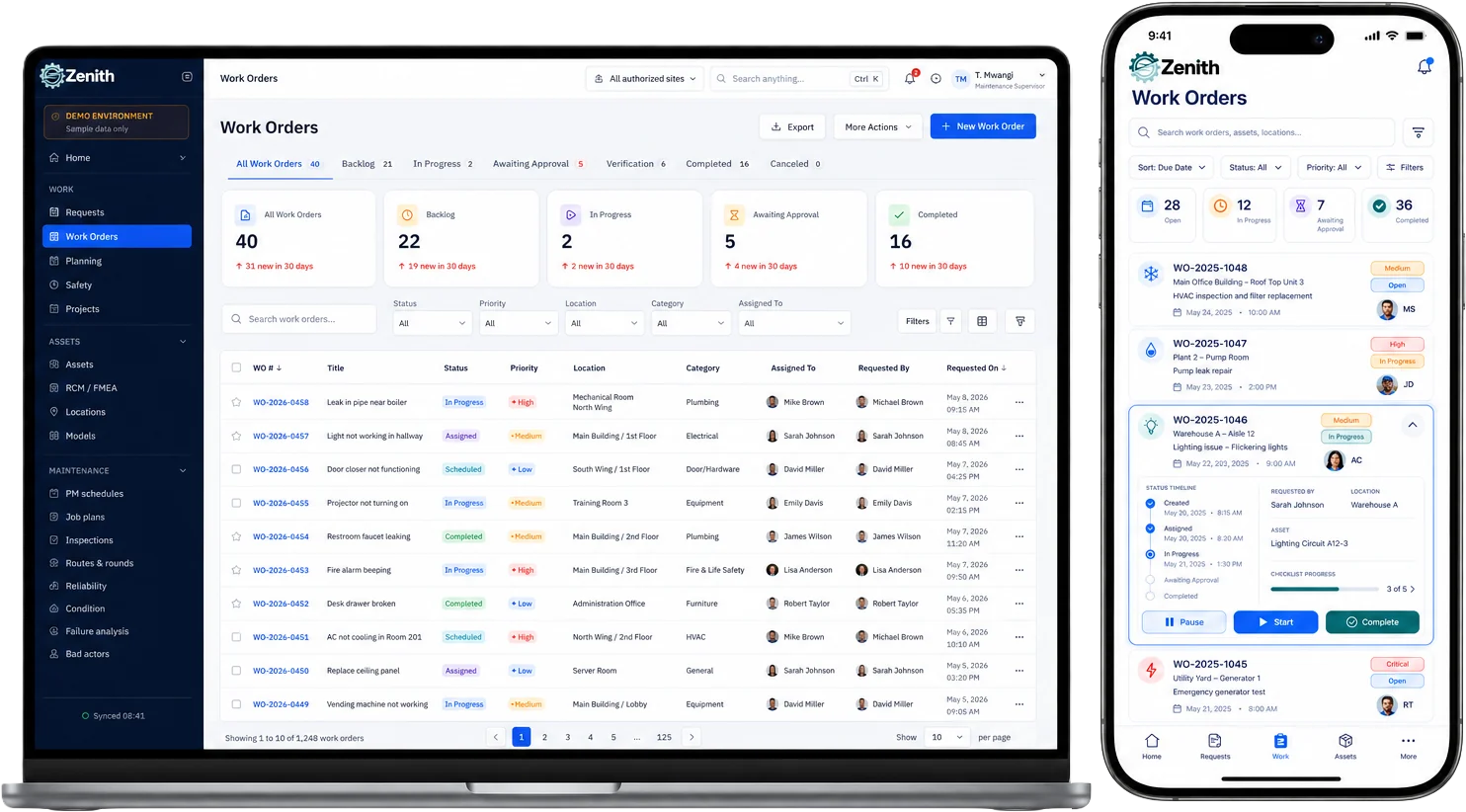
- Work Order Creation, Assignment & Tracking
- Maintenance Budgeting & Cost Analysis
- Spare Parts & Inventory Management
- Mobile Technician Access & Barcode/RFID Scanning
- IoT Integration & Condition Monitoring
- Regulatory Compliance Reporting
- Analytics Dashboards & KPI Tracking
- Document Management & SOP Libraries
4. Top Benefits of EAM Software
- Reduced Downtime
Fewer unplanned outages and faster mean time to repair (MTTR). - Lower Maintenance Costs
Optimized scheduling and inventory control cut labor and parts expenses. - Extended Asset Lifespan
Proactive upkeep prevents premature equipment failure. - Regulatory Compliance
Automated audits and digital records simplify safety and environmental reporting. - Data-Driven Insights
Real-time KPIs help stakeholders make strategic, cost-effective decisions. - Cross-Functional Collaboration
Centralized platform fosters coordination between operations, maintenance, and procurement.
5. EAM vs CMMS: What’s the Difference?
Both EAM and CMMS (Computerized Maintenance Management System) aim to streamline maintenance activities—but they differ in scope, scale, and strategic focus.
| Dimension | EAM | CMMS |
|---|---|---|
| Scope | Enterprise-wide asset lifecycle management | Maintenance work order management |
| Focus | Strategic planning, capital projects, ROI analysis | Day-to-day maintenance tasks |
| Inventory Control | Advanced forecasting, vendor contracts | Basic parts tracking |
| Analytics | Deep financial and operational KPIs | Maintenance metrics (e.g., MTTR, MTBF) |
| Integration | ERP, IoT platforms, CAFM, GIS | Often standalone or limited ERP integration |
| Ideal For | Large enterprises with diverse asset portfolios | Small to mid-size sites focusing on repairs |
EAM platforms encompass all CMMS functionality and extend into procurement, work planning, and strategic asset investment.
For organizations seeking a holistic, data-driven approach to asset management, EAM is the natural choice.
6. EAM vs ERP: How They Complement—and Contrast
Enterprise Resource Planning (ERP) systems manage an organization’s back-office functions—finance, HR, supply chain, procurement—across all business units.
EAM specializes in the operational and maintenance aspects of physical assets. While there’s overlap in purchasing and inventory, EAM adds dedicated modules for maintenance planning, asset hierarchy, and condition monitoring.
| Function | EAM Software | ERP Software |
|---|---|---|
| Maintenance Management | Comprehensive preventive & predictive | Limited or ad-hoc integration |
| Asset Accounting | Detailed asset lifecycle costing | Fixed asset register in financial module |
| Procurement Integration | Vendor performance, spares optimization | Purchase orders, supplier management |
| Operations Visibility | Real-time asset health, downtime alerts | High-level inventory & financial reports |
| Implementation Complexity | Medium to high—specialized functionality | High—broad enterprise scope |
| Best Suited For | Maintenance-intensive industries | Cross-functional organizational workflows |
Rather than replace each other, EAM and ERP systems often integrate deeply—feeding financial data into maintenance planning, and routing purchase requisitions through the ERP.
7. EAM vs CAFM: Facility Focused or Asset Focused?
CAFM (Computer-Aided Facility Management) tools cater primarily to space and facility management—room layouts, cleaning schedules, occupant comfort, lease management.
EAM zeroes in on equipment, machinery, and infrastructure performance. While CAFM tracks real estate and facility utilization, EAM monitors pumps, motors, HVAC units, and production lines.
| Aspect | EAM | CAFM |
|---|---|---|
| Primary Focus | Equipment reliability & maintenance | Space planning, occupancy, housekeeping |
| Asset Detail | Component-level hierarchy | Room or floor-level mapping |
| Maintenance Scheduling | Condition-based, predictive | Often calendar-based or reactive |
| Integration | IoT sensors, PLCs, ERP | CAD drawings, BIM, workplace services |
| Reporting Metrics | OEE, MTTR, asset ROI | Space utilization, cost per square foot |
| Ideal Use Case | Manufacturing, energy, transportation | Real estate firms, corporate offices, campuses |
In practice, large organizations sometimes deploy both CAFM and EAM—with integration touchpoints for work orders, space-asset relationships, and compliance checks.
8. Choosing the Right System for Your Organization
Selecting between EAM, CMMS, ERP, and CAFM hinges on your specific business needs, asset complexity, and growth strategy. Consider these guiding questions:
- Asset Complexity: Do you manage heavy machinery, distributed networks, or simple equipment?
- Maintenance Strategy: Are you reactive, preventive, or fully predictive?
- Integration Needs: Will you connect sensors, ERP modules, facility services, or other systems?
- Budget & ROI: What’s your expected payback period and TCO threshold?
- Scalability: How many users, sites, and assets must the platform support?
- Regulatory Landscape: Which compliance mandates does your industry require?
Answering these questions will help you map requirements to the solution that delivers maximum operational value.
9. Best Practices for EAM Implementation
- Secure Executive Buy-In
Align EAM goals with strategic KPIs—revenue impact, safety metrics, sustainability targets. - Define a Phased Rollout
Start with pilot sites or asset classes before scaling enterprise-wide. - Cleanse & Standardize Data
Consolidate asset hierarchies, bill of materials (BOMs), and historical work orders. - Leverage Mobile & IoT
Empower technicians with mobile apps and real-time condition alerts. - Train & Empower Users
Provide role-based training—planners, technicians, managers—to drive adoption. - Monitor KPIs & Iterate
Track OEE, MTTR, maintenance cost per asset, and adjust strategies accordingly.
11. Conclusion
Enterprise Asset Management software is the linchpin for organizations aiming to transform maintenance from a cost center into a strategic enabler.
By understanding the distinctions between EAM, CMMS, ERP, and CAFM, you can ensure you select a solution tailored to your asset complexity, operational goals, and growth trajectory.
Investing in the right EAM platform unlocks:
- Consistent uptime and throughput improvements
- Clear visibility into maintenance ROI
- Regulatory compliance confidence
- Data-driven roadmaps for capital investments
Ready to find the ideal EAM solution for your organization? Start by mapping your asset landscape, defining critical KPIs, and running a proof-of-concept with top vendors.
Whether you’re a maintenance manager, IT leader, or C-suite executive, mastering EAM sets the stage for operational resilience, cost efficiency, and sustainable growth.
Empower your team with the right tools—and watch your assets deliver greater value, day in and day out.
Additional Resources & Next Steps
- Download our EAM Buyer’s Checklist
- Explore case studies: “How X Utilities Slashed Downtime by 30%”
- Join our upcoming webinar: “From Reactive to Predictive: The EAM Evolution”
Stay ahead of the curve—leverage EAM to future-proof your asset operations today.
Absolutely! Here’s a tailored FAQ section you can add to your blog post titled “What Is EAM Software? A Comprehensive Guide (vs CMMS, ERP, CAFM)”. It’s designed to clarify common questions readers might have and boost SEO relevance:
❓ Frequently Asked Questions (FAQ)
🔧 What does EAM software do?
Enterprise Asset Management (EAM) software helps organizations manage the entire lifecycle of their physical assets—from acquisition and operation to maintenance and disposal. It improves asset reliability, reduces downtime, and supports strategic decision-making.
🆚 How is EAM different from CMMS?
While both manage maintenance tasks, CMMS focuses on scheduling and tracking work orders, whereas EAM offers broader capabilities like asset performance analytics, procurement integration, and lifecycle costing. EAM is ideal for enterprise-wide asset strategies.
🏢 Is EAM the same as ERP?
No. ERP (Enterprise Resource Planning) systems manage core business functions like finance, HR, and supply chain. EAM specializes in asset-centric operations. Some ERP platforms include basic asset modules, but they lack the depth of dedicated EAM tools.
🏗️ What is the difference between EAM and CAFM?
CAFM (Computer-Aided Facility Management) focuses on space utilization, room booking, and facility services. EAM, on the other hand, is geared toward equipment maintenance, asset health monitoring, and operational efficiency—especially in industrial settings.
🧠 Who should use EAM software?
EAM is best suited for organizations with high-value, complex assets—such as manufacturers, utilities, transportation companies, and energy providers. It’s especially valuable for teams managing preventive and predictive maintenance programs.
📊 Can EAM software integrate with other systems?
Yes. Most modern EAM platforms integrate with ERP systems, IoT devices, GIS platforms, and financial software to provide a unified view of asset performance and business impact.
💰 Is EAM software expensive?
Costs vary depending on the scale and features. Cloud-based EAM solutions offer flexible pricing, while enterprise-grade platforms may require significant investment. However, the ROI from reduced downtime and optimized asset usage often outweighs the cost.
🛠️ What features should I look for in EAM software?
Key features include:
- Preventive & predictive maintenance
- Asset hierarchy and tracking
- Work order management
- Inventory and procurement integration
- Mobile access and IoT compatibility
- Advanced reporting and analytics