


Introduction
In today’s demanding healthcare environment, facility management teams balance patient safety, regulatory compliance, and cost control daily. Aging infrastructure, critical life-support systems, and stringent infection-control standards leave little margin for error. Traditional reactive maintenance—waiting for equipment to fail before fixing it—no longer suffices when every minute of downtime risks patient outcomes and operational budgets.
Facility Management software in healthcare has emerged as an indispensable tool, transforming maintenance and operations into proactive, data-driven functions. By unifying work orders, real-time monitoring, predictive analytics, and compliance reporting, modern solutions empower facility teams to anticipate issues before they escalate, optimize resource allocation, and maintain airtight audit trails. Zenith stands out in this crowded landscape as a purpose-built platform that addresses the unique demands of hospitals, clinics, and long-term care facilities.
In this article, we’ll explore the core challenges facing healthcare facilities, define what comprehensive Facility Management software entails, and dive deep into how Zenith’s features and best practices deliver measurable improvements in safety, efficiency, and cost savings.
The Unique Challenges of Healthcare Facility Management
Healthcare facilities are complex ecosystems where building systems directly impact clinical operations and patient wellbeing. Several factors amplify the stakes for facility management teams:
- Critical Equipment Uptime
From HVAC systems that regulate airflow in operating rooms to medical gas lines that power ventilators, system failures can put lives at risk. Unplanned downtime during surgeries or emergency procedures is unacceptable. - Stringent Regulatory Environment
Accreditation bodies such as The Joint Commission (TJC) and local health authorities impose rigorous standards for safety, sanitation, and equipment maintenance. Noncompliance can lead to fines, legal liability, or closure. - Infection Prevention and Control
HVAC filters, water systems, and surface cleanings must align with infection-control protocols to minimize healthcare-associated infections (HAIs). Delayed maintenance or overlooked inspections can foster contamination. - Budget Constraints and Cost Pressures
Rising labor, energy, and equipment costs collide with fixed or shrinking budgets. Facility teams must demonstrate ROI for every maintenance dollar and justify capital expenditures. - Space Utilization and Flexibility
Evolving patient needs—such as surge capacity during pandemics—require flexible room assignments and rapid space reconfiguration. Without real-time visibility into occupancy, planners risk under- or over-allocating critical areas.
These challenges render manual processes, paper-based logs, and siloed spreadsheets inadequate. Facility Management software in healthcare provides the centralized data, analytics, and mobile capabilities needed to tackle these complexities head-on.
What Makes Facility Management Software in Healthcare Different?
Not all CMMS (Computerized Maintenance Management Systems) are created equal. Healthcare facilities require specialized features that extend beyond basic work-order tracking:
- Regulatory-Grade Compliance Tools
Pre-configured templates for TJC, NFPA, OSHA, and local building codes streamline audit preparation. Automated evidence capture—such as digital sign-offs, inspection photos, and IoT sensor logs—eliminates manual paperwork. - Environmental Monitoring and Infection Control
Integration with IoT sensors enables continuous tracking of temperature, humidity, air pressure differentials, and water quality. Alerts flag deviations in real time, supporting infection-control protocols and mitigating HAI risks. - Asset Hierarchy and Lifecycle Management
Detailed asset registers categorize medical equipment, building systems, and critical spares. Lifecycle analytics guide capital planning, helping teams decide when to repair, refurbish, or replace high-value assets. - Mobile Workforce Enablement
Technicians access work orders, blueprints, parts inventories, and service history via mobile apps. They can close out tasks, upload photos, and capture compliance signatures on the go—boosting productivity and reducing administrative delays. - Predictive Maintenance and Analytics
Machine-learning algorithms analyze equipment performance data—such as vibration, power draw, or cycle counts—to forecast failures weeks in advance. This proactive approach slashes emergency repair costs and unplanned downtime. - Space Management and Tracking
Interactive floor plans, occupancy sensors, and QR/RFID tagging optimize room assignments and asset locations. Facility planners can visualize heatmaps of usage to guide renovations or repurpose underutilized areas.
These features converge in purpose-built Facility Management software in healthcare, transforming FM teams from reactive responders into strategic partners in patient care delivery.
Why Healthcare Providers Are Adopting Facility Management Software
Adoption of Facility Management software in healthcare has accelerated across hospitals, outpatient centers, and senior living communities. Key drivers include:
- Patient Safety Imperatives
Proactive maintenance of sterilization equipment, emergency generators, and air-handling systems safeguards clinical environments and minimizes infection risks. - Operational Efficiencies
Automated routines reduce labor-intensive paperwork, schedule preventive maintenance optimally, and allocate technician resources based on real-time priorities. - Cost Containment
Predictive analytics cut emergency repair costs by up to 50%, reduce energy spend through continuous monitoring, and extend asset lifecycles by up to 20%. - Regulatory Confidence
Audit-ready reporting with time-stamped evidence ensures compliance and frees facility teams to focus on value-added projects rather than chasing documentation. - Scalability and Future-Proofing
Cloud-based platforms adapt to growing networks of satellite clinics and telehealth support spaces. Integration with building automation systems (BAS) and electronic health records (EHR) platforms paves the way for holistic data ecosystems.
As hospitals embrace digital transformation, Facility Management software in healthcare emerges as a linchpin for delivering safer, more efficient, and cost-effective care.
Introducing Zenith: Your Partner in Transformative Facility Management
Among the leading vendors in the space, Zenith distinguishes itself through a healthcare-centric approach, modular architecture, and seamless integration capabilities. Here’s why Zenith excels:
Unified CMMS and CAFM Functionality
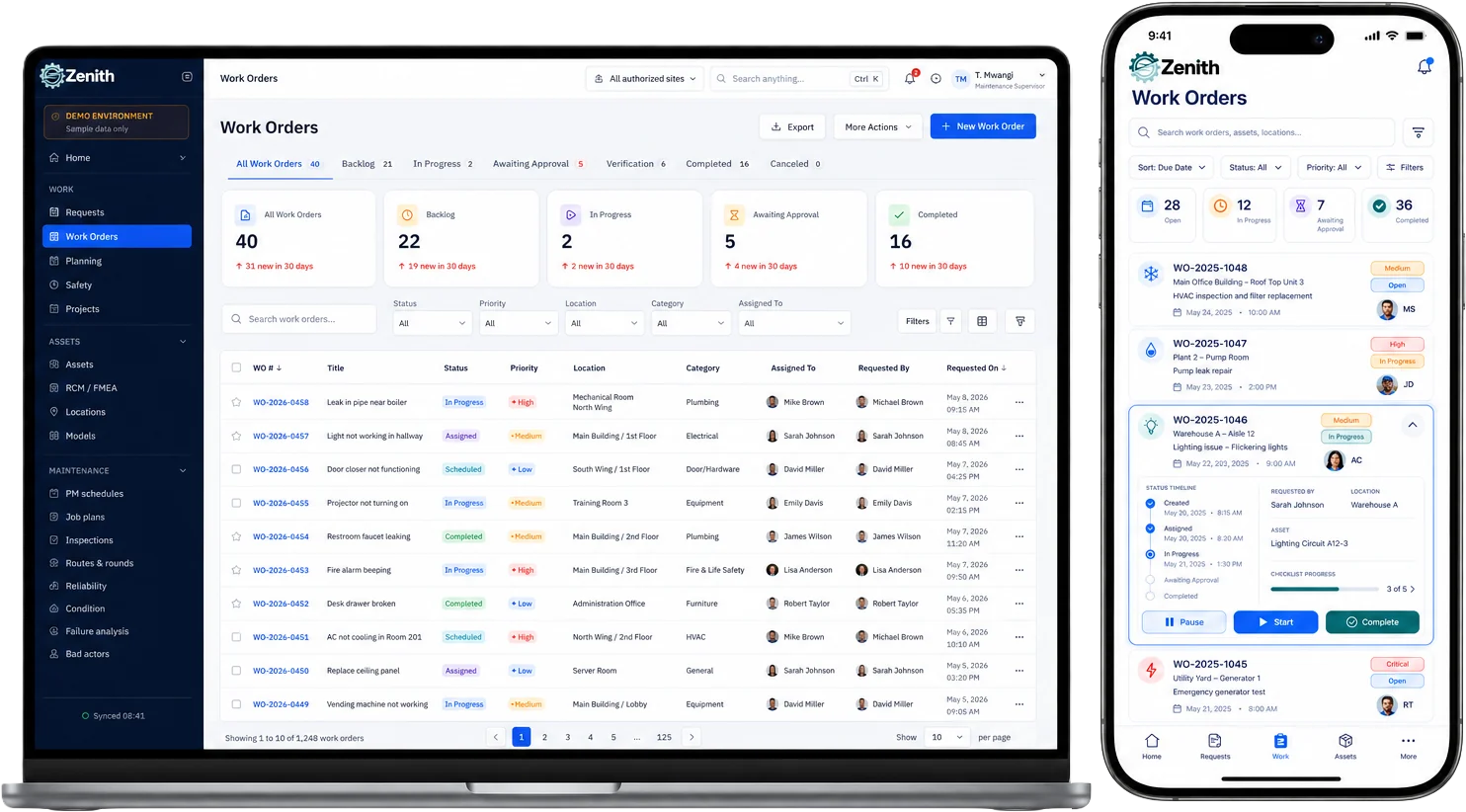
- Centralized Work Order Hub
Create, assign, and track maintenance tasks across multiple sites from a single dashboard. Prioritize tickets by risk level, asset criticality, or regulatory deadlines. - Asset and Space Library
Maintain a hierarchical inventory of assets and spaces with customizable metadata—such as manufacturer, installation date, and maintenance history. Link assets to floor plans for visual context.
Real-Time IoT Sensor Integration
- Environmental Dashboards
Stream live data from temperature, humidity, and differential pressure sensors. Configure multi-parameter alerts to enforce infection-control zones. - Energy Monitoring
Track power consumption of HVAC units, lighting systems, and medical equipment. Identify anomalies and optimize schedules for peak-demand shaving.
Predictive Maintenance Engine
- Machine-Learning Models
Leverage historical work-order data and sensor streams to forecast failures days or weeks ahead. Automate condition-based triggers to generate work orders proactively. - Customizable Thresholds
Tailor alert levels and maintenance triggers to asset types, clinical risk categories, and manufacturer recommendations.
Mobile App for Field Technicians
- Offline Mode
Download work orders, asset details, and schematics in advance. Synchronize updates automatically when connectivity resumes. - In-App Collaboration
Messaging and photo uploads enable real-time collaboration between field teams, supervisors, and external contractors.
Compliance and Reporting Suite
- Audit-Ready Templates
Pre-built forms for TJC, NFPA, and other healthcare standards. Digital signatures and time stamps ensure traceability. - Custom Reports and KPIs
Visualize metrics such as preventive vs. corrective ratio, mean time to repair (MTTR), and compliance scorecards. Schedule automated report distribution to leadership.
Space and Asset Optimization
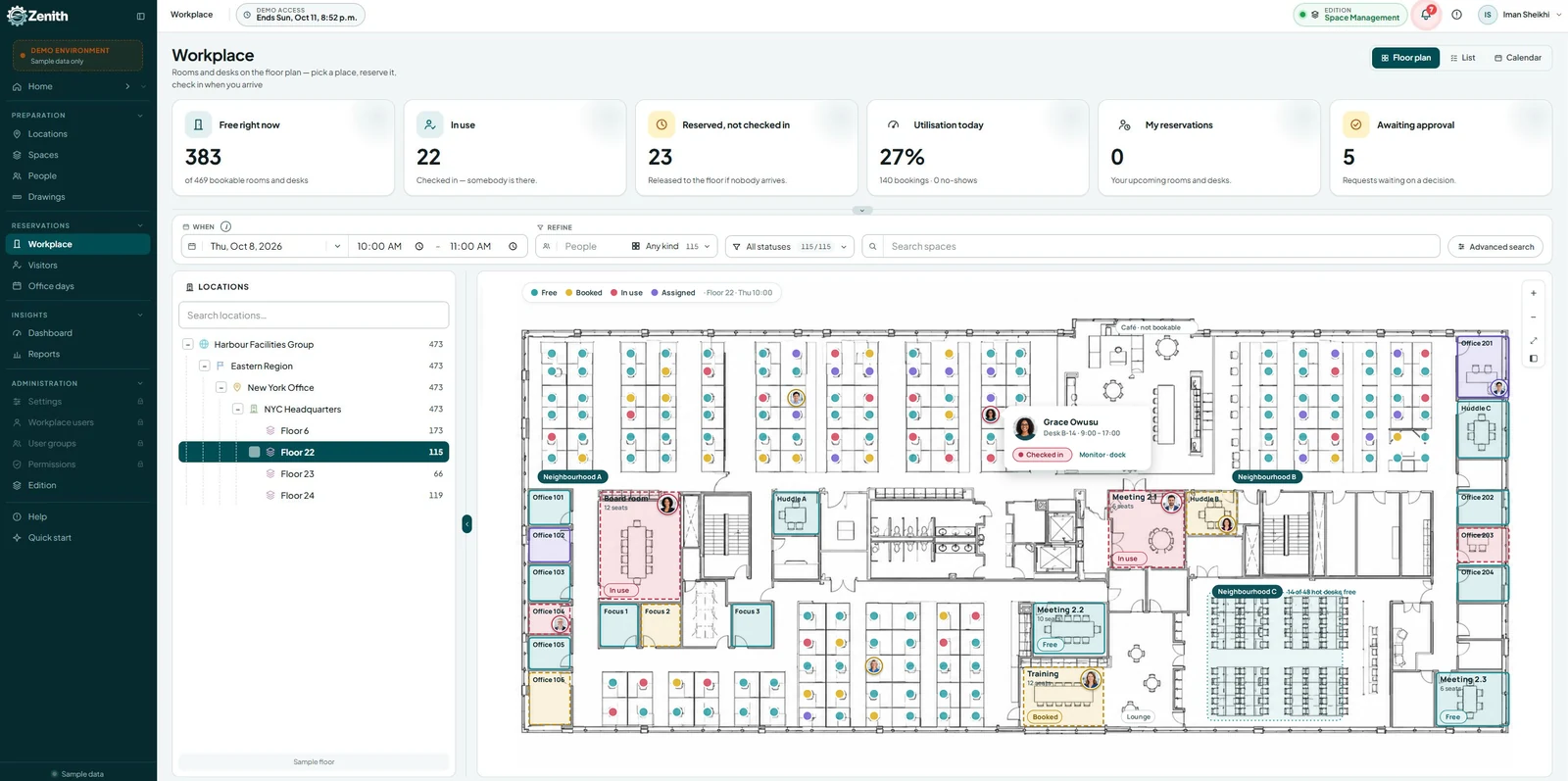
- Interactive Floor Plans
Heatmaps reveal room utilization, foot traffic, and equipment density. Identify under-used areas for repurposing or renovation. - QR/RFID Tagging
Quick asset lookups via barcode scans. Mobile inventory audits reduce stock discrepancies and lost-equipment write-offs.
Key Benefits of Zenith for Healthcare Organizations
Implementing Zenith delivers measurable outcomes that align with executive goals:
- Enhanced Patient Safety
Predictive alerts for critical systems reduce equipment-related incidents, creating safer clinical environments. - Increased Technician Productivity
Mobile work orders and offline access eliminate administrative bottlenecks, boosting on-task time by up to 30%. - Lower Total Cost of Ownership
Proactive maintenance and extended asset lifecycles cut capital expenditures and emergency repair costs by 40% on average. - Regulatory Peace of Mind
Automated compliance workflows and digital audit trails ensure 100% on-time submissions without last-minute scramble. - Optimized Energy and Sustainability Goals
Continuous monitoring uncovers inefficiencies, enabling energy savings of up to 15% and supporting green hospital initiatives. - Scalability for Growth
Cloud-native architecture supports multi-facility networks, from flagship hospitals to remote outpatient centers, with seamless data sharing.
Best Practices for Implementing Facility Management Software in Healthcare
To realize the full potential of Zenith, healthcare organizations should follow a structured implementation roadmap:
- Stakeholder Alignment
Engage clinical leaders, IT, finance, and biomedical engineering early. Define shared objectives—such as downtime reduction, compliance automation, or cost targets. - Comprehensive Needs Assessment
Audit current systems, workflows, and pain points. Map out asset criticality, regulatory requirements, and space-utilization challenges. - Phased Deployment
Begin with a pilot unit (e.g., one department or building). Validate configurations, gather feedback, and refine workflows before enterprise-wide rollout. - Data Migration and Clean-Up
Consolidate disparate asset lists, maintenance histories, and inspection records. Cleanse data to ensure accuracy and prevent duplicate entries. - Tailored Training and Change Management
Offer role-based training sessions—technicians, supervisors, and executives. Provide quick-start guides, video tutorials, and a dedicated support channel. - Continuous Monitoring and Optimization
Review key performance indicators monthly. Adjust predictive-model thresholds, refine preventive-maintenance intervals, and incorporate user feedback. - Integration Roadmap
Plan future integrations with BAS, EHR, and IoT platforms. A connected ecosystem unlocks advanced analytics and cross-departmental insights.
Real-World Impact: Zenith in Action
Northview Regional Hospital, a 300-bed acute care center, struggled with frequent HVAC failures and time-consuming compliance audits. After deploying Zenith across its main campus:
- Emergency maintenance calls dropped by 35% within four months.
- HVAC-related downtime decreased by 50%, ensuring uninterrupted climate control in critical care units.
- Audit preparation time for The Joint Commission inspections shrank from two weeks to two days.
- Technicians reported a 25% productivity boost thanks to mobile work orders and offline capabilities.
These results translated into cost savings exceeding $500,000 annually—and, more importantly, a demonstrably safer environment for patients and staff.
Frequently Asked Questions
Q1: What is the typical ROI timeline for Zenith?
Most healthcare organizations see a positive return on investment within 9–12 months, driven by reduced emergency repair costs, labor efficiencies, and energy savings.
Q2: Does Zenith support multi-facility deployments?
Yes. Zenith’s cloud-native design and role-based access controls make it ideal for large health systems, outpatient clinics, and long-term care networks.
Q3: Can I integrate Zenith with our existing BAS and EHR systems?
Zenith offers RESTful APIs and integration connectors for major building automation and electronic health record platforms, enabling seamless data exchange.
Q4: How does Zenith handle data security and compliance?
Zenith is hosted on SOC-2 compliant cloud infrastructure, employs end-to-end encryption, and adheres to HIPAA data-privacy standards for protected health information.
Conclusion
Facility Management software in healthcare is no longer a luxury—it’s an essential pillar of modern patient care delivery. The stakes are too high, and the margins too tight, for reactive maintenance and siloed systems to persist. Zenith offers healthcare organizations a holistic, scalable platform that unites CMMS, CAFM, IoT monitoring, predictive analytics, and compliance management.
By embracing Zenith, hospitals and clinics can transition from fire-fighting mode to proactive operations, cutting costs, mitigating risks, and—most importantly—creating safer environments for patients and caregivers alike. Ready to discover how Zenith can revolutionize your facility management? Contact our team for a personalized demo and start transforming your healthcare operations today.