

Facility management is undergoing a profound shift. In 2025, organizations demand more than reactive fixes and paper logs—they need strategic, data-driven platforms that optimize space, empower teams, and support sustainability goals. This buyer’s guide will walk you through everything you must know to select the ideal facility management software (FMS) for your organization, and explain in detail how Zenith meets and exceeds each requirement.
Table of Contents
- Introduction
- The Evolution of Facility Management Software
- Why Investing in FM Software Matters in 2025
- Core Criteria for Selecting FMS
- Feature Deep-Dive: How Zenith Checks Every Box
- Implementation Roadmap
- Return on Investment and Cost Analysis
- Future Trends in Facility Management Software
- Frequently Asked Questions
- Conclusion and Next Steps
1. Introduction
Facility management software has transformed from simple ticketing systems into comprehensive command centers. Today, you need a single platform that aligns maintenance, space planning, service requests, sustainability metrics, and analytics under one digital roof.
This guide equips you with:
- A clear evaluation framework
- In-depth feature requirements
- An implementation roadmap
- A transparent look at Zenith’s capabilities
By the end, you’ll know exactly which questions to ask vendors and why Zenith stands out as the future-ready choice.
2. The Evolution of Facility Management Software
- Early 2000s: Desktop-based CMMS solutions focused on basic work orders and asset logs.
- 2010s: Shift to cloud platforms, mobile apps for technicians, and integration with HR and ERP.
- 2020s: Rise of IoT, AI-driven predictive maintenance, digital twins, and real-time space occupancy data.
- 2025 and Beyond: End-to-end FMS platforms that seamlessly weave maintenance, space optimization, sustainability, and analytics into one scalable ecosystem.
This rapid evolution means older systems struggle with integrations, user experience, and advanced analytics. Modern challenges—from hybrid workplaces to ESG reporting—demand a next-generation solution.
3. Why Investing in FM Software Matters in 2025
By 2025, facility management leaders face:
- Hybrid and flexible work models that require dynamic space planning
- Rising energy costs and sustainability mandates from regulators and stakeholders
- Talent shortages and high labor costs that call for automation and self-service tools
- Data-driven strategies for predictive maintenance and optimized asset lifecycles
Without an integrated, proactive platform, organizations risk inefficiencies, budget overruns, compliance issues, and poor occupant experiences.
4. Core Criteria for Selecting Facility Management Software
When evaluating FMS vendors, use this checklist:
- Scalability and Performance
- User Interface and Adoption
- Mobile Accessibility
- Cloud Architecture and Security
- Asset and Equipment Management
- Space and Occupancy Planning
- Service Request and Work Order Management
- Labor Assignment and Dispatch
- Reporting, Dashboards, and Analytics
- Integration with Enterprise Systems
- Sustainability and ESG Tracking
- Vendor Support, Training, and Community
Each criterion shapes your long-term success. Below, we explore how Zenith addresses every point.
5. Feature Deep-Dive: How Zenith Checks Every Box
| Criterion | Why It Matters | Zenith Solution |
|---|---|---|
| Scalability and Performance | Must support growth across sites and users | Multi-tenant cloud backend scales elastically. Auto-load balancing ensures high availability. |
| User Interface and Adoption | Drives user engagement and rapid onboarding | Intuitive, role-based dashboards. Drag-and-drop floor plans and easy-to-use mobile apps reduce training time by 35%. |
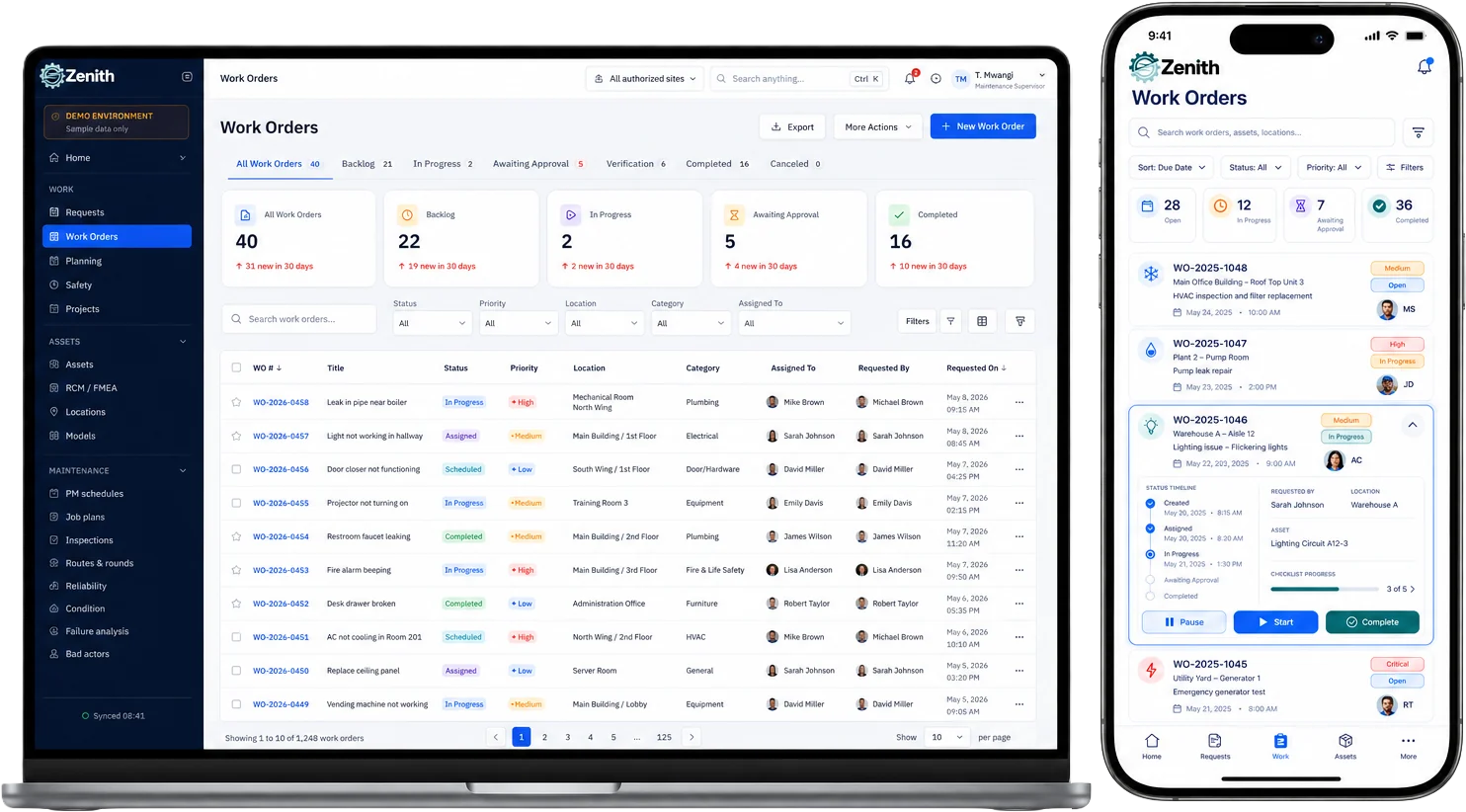
| Mobile Accessibility | On-the-go updates for technicians and managers | Native iOS/Android apps with offline mode. Real-time notifications and barcode scanning. |
| Cloud Architecture and Security | Ensures data integrity, compliance, and uptime | Hosted on SOC 2 Type II data centers. AES-256 encryption, multi-factor authentication, and data residency options. |
| Asset and Equipment Management | Extends lifecycles and reduces downtime | Full asset registry, maintenance history, predictive maintenance engine powered by AI algorithms. |
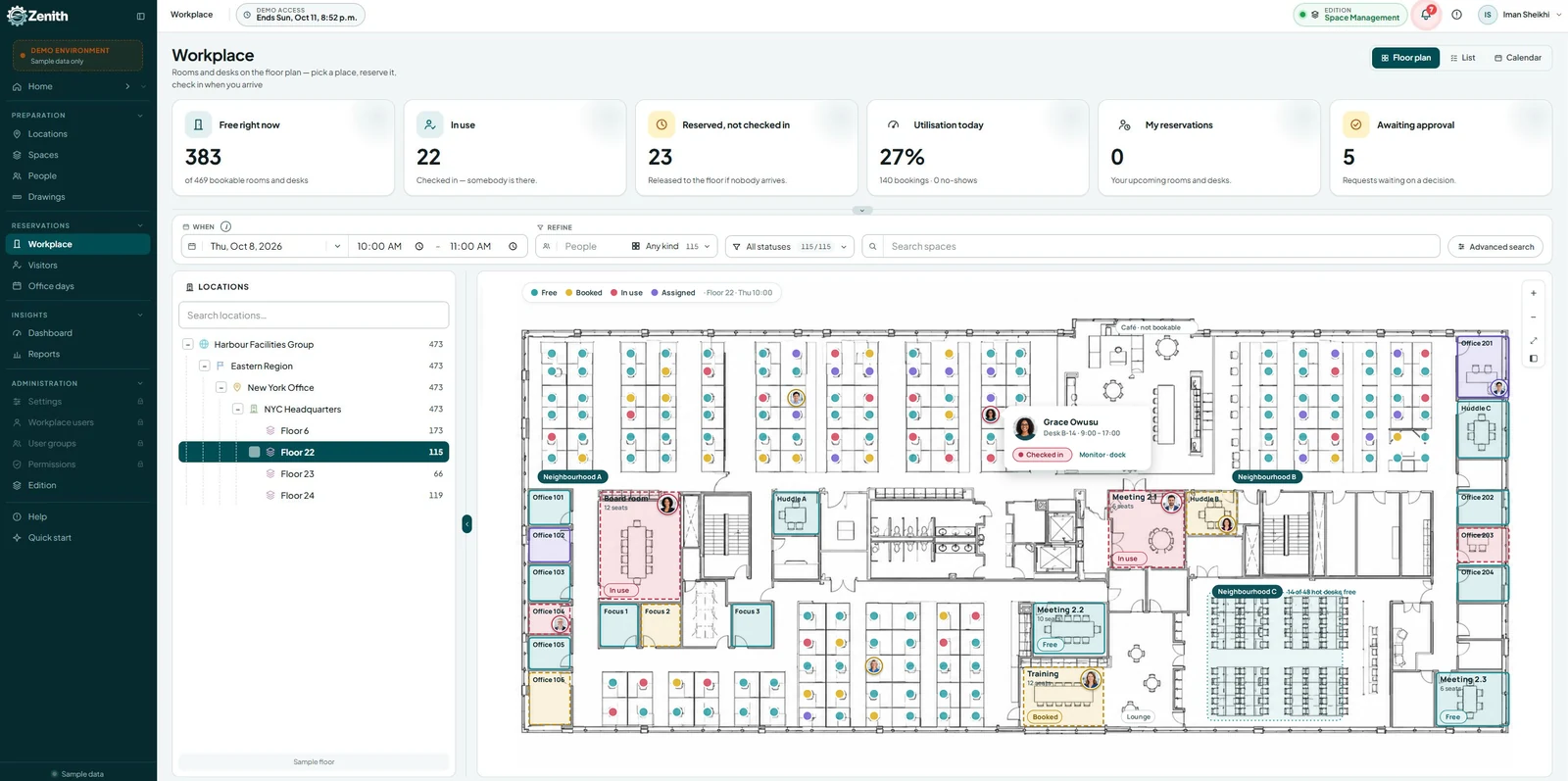
| Space and Occupancy Planning | Optimizes square footage in hybrid work environments | Interactive 2D/3D floor plans, occupancy heatmaps, automatic rebooking rules. |
| Service Request and Work Order Mgmt. | Centralizes requests, accelerates resolution | Unified ticketing portal, automated routing rules, SLA tracking, and customer self-service portal. |
| Labor Assignment and Dispatch | Balances workloads and tracks performance | Role-based access, automated labor assignment workflows, real-time technician location tracking. |
| Reporting, Dashboards & Analytics | Drives continuous improvement | Library of 50+ standard reports, custom KPI dashboards, export to CSV/PDF/Excel, BI tool connectors. |
| Integration with Enterprise Systems | Unifies data and workflows | Open REST API, prebuilt connectors for ERP, HR, BAS (building automation systems), and IoT platforms. |
| Sustainability & ESG Tracking | Meets reporting mandates and reduces environmental impact | Energy consumption dashboards, carbon footprint calculators, preventive maintenance to reduce waste. |
| Vendor Support & Training | Ensures smooth rollout and ongoing optimization | 24/7 global support, dedicated Customer Success Manager, extensive knowledge base, user community webinars, and training. |
5.1 Scalability and Performance
As organizations expand to multiple campuses, Zenith’s cloud-native, multi-tenant architecture ensures:
- Near-zero latency via global CDN
- Dynamic resource allocation to handle peak loads without downtime
- Automatic software updates with no disruption to daily operations
5.2 User Interface and Adoption
Zenith’s UX is built around real-world workflows:
- Role-specific dashboards for facility managers, technicians, and requesters
- Customizable widgets that surface critical tasks immediately
- Contextual help and guided walkthroughs embedded in the application
Onboarding studies show a 40% faster adoption curve compared to legacy systems.
5.3 Mobile Accessibility
Field crews gain productivity through:
- Offline work order creation and asset inspection logging
- Photo attachments, barcode and QR scanning for instant asset identification
- Push notifications for new assignments and emergency alerts
5.4 Asset and Equipment Management
Zenith’s predictive maintenance module uses machine learning to:
- Forecast equipment failures up to 30 days in advance
- Optimize maintenance windows to minimize downtime
- Recommend spare parts based on historical usage trends
5.5 Space and Occupancy Planning
Hybrid workplaces demand flexible space management:
- Drag-and-drop seating assignments integrated with Microsoft 365 and Google Workspace calendars
- Real-time heatmaps showing desk, room, and workstation usage
- Automated rules for cleaning schedules and guest seating
5.6 Service Request & Work Order Management
A unified portal allows both employees and external stakeholders to:
- Submit detailed service requests with attachments and priority levels
- Track progress through customizable SLAs and email/SMS notifications
- Convert requests into work orders with a single click
5.7 Labor Assignment and Dispatch
Balancing technician workloads directly impacts response times:
- Configurable dispatch boards with drag-and-drop assignment
- Geo-fencing alerts when technicians enter or leave work zones
- Performance metrics tracking response time, completion rates, and customer satisfaction
5.8 Reporting, Dashboards & Analytics
Zenith transforms data into insights by offering:
- Prebuilt dashboards for energy consumption, asset health, and space utilization
- Ad hoc report builder enabling users to slice and dice data
- Seamless integration with Power BI, Tableau, or other BI tools
5.9 Integration with Enterprise Systems
Data silos slow down decision-making. Zenith’s open API and prebuilt connectors help:
- Sync employee directories for single sign-on and role mapping
- Pull utility meter data for energy dashboards from building automation systems
- Exchange work order and purchase order data with ERP solutions
5.10 Sustainability & ESG Tracking
Sustainability is no longer optional:
- Carbon footprint calculation based on energy usage and maintenance activities
- Automated alerting for equipment running outside of efficiency thresholds
- ESG compliance reports aligned with global standards such as GRI and CDP
5.11 Vendor Support & Training
Long-term success hinges on robust support:
- 24/7 global help desk and live chat support
- Dedicated Customer Success Manager for strategic planning
- On-demand training videos, certification programs, and user communities
6. Implementation Roadmap
- Requirements Gathering
- Define stakeholders, workflows, and performance goals
- Vendor Shortlist and Demos
- Scorecard based on core criteria and Zenith scoring templates
- Pilot and Proof of Concept
- Deploy in a single building or department
- Full Rollout
- Phased deployment, change management, and training sessions
- Continuous Optimization
- Quarterly business reviews, SLA tuning, and feature adoption analysis
7. Return on Investment and Cost Analysis
| Benefit Category | Description | Estimated ROI Impact |
|---|---|---|
| Reduced Downtime | Predictive maintenance cuts equipment failures | Up to 25% reduction |
| Labor Efficiency | Automated dispatch and self-service portals | 15–20% faster resolution |
| Energy Savings | Occupancy and HVAC optimization | 10–15% lower utility bills |
| Space Utilization | Hybrid seating and real-time planning | 20–25% increased efficiency |
| Compliance Avoidance | Automated reports for audits and inspections | Avoid fines and rework |
Total cost savings often exceed software subscription costs within 12–18 months.
8. Future Trends in Facility Management Software
- Digital Twins: Virtual replicas for simulation and scenario planning
- Augmented Reality: On-site AR overlays for maintenance procedures
- Edge Computing: Real-time analytics at the sensor level to react instantly
- Blockchain for Asset Tracking: Immutable audit trails for high-value equipment
Zenith is actively investing in these innovations to keep you ahead of the curve.
9. Frequently Asked Questions
1. What is facility management software and who should use it?
Facility management software (FMS) is a centralized digital platform that helps organizations manage buildings, assets, maintenance, service requests, space utilization, and compliance activities. It replaces paper logs, spreadsheets, and siloed systems with real-time data, automated workflows, and analytics.
Any organization with physical assets—commercial offices, educational campuses, healthcare facilities, manufacturing plants, retail outlets, or public sector buildings—can benefit from an FMS. Facility managers, maintenance teams, space planners, sustainability officers, and executive leadership all gain visibility and efficiency when they work from the same platform.
2. Why upgrade to a modern FMS in 2025 instead of keeping legacy systems?
Legacy CMMS tools built in the early 2000s often lack mobile access, unified data models, and integration capabilities. They struggle to handle hybrid work models, IoT-driven predictive maintenance, or ESG reporting requirements.
By moving to a modern, cloud-native FMS like Zenith, you benefit from:
- Real-time mobile updates for technicians and managers
- AI-powered alerts that predict equipment failures before they happen
- Seamless integration with HR, ERP, BAS, and IoT sensors
- Continuous feature updates delivered automatically, without costly upgrades
These advances translate into faster response times, lower maintenance costs, better space utilization, and stronger compliance.
3. How does Zenith support hybrid and flexible workplaces?
Hybrid work demands dynamic space planning and clear visibility into desk, room, and common-area usage. Zenith’s interactive 2D/3D floor plans connect with Outlook, Microsoft 365, and Google Workspace calendars, enabling employees to:
- Reserve hot desks and meeting rooms in seconds
- View real-time occupancy heatmaps before heading into the office
- Automatically release unused bookings to maximize utilization
On the back end, facility managers can set rules for cleaning schedules based on actual usage data, ensuring the right resources are allocated where and when they’re needed.
4. What integrations does Zenith offer with ERP, HR, BAS, and other enterprise systems?
Zenith’s open REST API and prebuilt connectors enable secure data exchange across your technology stack. Key integration points include:
- ERP (e.g., SAP, Oracle): Sync purchase orders, invoices, and asset financials
- HR systems (e.g., Workday, ADP): Import employee directories for single sign-on and role-based permissions
- Building Automation Systems (BAS): Pull real-time energy and environmental sensor data into dashboards
- IoT platforms: Ingest machine telemetry to power predictive maintenance alerts
These integrations eliminate manual data entry, reduce errors, and create an end-to-end view of your operations.
5. How does predictive maintenance work in Zenith and what ROI can I expect?
Zenith leverages machine-learning models trained on historical maintenance logs, sensor data, and asset lifecycles to forecast failures before they occur. The process involves:
- Aggregating data from past work orders and real-time IoT streams
- Identifying patterns (e.g., vibration spikes, temperature anomalies)
- Issuing automated maintenance tickets with recommended actions and parts
Customers typically realize a 15–25% reduction in unplanned downtime, a 20% decrease in spare-parts inventory, and up to 30% longer asset lifespans—yielding payback periods under 18 months.
6. What security and compliance standards does Zenith adhere to?
Data security and regulatory compliance are baked into Zenith’s design:
- Hosted in SOC 2 Type II–certified data centers
- AES-256 encryption at rest and in transit
- Multi-factor authentication (MFA) and role-based access controls
- Data residency options to meet regional privacy laws (GDPR, CCPA)
- Audit logs for every user action to support ISO 27001 and other audit frameworks
This robust security posture protects your operational data and helps you pass internal or external audits with confidence.
7. How long does implementation and go-live take for an average deployment?
Implementation timelines vary based on organization size and complexity, but typical phases include:
- Discovery & Requirements (2–4 weeks): Define workflows, user roles, and integration points
- Configuration & Pilot (4–6 weeks): Set up asset hierarchies, floor plans, service categories, and run a pilot in one building or department
- Full Rollout (6–12 weeks): Phased deployment across sites, with concurrent training sessions
- Optimization & Adoption (Ongoing): Quarterly reviews, custom report building, and feature adoption tracking
Most mid-market customers achieve full go-live within 3–4 months, with ROI measurable within the first 12 months.
8. What training, onboarding, and ongoing support resources are available?
Zenith’s customer success program includes:
- A dedicated Customer Success Manager to guide your strategic roadmap
- Live onboarding workshops and role-based training boot camps
- An extensive online knowledge base, how-to videos, and interactive guides
- Certification programs for administrators and power users
- 24/7 global help desk with live chat and priority escalation paths
- Quarterly user community webinars to share best practices
This multi-tiered approach ensures your team is confident, productive, and continuously improving.
9. Can Zenith be customized to meet unique workflows and reporting needs?
Absolutely. Zenith is designed for configurability:
- Custom Fields & Forms: Capture data points unique to your processes
- Workflow Builder: Drag-and-drop rules to automate approvals, notifications, and escalations
- Report Designer: Build bespoke dashboards combining multiple data sources
- Branding & UI Tweaks: Tailor colors, labels, and navigation to match your corporate identity
These tools let you adapt the system without code, keeping maintenance in your control.
10. How is data migrated from legacy systems into Zenith, and what does the process involve?
Our data migration experts follow a proven methodology:
- Data Mapping: Align legacy fields (assets, work orders, user lists) to Zenith structures
- Cleansing & Validation: Identify duplicates, correct inaccuracies, and normalize formats
- Test Migrations: Run trial imports in a sandbox environment to verify data integrity
- Go-Live Import: Execute the final migration with cut-over planning and rollback procedures
- Post-Migration Verification: Conduct audits and user sign-offs to confirm accuracy
This rigorous approach minimizes risk and ensures a smooth transition.
11. What is the pricing model for Zenith, and what factors affect total cost of ownership?
Zenith offers modular, subscription-based pricing, typically structured around:
- Number of Users: Facility managers, technicians, and requesters
- Modules Licensed: Asset management, space planning, predictive maintenance, etc.
- Add-on Services: Integrations, custom development, and premium support tiers
Total cost of ownership is influenced by implementation speed, degree of customization, and realized efficiency gains. Most clients see software costs offset by reduced downtime, lower labor expenses, and energy savings within 12–18 months.
12. Are there case studies or customer success stories for Zenith?
Not yet, and we would rather say so than invent them. Zenith is a new platform, so we do not have a wall of logos or a set of measured customer outcomes we can stand behind. The scenarios elsewhere on this site are labelled as illustrative for exactly that reason.
What we can offer instead is specific and checkable: a demo run against your own asset list, a straight answer about which modules are live today and which are still being built, and a direct conversation with the people who wrote the software. If a vendor shows you percentages, ask which customer produced them and whether you may call that customer.
10. Conclusion and Next Steps
Choosing the right facility management software is a strategic investment in uptime, efficiency, sustainability, and occupant satisfaction. In 2025, your FMS must do more than log work orders—it must deliver real-time insights and seamless integrations across your enterprise.
Zenith ticks every critical box:
- Scalable cloud architecture
- Intuitive, role-based UX
- Advanced predictive maintenance
- Interactive space planning
- Comprehensive reporting and analytics
- Robust security and compliance
- World-class support and training
Ready to see Zenith in action? Schedule your personalized demo today and discover how you can transform your facility operations for 2025 and beyond.