

A hospital, a school board or a college cannot simply buy the booking system it likes. The BPS Procurement Directive decides how the purchase has to happen, and the answer changes at specific dollar figures. Get the threshold wrong and the procurement gets unwound — sometimes after the software is already in use.
This guide covers who the directive binds, the thresholds that set your process, the classification trap that catches software buyers, and the seven things a broader public sector evaluation actually asks of a space booking system.
Who the BPS Procurement Directive applies to
It binds designated broader public sector organisations under the Broader Public Sector Accountability Act, 2010. In practice: hospitals, school boards, universities, colleges, children’s aid societies and shared services organisations.
Municipalities sit outside it and follow their own procurement by-laws, though those usually rhyme with the same principles. Federal bodies work to a different regime again. If you are unsure which applies, that is the first question for your procurement office, not your vendor. What municipalities do face is a privacy deadline, covered in municipal space booking.
The thresholds that set your process
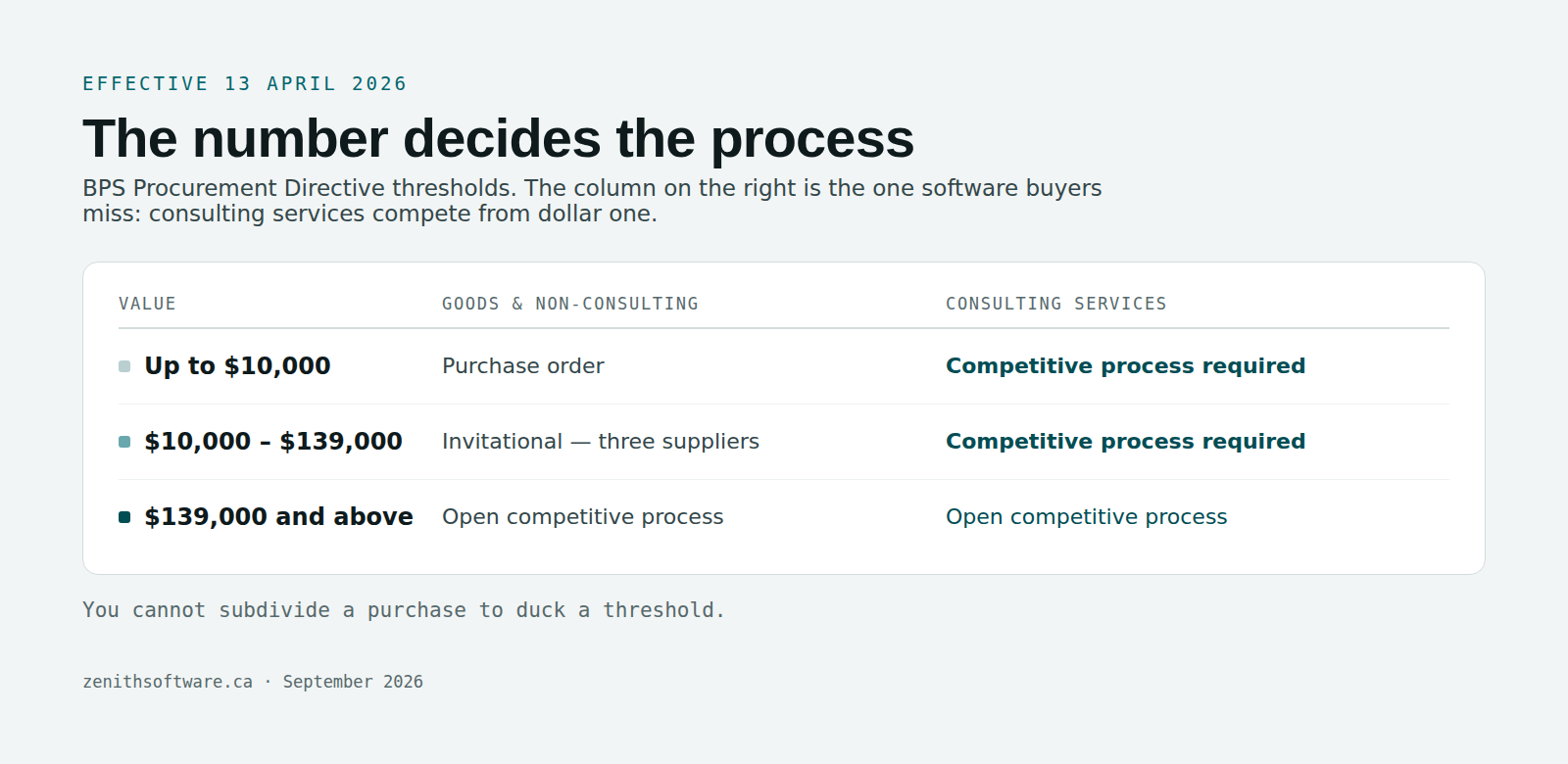
The current directive, effective 13 April 2026, sets these out plainly.
| Value | Goods & non-consulting services | Consulting services |
|---|---|---|
| Up to $10,000 | Purchase order | Competitive process required |
| $10,000 – $139,000 | Invitational — at least three suppliers invited | Competitive process required |
| $139,000 and above | Open competitive process required | Open competitive process required |
One rule underpins all of it: you cannot subdivide a purchase to duck a threshold. Three $50,000 phases of the same project are a $150,000 project.
The classification trap in a BPS Procurement Directive purchase
Here is where software buyers get caught. A booking system is rarely one thing on the invoice.
- The licence or subscription is generally goods or non-consulting services. Under $10,000 it can go on a purchase order.
- The implementation — advice, configuration decisions, process design — can be consulting services. And consulting has no lower threshold. A competitive process is required from dollar one.
So a $9,000 subscription with $12,000 of implementation advice is not a quiet purchase order. Split the quote into its parts before you decide the route, and have your procurement office classify each one. A vendor who offers to bundle it all into a single low line to “keep it simple” is offering you a problem, not a favour.
Seven things a BPS Procurement Directive evaluation asks
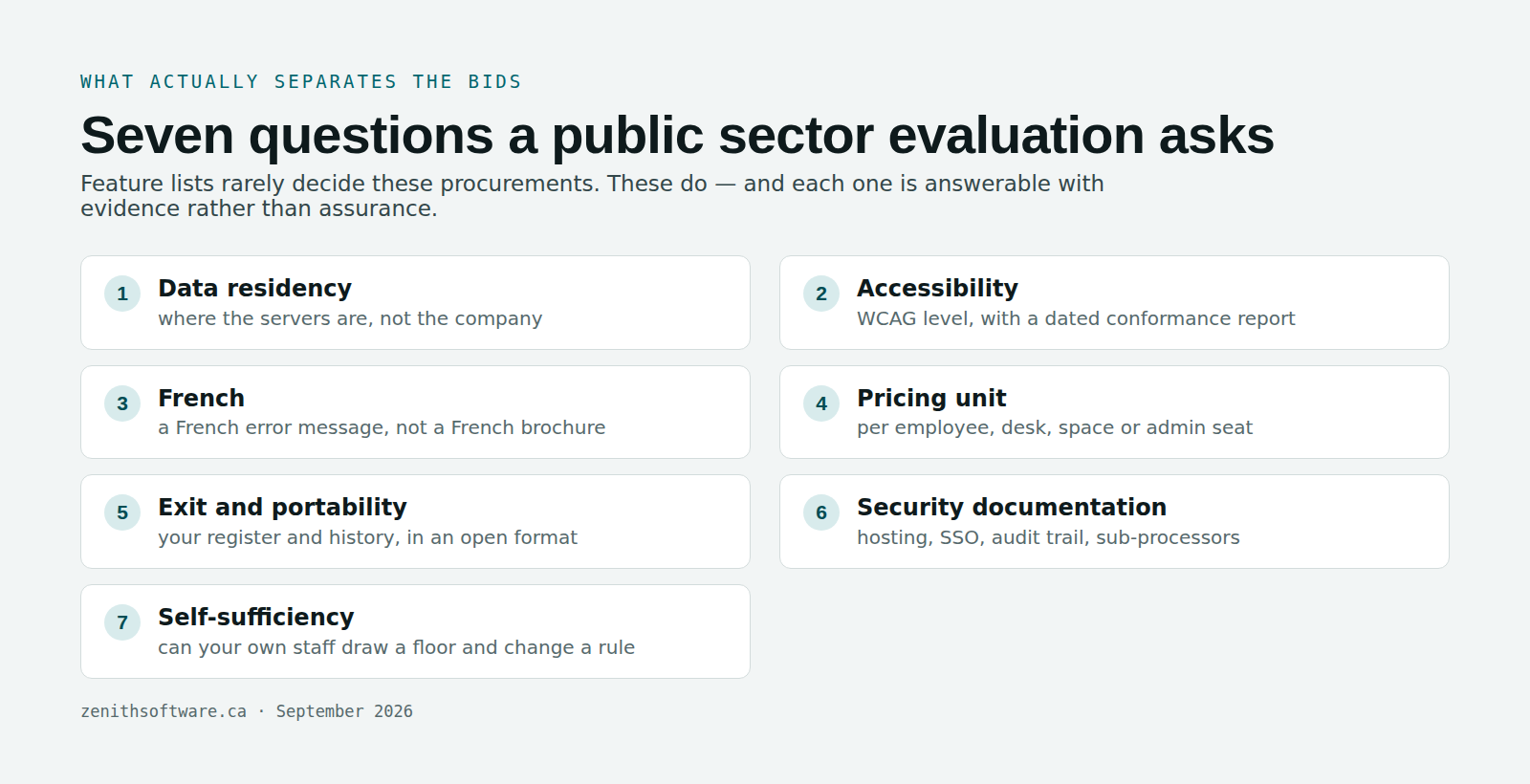
Feature lists rarely decide these. These seven do.
- Where does the data physically live? Not where the company is — where the servers are. Many strong products host outside Canada. That is a hard filter for some organisations and irrelevant to others, so establish which you are early.
- What accessibility standard does it meet, with evidence? Under the AODA, designated public sector organisations must make public websites meet WCAG 2.0 Level AA. Ask for a conformance report with a date and an author, and run your own keyboard test. Our guide to accessible booking systems covers what to check.
- Is French first-class or a translated skin? Ask to see a French user’s notification email and a French error message, not the marketing site.
- What is the pricing unit? Per employee, per desk, per space and per site scale very differently over a five-year term, and the term is what gets evaluated.
- What happens to your data at the end? Exit and portability belong in the evaluation, not in the renewal conversation three years later. Ask for an export of the space register and the booking history in an open format.
- Who holds the security documentation? Hosting model, encryption, single sign-on, audit history, breach process, sub-processors.
- Can your own staff run it? If only the vendor can draw a floor plan or change a rule, every future fit-out becomes a new purchase — possibly a new procurement.
Why the pricing model outranks the price
Evaluations under the BPS Procurement Directive score total cost over a term, usually five years. That makes the unit of pricing more consequential than the headline rate.
A per-employee model grows with your headcount whether or not more people book anything. A per-desk model charges you for holding an accurate register — which is precisely the behaviour good space management depends on. A model priced by administrator seats stays flat while reservation users grow, which tends to score better across a term and is easier to defend in an evaluation.
Model your own numbers over the full term before you compare rates. The cheapest year one is regularly the most expensive year five.
Preparing your side of a BPS Procurement Directive process
- Write the requirement, not the product. “Staff can book a desk from a floor plan and the space register stays accurate” is a requirement. A named vendor’s feature list is not, and it will be challenged.
- Decide your mandatory versus rated criteria early. Mandatories exclude; make sure each one is genuinely essential and defensible.
- Name the evaluation team and the scoring method before you see any bids.
- Pick one floor for the demo — ideally the one nobody can account for — and make every vendor show you that floor rather than their own.
- Keep the record. The directive expects documented, defensible decisions. Notes written afterwards are not the same thing.
Questions people actually ask
Does the BPS Procurement Directive apply to municipalities?
No. Municipalities follow their own procurement by-laws, and Ontario has separate directives aimed at them. The principles overlap enough that the seven questions above still apply, but the thresholds and the process will be your own council’s.
Is software a good or a service under the directive?
A licence or subscription is generally treated as goods or non-consulting services, while advisory and configuration work can fall under consulting services, which is competitive from dollar one. Because the classification changes the route, get your procurement office to rule on each line of the quote rather than deciding it yourself.
Can we buy from an existing vendor without competing?
Only in the limited circumstances the directive allows, and each needs documented justification. “We already use them” is not one of them. If an existing contract might cover the new purchase, have procurement check the original scope before you assume it does.
Do we have to pick the lowest bid?
No. You must apply the evaluation criteria you published, and score against them consistently. That is why the criteria matter more than the bids — they are the decision, made in advance.
How long does a BPS Procurement Directive process take?
An invitational process can run in weeks. An open competitive process is usually months once you include drafting, the posting period, evaluation and approvals. Plan the implementation timeline backwards from that, not forwards from the day you choose.
What about Buy Ontario expectations?
Ontario has directives encouraging Ontario and Canadian suppliers in public sector purchasing. They sit alongside the BPS Procurement Directive rather than replacing it, and the details change — check the current version with your procurement office rather than relying on a vendor’s summary, including ours.
Where to start
Get the quote split into its parts, have procurement classify each one, and confirm your BPS Procurement Directive threshold before anything else. That single step prevents the most common and most painful failure in this category: a purchase that has to be redone because it took the wrong route.
Then write the seven questions into your evaluation. If a Canadian-owned, Canadian-hosted option belongs on the list, Zenith Workplace is priced by administrator seats rather than by desk or employee, built to WCAG 2.2 AA, bilingual in both directions, and drawn by your own staff rather than ours.
Published by Zenith Software Corp., Victoria, British Columbia · September 2026. Practical guidance, not procurement or legal advice — confirm every threshold and rule with your own procurement office. We verified the external references in September 2026.