

Most hot desking rollouts that go wrong did not fail on the software. They failed because nobody wrote the rules down. Two months in, the floor runs out of a group chat, one team has quietly colonised the window row, and somebody in HR is fielding a complaint nobody anticipated. A hot desking policy is what prevents that, and it takes an afternoon.
Below is a hot desking policy template you can adapt — thirteen clauses, the wording for each, and the reasoning underneath. It assumes a Canadian workplace, so it also covers the three clauses most drafts miss.
What makes a hot desking policy fail
Three failures account for almost all of them.
- Silence. No rule means the loudest person wins. People who arrive early or push hardest end up with the good desks, and everybody else learns not to bother.
- Rules nobody can act on. “Book responsibly” is not a rule. A rule names the limit, the consequence and who to ask.
- Undocumented exceptions. One manager quietly reserves desks for their team, and the policy dies. Exceptions are fine. Secret ones are not.
Write it down, make the limits numeric, and publish the exceptions. That is most of the work.
The thirteen decisions your hot desking policy has to make
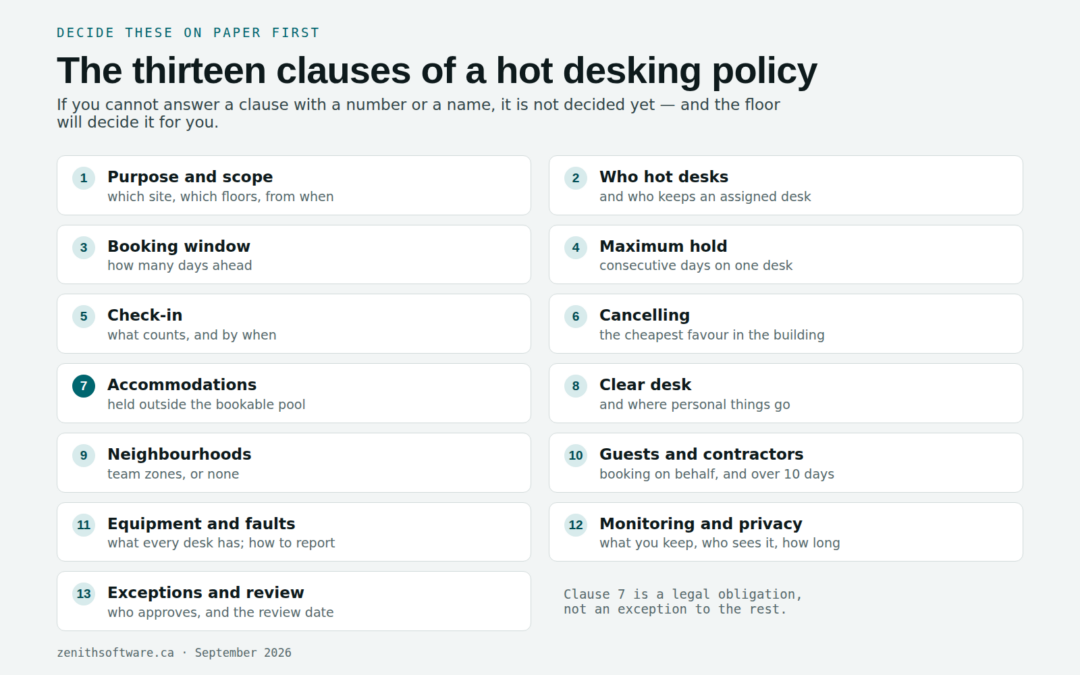
Each one is a decision, not a paragraph of prose. If you cannot answer it with a number or a name, it is not decided yet.
The hot desking policy template
Copy this, replace everything in square brackets, and delete what does not apply. It is deliberately plain. A policy people read beats a policy that sounds impressive.
Clauses 1–4: scope and limits
1. Purpose and scope. This policy covers desk use at [site / building / floor]. It applies to [all staff / named teams] from [date]. It does not cover meeting rooms, which are governed by [policy name].
2. Who hot desks. [Teams or roles] use bookable desks. [Roles] keep assigned desks because [reason: specialist equipment, confidential work, accommodation]. Assigned desks are listed in [location] and are not bookable by anyone else.
3. Booking window. You may book up to [10] working days ahead. Bookings open at [time] each day. The window exists so the floor cannot be claimed months in advance by whoever plans furthest ahead.
4. Maximum hold. No one may hold the same desk for more than [5] consecutive working days without approval from [role]. If you need a desk permanently, ask for an assigned one instead.
Clauses 5–8: day-to-day use
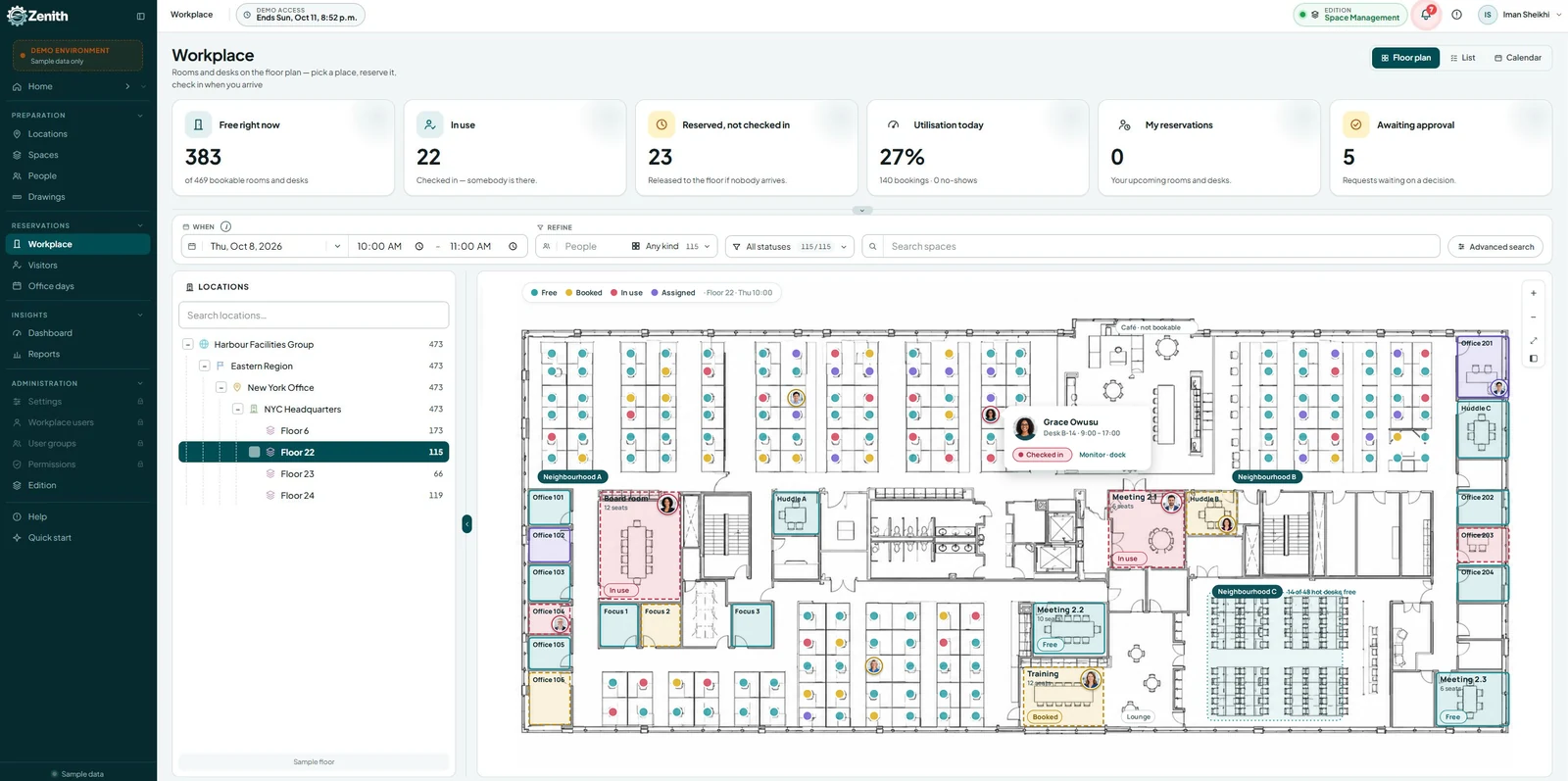
5. Check-in. Confirm your booking in [the app / on arrival] by [09:30, or within 15 minutes of the start time]. Unconfirmed bookings are released automatically and the desk returns to the plan for anyone to take.
6. Cancelling. If your plans change, cancel. Cancelling early costs you nothing and is the single most useful thing you can do for a colleague.
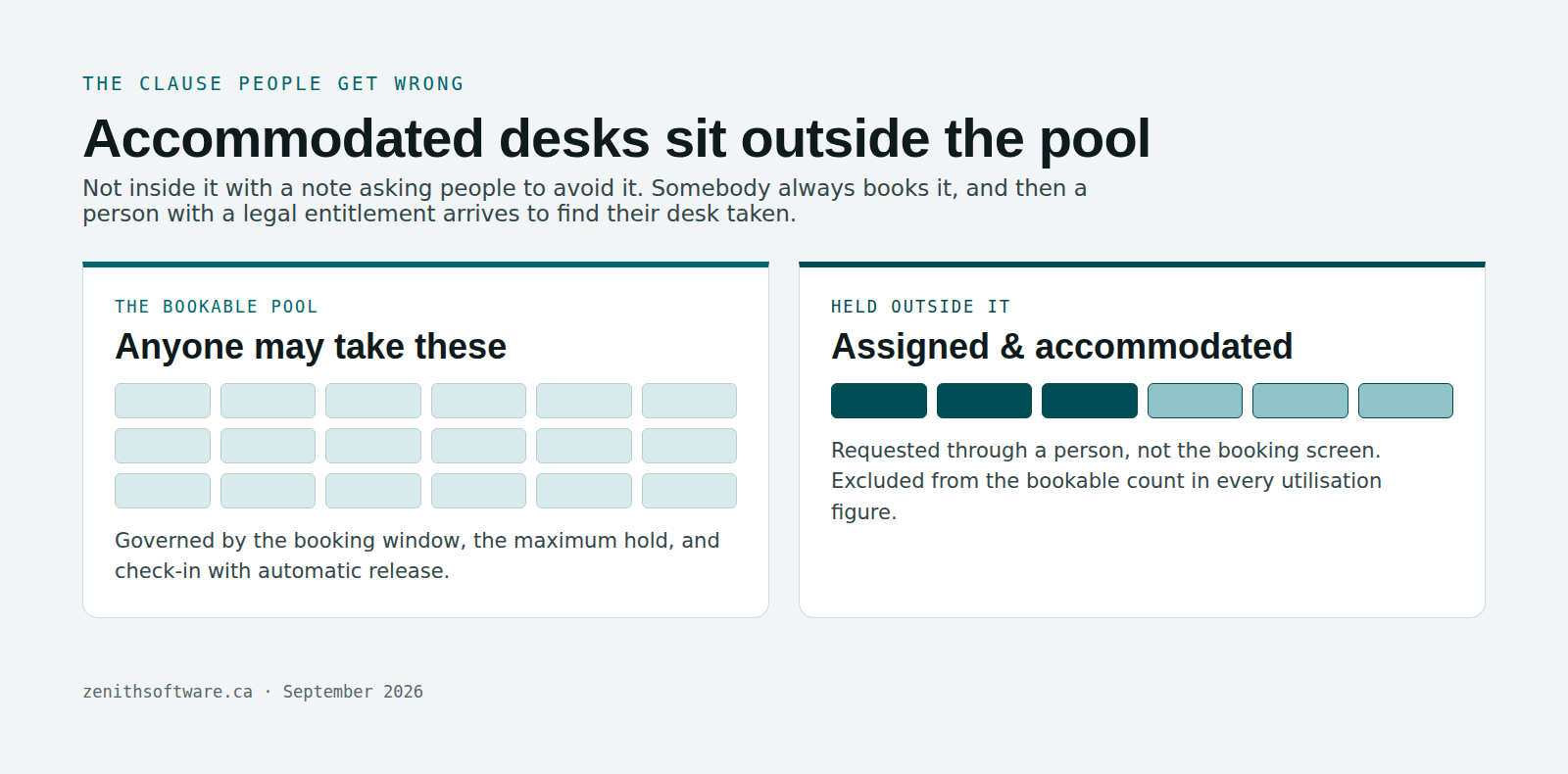
7. Accommodations. If you need a specific desk or equipment for health, disability, religious or caregiving reasons, contact [role] rather than this booking system. Accommodated desks are held outside the bookable pool. This is not an exception to the policy; it is a legal obligation and it takes priority over it.
8. Clear desk. Leave the desk as you found it. Take everything with you, including cables, mugs and paper. Personal storage is [locker number / pedestal / none provided].
Clauses 9–13: people, data and review
9. Neighbourhoods. [Team] desks sit in [zone] so the team can be found. Within the zone, any desk may be booked by any team member. [Or: we do not operate neighbourhoods.]
10. Guests and contractors. Book on a guest’s behalf using [method]. Guests are recorded against the booking. Contractors on site for more than [10] days are handled as [assigned / bookable].
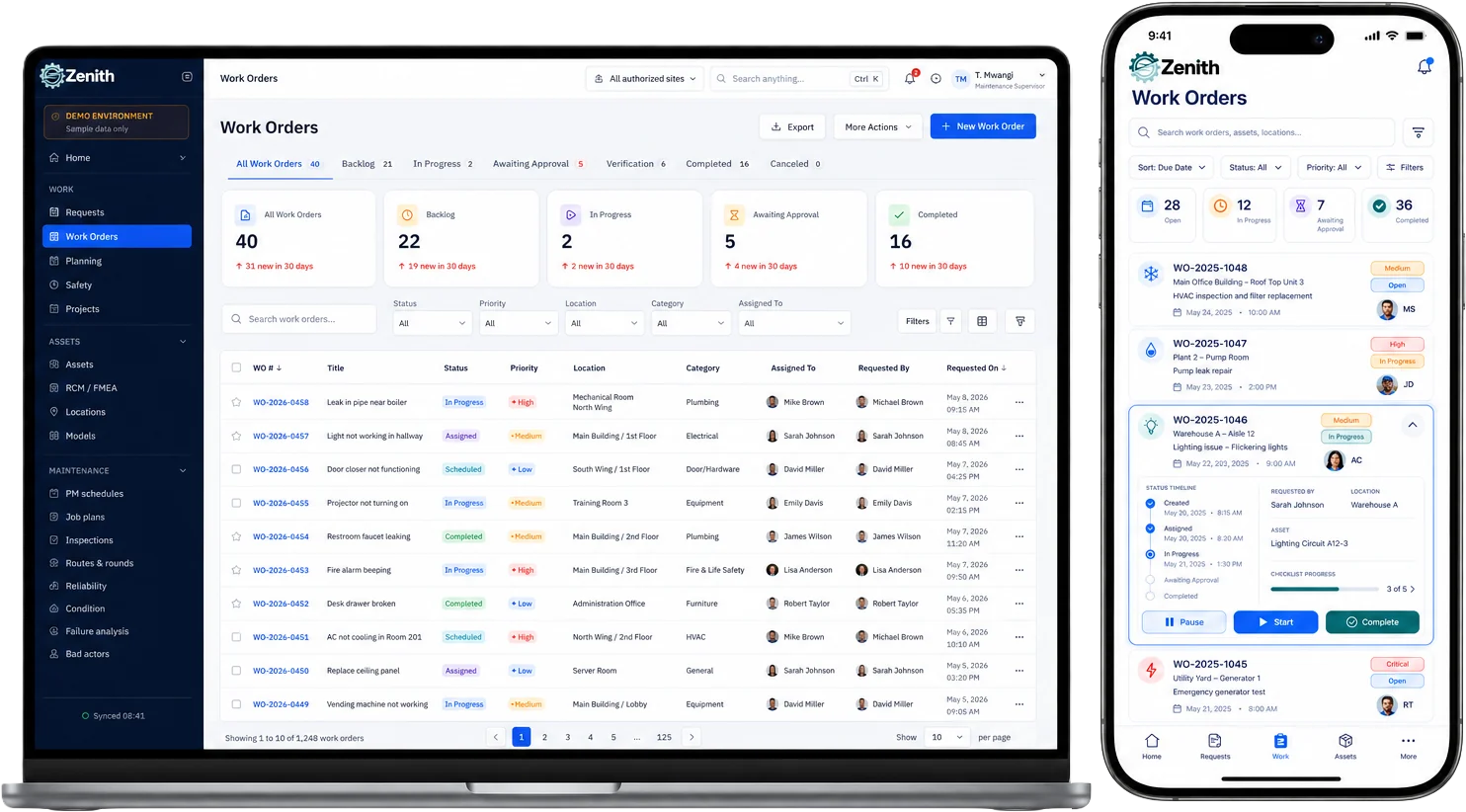
11. Equipment and faults. Every desk has [monitor, dock, chair]. Report a fault through [method] and it becomes a work order. Do not move equipment between desks.
12. Monitoring and privacy. We keep bookings and check-ins to run the floor and to report on how much of it is used. We report by floor, team and space type, not by individual. Access is limited to [roles]. Records are kept for [12] months. We do not use this data for attendance management [or: we do, and here is how].
13. Exceptions and review. Exceptions are approved by [role] and recorded in [location]. This policy is reviewed on [date], and sooner if the floor changes.
Thirteen clauses, none of them long. If yours runs past two pages, you are writing a handbook instead of a policy.
Three clauses Canadian workplaces get wrong
The template above is generic. These three are where Canadian employers actually get into difficulty.
Accommodation is not an exception
Employers have a duty to accommodate. The Canadian Human Rights Commission puts the obligation plainly: employers must adjust rules, policies or practices so everyone can participate fully, and that explicitly includes physical workspace and equipment.
In practice this means one thing for your floor plan. A desk set up for somebody’s accommodation comes out of the bookable pool entirely. It does not sit in the pool with a note asking people to avoid it, because somebody will book it, and then a person with a legal entitlement arrives to find their desk taken. Clause 7 exists to prevent exactly that conversation. The booking screen needs the same care: our guide to an accessible booking system lists the eight checks to run before you buy.
Booking data is personal information
A booking record says who was in which building on which day. That is personal information, and Canadian privacy law treats it as such. The Office of the Privacy Commissioner’s summary of PIPEDA is the place to start, and Quebec employers have additional obligations under Law 25.
Clause 12 is not boilerplate. Say what you collect, why you collect it, who can see it, how long you keep it, and — this is the one people care about — whether it feeds attendance management. If it does, say so. Staff will work it out either way, and finding out by accident is what turns a policy into a grievance.
Bilingual and unionised workplaces need it in writing twice
If you operate in both official languages, the policy exists in both, and so do the refusal messages your booking tool sends. An English-only “booking declined” tells a French-speaking employee nothing.
And in a unionised workplace, changing how you allocate desks can touch the collective agreement. Check before you publish, not after the first grievance.
Rolling the hot desking policy out
Announce the policy a week before it takes effect. Start with a generous check-in grace period and tighten it once people have seen the release work. Publish the exceptions list on day one.
We wrote a longer piece on sequencing this — how to roll out a space scheduler without disrupting work — and the short version is that the policy decisions are the critical path, not the software configuration.
Choosing the system that will enforce the policy? Our desk booking software guide for Canadian offices lists the features and demo questions that matter.
How to tell whether the hot desking policy is working
Three numbers, checked monthly. Each one reports on a different clause of the hot desking policy.
- No-show rate. Bookings never checked into, divided by bookings made. If it stays high, clause 5 is too soft or checking in is too hard. The mechanics are in our piece on no-shows and ghost bookings.
- Peak-day occupancy. Not the monthly mean — the busiest day. If your peak brushes capacity, you do not have enough desks, whatever the average says. How to calculate space utilisation covers the divisor, which is where most of these figures go wrong.
- Exceptions granted. Count them. A policy with thirty exceptions is not a policy; it is an assigned-seating plan with extra steps.
Questions people actually ask
What should a hot desking policy include?
A workable hot desking policy answers seven questions. Who hot desks and who does not. How far ahead people book. How long they can hold a desk. What happens when they do not turn up. How you handle accommodations. What the clear-desk rule says. And what you do with the booking data. The thirteen clauses above cover those, plus the practical extras.
Is a hot desking policy legally required in Canada?
No single law requires the document. But several obligations land on it: the duty to accommodate, privacy law covering booking records, health and safety duties for the workstations themselves, and any collective agreement terms about workspace. A written policy is how you demonstrate you have thought about them. We are a software company, not your lawyers — have counsel read it before you publish.
How many desks per person should we plan for?
Measure rather than guess. Take your peak-day attendance over a full quarter, add headroom for growth, and size to that. Published ratios circulate widely, but they come from other organisations’ attendance patterns, which are not yours. Your own peak day is the only number that means anything.
Can we require people to hot desk?
Generally yes, subject to accommodation duties and any collective agreement. What you cannot do is impose it without a plan for the people who genuinely need a fixed setup. That is what clause 2 and clause 7 are for.
Do we need to consult the union first?
If desk allocation touches your collective agreement, yes. Even where it does not, consulting early is cheaper than a grievance. Bring the draft, not the decision.
How often should the policy be reviewed?
Set a date in the document — six or twelve months — and review sooner if the floor changes. A fit-out, a team move or a change in attendance patterns all invalidate the numbers you chose.
What if people ignore it?
Look at which clause they ignore before you enforce anything. Widespread rule-breaking usually means the rule is wrong. If everybody holds desks for a week, your booking window or your desk count is the problem, not your staff.
Where to start
Take the template, fill in the brackets for one floor, and circulate it to the managers on that floor. Their objections will tell you which numbers are wrong faster than any amount of planning. Publish it, run it for a month, then look at the three metrics.
Would you rather the system enforced the hot desking policy instead of everybody’s memory? Booking windows, maximum holds, check-in and release, all as rules per space type — that is what Zenith Workplace does, with house rules you set per desk and per room. Canadian-owned, Canadian-hosted, and bilingual in both directions.
Published by Zenith Software Corp., Victoria, British Columbia · September 2026. Treat this as practical guidance, not legal advice. We verified the external references in September 2026.