
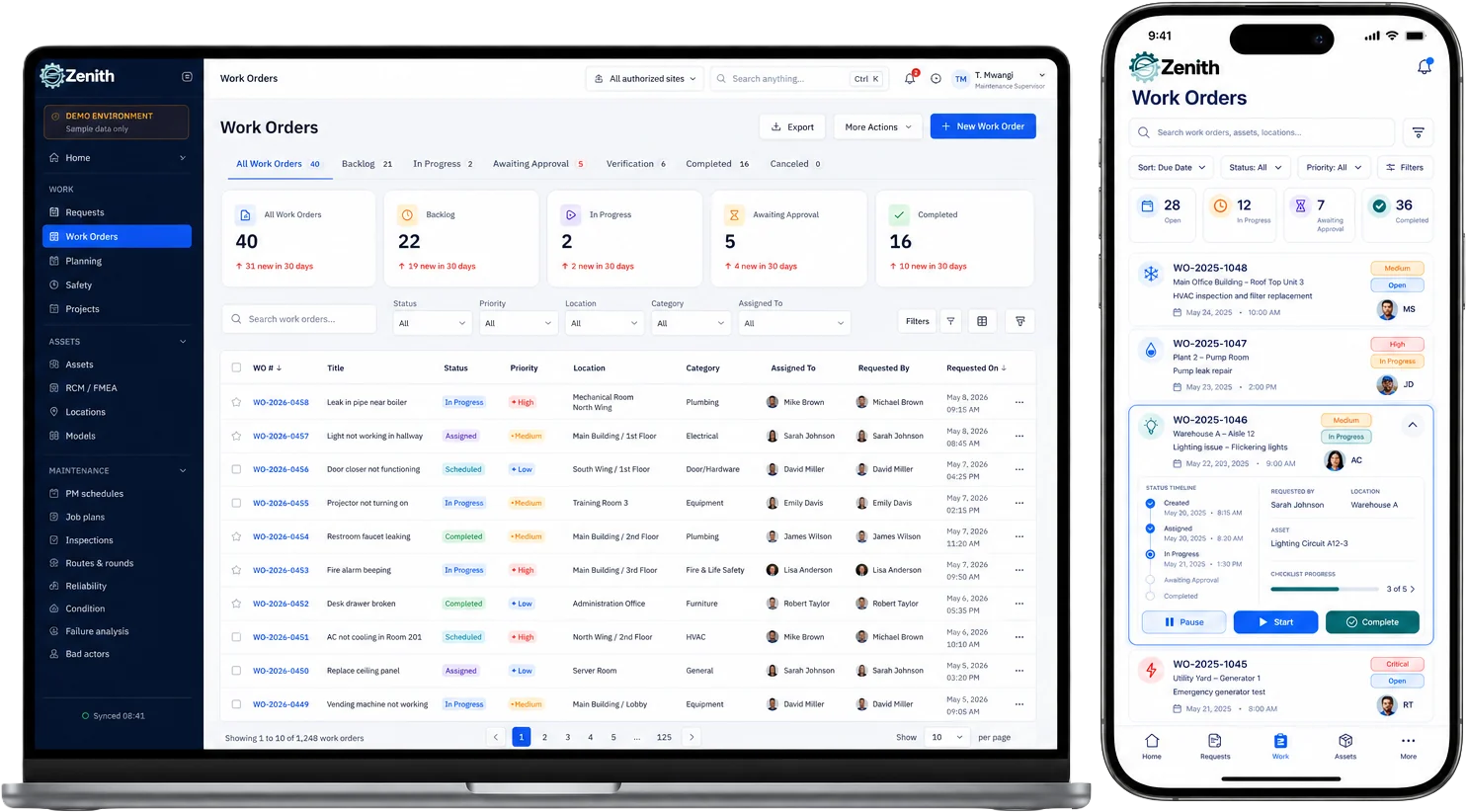
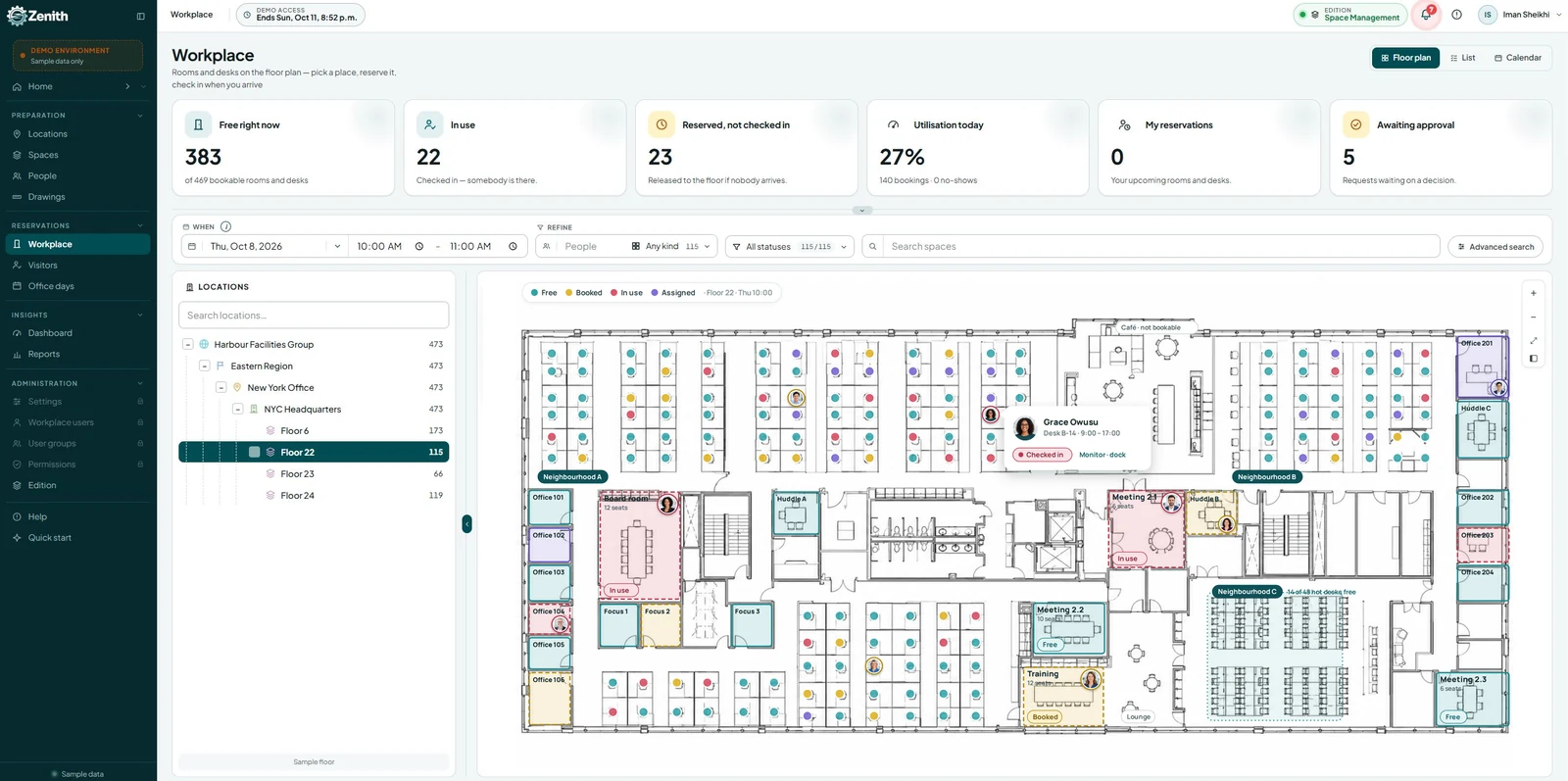


Canadian utilities keep the basics running. For example, water treatment plants, reservoirs, pump and lift stations, wastewater plants, substations and generating stations all need regular maintenance, and most of them are owned by municipalities or public agencies that must show residents, councils and regulators where the money goes. Therefore, this guide explains what is different about utility maintenance in Canada, what a CMMS for utilities needs to do, and how Zenith’s Advanced and Premium editions support water, wastewater and electricity utilities.
What is different about utility maintenance in Canada
Asset management is now the law for municipalities in Ontario
First, the planning rules have changed. For instance, under Ontario Regulation 588/17, every municipality had to have an approved asset management plan for all its infrastructure assets by July 1, 2025. In addition, the plan must set proposed levels of service, list the activities needed to reach them and show a strategy to fund those activities. In other words, councils now expect maintenance data to support lifecycle costs, condition and service levels, not just a list of repairs.
Drinking water: a quality management standard with a maintenance element
Similarly, in Ontario, municipal drinking water systems operate under the Drinking Water Quality Management Standard (DWQMS). Notably, the updated version 3.0, published in February 2026, includes an element on infrastructure maintenance, rehabilitation and renewal. Among other things, it expects the operating authority to:
- first, document a summary of its maintenance, rehabilitation and renewal programs;
- also, keep a long-term forecast of major activities and review it at least once each calendar year;
- then, monitor how effective the maintenance program is;
- in addition, follow a procedure for the calibration, verification and maintenance of measurement and recording equipment;
- finally, consider equipment reliability and redundancy in its risk assessment.
As a result, a water utility needs more than work orders, and a CMMS for utilities has to hold the evidence. It needs schedules, effectiveness figures and calibration records it can show during an audit.
Electricity: reliability standards and electrical maintenance
Electricity utilities answer to reliability rules as well. For instance, in Ontario, North American (NERC) reliability standards and NPCC criteria are mandatory, with enforcement dates set under the market rules. These include PRC-005, which covers the maintenance of protection systems. Likewise, Alberta applies its own versions of several of these standards. Separately, CSA Z463:24, Maintenance of electrical systems, published in September 2024, sets requirements for keeping electrical equipment in working order. However, it excludes supply equipment owned by electrical utilities, which falls under another CSA standard, but it applies to the electrical systems inside plants, pump stations and other facilities.
Climate, distance and small teams
Finally, the conditions are Canadian. For example, frost, freeze-thaw cycles, spring runoff and wildfire seasons put stress on mains, pumps and lines. Also, many utilities serve large areas with a small crew, often with an operator who covers several stations on a route. Moreover, many communities need service and records in both English and French.
Maintenance challenges a CMMS for utilities must solve
- Many sites, few people. Above all, treatment plants, reservoirs, wells, lift stations and substations must be visited and checked on a schedule.
- Different clocks. For example, pumps and generators need service on run hours, others on the calendar, and some only when a reading drifts out of range.
- Calibration and regulatory tasks. Similarly, analyzers, flow meters and protection relays need recurring tests with records that prove they were done on time.
- Safe work. Moreover, confined spaces in wet wells and chambers, energy isolation on pumps and switchgear, and hot work all need permits.
- Capital renewal. Likewise, replacing a pump station or a substation transformer is a project with a budget and a timeline.
- Reporting to council. Finally, asset management plans need lifecycle costs, condition and service-level figures from real maintenance data.
What a CMMS for utilities should include

- An asset register by site. First of all, every pump, motor, valve, analyzer, generator and breaker sits under its plant or station, with specifications, drawings and full history.
- Preventive maintenance with several triggers. In other words, calendar, run hours or whichever comes first, and programs that cover a whole class of equipment.
- Routes and inspections. Then, station rounds with readings and pass/fail checks, and automatic follow-up work when something fails.
- Calibration and regulatory schedules. Also, recurring tasks for each instrument or relay, with the result and the person recorded.
- Permits to work. In addition, confined space entry, energy isolation and hot work permits linked to the job.
- Cost and reliability data. Besides, maintenance cost per asset, failure history and bad actors to feed the asset management plan.
- Mobile and offline. Lastly, operators record work at the station, even where the signal is weak.
Zenith as a CMMS for utilities: Advanced and Premium
To begin with, Zenith’s Basic and Essential editions cover requests, work orders, assets, preventive maintenance, meters, parts, labour and the technician mobile app. For water, wastewater and electricity utilities, the Advanced and Premium editions add:
Advanced and Premium features at a glance
| Utility need | Zenith feature | Edition |
|---|---|---|
| Station and lift-station rounds | Routes and rounds: many assets, one walk | Advanced |
| Hydrant, valve and analyzer checks | Inspections: checklists and readings with pass/fail and automatic follow-up work | Advanced |
| Pumps and generators on run hours | Hybrid triggers: time or meter, whichever comes first | Advanced |
| One program for every pump of a type | Class and fleet scope, with exclusions | Advanced |
| Standard procedures | Job plans: reusable steps, crafts, parts and tools | Advanced |
| Wet wells, chambers and switchgear | Safety: permits to work for confined space entry, energy isolation and hot work, with isolation points and a hazard register | Advanced |
| Capital renewal | Projects with scope, budget, progress and Gantt, plus the planning board | Advanced |
| Lifecycle cost for the asset management plan | PM cost forecast: labour, parts and contractor cost per year | Advanced |
| Contractors and suppliers | Vendors and contracts, and purchasing with requisitions, purchase orders and receiving | Advanced |
| Failing assets and repeat problems | Reliability: asset health, failure analysis, MTBF and MTTR, RCM and FMEA | Advanced |
| Work raised by a reading | Condition and event triggers: an out-of-limit reading raises the work | Premium |
| Proving the program works | PM effectiveness: failures between services and a suggested interval | Premium |
| Reports for council and management | Executive and multi-site reports, and a custom report builder | Premium |
| Data from finance and meters | Integrations with ERP and meter sources | Premium |
| Rules and forms | Automation and workflows | Premium |
| Fast answers from the history | Zenith Assist: history summaries and repair-or-replace advice | Premium |
Documents and your GIS
In addition, every edition keeps manuals, drawings, certificates and inspection reports on the asset they belong to, with revisions and status. Note that Zenith organizes assets by site, facility and area; it doesn’t replace your GIS, but it gives each station and plant a complete maintenance record. Of course, the editions and prices page lists every feature.
Example: a CMMS for utilities at a lift station
So, to see a CMMS for utilities at work, consider a wastewater lift station in a mid-sized municipality:
- First, the station and its two pumps sit in the register, each with its motor, nameplate, drawings and run-hour meter.
- Next, an operator round covers six lift stations. At each stop, the operator records run hours and checks alarms on a phone.
- Meanwhile, pump service follows a hybrid trigger: every 2,000 run hours or every 12 months, whichever comes first.
- Then one pump’s vibration check fails. Consequently, Zenith raises a follow-up work order, and the crew issues a confined space permit for the wet well before the repair.
- Finally, at year end, the cost, failure and service history of each pump feeds the asset management plan and the renewal forecast.
Getting started with a CMMS for utilities
- Start with one system. To start, load the water plant, or the wastewater lift stations.
- Bring your history. Next, import the asset list and past work from spreadsheets so your record starts complete. Our guide to building a preventive maintenance schedule you will actually keep helps with the programs.
- Set up the rounds. After that, turn station checks into routes with readings.
- Link to your plan. Then use the cost and condition data to update your asset management plan each year.
Finally, Zenith is made by Zenith Software Corp. in Victoria, BC. It works in English and French, on any phone, with your data hosted in Canada. You can book a demo to see the Advanced and Premium editions with utility equipment, or read our article on how long to keep maintenance records in Canada.
Questions people ask
What is a CMMS for utilities?
In short, it is maintenance software that keeps the asset register, schedules, inspections, work orders, permits and records for water, wastewater and electrical assets in one place, so a utility can plan its work, prove it was done and report on its assets.
Which Zenith edition does a utility need?
In most cases, utilities need Advanced, for routes, inspections, hybrid triggers, permits, projects and reliability. Premium also adds condition triggers, PM effectiveness, executive reports, automation and integrations, which larger utilities and regional systems usually want.
Can a CMMS help with an asset management plan?
Yes. Of course, a CMMS doesn’t write the plan, but it provides the data the plan depends on: what you own, its condition, how often it fails and what it costs to maintain.
Does Zenith replace our GIS or SCADA?
No. Instead, Zenith manages maintenance. Your GIS keeps the map of the network and your SCADA system runs the process; Zenith holds the maintenance work and history for the assets they show.
This article is general information, not legal or engineering advice. After all, requirements depend on the province, the regulator and the type of utility; always follow your regulator and your own management system.
Sources
- Municipality of South Huron, 2025 Asset Management Plan update (O. Reg. 588/17 requirements)
- Government of Ontario, Drinking Water Quality Management Standard, version 3.0 (February 2026)
- IESO, Reliability standards enforcement dates in Ontario
- Standards Council of Canada, CSA Z463:24, Maintenance of electrical systems