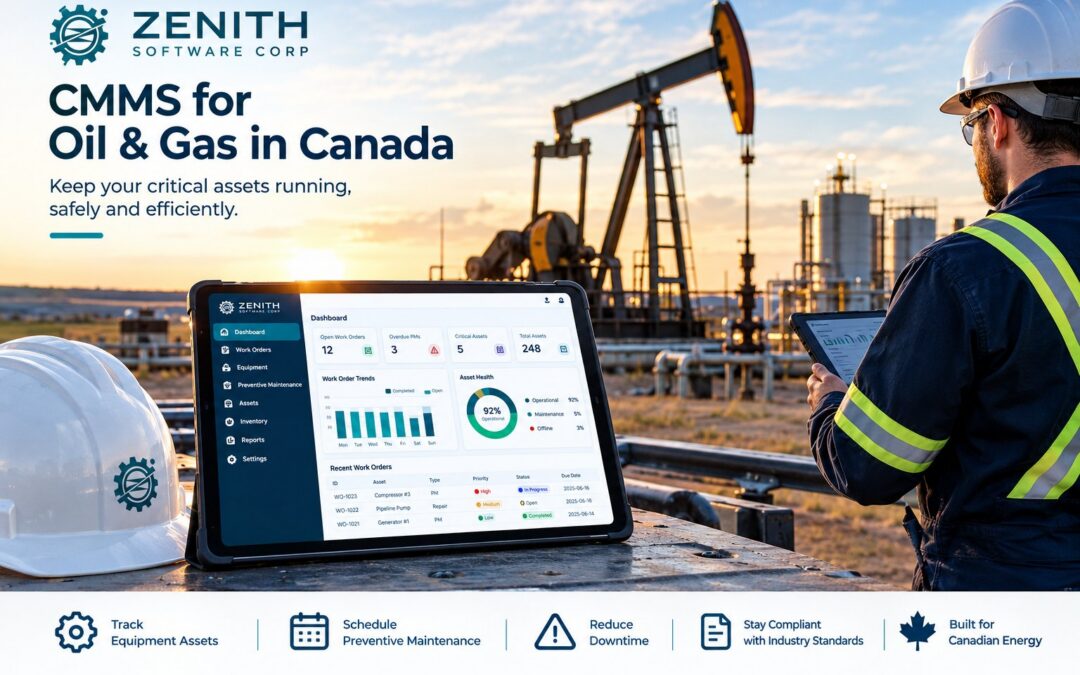
Oil and gas maintenance in Canada happens far from the office. For example, wellsites, compressor stations, gas plants, batteries and pipelines are spread across thousands of kilometres, often in deep cold, and much of the work is done by contractors. At the same time, regulators expect a clear record of every inspection, repair and integrity decision. Therefore, this guide explains what is different about maintenance in the Canadian oil and gas sector, what a CMMS for oil and gas needs to handle, and how Zenith’s Advanced and Premium editions cover it.
What is different about oil and gas maintenance in Canada
Several regulators, depending on where the asset is
First, the rules depend on who regulates the asset. Pipelines that cross provincial or national borders fall under the Canada Energy Regulator (CER). By contrast, most wells, facilities and pipelines inside one province fall under a provincial regulator, such as the Alberta Energy Regulator (AER) or the BC Energy Regulator. Moreover, pressure equipment has its own safety authorities, and federal environmental rules apply on top. Consequently, a single operator can answer to three or four bodies, each with its own expectations for records.
Pipelines: integrity management and audits
For instance, under the CER’s Onshore Pipeline Regulations, a company must run an integrity management program and audit it at least every three years. In addition, companies must keep audit and inspection records for the most recent five years of operation, or the period covered by the two most recent audits, whichever is longer. Similarly, in Alberta, the AER’s Directive 077 (latest edition July 2, 2026) brings its pipeline requirements together and supplements the Pipeline Act, the Pipeline Rules and CSA Z662, Oil and gas pipeline systems.
Pressure equipment: one harmonized integrity standard on the Prairies
Meanwhile, separators, treaters, compressors, boilers and pressure vessels are everywhere in upstream operations. In October 2025, Alberta (ABSA), Saskatchewan (TSASK) and Manitoba published AB-512H, a harmonized set of requirements for a Pressure Equipment Integrity Management System. Among other things, it expects owners to keep:
- an accurate inventory of all pressure equipment;
- records of design, manufacturing, maintenance, inspection, testing and repairs for each item;
- equipment-specific inspection plans, with periodic assessments on the required intervals;
- evidence that the people doing the work are competent, including any required certificates.
In other words, the regulator expects a living equipment register with history, not a filing cabinet.
Methane: more inspections, tighter repair timelines
The federal government finalized major amendments to the methane regulations for upstream oil and gas in December 2025. However, the main changes take effect on January 1, 2028, and by 2030 they cover all upstream onshore facilities. Specifically, facilities must carry out regular fugitive-emission inspections with optical gas-imaging instruments and repair leaking equipment within set timelines. As a result, leak detection and repair (LDAR) becomes a recurring maintenance program with due dates, findings and follow-up work, which is exactly what a CMMS is built to track.
Remote sites, winter and contractors
Finally, the conditions are uniquely Canadian. For instance, many sites have weak or no cell coverage. Also, winter access roads open and close with the season, and crews have to winterize and check equipment before freeze-up. In addition, contractors and service companies do much of the field work, so the operator needs to know who did what, with which certificate, and under which safe work permit. That is why a CMMS for oil and gas has to work offline and keep contractors in the same record as employees.
Maintenance challenges a CMMS for oil and gas must solve
- Thousands of assets in many places. Above all, wells, tanks, pumps, compressors, meters and pressure vessels need one register organized by area, site and facility.
- Mixed schedules. For example, some equipment is serviced on the calendar, some on run hours or meter readings, and some only when a condition changes.
- Field rounds. Typically, operators visit many sites on a route and record readings and checks at each stop.
- Safe work. Above all, hot work, confined space entry and energy isolation need permits, isolation points and sign-off before the job starts.
- Contractors and parts. Similarly, service contracts, warranties, purchase orders and spare parts must be tied to the work.
- Turnarounds and projects. Likewise, planned shutdowns need scope, budget, crews and a timeline.
- Proof. Finally, when an auditor or inspector asks, the operator must show the plan, the work and the result for a specific asset, often years later.
What a CMMS for oil and gas should include
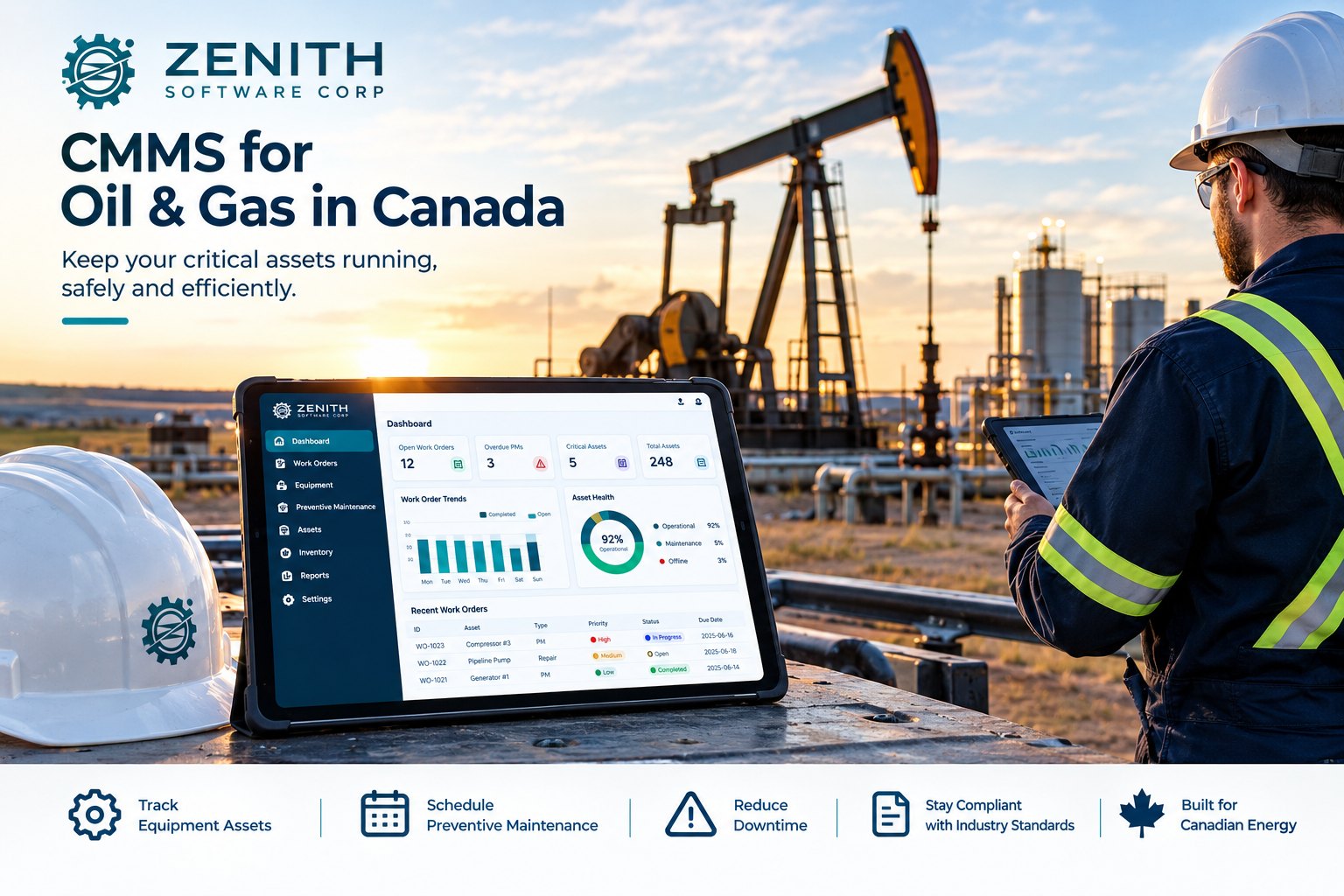
- An asset register with history. First of all, every item has its location, specifications, parent and child relationships, drawings, certificates and a complete work history.
- Preventive maintenance with several triggers. In other words, calendar, meter, or whichever comes first, applied to a single asset or to a whole class of equipment.
- Inspections and routes. Checklists with readings and pass/fail results, grouped into operator rounds, with follow-up work raised automatically when something fails.
- Permits to work. Hot work, confined space and energy isolation permits linked to the job and the asset, with the isolation points recorded.
- Mobile and offline. That way, technicians see their work, record time, readings and photos on a phone, and keep working without signal.
- Reliability analysis. Then, failure coding, bad actors, mean time between failures and RCM/FMEA to decide what maintenance is really worth doing.
- Planning, purchasing and contractors. Lastly, a planner’s board, purchase orders and receiving, and vendor contracts in the same system.
Zenith as a CMMS for oil and gas: Advanced and Premium
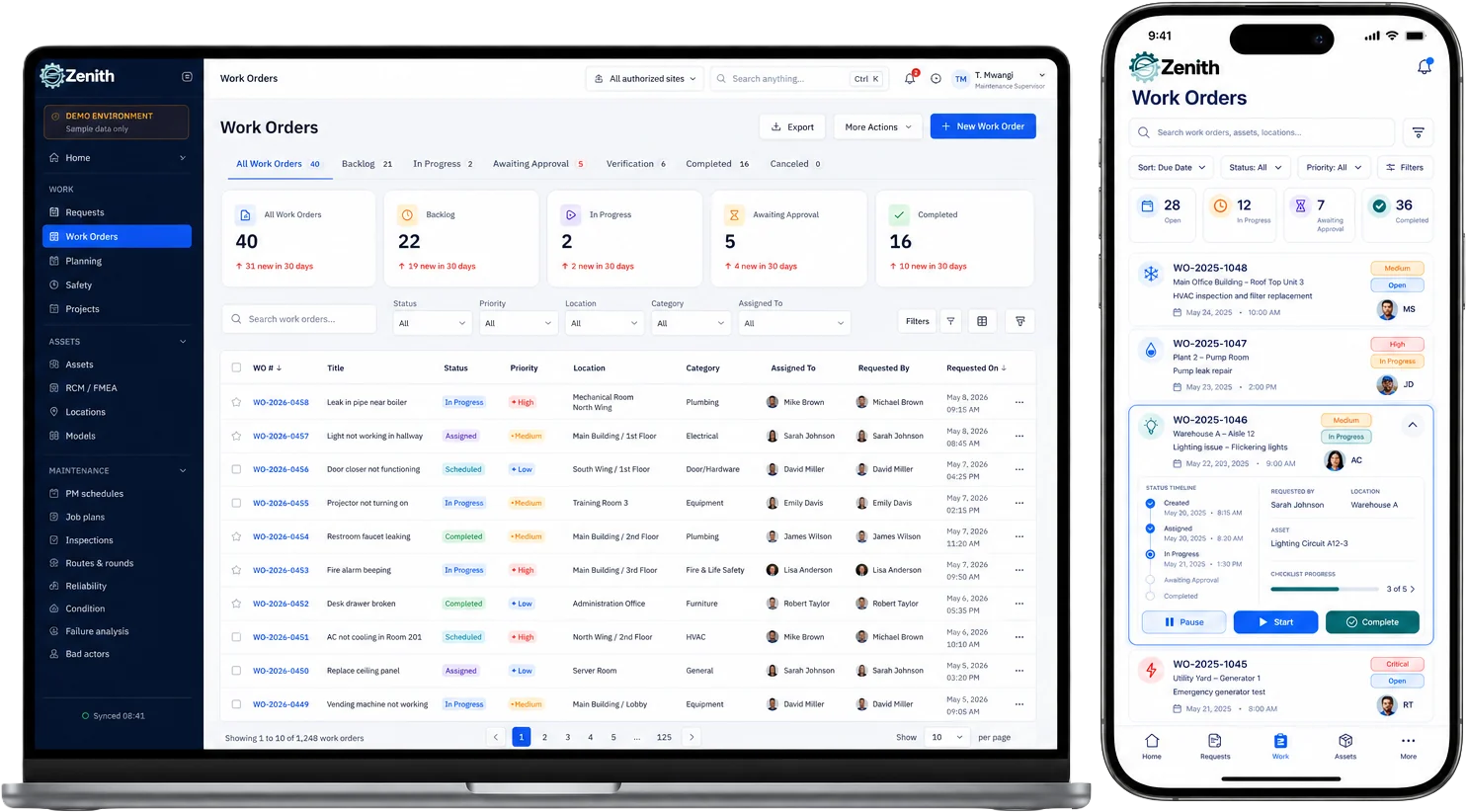
Zenith is built in editions. To begin with, Basic and Essential cover requests, work orders, assets, preventive maintenance, meters, parts, labour and the technician mobile app. For oil and gas operators, the Advanced and Premium editions add the tools that matter most:
Advanced and Premium features at a glance
| Need in the field | Zenith feature | Edition |
|---|---|---|
| Standard procedures for repeat jobs | Job plans: reusable steps, crafts, parts and tools for each kind of job | Advanced |
| Pressure equipment and LDAR inspections | Inspections: checklists and readings with pass/fail and automatic follow-up work | Advanced |
| Operator rounds across many sites | Routes and rounds: many assets, one walk | Advanced |
| Compressors and engines on run hours | Hybrid triggers: time or meter, whichever comes first | Advanced |
| One program for every separator or pump | Class and fleet scope, with exclusions | Advanced |
| Hot work, confined space, energy isolation | Safety: permits to work with isolation points, hazard register, safety tab on every asset and place | Advanced |
| Turnarounds and shutdowns | Planning and scheduling board, and Projects with scope, budget and Gantt | Advanced |
| Service companies and warranties | Vendors and contracts, plus purchasing: requisitions, purchase orders and receiving | Advanced |
| Budgeting maintenance | PM cost forecast: labour, parts and contractor cost per year | Advanced |
| Bad actors and failure patterns | Reliability: asset health, failure analysis, MTBF and MTTR, RCM and FMEA | Advanced |
| Work raised by a reading or an alarm | Condition and event triggers: an out-of-limit reading raises the work | Premium |
| Are the PMs actually working? | PM effectiveness: failures between services and a suggested interval | Premium |
| Many fields and facilities | Executive and multi-site reports, with site-by-site benchmarking, and a custom report builder | Premium |
| Company rules and forms | Automation and workflows: rules, forms and templates | Premium |
| Data from other systems | Integrations with ERP and meter sources | Premium |
| Quick answers from the history | Zenith Assist: history summaries and repair-or-replace advice | Premium |
Documents, crews and certificates
In addition, every edition keeps documents such as inspection reports, certificates and drawings on the asset they belong to, with revisions and status. From Essential up, Zenith also tracks crafts and certifications for your crews and contractors, and the calibration of your tools. Of course, the editions and prices page shows the full list.
Example: a CMMS for oil and gas, from inspection to repair
So, to see how a CMMS for oil and gas fits together, take a production separator at a gas plant in northern Alberta:
- First, the separator sits in the register under its site and facility, with its nameplate, drawings and inspection plan attached.
- Next, an inspection program covers every separator in the class. When the inspection comes due, the inspector completes the checklist on a phone, even without signal.
- Then a wall-thickness reading fails. Consequently, Zenith raises a follow-up work order automatically, linked to the separator and the failed reading.
- After that, the planner adds the repair to the next shutdown, assigns a contractor with the right certification and issues a hot work permit with its isolation points.
- Finally, after the repair, the record shows the reading, the permit, the contractor, the parts and the sign-off: everything an auditor will ask for.
Getting started with a CMMS for oil and gas
- Start with one area. To start, load the assets of one field or facility, with their current inspection plans.
- Bring your history. Next, import the equipment list and past work from spreadsheets, so the record starts complete. Our guide on switching CMMS software without losing your history explains how.
- Turn rules into programs. After that, set up the inspection, PM and LDAR programs with their triggers and due dates.
- Put the crews on mobile. Then give technicians and contractors the app, so the record is written where the work happens.
Finally, Zenith is made by Zenith Software Corp. in Victoria, BC. Besides, it works in English and French, on any phone, with your data hosted in Canada. You can book a demo to see the Advanced and Premium editions with oil and gas equipment, or read how to choose a CMMS edition by industry.
Questions people ask
What is a CMMS for oil and gas?
In short, it is maintenance software that keeps the asset register, inspection and maintenance programs, work orders, permits and records for wells, facilities and pipelines in one place, so operators can plan the work and prove it was done.
Which Zenith edition does an oil and gas operator need?
In most cases, operators need Advanced, for inspections, routes, permits to work, planning, purchasing and reliability. Premium also adds condition and event triggers, PM effectiveness, multi-site reporting, automation and integrations for larger or multi-field operations.
Does Zenith work at sites without cell coverage?
Yes. In fact, the technician mobile app keeps working offline and sends the results when the connection returns. However, photos taken offline need a connection to upload.
Can a CMMS replace our integrity management program?
No. Instead, a CMMS holds the inventory, plans, inspections and records that the program relies on, but the program itself, its engineering decisions and its approvals remain your company’s responsibility.
This article is general information, not legal or engineering advice. After all, requirements depend on the asset, the province and the regulator; always follow your regulator, your safety authority and your own integrity management program.
Sources
- Justice Laws Website, Canadian Energy Regulator Onshore Pipeline Regulations (SOR/99-294)
- Alberta Energy Regulator, Directive 077: Pipelines – Requirements and Reference Tools
- ABSA, TSASK and Manitoba, AB-512H: Harmonized Requirements for Pressure Equipment Integrity Management Systems
- Lawson Lundell, Federal government finalizes major amendments to methane regulations for upstream oil and gas facilities