

A CMMS for Canadian property management has to solve a problem that does not exist in a single-jurisdiction market. The same elevator, in the same building type, generates a legally different maintenance record depending on which province it stands in. Real estate, rental and leasing is the largest sector in the Canadian economy — roughly 13.2% of GDP, a larger share than any other single sector, manufacturing included. It is also the sector where the record-keeping rules are most scattered, because no single regulator owns a building. Five of them do.
Updated September 2026. The Ontario Fire Code provisions below were read on e-Laws against the consolidation in force from 1 January 2026, currency date 31 August 2026.
Why a CMMS for Canadian property management answers to five regulators, not one
Walk a commercial tower and count the authorities. Elevators answer to the provincial elevating-device regulator. Fire alarms and sprinklers report to the provincial fire code and the local fire official. Boilers fall to the provincial pressure-equipment authority. Asbestos sits under occupational health and safety law. Backflow prevention often answers to a municipal bylaw.
That is five separate authorities before anyone has looked at the building envelope, which answers to nobody in particular until something falls off it. Each of those regulators wants a record. Each defines the record differently. None of them accepts the others’ format.
Consequently the job of a CMMS for Canadian property management is less about scheduling work than about producing five different kinds of proof from one set of maintenance activity. That is a data problem, and it is the reason software written for a single national code struggles here.
Elevating devices: the clearest case of provincial divergence in Canada
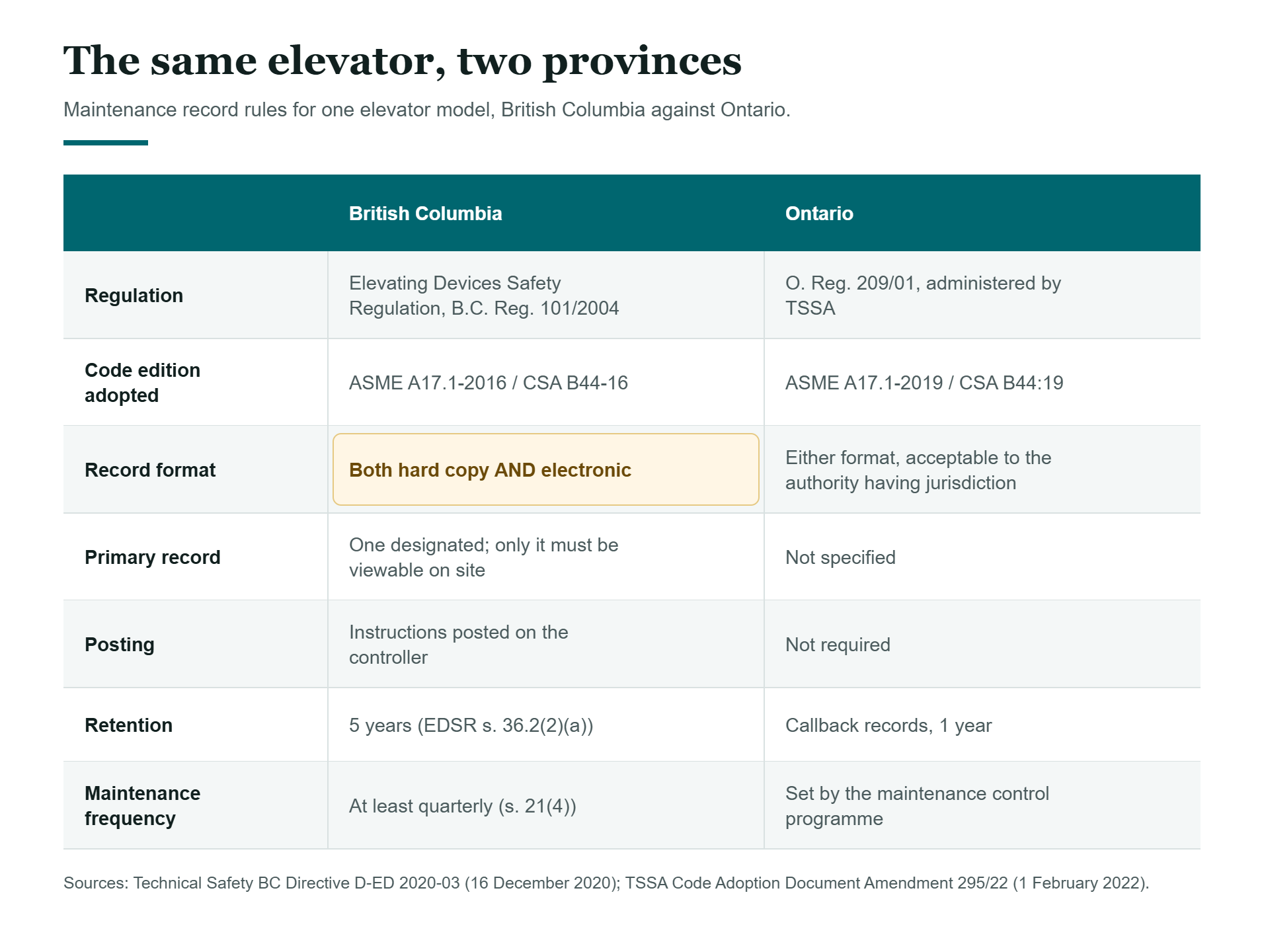
If you want one example that settles the argument about whether Canadian buildings need Canadian software, it is the elevator maintenance record. British Columbia and Ontario adopt the same North American code family, ASME A17.1/CSA B44, in different editions. However, they vary it in opposite directions, on the one point that decides what your software has to produce.
British Columbia requires both formats
Elevating devices in British Columbia fall under the Elevating Devices Safety Regulation, B.C. Reg. 101/2004, made under the Safety Standards Act. The regulation adopts ASME A17.1/CSA B44 and then modifies it through its Schedule.
Technical Safety BC Directive D-ED 2020-03, dated 16 December 2020, sets out what this means in practice. Maintenance control program records must be viewable on site by elevator personnel in both hard copy and electronic format. The contractor designates one version as the primary record, containing the full level of detail the code requires; the secondary version may hold the same information in summary. Only the primary record must be viewable on site.
Furthermore, instructions for locating those records for on-site viewing must be posted on the controller, or at the location where the means to perform tests are kept. Records are retained for no less than five years.
The regulation backs this independently. Under section 36.2(2)(a), the maintenance log must hold detailed records of all tests, inspections and other maintenance activities for the five previous years. Moreover, that log lives on the inside surface of the controller cover, or another location specified on the device, per section 36.2(2)(c). Meanwhile, where records are kept electronically and independently, section 36.2(2)(b) allows three months to complete it. Otherwise entries are made immediately after each maintenance activity.
Separately, section 21(2) requires the owner to engage a licensed contractor to maintain a programme of mandatory maintenance, and section 21(4) sets the frequency at at least quarterly.
Ontario requires either format
Ontario regulates elevating devices through the Technical Standards and Safety Authority under O. Reg. 209/01, made under the Technical Standards and Safety Act, 2000. TSSA’s Code Adoption Document Amendment 295/22, dated 1 February 2022, adopts ASME A17.1-2019/CSA B44:19 and amends the maintenance clauses.
Under that amendment, on-site maintenance records must be viewable by elevator personnel in either hard copy or electronic format acceptable to the authority having jurisdiction. Callback records are maintained for a minimum of one year. Note the qualifier: “either format” is not an unconditional permission, and the authority having jurisdiction still has a say in what it will accept.
Why the difference matters
A property group with towers in Vancouver and Toronto is running the same elevator under two record regimes. In Vancouver both a paper log and an electronic record must exist, one of them nominated as primary, with a notice on the controller telling an inspector where to look. In Toronto one format suffices.
An American CMMS will offer you an electronic elevator log and consider the problem solved. In British Columbia that is not compliance; it is half of it. The divergence here is specifically about format — both provinces expect a maintained record and a real retention period, but only one of them insists the record exist twice.
That kind of requirement has to live in configuration, not in a national template. Indeed, per-site rules in a CMMS for Canadian property management exist for exactly this.
Fire alarm records: Ontario explicitly permits electronic, and few owners know it
The Ontario Fire Code, O. Reg. 213/07, references CAN/ULC-S536-2019, “Standard for Inspection and Testing of Fire Alarm Systems”, invoked at Articles 6.3.2.2.(1) to (3) and 6.3.2.4. That much is unsurprising. The record provisions are where the useful detail sits.
- Article 1.1.2.1(1). Where the Code requires tests, corrective measures or operational procedures, records must be made noting what was done and the date and time it was done.
- Article 1.1.2.1(3). Those records are retained at the building premises for examination by the Chief Fire Official.
- Article 1.1.2.1(4). Electronic records that can be made readily available to the Chief Fire Official on request are deemed to comply with the on-premises requirement.
- Article 1.1.2.2(1)(a). Records are retained at the building for at least two years after being prepared.
- Article 1.1.2.2(1)(b). At minimum, the most recent and the immediately preceding record of a given test or inspection must be retained — which can exceed two years for an infrequent test.
- Article 1.1.2.2(2). Initial verification or test reports for fire protection systems installed after 21 November 2007 must be retained throughout the life of the systems.
Two of those deserve emphasis. Article 1.1.2.1(4) is an explicit statutory blessing for electronic record-keeping. In other words, the binder in the fire panel room is a convention, not a requirement, provided the records can be produced on request. A great many Ontario property managers still maintain paper because nobody told them otherwise.
Article 1.1.2.2(2) is the harder one. A verification report for a sprinkler system installed in 2009 must still exist when that system is decommissioned, potentially in 2059. That is a fifty-year retention obligation attached to a physical asset. It is also the single most common thing lost when a building changes hands or a property manager changes systems.
Asbestos: a recurring obligation with no fixed inspection interval
Ontario’s O. Reg. 278/05 imposes an ongoing duty on building owners where asbestos-containing material is present or reasonably suspected.
Under section 8(3)(a) the owner must prepare and keep on the premises a record containing the information set out in section 8(4). Specifically, that means the location of all such material, and whether it is friable or non-friable at each location. For friable sprayed-on material it also means the type of asbestos, where known.
Section 8(3)(f) requires the owner to inspect the material mentioned in the record at reasonable intervals to determine its condition. No number is given. As with Ontario’s refrigerant rules, the interval is yours to set and yours to defend.
Section 8(5) then requires the record to be updated at least once in each 12-month period, and whenever the owner becomes aware of new information. Section 8(3)(b) and (c) require notice to occupiers about material in their areas and to employers before work that may disturb it.
In practice this is three things at once: a recurring task, a document with a version history, and a notification workflow. By contrast, a spreadsheet handles all three badly. A maintenance system handles them as a matter of course. This is safety and compliance work, not paperwork.
Other Canadian sectors hit the same wall from different directions. See our write-ups on Canadian manufacturing and Canadian healthcare.
Boilers and pressure vessels: fixed intervals, hard deadlines
Ontario regulates boilers and pressure vessels under O. Reg. 220/01. Section 3(3) requires every owner and operator to operate their equipment safely and keep it in safe working condition, and a TSSA Certificate of Inspection is required before operation.
The intervals come from TSSA’s code adoption document rather than the regulation itself. They are specific: annually for high-pressure boilers, deaerators and quick-opening vessels; every two years for low-pressure boilers; every three years for pressure vessels. TSSA’s own guidance is to arrange the inspection 60 days before the expiry date printed on the existing certificate.
That last figure is the one that catches property teams out. Missing it is not a maintenance failure. Indeed, the equipment may be in perfect condition. Rather, it is a scheduling failure, and the kind that leaves you chasing an inspector while a certificate runs down. It is also, precisely, what a scheduling system exists to prevent.
Which modules a CMMS for Canadian property management actually needs
Assets
Every regulated device gets its own asset record: each elevator, panel, boiler and pressure vessel. In turn, the certificate, licence number, verification report and inspection history all attach to it. The fifty-year sprinkler verification report belongs on the sprinkler system, not in a folder named 2009.
Spatial
Buildings, floors, suites, risers, plant rooms. Asbestos records are location-specific by regulation: section 8(4) requires the location of all such material and, for each location, whether it is friable or non-friable. A record that says “present in the building” fails the test.
Maintenance
Preventive maintenance covers the quarterly BC elevator programme, the annual boiler inspection, the annual asbestos record update, the fire alarm testing cadence from CAN/ULC-S536. Where the interval is fixed, the schedule enforces it. Where the regulation says “reasonable intervals”, the schedule is your evidence of what you decided reasonable meant.
Work
Date, time, what was done, by whom — the literal content Article 1.1.2.1(1) requires. Each visit is a work order, so contractor attendance sits against the asset rather than against an invoice.
Administration
Per-site rules and data scope. A BC site carrying a dual-format record obligation and a controller-posting requirement; an Ontario site carrying neither. Same portfolio, same register, different configuration. Plus the audit trail, which is what turns a maintenance record into evidence.
Workforce and Vendors
Contractors matter here. Elevator mechanics are certified under O. Reg. 222/01 in Ontario and licensed in British Columbia. Quebec’s trades carry their own certification. Knowing that the person who signed a record held a valid certification on the day they signed it is part of the record’s value.
Analytics
Reporting shows certificate expiry across the portfolio, ranked by days remaining. Callback frequency by elevator, by building, by contractor. The 60-day boiler renewal window as a rolling report rather than a diary note.
How and why Zenith works as a CMMS for Canadian property management
Per-site regulatory context. This is the property a CMMS for Canadian property management lives or dies on: one register, per-site rules. The BC dual-format requirement and the Ontario single-format allowance can coexist in the same portfolio without maintaining two systems or pretending one rule fits both.
Documents that live for the life of the asset. Article 1.1.2.2(2) requires initial verification reports to survive as long as the system does. A document attached to the asset record survives building sales, property manager changes and contractor turnover in a way that a shared drive does not.
Records structured to be produced on demand. Ontario deems electronic records compliant where they can be made readily available to the Chief Fire Official on request. “Readily available” is doing real work in that sentence, and what counts is ultimately the Chief Fire Official’s call. What we can say is simpler. In short, being able to pull a building’s fire alarm testing history up on the spot beats an archive that takes two days to search.
Bilingual EN/FR at the platform level. A portfolio with Montreal assets produces French records because the platform carries French natively.
Terminology you can change. Property managers do not call things what plant engineers call them. If your organisation says “Suite” rather than “Location” and “Building Systems” rather than “Assets”, you change the words without a code release.
Frequently asked questions
Do British Columbia elevator records really have to be kept on paper as well as electronically?
Yes. Technical Safety BC Directive D-ED 2020-03 requires maintenance control program records to be viewable on site in both hard copy and electronic format. In addition, one is designated the primary detailed record, and only that primary must be viewable on site. This is a BC variation on the adopted code, not a national rule. It also reaches you through a regulator’s directive interpreting the code, rather than through the words of the regulation itself. Read the directive before you design around it.
How long must BC elevator maintenance records be kept?
No less than five years. The directive states this, and the Elevating Devices Safety Regulation independently requires the maintenance log to contain detailed records for the five previous years under section 36.2(2)(a).
How often must elevators be maintained in British Columbia?
At least quarterly. Section 21(2) of the Elevating Devices Safety Regulation requires the owner to engage a licensed contractor for a mandatory maintenance programme, and section 21(4) sets the minimum frequency.
Is Ontario’s elevator record rule the same?
No. Under TSSA Code Adoption Document Amendment 295/22, Ontario requires on-site maintenance records to be viewable in either hard copy or electronic format acceptable to the authority having jurisdiction. Callback records are kept for a minimum of one year.
Can we keep Ontario fire alarm records electronically?
Yes, explicitly. Ontario Fire Code Article 1.1.2.1(4) covers this directly. Specifically, electronic records that can be made readily available to the Chief Fire Official on request are deemed to comply with the on-premises requirement.
How long do Ontario fire alarm inspection records have to be kept?
At least two years after being prepared under Article 1.1.2.2(1)(a), and in any case at least the most recent and immediately preceding record of a given test under 1.1.2.2(1)(b). For an annual test that means two records; for a less frequent test it can mean considerably longer than two years.
Is there anything we have to keep permanently?
Yes. Article 1.1.2.2(2) requires initial verification or test reports for fire protection systems installed after 21 November 2007 to be retained throughout the life of the systems. In practice that is a multi-decade obligation attached to a physical asset.
Which edition of CAN/ULC-S536 does Ontario reference?
CAN/ULC-S536-2019, per the referenced documents table in the Fire Code as consolidated 1 January 2026. Note that the standard itself is published by ULC and is paywalled; we name it by number and title only.
How often must an asbestos record be updated?
At least once in each 12-month period under O. Reg. 278/05 section 8(5)(a), and whenever the owner becomes aware of new information relating to the matters the record deals with.
How often must asbestos-containing material be inspected?
The regulation says “at reasonable intervals” in section 8(3)(f) and sets no number. That makes the interval a decision you make and must be able to justify — which is an argument for scheduling it deliberately rather than leaving it to judgment.
What is the 60-day boiler deadline?
It is guidance, not a statutory deadline. TSSA advises arranging the inspection 60 days before the expiry date printed on the existing Certificate of Inspection, which is what gives you time to get an inspector booked. Inspection intervals run annually for high-pressure boilers, deaerators and quick-opening vessels, two years for low-pressure boilers and three years for pressure vessels.
Does a CMMS make us compliant?
No. Software does not comply with anything; your maintenance programme does. What a CMMS does is make the programme evidenceable. Instead, it holds the schedule, the completion, the technician, the reading and the document in one place. Answering “show me” then takes minutes, not a week of searching. Every interval and retention period in this article is a duty on you, not on your software vendor.
We manage buildings in four provinces. Does that mean four systems?
No. A CMMS for Canadian property management should run as one system with per-site rules. The differences between provinces are real but they are configuration differences — intervals, formats, retention periods — not different kinds of maintenance. Splitting into four databases guarantees that your portfolio-level numbers never reconcile.
A note on sources
The Ontario Fire Code and O. Reg. 278/05 provisions cited here were read on Ontario e-Laws in September 2026, against the Fire Code consolidation in force from 1 January 2026. The British Columbia elevating-device requirements come from Technical Safety BC’s own published directive and the Elevating Devices Safety Regulation. The Ontario elevating-device requirements and boiler inspection intervals come from TSSA’s own published documents rather than from the regulations. ASME A17.1/CSA B44 and CAN/ULC-S536 are paywalled standards, named here by number and title only. Nothing in this article paraphrases their text. Read the standard itself before building a compliance programme on any summary, including this one.