


A CMMS for Canadian retail has to solve a problem most software vendors never meet. Specifically, the refrigeration compliance record that governs your stores is written differently in every province. In at least one of them, it does not legally belong to you. Retail trade contributes roughly $125 billion to Canadian GDP, about 5.3% of the total. Wholesale and retail together employ close to 3 million people, around 14% of everyone working here. (Statistics Canada. GDP and Labour Force Survey use different industry groupings, so the two figures are not directly comparable.) Yet the rules that decide whether a grocer can prove it maintained its refrigeration are provincial, inconsistent and widely misunderstood.
Updated September 2026. The federal, Ontario and Quebec provisions below were read in their current consolidated text this month rather than taken from a compilation. Where we could not read a province’s own text — British Columbia and Alberta — we say so instead of guessing.
Why a CMMS for Canadian retail starts with the refrigeration rack
In a supermarket, refrigeration is not one asset among many. It is the asset. It runs continuously, it holds the inventory that generates the margin, and it fails in a way that is expensive twice over — once in lost product, once in the emergency call-out that gets it running again.
Moreover, refrigeration is the only system in the building carrying a distinct environmental compliance obligation on top of the ordinary maintenance duty. A rooftop unit that leaks refrigerant is not merely broken. It is a reportable environmental release, and the paperwork that follows is not optional.
Consequently, the first question to ask of any CMMS for Canadian retail is not whether it can raise a work order. It is whether it can hold a refrigerant record in the shape the province actually demands.
The federal rule most vendors quote at you probably does not apply
Search for Canadian refrigerant compliance and you will be told about the Federal Halocarbon Regulations, 2022 (SOR/2022-110). It is a real regulation with real teeth. It is also, for most grocers, the wrong one.
Section 2(1) sets the scope. The regulations apply to systems owned by the federal Crown, a federal board or agency, a Crown corporation or a federal work or undertaking — or to systems located on federal or Aboriginal lands. An ordinary supermarket on a commercial lease in Mississauga is none of those things. It falls under provincial law.
This distinction matters more than it sounds. Vendors and consultants routinely quote federal intervals and the federal five-year retention period as though they were national requirements for retail. They are not. If you build your compliance programme on them, you will be over-complying in one province and under-complying in another.
What the federal regulation actually says
Sometimes it does apply: a store on federal land, an airport concession, a facility of a federal work or undertaking. Above all, those obligations are worth knowing. They are the most demanding version of the rule in the country. Note as you read that the duties fall on different people: testing on the certified person, the inventory on the owner, the log on the responsible person.
- Size threshold, section 1. A “large” system is one whose circuit contains or is designed to contain more than 10 kg of halocarbon. Ten kilograms or less is “small”.
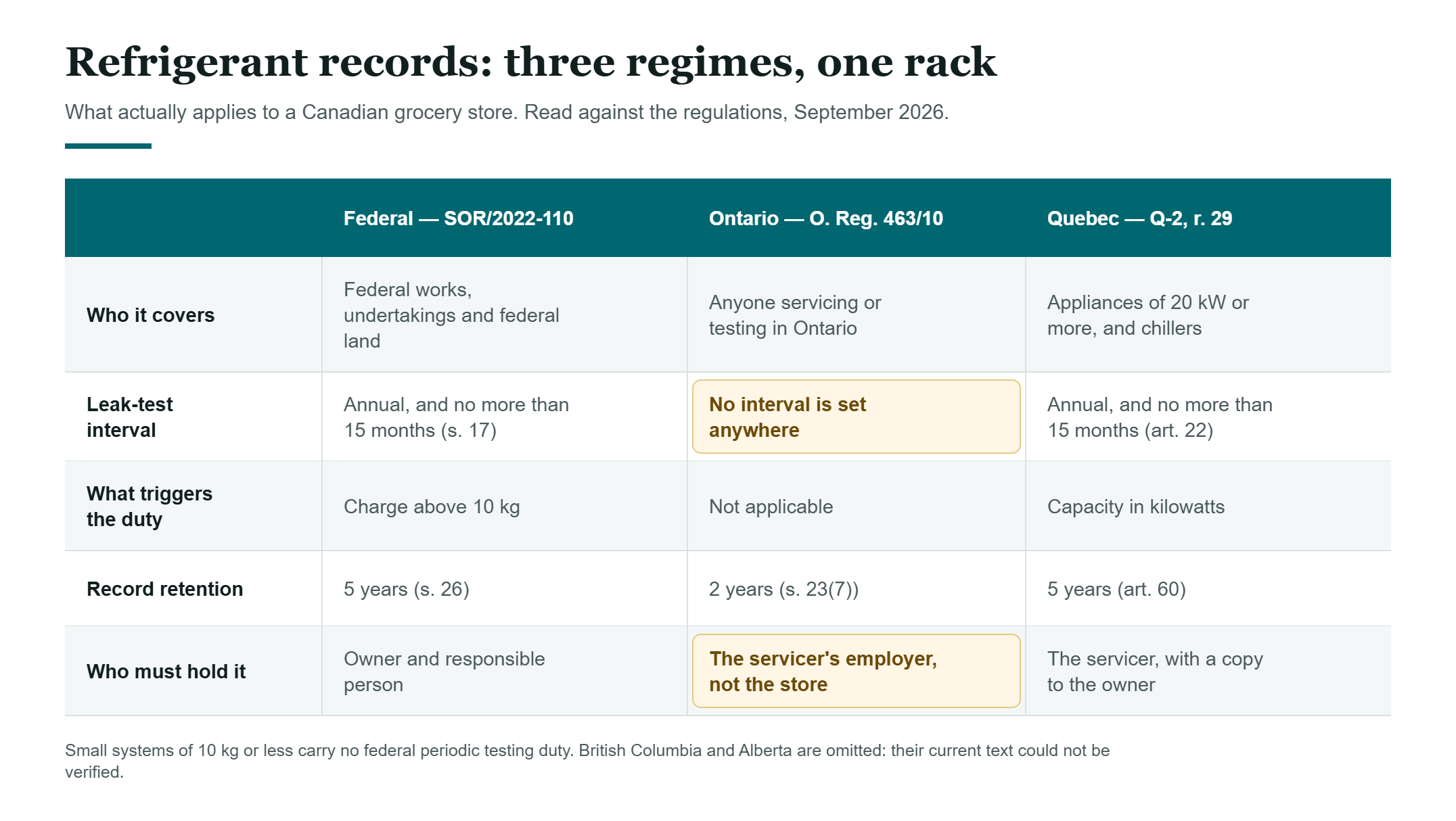
- Leak testing, section 17. Large systems are leak tested by a certified person at least once every calendar year, and no more than 15 months after the previous test. Note carefully that these are two halves of a single rule, not two options. Small systems carry no periodic testing requirement at all.
- Leaks, section 18. Once a leak is detected the system must, within seven days, either be repaired, or isolated and its halocarbon recovered, or have its halocarbon recovered. Repair is one of three permitted responses, not the only one.
- Inventory, section 22 and Schedule 2, Part 4. Owners of large systems must maintain an inventory. Section 22 imposes the duty; the seven fields it requires — equipment type, owner, responsible person, location, serial number, halocarbon type and charge capacity — are set out in Part 4 of Schedule 2.
- Logs, section 23. For large systems, an entry is required each time the system is installed, serviced, permanently withdrawn from use, or its ownership transferred. For small systems, only servicing triggers an entry.
- Release reporting, sections 24 and 25. A release of 100 kg or more must be reported within 24 hours of detection, with a written report inside 30 days. Releases over 10 kg but under 100 kg are reported semi-annually.
- Retention, section 26. Documents must be kept at least five years from the day they were prepared or submitted.
Read that list as a data model and you have a fair specification for what a refrigeration module needs to hold. Read it as a description of your legal duty in an Ontario grocery store and you have been misinformed.
Ontario: no testing interval, and the record is not yours
Ontario governs refrigerants through O. Reg. 463/10 under the Environmental Protection Act. Two features of it should change how a retailer thinks about maintenance records.
There is no periodic leak-test requirement
The regulation says how a leak test must be conducted. Under section 22(4) it must follow the federal Environmental Code of Practice. Meanwhile, section 22(5) requires the tester to inform the owner of the results. What the regulation never does is set a frequency. No annual test. No 15-month ceiling. Nothing.
Therefore any claim that Ontario mandates annual leak inspections for supermarket refrigeration is wrong. What Ontario actually does is leave the interval to you. In effect, the interval you can defend is the one your own maintenance programme sets and evidences. That is a stronger argument for a CMMS than a prescribed interval would be, not a weaker one. For example, picture a regulator asking why a rack went fourteen months without a check. That conversation gets harder when nothing forced your hand and you chose the schedule yourself.
The compliance record belongs to your contractor
This is the part that surprises operations directors. Section 23(1) requires the person who services or tests refrigeration equipment to promptly create records. Section 23(7) then requires a copy of each record to be kept for two years — by the employer of the person who did the work, or, failing that, by the person themselves.
Read it again. The duty to hold the record sits with the refrigeration contractor, not with the store owner. The retailer is entitled under section 22(5) to be told the test results, but the statutory record-keeping obligation is somebody else’s.
In practice this produces a predictable failure. A chain switches refrigeration contractors after a tendering round. Two years of service history stays with the outgoing contractor. Moreover, they have no obligation to hand it over, and no commercial reason to. The new contractor starts from nothing. The retailer, who owns the equipment and carries the business risk, has the least complete picture of anyone.
Accordingly, the reason to run a CMMS for Canadian retail in Ontario is not that the regulation requires you to. It is that the regulation does not. Meanwhile, the party that does hold the record is one procurement cycle away from being replaced.
Quebec: a different threshold, a longer memory
Quebec regulates halocarbons under RLRQ c. Q-2, r. 29, and it differs from Ontario in nearly every respect that matters operationally.
- Article 22 requires leak testing at least once a year with no more than 15 months between tests — the federal pattern, applied provincially. It specifies an electronic detector with a sensitivity of at least 5 g per year, and a further test between the 30th and 60th day after the appliance is returned to service.
- The threshold is measured in kilowatts, not kilograms. Article 22 applies only to appliances described in paragraphs 6, 7 and 9 of article 18 — refrigeration and air conditioning units of 20 kW or more, and chillers. Commercial equipment below that capacity carries no article 22 testing duty at all. This is a fundamentally different trigger from the federal 10 kg charge test: a system that is “large” federally may not be caught in Quebec, and the reverse is equally possible.
- Article 59 sets out what the log must contain: the date and nature of the work, the equipment location and serial number, the halocarbon type and quantity in kilograms, any leak test results, and the technician’s certification. In addition, a copy goes to the owner.
- Article 60 requires retention for at least five years from the date of the last entry, and the owner keeps its own copy for five years from the date of the work.
- Article 13 requires the minister to be notified without delay of a release of more than 10 kg of halocarbon in the liquid state. Releases in the gaseous state above the same threshold carry the reporting duty but not the immediate notice. In both cases an annual report is due by 31 March of the following year.
Notice what Quebec does that Ontario’s section 23(7) does not: article 59 puts a copy in the owner’s hands, and article 60 obliges the owner to keep it for five years. In Quebec the retailer is a record holder by law. In Ontario the retailer is a bystander unless it decides otherwise.
What this means for a chain operating in more than one province
Consider a grocery group with stores in Ontario, Quebec and the Atlantic provinces. On the same refrigeration rack model, in the same year:
- Testing interval — company policy in Ontario, regulation in Quebec.
- Obligation trigger — charge weight federally, appliance capacity in Quebec.
- Retention period — two years in Ontario, five in Quebec, five federally.
- Record holder — the contractor in Ontario; contractor and owner in Quebec.
- Reporting calendar — 31 March in Quebec, a different federal cycle where federal rules apply.
No single national report satisfies all of that. A head-office compliance summary built on one set of assumptions will be wrong somewhere, and the place it is wrong is the place you will be asked about.
This is precisely the shape of problem that a system designed for a single national regulator cannot express. It is not a reporting preference. It is a data model requirement: the record has to carry which regime it was created under, because the same field means different things in different provinces.
Beyond refrigeration: the rest of the retail asset base
Refrigeration dominates the compliance conversation, but it is not the whole estate. A mid-size supermarket also runs an HVAC plant, plus a bakery and deli full of commercial cooking equipment. In addition, there are compactors and balers, automatic doors, loading dock levellers, fire alarm and sprinkler systems, and emergency lighting. Beyond that, many stores add a pharmacy with its own temperature-controlled storage.
Mechanical refrigeration in Canada is addressed by CSA B52, the Mechanical refrigeration code. It is a voluntary standard with no force of its own; it binds you only once your province adopts it, and provinces adopt different editions on different dates — Manitoba moved to B52-23 by bulletin, Alberta by a separate notification. Fire protection systems fall under the provincial fire code. Pressure equipment falls under the provincial boiler and pressure vessel authority. Each has its own inspection cadence and its own record.
Multiply that by 40 stores across three provinces and the problem stops being a maintenance problem and becomes a records problem.
The same pattern turns up elsewhere. Our write-ups on maintenance management in Canadian manufacturing and Canadian healthcare reach the same conclusion from entirely different regulations. Day to day, most of this work lands in safety and compliance.
Which modules a CMMS for Canadian retail actually needs
Not every module earns its place in a grocery estate. These are the ones a CMMS for Canadian retail actually uses.
Assets
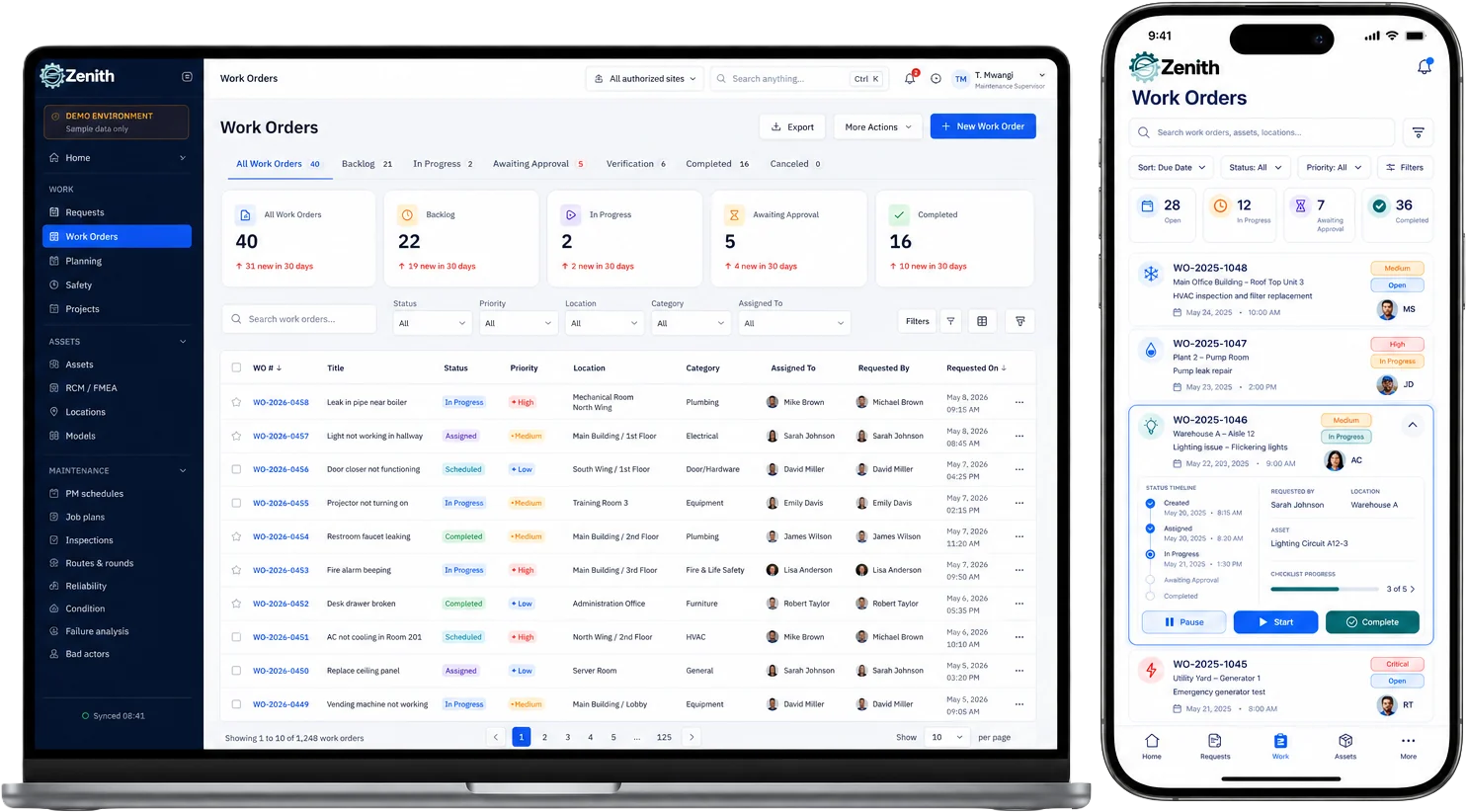
The asset register is where the refrigerant data lives. Every rack, condenser and display case needs equipment type, location, serial number, refrigerant type and charge capacity held against the asset itself. Notably, that is the inventory the federal regulation describes in section 22. It is also the identifying data Quebec’s article 59 requires in every log entry. Documents attach to the machine and stay with it for its life.
Maintenance
Preventive maintenance schedules carry the leak-test cadence. Where a province sets the interval, the schedule enforces it. Where a province does not — Ontario — the schedule is the evidence that you set one and kept to it, which is the defence you will actually need.
Work
Every service visit produces a record with a date, a technician, a certification number and a result. The seven-day federal repair clock, where it applies, is a work order with a due date, not a note in somebody’s calendar.
Spatial
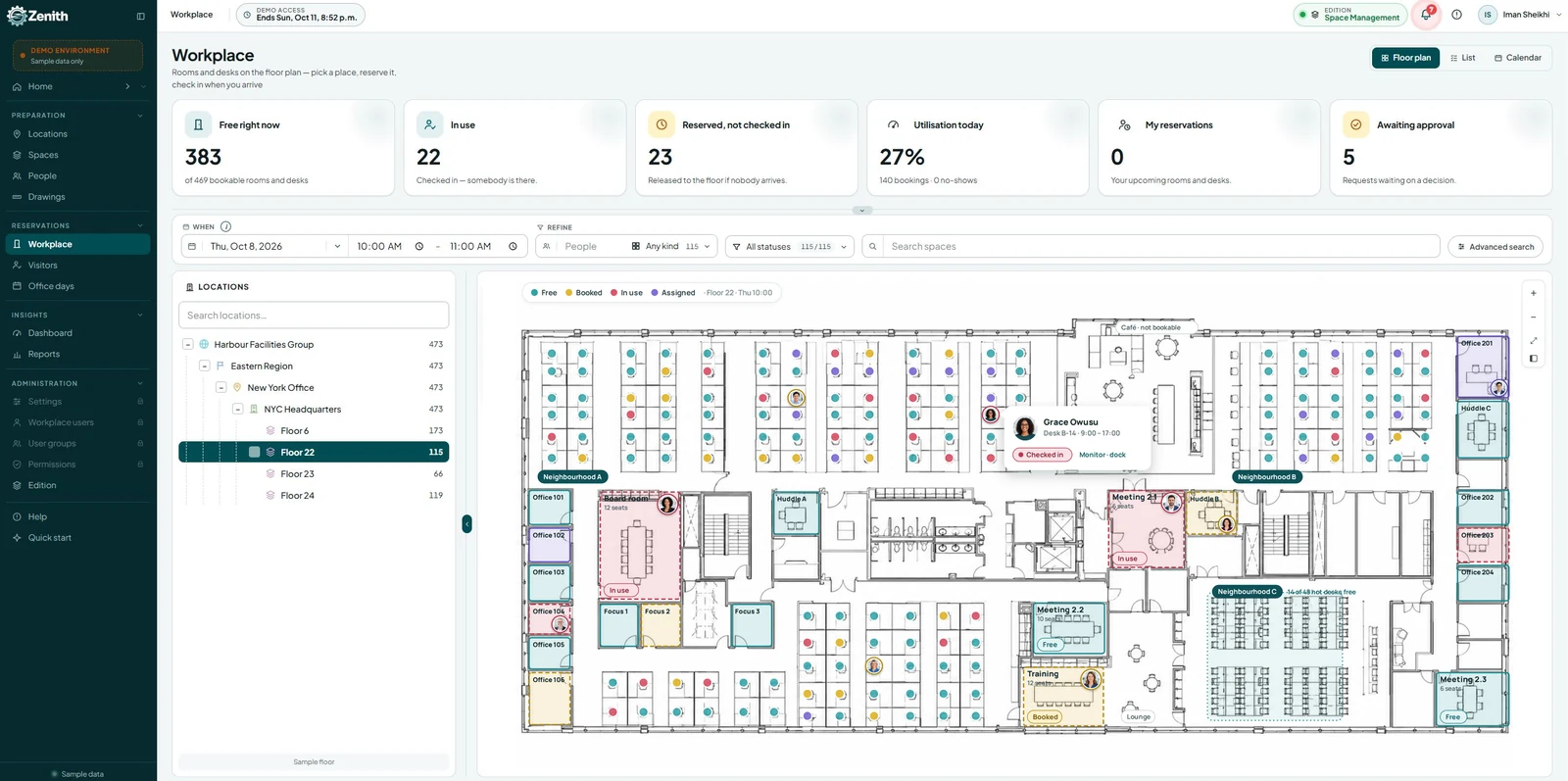
Store, department, and the specific position of the case on the floor. When a regulator or an insurer asks which unit leaked, “the third rack” is not an answer.
Inventory and Procurement
Refrigerant is stock with a legal identity. Quantities charged and recovered have to reconcile, in kilograms, against what was purchased. A storeroom ledger that tracks refrigerant the way it tracks gaskets is doing half the job.
Analytics
Reporting covers leak rate by store, by rack model and by contractor. This is where the money is: a rack that needs topping up three times a year is telling you something the individual service tickets never will.
Administration
Per-site data scope with per-province rules, and a terminology layer so that a Quebec site reports in French because the platform carries French, not because someone translated a report.
How and why Zenith works as a CMMS for Canadian retail
Zenith was built in Canada, for Canadian regulatory structure, after years of watching maintenance teams try to make single-jurisdiction software describe a multi-jurisdiction reality. Three properties matter most in retail.
Per-site regulatory context. One asset register, one set of PM schedules, but rules that differ by site. An Ontario store and a Quebec store can hold the same rack model under different testing cadences and different retention periods, and still roll up into one number for the executive team. That is not a report format. It is how the data is scoped.
The record is yours. Because service history is captured against your asset in your system, a change of refrigeration contractor does not erase two years of evidence. The contractor keeps their statutory copy; you keep yours. In Ontario, where the regulation gives you no record at all, this is the entire argument.
Bilingual at the platform level. English and French are carried natively rather than bolted on. For a chain operating in Quebec, work records and logs exist in French because the system was built that way.
Finally, and less glamorously: documents live against the asset. A leak test report, a technician’s certification, a CSA B52 inspection — these attach to the machine they describe and stay there for the machine’s life. Not in a shared drive organised by year, and not in an inbox belonging to someone who left.
Frequently asked questions
Do the Federal Halocarbon Regulations apply to my grocery store?
Almost certainly not. Section 2(1) limits them to systems owned by the federal Crown, a federal board, agency or Crown corporation, or a federal work or undertaking, and to systems located on federal or Aboriginal lands. A commercial supermarket is normally under provincial law. If you operate a concession at an airport or a store on federal land, check carefully — the answer may differ site by site.
How often does Ontario require refrigeration leak testing?
It does not set an interval. O. Reg. 463/10 prescribes how a test must be conducted and requires the tester to inform the owner of the results, but no periodic frequency appears in the regulation. Your interval is a business decision, which means it is also a decision you may have to justify.
How long do refrigerant records have to be kept in Ontario?
Two years from the date of the servicing or testing, under section 23(7). Note that the obligation falls on the employer of the person who did the work, not on the equipment owner.
Then who actually holds my refrigeration compliance records in Ontario?
Your refrigeration contractor, or their employer. If you change contractors, the statutory record goes with the outgoing firm. Nothing in the regulation requires them to hand it to you. Keeping your own parallel record is the only reliable way to retain continuity of evidence.
Is Quebec’s rule the same as the federal one?
The interval is similar — at least once a year, no more than 15 months apart under article 22 — but the trigger is not. Quebec’s obligation attaches by appliance capacity in kilowatts; the federal regulation uses a 10 kg charge threshold. A system caught by one may not be caught by the other.
What has to be in a Quebec refrigerant log?
Article 59 requires the date and nature of the work, the equipment’s location and serial number, the type of halocarbon charged or recovered with the quantity in kilograms, the results of any leak tests, and the technician’s certification and employer details. A copy goes to the owner, and article 60 requires five-year retention.
What about British Columbia and Alberta?
Both provinces regulate halocarbons — British Columbia under B.C. Reg. 387/99 and Alberta under the Ozone-Depleting Substances and Halocarbons Regulation, Alta Reg 181/2000. We have deliberately not published interval or retention figures for either, because we could not read the current consolidated text on the province’s own site to verify them. Check the King’s Printer and BC Laws directly rather than relying on any vendor’s summary, including this one.
Does a CMMS make us compliant?
No. Software does not comply with anything; your maintenance programme does. What a CMMS does is make the programme evidenceable. Instead, it holds the schedule, the completion, the technician, the reading and the document in one place. The answer to “show me” then takes minutes, not a week of email archaeology.
We have 40 stores in three provinces. Do we need three systems?
No, and running three is how the numbers stop reconciling. A CMMS for Canadian retail needs per-site data scope, so that provincial differences live in the configuration rather than in separate databases.
How does refrigerant tracking differ from ordinary parts inventory?
Refrigerant has to reconcile as a quantity in kilograms across purchase, charge, recovery and release — and in Quebec those quantities appear in a regulated log. Ordinary consumables do not carry that obligation. Treating refrigerant as just another stock item is where most reconciliation failures begin.
What is CSA B52?
CSA B52, the Mechanical refrigeration code, is the Canadian standard covering mechanical refrigeration systems, with B52:23 the 2023 edition. It carries no legal force by itself — it applies where a provincial safety authority has adopted it, and which edition is in force varies by province. The standard is paywalled, so we name it by number and title only; read it before building a compliance programme on any summary, this one included.
Where should we start if our records are currently in a contractor’s system?
Ask your incumbent for a full export while the relationship is good, load it against your asset register, and set your own testing schedule from that date forward. The history you cannot recover is a sunk cost; the history you start creating today is the one that will matter in two years.
A note on sources
The federal, Ontario and Quebec provisions cited here were read in their current consolidated text in September 2026. O. Reg. 463/10 was read on Ontario e-Laws; the federal regulation on the Justice Laws website; the Quebec regulation on Légis Québec. CSA standards are paywalled and are named by number and title only. Where we could not verify a provincial position from the province’s own published text — British Columbia and Alberta — we have said so rather than repeat a compilation.