


Choosing a CMMS for Canadian healthcare is not the same problem as choosing one for a hospital in Ohio. Health care and social assistance employs 3.0 million people in Canada — more than any other sector — and contributes $192.7 billion to GDP. Yet no federal hospital regulator exists. Provinces run the hospitals, provinces regulate them, and the standards that actually govern building maintenance come from a body most American vendors have never had to read.
Updated September 2026 with current Statistics Canada figures and the standards position as of this month.
Why a CMMS for Canadian healthcare answers to no federal regulator
To begin with, there is no Canadian equivalent of a national hospital authority setting maintenance rules. Each province operates and regulates its own hospitals and long-term care homes. Occupational health and safety law sits provincially too, which is why roughly 94% of Canadian workers fall outside federal jurisdiction entirely.
Consequently, a health authority running sites across two provinces answers to two different labour regulators, two building code adoptions, two elevating-device authorities and two health-privacy statutes. Meanwhile the clinical standards it works to are national — which produces the awkward shape at the heart of Canadian healthcare facilities management: national standards, provincial enforcement, and no single reporting format that satisfies both.
Software written for a single national regulator cannot express that. A CMMS for Canadian healthcare has to carry per-site regulatory context while still reporting nationally against the CSA suite.
CSA Z8002 and the standards a CMMS for Canadian healthcare has to serve
The standard with no American counterpart
CSA Z8002, “Operation and maintenance of health care facilities”, is the single most important reference in this article. It exists in Canada and has no United States equivalent. An American CMMS vendor selling into a Canadian hospital has, almost without exception, never designed against it.
It sits inside a family. CSA Z8000 covers planning, design and construction of health care facilities; Z8001 covers commissioning; and Z8002 picks up where those stop — the operating life, which is where a maintenance system lives.
Z317.13 changes how maintenance work itself is done
Furthermore, the Z317 series governs the building systems clinical care depends on: Z317.1 for plumbing installations, Z317.2 for HVAC systems, and Z317.12 for cleaning and disinfection.
The one that reshapes maintenance operations is CSA Z317.13, infection control during construction, renovation and maintenance of health care facilities. Read that title carefully. It does not govern what you maintain. It governs how you are permitted to do the work while patients are in the building.
In practice this means a work order in an occupied clinical area is not simply a job. It carries a preventive-measures assessment, containment requirements, and sign-off from infection prevention and control before a technician opens a ceiling. A maintenance system that treats that as a free-text note in the description field has not modelled the requirement. It has recorded a rumour of it.
Medical gas, patient lifts and essential power
Three further standards deserve naming, because each attaches maintenance obligations to specific assets:
- Medical gas pipeline systems — CSA Z7396.1. Oxygen, medical air and vacuum are life-safety systems, and they run through the building like any other utility.
- Person-transfer lifts — CSA Z10535.2, which covers installation, use and maintenance of patient lifts. These are load-bearing devices carrying human beings, distributed across hundreds of rooms.
- Electrical safety and essential electrical systems — CSA Z32. Essential power is what keeps an operating room running when the grid stops.
In addition, CSA Z314 covers medical device reprocessing, and it reaches maintenance because reprocessing equipment itself has to be maintained. Sterilizers are assets with schedules, histories and failure consequences.
Separately, Accreditation Canada’s Qmentum program assesses the physical environment as part of accreditation. For most Canadian hospitals that is the moment someone from outside reads the maintenance records.
One caution worth stating plainly: CSA standards are paywalled documents. This article names them, their numbers and their scope. Buy the standard and read the clauses before you build a compliance programme on any summary, including this one.
What breaks in a hospital, and what the record has to prove
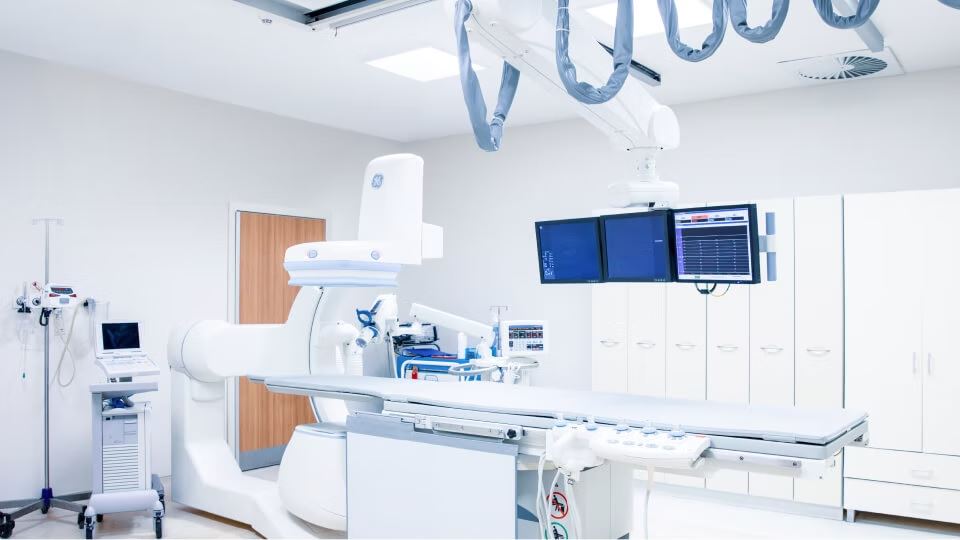
Hospitals fail differently from factories. A production line stopping costs money. An air handler serving an operating suite stopping costs a cancelled surgical list, and the question afterwards is never “what broke” — it is “when did you last inspect it, and can you show me.”
Certain patterns recur across Canadian health authorities:
- Maintenance history lives in three systems that disagree. The BAS holds alarms, the CMMS holds work orders, and the compliance binder holds inspection certificates. No single view answers a question about one room.
- Room-level location data is missing. Teams record work against a building or a floor, so nobody can answer which clinical spaces were affected by a shutdown.
- Infection-control approval is invisible. The assessment happened, but it lives in an email, so the work order shows a job that looks unauthorised.
- Contractor certificates expire silently. A vendor’s insurance or trade certification lapses and nobody notices until an audit.
Above all, none of these are exotic failures. They are ordinary record-keeping gaps that become serious specifically because healthcare gets audited on its records rather than on its intentions.
Elevating devices: the requirement hospitals underestimate
Hospitals run more elevators per square metre than almost any other building type, and they run them carrying patients. Elevating devices fall under ASME A17.1/CSA B44, which each province adopts, with a different authority in each province — Technical Safety BC in British Columbia and TSSA in Ontario.
British Columbia sets out an unusually specific obligation. Under its Elevating Devices Safety Regulation, Technical Safety BC Directive D-ED 2020-03 requires a Maintenance Control Program. Records must exist in both hard copy and electronic format, with one serving as the primary detailed record, viewable on site; the operator must post maintenance instructions at the controller; and retention runs to not less than five years.
Two details there defeat most software. Records viewable on site means an inspector standing at the machine room asks to see them there, not later by email. And a five-year retention floor on a device that gets serviced monthly produces a volume of history that has to stay queryable rather than sitting in a folder nobody can search.
Which modules a CMMS for Canadian healthcare needs
Zenith runs as independent modules on one platform, so a health authority can start narrow. These are the ones that matter here, and why.
Spatial — rooms, not just buildings
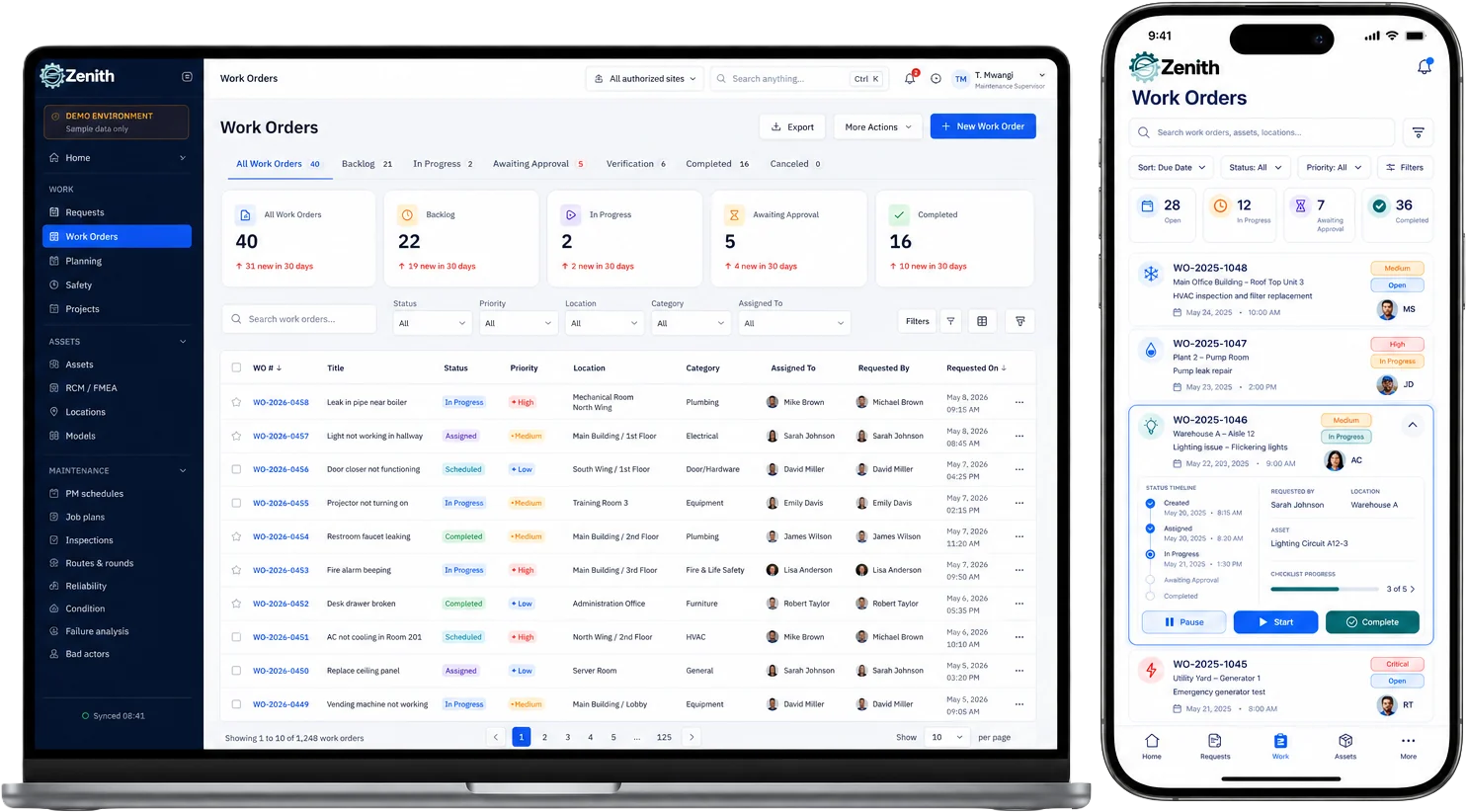
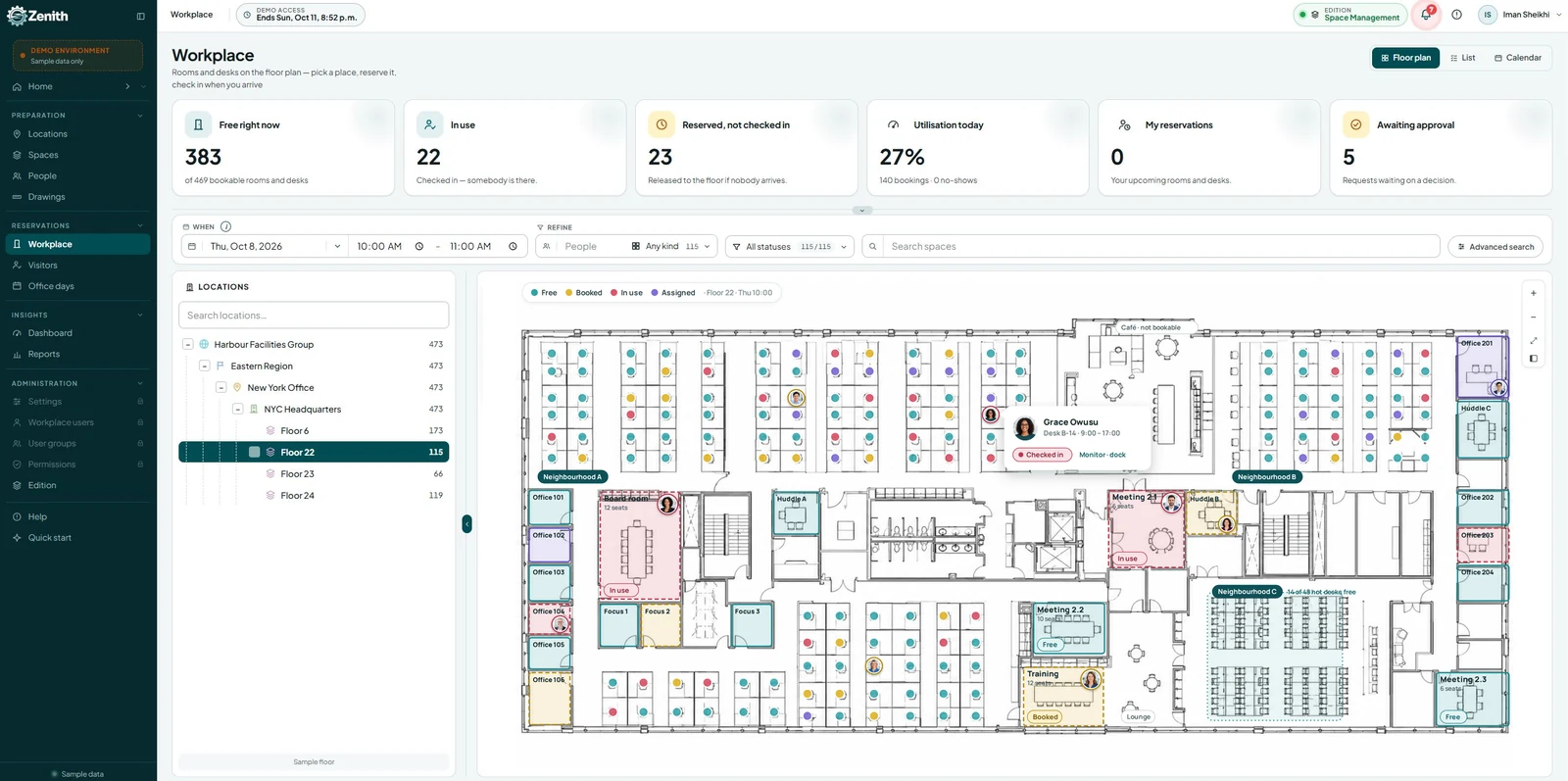
This module comes first for healthcare, which is unusual. Hospitals are organised by room, and so is clinical risk. Location 360 holds the hierarchy down to the individual space, so a shutdown, an inspection or an infection-control assessment attaches to the rooms it actually affects rather than to a floor plan in a drawer.
Assets — the register, with documents attached
The asset register carries hierarchy, criticality, health, warranty, specifications and media, with an Asset 360 view per item. Zenith models relationships explicitly — supplies, backup for, depends on, connected to — which is how you answer the question that matters during a failure: what clinical service stops if this stops.
Compliance documents attach to the asset itself. A Z7396.1 verification on a medical gas zone, a lift certification, an essential-power test record: all against the equipment, for its life.
Maintenance — PM programs, inspections and routes
PM schedules combine scope, trigger, job plan, labour, parts, safety and generation rules, tracking cost, documents and history per schedule. Triggers run on calendar or meter.
Inspections exist as first-class objects with their own execution flow rather than as a checkbox buried in a work order. Routes handle the rounds — the technician who checks ninety patient lifts across four floors in one pass.
Work — permits, hazards and the infection-control gate
This is where Z317.13 becomes software rather than paperwork. Permits, hazards and safety checklists gate the work order, so a job in an occupied clinical area cannot be completed while its required approvals are outstanding. The system enforces the gate; nobody has to remember it.
Timers become labour records and materials consume against the work order, so cost and downtime derive from what happened rather than from an estimate.
Workforce — competencies and contractor compliance
Certifications attach to people, so the system knows who is qualified before the job is assigned. The same applies to external vendors, which matters because contractor documentation expiring unnoticed is one of the most common audit findings in Canadian facilities.
Reliability, Inventory, Procurement
Reliability supplies condition monitoring, failure cases with modes and causes, and a bad-actors view showing which assets consume disproportionate effort. Inventory covers the parts catalog, storerooms, a movement ledger, reservations against planned work and reorder points, with Procurement handling purchase orders and receipts.
Analytics, Automation, Administration
Analytics turns recorded work into the reports an accreditation surveyor asks for. Automation fires rules without anyone remembering to. Administration carries permissions, multi-site data scope, audit trail, and a terminology service — which matters more in healthcare than anywhere else, because one authority says “Equipment” where another says “Asset” and neither will change its vocabulary for a software vendor.
Where a CMMS for Canadian healthcare has to keep its data
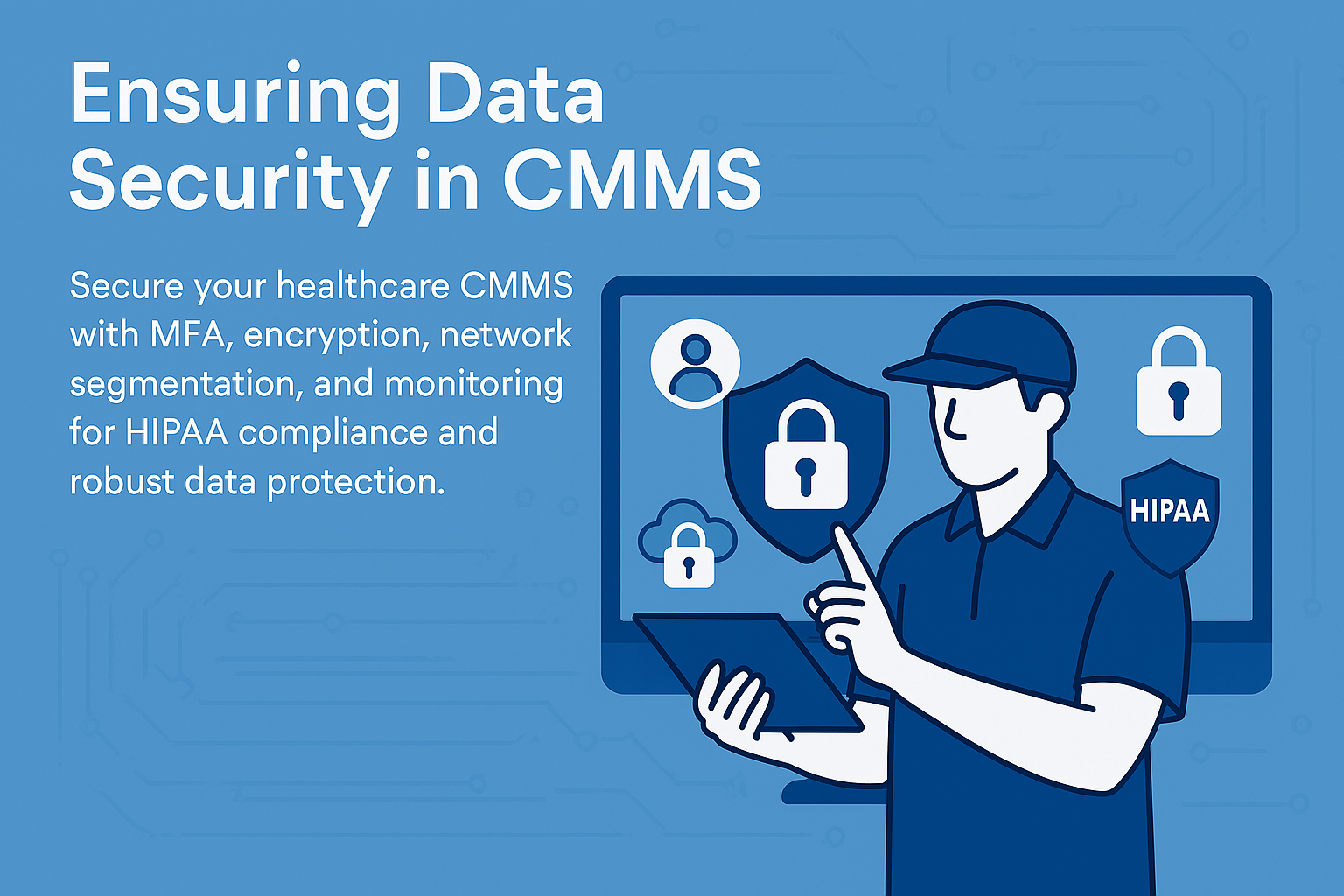
Health authorities are public bodies, and public bodies in Canada face data rules that private manufacturers do not. This is the part most vendors get vague about, so here is the position as precisely as it can honestly be stated.
Federal buyers face the hardest gate. Treasury Board’s Direction for Electronic Data Residency requires Canadian residency for data at Protected B, Protected C and Classified levels, and only data up to and including Protected B may go to public cloud at all — where it must reside in Canada.
Quebec operates a documented-assessment regime rather than a ban. Under Law 25, an organization must complete a privacy impact assessment before communicating personal information outside Quebec, weighing sensitivity, purpose, protective and contractual measures, and the legal framework of the receiving state. The Act separately requires written service-provider contracts.
Nova Scotia is mid-transition. PIIDPA currently constrains storage of and access to public-sector personal information outside Canada. Bill 150 repeals and replaces FOIPOP and revokes PIIDPA, with the new Act in force April 2027 — and the regulations that will govern out-of-country storage do not yet exist. Nova Scotia public-sector buyers are therefore choosing under rules that do not exist yet, which is a strong argument for a Canadian-hosted default.
Ontario health data sits under PHIPA, which imposes duties on health information custodians and their service providers. Custodians generally handle cloud hosting outside Canada through due diligence, contractual safeguards and guidance from the Information and Privacy Commissioner of Ontario rather than through a statutory residency prohibition. Verify the current position with your privacy office before relying on any vendor’s summary, including this one.
CMMS for Canadian healthcare: frequently asked questions
Is there a Canadian standard for hospital maintenance?
Yes. CSA Z8002, “Operation and maintenance of health care facilities,” is the primary one, and it has no United States equivalent. It sits alongside Z8000 for design and Z8001 for commissioning, with the Z317 series covering plumbing, HVAC, cleaning and disinfection, and infection control during maintenance.
What is CSA Z317.13 and why does it affect work orders?
It covers infection control during construction, renovation and maintenance of health care facilities. Because it governs how work is carried out in occupied clinical space, a maintenance job in a patient area typically requires a preventive-measures assessment and infection-control approval before work begins. That approval belongs on the work order as a gate, not in somebody’s inbox.
Can a CMMS for Canadian healthcare handle infection-control requirements?
It can if permits and approvals are enforced gates rather than optional fields. The test is simple: try to complete a work order in a clinical area without the required approval recorded. If the system lets you, it is documenting a process rather than running one.
Does a CMMS for Canadian healthcare need to store data in Canada?
It depends on the buyer. Federal buyers face a hard Canadian-residency requirement for Protected B and above. Quebec requires a documented transfer assessment rather than imposing a ban. Nova Scotia’s rules change in April 2027 and the replacement regulations are unpublished. Ontario’s PHIPA governs custodians and service providers without a clear statutory residency prohibition. Confirm with your own privacy office.
Who regulates hospital maintenance in Canada?
Provinces do. There is no federal hospital regulator. Occupational health and safety, building code adoption, elevating devices and health privacy are all provincial, which is why a multi-province health authority runs several compliance regimes simultaneously.
How do CSA standards and Accreditation Canada relate?
They answer different questions. CSA standards are technical documents describing how facilities and systems should be operated and maintained. Accreditation Canada’s Qmentum program assesses organizations, including the physical environment, as part of accreditation. In practice, accreditation is often when an outside party examines maintenance records.
Are CSA standards free to read?
No. They are paywalled publications. Any article, including this one, can tell you a standard’s number, title and scope. Building a compliance programme requires purchasing and reading the standard itself.
What maintenance records should a hospital be able to produce on demand?
At minimum: the inspection and service history of the asset in question, the schedule it runs on, who performed the work and under what qualification, any permits or infection-control approvals that applied, and the parts consumed. If producing that takes more than a few minutes, the records exist but are not usable.
Why does room-level location data matter so much in healthcare?
Because clinical risk is organised by room. A shutdown affecting an air handler matters differently depending on whether it serves an operating suite, an isolation room or an administrative corridor. Recording work against a building loses exactly the distinction that decides how serious the event is.
Which modules should a CMMS for Canadian healthcare include first?
Spatial, Assets, Work and Maintenance. Spatial comes earlier here than in other industries because room-level location is foundational rather than a refinement. Workforce follows quickly where contractor compliance is a live audit risk.
Does the software need to be bilingual?
In Quebec, effectively yes, and in bilingual health authorities elsewhere it is frequently a procurement requirement. Zenith carries EN/FR at the platform level rather than as a translation layer added afterwards.
What should I ask a vendor selling a CMMS for Canadian healthcare?
Start with whether they have read CSA Z8002 and Z317.13. Where does the system store data, and can that be Canada? How deep does the location hierarchy go — building, floor, or room? Can an approval be made a hard gate on work-order completion? Finally, what happens to an asset’s history when the asset is retired?
Where Zenith fits as a CMMS for Canadian healthcare
Zenith is built in Canada, for Canadian operations. For healthcare specifically that means three things: a location model that reaches the room, approvals that behave as gates rather than as fields, and EN/FR carried at the platform level rather than bolted on.
Ultimately, one principle sits behind the design — the system should never claim more than it can show. Every figure derives from a record. Where the data cannot answer a question, Zenith says so instead of filling the gap with an average. In a sector audited on evidence, that is not a stylistic preference.
Talk to us about your facilities, or read more about preventive maintenance, asset management and safety and compliance in Zenith.
Sources
- Statistics Canada, Gross domestic product by industry, May 2026, released 31 July 2026 (Table 36-10-0434-01).
- Statistics Canada, Labour Force Survey, May 2026, released 5 June 2026 (Table 14-10-0355-01).
- CSA Group — Z8000, Z8001, Z8002, Z317.1, Z317.2, Z317.12, Z317.13, Z32, Z7396.1, Z10535.2, Z314.
- Accreditation Canada — Qmentum Accreditation Program.
- Information and Privacy Commissioner of Ontario — PHIPA guidance.
- Commission d’accès à l’information du Québec — Law 25.
- Office of the Information and Privacy Commissioner for British Columbia — FIPPA.
- Treasury Board of Canada Secretariat — Direction for Electronic Data Residency.
- Nova Scotia Bill 150 (2025), replacing FOIPOP and revoking PIIDPA, in force April 2027.