


Choosing a CMMS for Canadian manufacturing looks like a software decision. It is really a compliance decision. Canadian manufacturing contributes $199.6 billion to GDP and employs 1.83 million people, making it the second-largest sector by output and the fourth-largest by employment. It is also the sector where maintenance failure costs the most, the fastest: a line that stops does not stop politely, and the machine that stopped it usually gave warning that nobody wrote down.

Updated September 2026 with current Statistics Canada figures and the regulatory position as of this month.
Most maintenance software sold into Canadian plants was written for American ones. That sounds like a small distinction. It is not, and this article explains why it decides which system you should buy.
Why a CMMS for Canadian manufacturing cannot be an American one
To begin with, Canada has no OSHA.
Provincial occupational health and safety law covers roughly 94% of Canadian workers. Federal jurisdiction reaches only a defined list — interprovincial trucking and rail, aviation, marine shipping, banking, telecommunications, uranium, grain elevators, and employers in the three territories. Almost every manufacturing plant in the country answers to its province instead.
For example, a manufacturer running plants in Ontario, Quebec and British Columbia does not comply with one maintenance regime. That company complies with three, each carrying its own machine-guarding rules, its own lockout requirements, its own inspection obligations and its own record-keeping expectations. Add Alberta and the count reaches four.
Software built for a single national regulator has no concept of this. It offers one set of compliance fields and one report format. A CMMS for Canadian manufacturing has to hold per-site rules that differ by province while still rolling everything up into one view for whoever answers for all of them.
Three Canadian requirements a CMMS for Canadian manufacturing must meet
Ontario’s Pre-Start Health and Safety Review has no American equivalent
Under Ontario Regulation 851, section 7, a licensed professional engineer must review and report on certain apparatus before it first operates — and again after any modification. The list covers safeguarding devices such as light curtains, two-hand controls and interlocked guards; racking and stacking structures; dust collectors carrying fire or explosion risk; molten-metal operations; flammable-liquid storage and dispensing; suspended and supported cranes and lifting devices; and ventilation controlling hazardous biological or chemical agents.
O. Reg. 434/21, in force since 1 January 2022, put that obligation on the owner, lessee or employer. Leasing the equipment does not move the duty elsewhere.
Here is the consequence that maintenance teams almost always miss: a PSR report belongs to an asset, permanently, and you must produce it on demand. Store your PSR reports in a shared drive organised by year rather than against the machine they describe, and you will hand an inspector the wrong one — or none at all. Worse, when a modification triggers a fresh PSR and nobody links the work order to that obligation, the machine runs out of compliance and no system notices.
British Columbia demands records for the service life of the equipment
Part 4 of BC’s Occupational Health and Safety Regulation is unusually explicit.
Section 4.3 requires installation, inspection, testing, repair and maintenance to follow the manufacturer’s instructions or a professional engineer’s specifications. Not “good practice” — the manufacturer’s instructions.
Furthermore, section 4.9 goes further. An effective written or other permanent recording system must sit immediately available to operators and maintenance personnel. It must carry an entry on each shift, signed by the operator, recording the start-of-shift inspection and any defects observed. And it must retain detailed reports of inspection, maintenance, repairs and modifications for the duration of the service life of the equipment.
Consequently, read that retention rule twice, because it breaks the usual pattern. Not seven years. Not “while in service plus two”. The service life. A press installed in 1994 and still running carries thirty-two years of required history, and the day you scrap it becomes the first day you may stop keeping the file.
Section 4.43.1 adds storage racks: a qualified person must inspect them, record each inspection, and give that record to the employer.
No spreadsheet survives this. Neither does a maintenance system that prunes history to keep the database small, or one where retiring an asset takes its work history with it. Any serious CMMS for Canadian manufacturing has to treat history as permanent by default.
Quebec requires a lockout data sheet for every machine
Quebec’s Règlement sur la santé et la sécurité du travail, articles 188.1 to 188.13, requires a documented lockout procedure — the fiche de cadenassage — specific to the machine and available to the workers who operate it. It is a per-asset document, in French, and it has to match the machine’s actual energy sources.
As a result, bilingual capability stops being a courtesy here and becomes a compliance question. A lockout sheet that exists only in English is not a compliant lockout sheet in a Quebec plant. Neither is one attached to the wrong revision of the machine.
The standards behind a CMMS for Canadian manufacturing
Canadian plants sit on a stack of CSA standards, which the provinces adopt and enforce individually:
- Pressure equipment — CSA B51 (currently B51:24). Boiler, pressure vessel and pressure piping code. Designs need a Canadian Registration Number, registered province by province. No US analogue to the CRN exists, and it catches importers of American equipment constantly.
- Hazardous energy — CSA Z460. Control of hazardous energy: lockout and other methods.
- Electrical safety — CSA Z462. Canada’s counterpart to NFPA 70E, covering arc-flash assessment and energized work permits.
- Refrigeration — CSA B52. Mechanical refrigeration code, including ammonia systems, which matters in any plant running process cooling.
A different authority regulates pressure equipment in every province: Technical Safety BC in British Columbia, ABSA in Alberta, TSASK in Saskatchewan, the Office of the Fire Commissioner in Manitoba, TSSA in Ontario, the Régie du bâtiment du Québec in Quebec, and ACI Central or a provincial department across most of Atlantic Canada.
Meanwhile, one recent change deserves attention. Quebec’s amended pressure-installations regulation took effect on 29 July 2026. It harmonises with other provinces, adds operating permits for mobile pressure equipment, and — the part that matters to planners — reinstates periodic inspections by the RBQ. Quebec operators are entering a periodic-inspection cycle right now, and the plants that handle it comfortably will be the ones whose inspection history already sits in one system.
What breaks, and why a CMMS for Canadian manufacturing tracks records not repairs

Ask a plant maintenance manager what went wrong last quarter and you hear about a bearing, a drive, a compressor. Ask what it cost and the answer turns vague, because the cost hid in three places: downtime nobody timed precisely, labour booked to a general account, and parts that left the shelf without a work order.
In practice, the pattern repeats across Canadian plants:
- One asset fails repeatedly and nobody notices it is the same asset. Three work orders across eighteen months, three technicians, three different descriptions of one root cause.
- PM compliance becomes a percentage that means nothing. “94% PM completion” counts a signed-off checklist identically whether the technician did the work or closed the ticket at shift end.
- Shift logs live on paper — which satisfies BC 4.9 in the narrowest sense while making the history unusable for analysis and impossible to produce quickly.
- Compliance documents sit filed by document type, not by asset. PSR reports in one folder, arc-flash studies in another, pressure vessel certificates in a third, and no way to answer “show me everything that applies to press line 3.”
None of that starts as a technology problem. It starts as a records problem. But only a system built around the asset — rather than around the ticket — actually fixes it, which is the first thing to test when you evaluate a CMMS for Canadian manufacturing.
Which modules a CMMS for Canadian manufacturing needs
Zenith runs as independent modules on a common platform, so a manufacturer does not need all of them on day one. These carry the load.
Assets — the register everything hangs from
The asset register holds equipment hierarchy, criticality, health, warranty, specifications and media, with a full Asset 360 view per machine. Zenith models relationships between assets properly — controlled by, backup for, supplies, connected to, depends on — rather than through a single parent field. That is what lets you answer “what else stops if this stops.”
Above all, documents attach to the asset, which is the detail Canadian compliance turns on. A PSR report, a CRN certificate, an arc-flash study and a lockout sheet all live against the machine they describe, for that machine’s life.
Maintenance — PM programs, job plans, inspections and routes
PM schedules combine scope, trigger, job plan, labour, parts, safety and generation rules, each on its own tab, tracking cost, documents and history per schedule. Triggers run on calendar or meter, which is what BC section 4.3 effectively demands when the manufacturer specifies hours rather than months.
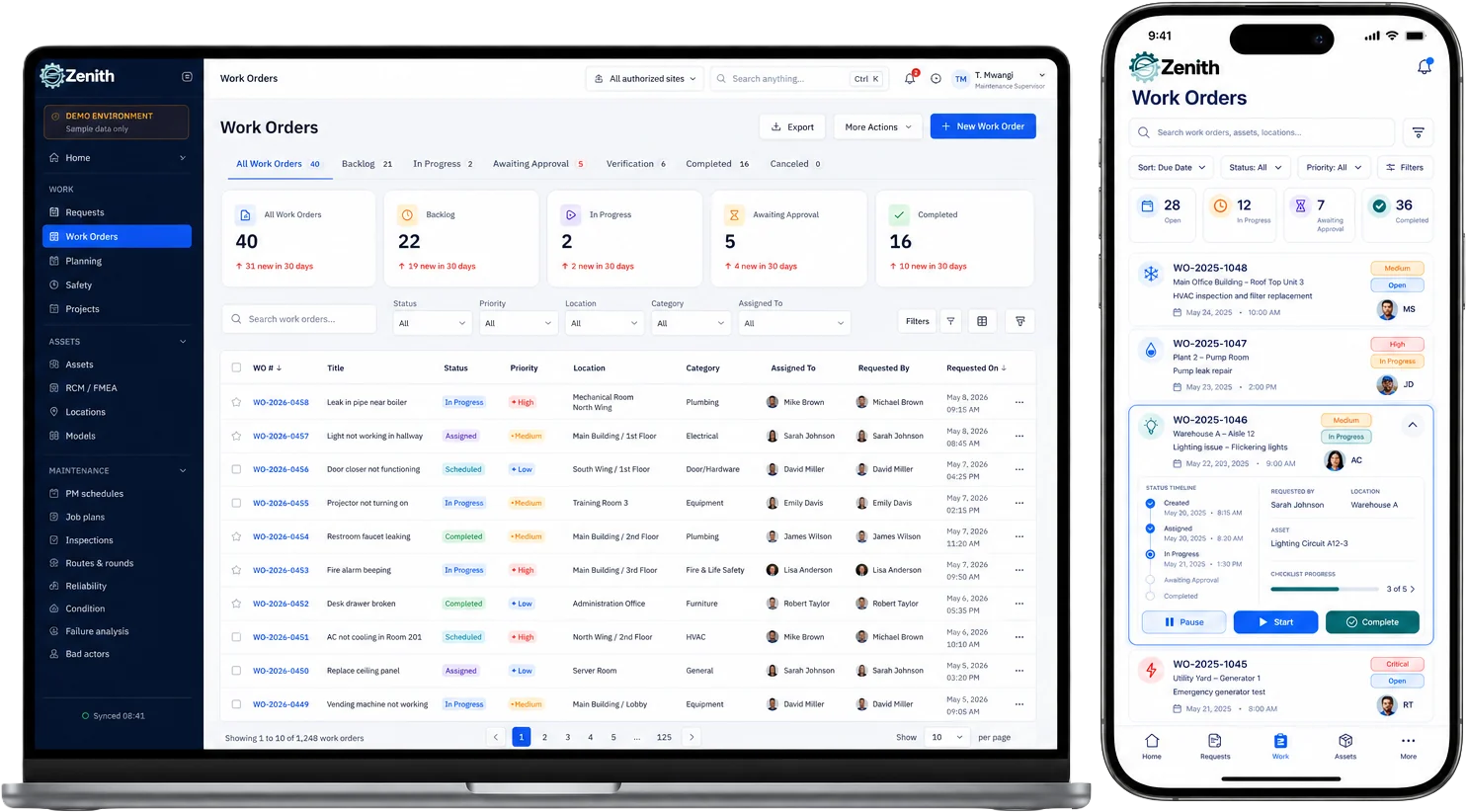
Inspections exist as first-class objects with an execution flow, not as a checkbox on a work order — the difference between a shift inspection you can produce on request and one you cannot. Routes handle rounds where a technician touches forty assets in sequence.
Work — work orders, permits and safety gates
The work module runs a job end to end: request, triage, plan, approve, schedule, execute, verify, close. Permits, hazards and safety checklists gate the work order, so nobody closes a job that required lockout as though it did not.
In addition, timers become labour records and materials consume against the work order. That is how downtime and cost figures stop being estimates.
Reliability — conditions, failure analysis and bad actors
In particular, this module answers the repeated-failure problem. Condition monitoring, failure cases carrying modes and causes, and a bad actors view surfacing the assets that eat disproportionate maintenance effort. Zenith computes MTBF and MTTR from recorded failure events rather than accepting typed-in numbers.
Inventory and Procurement — parts, reservations and the stock ledger
Parts catalog, storerooms, a movement ledger covering every issue, receipt and adjustment, reservations against planned work, reorder points and purchase orders. Multi-site inventory and vehicle stock both work, which matters for a plant running a satellite site or a mobile crew.
Workforce — people, crews, labour and tool custody
Certifications and competencies attach to people, so the system knows who may do the work. Tool custody follows the tool — who holds the torque wrench, when it last saw calibration — which turns into an audit question more often than plants expect.
Analytics, Automation and Administration
Analytics turns recorded work into the reports a regulator or an owner asks for. Automation fires rules without anyone remembering to. Administration carries permissions, multi-site data scope and audit trail, plus the terminology service that lets one plant say “Failure Mode” and another say “Defect Type” without a code release.
Why a CMMS for Canadian manufacturing must work across provinces
However, everything above is table stakes. The genuinely Canadian requirement appears when you run four plants in four provinces.
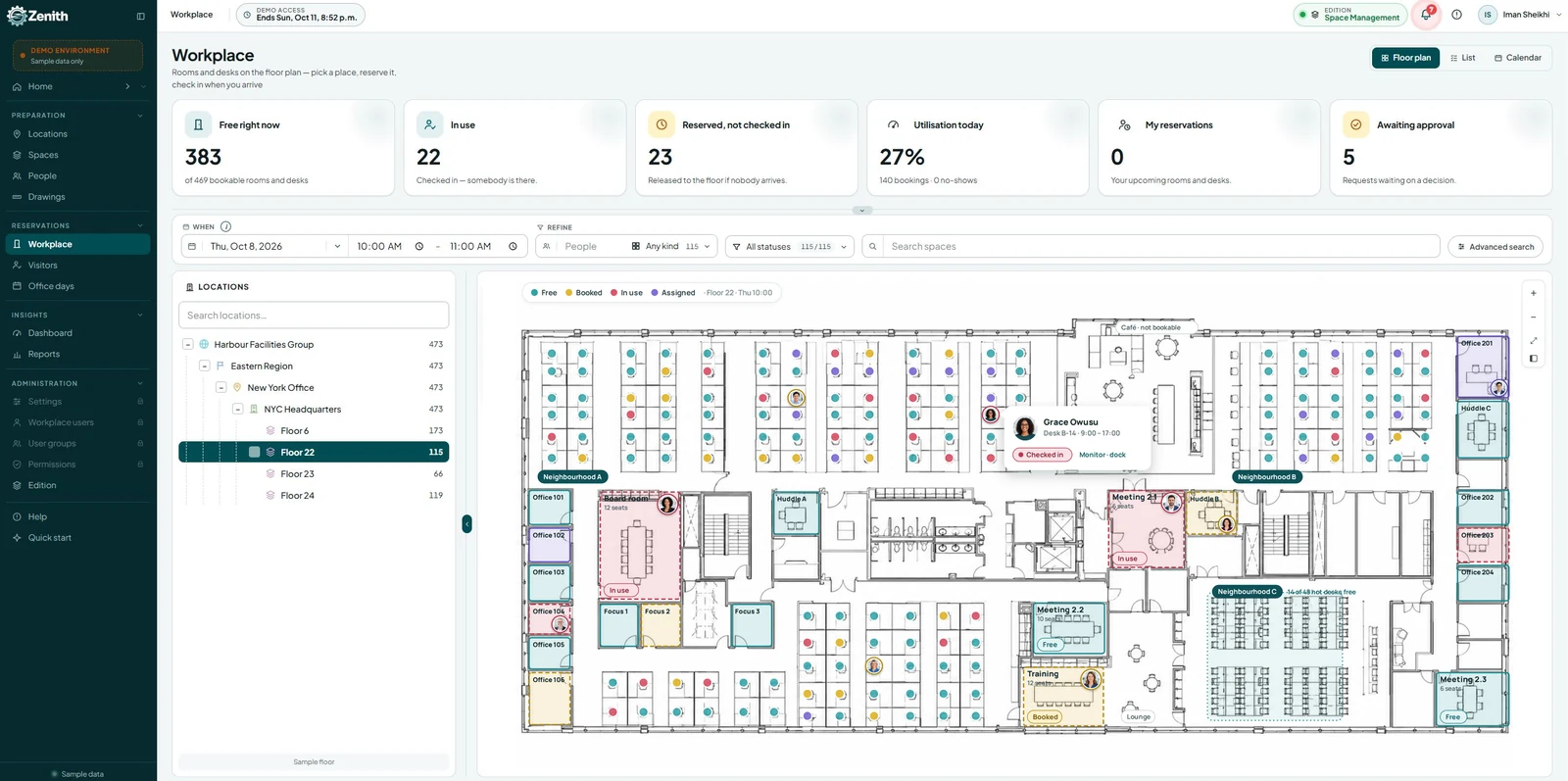
In short, you need one asset register carrying per-site rules. Ontario sites carry PSR obligations. BC sites carry service-life retention and signed shift entries. Quebec sites need French lockout sheets and a pressure-inspection cycle that restarted this July. Alberta sites answer to ABSA rather than TSSA for the same vessel.
One system has to hold all four regimes at once, report to each in the form its regulator expects, and still hand the VP of Operations a single number for the company. Zenith runs multi-site and bilingual at the platform level — EN/FR sits in the foundation, not in a translation layer bolted on afterwards — because that is the Canadian shape of the problem.
CMMS for Canadian manufacturing: frequently asked questions
Does Canada have an OSHA equivalent for manufacturing maintenance?
No. Provincial occupational health and safety law covers roughly 94% of Canadian workers. Federal jurisdiction reaches only specific industries — interprovincial transport, aviation, marine, banking, telecommunications, uranium, grain handling and the territories. A manufacturer in Ontario answers to the Ontario Ministry of Labour under OHSA and Regulation 851, not to a national body.
What is a Pre-Start Health and Safety Review, and does it apply to my plant?
It is an Ontario requirement under O. Reg. 851 s. 7. A licensed professional engineer must review and report before certain apparatus first operates, and again after modification. It applies to safeguarding devices, racking and stacking structures, dust collectors carrying fire or explosion risk, molten-metal operations, flammable-liquid storage, certain cranes and lifting devices, and ventilation controlling hazardous agents. Since O. Reg. 434/21 took effect on 1 January 2022, the duty sits with the owner, lessee or employer.
How long must I keep maintenance records in Canada?
That depends on the province and the record. British Columbia sets the strictest rule most manufacturers meet: OHSR s. 4.9 requires detailed reports of inspection, maintenance, repairs and modifications for the service life of the equipment. Other provinces and other record types differ, and fleet records under the National Safety Code follow their own rules. Check the regulation covering your site rather than assuming one retention period.
What is a Canadian Registration Number, and why has my American supplier never heard of it?
A CRN registers a pressure equipment design with a provincial authority, as CSA B51 requires. Each province registers separately. The United States has no equivalent, which is why equipment from a US supplier frequently arrives without one and cannot legally enter service until someone registers the design.
Which CSA standards apply to manufacturing maintenance?
Most often CSA B51 for boilers, pressure vessels and pressure piping; CSA Z460 for control of hazardous energy; CSA Z462 for workplace electrical safety including arc flash; and CSA B52 for mechanical refrigeration wherever the plant runs process cooling or ammonia systems.
Do I need different maintenance procedures in each province?
For some things, yes. Lockout shows it most clearly: Quebec requires a documented fiche de cadenassage per machine under RSST arts. 188.1–188.13, British Columbia requires written lockout procedures available to all workers under OHSR Part 10, and Ontario’s requirements sit in Regulation 851. The underlying practice looks similar; the documentation obligations do not match.
Can a spreadsheet meet these requirements?
For one small site, sometimes, briefly. It fails three tests: producing a specific record on demand during an inspection, holding history for an asset’s service life without loss, and connecting a compliance document to the asset it governs. Those three are the point of the requirement rather than incidental to it.
What changed in Quebec pressure equipment rules in 2026?
The amended Règlement sur les installations sous pression took effect on 29 July 2026. It updates referenced codes, adds automatic-adoption provisions, harmonises with other provinces, introduces operating permits for mobile pressure equipment, and reinstates periodic inspections by the Régie du bâtiment du Québec along with permit-display requirements.
Does a CMMS need to be bilingual to work in Canada?
Operating in Quebec, effectively yes — workplace documentation including lockout procedures must exist in French, and software that cannot produce French records pushes that obligation back onto the maintenance team by hand. Elsewhere it depends on your workforce. Zenith carries EN/FR at the platform level rather than as an add-on.
Which modules should a CMMS for Canadian manufacturing include first?
Assets, Work and Maintenance form the minimum useful core of a CMMS for Canadian manufacturing: the register, the jobs, and the PM programs and inspections. Inventory follows quickly when stockouts drive downtime. Reliability earns its place once you hold enough recorded failure history for the analysis to mean something — typically six to twelve months of disciplined recording.
How do you measure PM compliance honestly?
Not as a single completion percentage. A useful measure separates PMs finished on schedule from PMs finished late, shows what the technician actually did against the job plan rather than only that somebody ticked a box, and surfaces assets where PM completion runs high but failures continue — which usually means the PM is wrong rather than the compliance.
What should I ask a vendor selling a CMMS for Canadian manufacturing?
Start with whether the system holds different compliance rules per site while still reporting across all of them. Where do documents attach — to the asset, or to a folder? Find out what happens to work history when you retire an asset. Is French a supported interface language, or a spreadsheet of translations? Finally, check how long the system retains history by default, and whether you can set that to indefinitely.
Where Zenith fits as a CMMS for Canadian manufacturing
Zenith is built in Canada, for Canadian operations, by a team that has spent years inside Canadian maintenance departments. That is not a line about flags. It explains why the platform runs multi-site and bilingual at the foundation rather than the edges, and why the asset model rests on functions, failure modes and consequences rather than on tickets.
Ultimately, one principle sits behind the design: the system should never claim more than it can show. Every number derives from a record. Where the data cannot answer, Zenith says so rather than filling the gap with an average.
Running plants in more than one province makes that combination — one register, per-site rules, bilingual records, evidence behind every figure — the exact problem a CMMS for Canadian manufacturing has to solve. That is what Zenith was built for.
Talk to us about your operation, or read more about preventive maintenance, asset management and work order management in Zenith.
Sources
- Statistics Canada, Gross domestic product by industry, May 2026, released 31 July 2026 (Table 36-10-0434-01).
- Statistics Canada, Labour Force Survey, May 2026, released 5 June 2026 (Table 14-10-0355-01).
- Ontario Regulation 851 (Industrial Establishments) under the Occupational Health and Safety Act, s. 7; O. Reg. 434/21.
- British Columbia Occupational Health and Safety Regulation, Part 4 ss. 4.3, 4.9, 4.43.1; Part 10.
- Quebec Règlement sur la santé et la sécurité du travail, arts. 188.1–188.13.
- Quebec Règlement modifiant le Règlement sur les installations sous pression, in force 29 July 2026.
- CSA Group — B51:24, Z460:20, Z462:24, B52.