
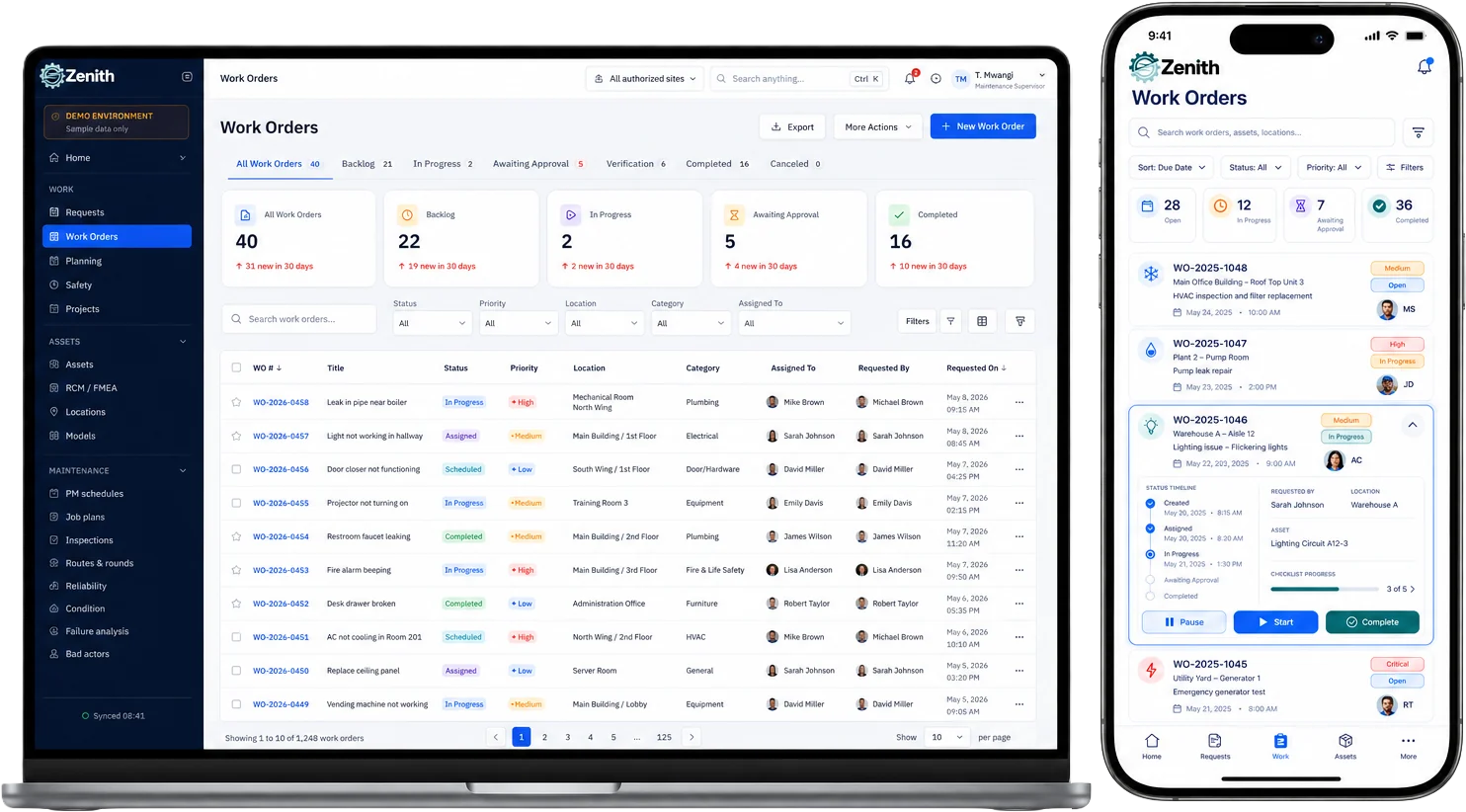


A reliable plant, fewer surprise breakdowns, lower costs, and peace of mind—this is what a well-run preventive maintenance (PM) program delivers. When you pair PM with a modern Computerized Maintenance Management System (CMMS), you move from firefighting to foresight. This guide walks you through the why, what, and how—so you can build, optimize, and scale a PM program that actually sticks.
TL;DR
- Preventive maintenance reduces unplanned downtime, extends asset life, and improves safety.
- CMMS software turns PM from “good intentions” into consistent execution with scheduling, work orders, inventory, and analytics.
- Start with critical assets, standardize PM tasks, schedule realistically, and track KPIs like PM compliance, MTTR, and PMP.
- Expect a phased rollout: pilot > standardize > scale. Invest in training and change management as much as in software.
What is preventive maintenance?
Preventive maintenance is planned, routine work performed to keep equipment in optimal condition and prevent failures. Instead of waiting for breakdowns, you proactively inspect, lubricate, calibrate, and replace parts at the right intervals.
- Goals: Reduce downtime, improve safety and compliance, extend asset life, and lower total maintenance cost.
- Triggers: Time-based (calendar), usage-based (meter), condition-based (sensor/inspection), or event-based (seasonal, startup/shutdown).
What is a CMMS?
A CMMS is software that centralizes maintenance operations—assets, work orders, schedules, parts, vendors, and reports—so your team can plan, execute, and optimize maintenance work.
- Core modules: Asset registry, PM scheduling, work orders, inventory/parts, purchasing, labor/time, vendor management, mobile, reporting/dashboards.
- Why it matters: It provides standardization, visibility, accountability, and data to continuously improve.
Why combine PM with CMMS?
- Consistency: Auto-generate PMs, assign resources, and ensure nothing slips through the cracks.
- Accountability: Digital checklists, timestamps, photos, and e-signatures create strong audit trails.
- Optimization: Track failures, costs, and trends to adjust intervals and tasks over time.
- Coordination: Align maintenance windows with production, and kit parts in advance.
- Scalability: Standard libraries and templates make multi-site rollouts practical and controllable.
Types of preventive maintenance and triggers
Common PM strategies
- Time-based: Perform tasks every week/month/quarter. Simple and effective for age-related wear.
- Meter-based: Trigger at usage thresholds (run-hours, cycles, starts). Better aligns work with actual wear.
- Condition-based: Use inspections or sensors to perform work when conditions drift (temperature, vibration).
- Seasonal/event-based: Prepare for seasonal loads or after specific events (power outages, line changeovers).
PM trigger matrix
| Trigger type | Examples | Best for | Watch-outs |
|---|---|---|---|
| Time-based | Monthly belt inspection | Age-related degradation | Risk of over-maintenance |
| Meter-based | Lubricate every 250 run-hours | Usage-dependent wear | Requires accurate meter data |
| Condition-based | Replace filter at ΔP threshold | Variable operating environments | Sensor and analytics reliability |
| Seasonal/event | Winterization, post-storm checks | Environmental and operational shifts | Requires calendar discipline |
Building your PM program in a CMMS
- Set objectives: Define targets for uptime, quality, safety, and cost. Prioritize what matters most.
- Inventory assets: Create an accurate asset registry with hierarchies, locations, and BOMs.
- Assess criticality: Rank assets by impact on safety, production, quality, environment, and cost.
- Gather documentation: O&M manuals, OEM recommendations, prior PMs, and failure history.
- Draft PM tasks: Clear, measurable steps with tools, parts, torque specs, and safety notes.
- Choose triggers: Time-, meter-, or condition-based—aligned with failure modes and operations.
- Estimate effort: Duration, labor skill, tools, and downtime needed. Avoid optimistic scheduling.
- Schedule realistically: Level-load PMs, respect production windows, and avoid end-of-month pileups.
- Kit parts: Pre-stage spare parts and special tools; link stock to each PM.
- Mobilize: Enable technicians with mobile access, QR codes, photos, and offline mode.
- Track KPIs: PM compliance, schedule compliance, MTTR, MTBF, and PMP (planned maintenance percentage).
- Review and refine: Close the loop with failure analysis and interval adjustments.
Asset criticality analysis
Prioritization ensures your team’s effort goes where it matters most. A simple risk-based approach works well:
- Criteria: Safety, Environment, Production loss, Quality impact, Repair cost, Lead time, Redundancy.
- Scoring: Rate each criterion (e.g., 1–5) and calculate a composite risk score.
- Simple model: ( \text{Risk Score} = \text{Severity} \times \text{Probability} \times \text{Detectability} ).
- Outcome: Focus PM precision and inventory on high-risk assets; run-to-failure may be acceptable for low-risk items.
Crafting effective PM tasks
- Be specific: “Inspect belt for cracks; replace if cracks > 5 mm or fraying visible over 10% of length.”
- Include tolerances: Alignment within 0.05 mm, torque 35 N·m ± 10%.
- Safety first: Note PPE, LOTO steps, stored energy hazards, and confined space requirements.
- Add evidence: Require photos, meter readings, and condition codes for traceability.
- Standardize: Use task libraries and checklists to reduce variation between technicians.
- Time-box wisely: If a “15-minute inspection” takes 45 minutes in reality, schedules will crumble.
Scheduling and coordination
- Level-loading: Distribute PMs across weeks to avoid spikes; avoid bunching at month-end.
- Blackout windows: Respect production constraints and regulatory windows.
- Auto-generation: Use CMMS to auto-create PM work orders with checklists and kits.
- Backlog control: Track PM backlog in weeks. Aim to keep it within manageable thresholds.
- Communication: Share the weekly schedule with operations; hold short daily standups.
Work order management in CMMS
- Requests: Standard intake from operators with asset, symptoms, and priority.
- Triage: Screen for safety, duplication, and scope; convert to WO or merge.
- Assignment: Match skills, certifications, and availability; consider travel time.
- Execution: Mobile steps, parts issue, photos, and readings.
- Completion: Close-out notes, failure codes, labor/parts costs, and follow-up tasks.
- Feedback loop: Use failure and cause codes to refine PM tasks and intervals.
Spare parts and inventory
- BOM linkage: Tie parts to assets and PMs to prevent missed kits.
- Min/max and reorders: Right-size stock with lead times and criticality in mind.
- ABC analysis: Focus controls on A-items (high value/critical).
- Cycle counts: Catch discrepancies early; track stockouts and turns.
- Kitting: Pre-pick parts for scheduled PMs to raise wrench time.
Vendor, warranty, and contracts
- Warranty tracking: Link warranty start/end to assets; avoid paying for covered work.
- Service contracts: Record SLAs, response times, and rate cards.
- Vendor performance: Track quality, timeliness, and cost to inform renewals.
Mobile CMMS essentials
- Offline mode: Keep work flowing in low-connectivity areas.
- QR/barcodes: Fast asset identification; reduce lookup errors.
- Multimedia: Attach photos, videos, and voice notes for clarity.
- Digital signatures: Support compliance and accountability.
KPIs that matter
| KPI | What it measures | How to compute | Good signals |
|---|---|---|---|
| PM compliance | % of PMs done on time | On-time PMs ÷ Scheduled PMs | Reliability discipline improving |
| Schedule compliance | Planned vs. executed within the window | Completed as scheduled ÷ Planned | Predictable work execution |
| Planned maintenance percentage | Share of planned vs. total maintenance | Planned hours ÷ Total hours | Less firefighting, more control |
| MTTR | Average repair duration | Downtime duration ÷ # of failures | Faster recoveries |
| MTBF | Average runtime between failures | Runtime hours ÷ # of failures | Higher reliability |
| Emergency work ratio | Emergencies vs. total work | Emergency WOs ÷ Total WOs | Risk exposure trending down |
| Stockout rate | Frequency of parts unavailability | Stockouts ÷ Requests | Inventory practices effective |
| Maintenance cost as % of RAV | Spend relative to asset value | Annual maintenance cost ÷ Replacement Asset Value | Cost efficiency |
| Backlog (weeks) | Volume of pending work | Total labor hours backlog ÷ Weekly capacity | Work is under control |
ROI and the business case
A CMMS-enabled PM program pays for itself through downtime avoidance, extended asset life, and efficient labor.
- Simple ROI: ( \text{ROI} = \dfrac{\text{Annual Benefits} – \text{Annual Costs}}{\text{Annual Costs}} ).
- Annual benefits can include:
- Downtime savings: Production value or service value per hour × hours saved.
- Maintenance cost reduction: Fewer emergencies, better planning, lower contractor premiums.
- Inventory optimization: Lower carrying costs and fewer obsolete parts.
- Energy savings: Proper lubrication, alignment, and calibration.
- Example:
- Downtime reduced by 120 hours × $5,000/hr = $600,000
- Emergency work cut by $150,000; inventory carrying cost down $50,000
- Annual CMMS + training + devices = $180,000
- ROI = (600,000 + 150,000 + 50,000 − 180,000) ÷ 180,000 = 3.38 (338%)
Implementation roadmap (90–180 days)
- Discovery: Objectives, pain points, data sources, compliance needs.
- Data prep: Clean asset lists, locations, BOMs, meters, and vendor data.
- Configuration: Sites, roles, workflows, codes, notifications, and security.
- Pilot: 10–20 critical assets, a handful of PMs, and 2–3 crews.
- Training: Role-based—planners, techs, approvers, storeroom, and managers.
- Iterate: Fix data gaps, refine task clarity, adjust intervals.
- Scale: Import remaining assets, expand PM library, standardize templates.
- Integrate: ERP for purchasing, SSO for access, sensors for meters.
- Sustain: Governance, SOPs, audits, and KPI reviews.
Integrations that amplify value
- ERP/Finance: Purchasing, receiving, and cost postings.
- SCADA/IoT/BMS: Automated meters, alarms, and condition data.
- Identity/SSO: Streamlined, secure user access.
- File repositories: Drawings, manuals, and calibration certificates.
- Analytics/BI: Deeper insights across plants and portfolios.
Compliance and audits
- Standards: ISO 55001 (asset management), ISO 9001 (quality), cGMP, and industry-specific codes.
- Regulatory needs: Electronic records and signatures, calibration traceability, and audit trails.
- Safety: LOTO procedures embedded in PMs; record incidents and corrective actions.
- Proof-on-demand: PM histories, calibration logs, and training records at your fingertips.
Best practices
- Start small, prove value: Pilot on critical assets, then expand.
- Standardize relentlessly: Templates for tasks, codes, priorities, and naming.
- Right-size intervals: Use data to prevent both over- and under-maintenance.
- Invest in planners: Planning and kitting can double wrench time.
- Close the loop: Use failure codes and root cause analysis to improve PMs.
- Keep it mobile: Reduce paperwork; increase data quality at the point of work.
- Governance: Establish ownership for master data and KPIs.
Common pitfalls (and how to avoid them)
- Too many PMs, too soon: Leads to noncompliance and burnout. Phase your rollout.
- Vague tasks: Results in inconsistent work. Make steps measurable.
- Ignoring operations: Causes friction. Co-create schedules with production.
- No change management: Tech alone won’t change habits. Train, coach, and recognize.
- Dirty data: Garbage in, garbage out. Clean and maintain master data.
- No feedback loop: If techs can’t suggest changes, PMs stagnate.
Sample PM checklist (compressor example)
- Inspect for oil leaks; if present, document area and severity with photos.
- Measure inlet temperature and pressure; record readings.
- Check belt tension and alignment; adjust to specification 35 N·m ± 10%.
- Replace air filter if ΔP > 1.5 kPa or visual clogging > 50%.
- Verify safety relief valve operation; test per SOP 12.4.
- Drain condensate; ensure trap functioning.
- Confirm vibration levels < 4.5 mm/s RMS; escalate if above threshold.
- Clean cooling fins; ensure unobstructed airflow.
- Perform functional test; log amperage and discharge pressure.
- Update digital log; attach photos and sign off.
Reliability methods that enhance PM
- RCM (Reliability-Centered Maintenance): Align tasks to functional failures and consequences.
- FMEA: Identify failure modes and prioritize mitigations by risk priority numbers.
- CBM/PdM: Use condition monitoring (vibration, thermography, oil analysis) to refine task timing.
- Run-to-failure (selective): For low-risk, low-cost items where PM adds little value.
Multi-site standardization
- Global libraries: Shared PM templates, codes, and naming conventions.
- Local flex: Allow site-specific tweaks for environment and regulations.
- Benchmarking: Compare KPIs across sites; share wins and lessons.
- Central governance: Review boards to manage changes and version control.
Quick case snapshots
- Food processor: PM compliance up from 52% to 88% in 6 months; MTTR down 28% via kitting and checklists.
- Municipal fleet: Meter-based PMs triggered by odometer/GPS cut breakdowns by 35% year-over-year.
- Pharma plant: Electronic signatures and calibration histories slashed audit prep from weeks to hours.
FAQ
What’s the difference between CMMS and EAM?
CMMS focuses on maintenance operations—work orders, PMs, and inventory. EAM (Enterprise Asset Management) spans broader lifecycle functions like asset investment planning, risk, and financials. Many organizations start with CMMS and extend toward EAM as maturity grows.
How often should I perform preventive maintenance?
Base intervals on failure modes and usage. Start with OEM guidance, then tune using your data. High-duty assets often benefit from meter-based triggers; low-duty or seasonal assets can be time-based.
What data do I need to get started?
An asset list with unique IDs, locations, criticality, key specifications, BOMs, and meters. Add vendor/warranty details, PM tasks, and failure history if available. Imperfect data is okay—clean as you go.
How do I avoid over-maintenance?
Align tasks with actual failure modes. Use condition data and inspections to extend intervals where evidence supports it. Track failures; if none occur over multiple cycles, consider stretching the schedule.
What KPIs should I track first?
PM compliance, schedule compliance, MTTR, and planned maintenance percentage. Add MTBF and emergency work ratio as your data stabilizes.
Can small teams benefit from a CMMS?
Yes. Even small operations gain from standardized PMs, mobile WOs, and parts control. Start lean: critical assets, a few PMs, and simple dashboards.
How long does implementation take?
A focused pilot can go live in 4–8 weeks. Full rollouts vary (3–6 months) depending on data, integrations, and training.
Cloud or on‑prem CMMS?
Cloud offers faster deployment, lower infrastructure overhead, and easier updates. On‑prem can suit strict data residency or custom integration needs. Evaluate security, latency, and IT support.
How does CMMS help with compliance?
It provides audit trails, electronic signatures, controlled document versions, calibration histories, and training records. You can prove PM execution with timestamps and evidence.
What about cybersecurity?
Use SSO/MFA, role-based permissions, network segmentation for OT, and encrypted data at rest/in transit. Keep mobile devices managed and patched.
How do I migrate from spreadsheets?
Clean and map columns to CMMS fields, import in batches, and validate with spot checks. Run old and new in parallel for a short period, then decommission spreadsheets.
How do I calculate ROI?
Estimate downtime savings, maintenance cost reductions, and inventory benefits, then apply ( \text{ROI} = (\text{Benefits} – \text{Costs}) / \text{Costs} ). Track actuals post-implementation.
What’s the difference between preventive and predictive maintenance?
Preventive is scheduled (time/meter). Predictive uses condition monitoring and analytics to forecast failures. Many programs blend both.
How do I manage PM backlog?
Level-load schedules, prioritize by criticality, increase planner capacity, and temporarily defer low-risk PMs. Track backlog weeks and trend down.
Can CMMS handle multi-site operations?
Yes—with site hierarchies, role scoping, standardized templates, and cross-site reporting. Balance global standards with local flexibility.
How do I improve wrench time?
Plan work, kit parts, ensure access permits, and remove administrative friction with mobile WOs. Daily huddles help eliminate blockers.
What training is needed?
Role-based training: planners on scheduling and kitting, techs on mobile and close-out quality, managers on KPIs and dashboards. Reinforce with job aids and coaching.
Does CMMS support barcodes and QR codes?
Modern systems do. They speed up asset identification, parts picking, and data entry—improving accuracy.
How do I set min/max for spare parts?
Consider criticality, lead time, demand variability, and carrying cost. Start with historical usage and adjust via cycle counts and stockout analysis.
How do I handle warranties?
Record warranty dates and terms, flag WOs within warranty, and require vendor approval before internal repairs to preserve coverage.
What if operations reschedules my PMs?
Build a joint planning rhythm. Protect critical PM windows, but maintain flexibility. Track deferrals and their impact.
How do I standardize naming and codes?
Create a controlled vocabulary for assets, locations, failure/cause/remedy codes, and priorities. Govern changes through a review board.
Can I attach manuals and photos?
Yes. Store O&M manuals, SOPs, diagrams, and images with assets and tasks for quick reference on mobile.
How do I use condition monitoring with CMMS?
Feed sensor or inspection data into CMMS as meters or condition readings. Auto-trigger WOs when thresholds are exceeded.
What’s a good planned maintenance percentage?
Aim to push PMP above 60–70% over time. The right target depends on industry and asset mix; trend direction matters most.
Conclusion
Preventive maintenance powered by a CMMS isn’t just about fewer breakdowns—it’s about control, confidence, and a culture that values reliability. Start with what matters most, standardize the work, schedule realistically, and let your data guide continuous improvement. If you want, tell me about your assets and goals—I’ll help you sketch a focused 90‑day PM rollout you can trust.
What a CMMS preventive maintenance guide misses about Canada
Most preventive maintenance advice assumes you choose your intervals. In Canada that is sometimes true and sometimes not, and the difference matters more than the scheduling theory.
Ontario sets no periodic leak-test interval for commercial refrigeration. Quebec requires testing at least once a year with no more than fifteen months between tests. Same equipment, same company, two provinces, two answers — and the Ontario case is the harder one, because an interval you chose is an interval you have to defend. See CMMS for Canadian retail.
Elsewhere the interval is fixed for you. British Columbia requires elevating devices to be maintained at least quarterly by a licensed contractor. Federally regulated pipelines carry a maximum three-year audit interval. See property management and mining and pipelines.
The practical consequence is that a PM schedule in Canada is per site, not per asset type. More at CMMS software in Canada.