

Computerized Maintenance Management Systems (CMMS) help organizations streamline maintenance operations, boost uptime, and control costs. Below are 50 of the most-searched questions, organized by topic, each with a concise, practical answer.
CMMS Basics
What is a CMMS?
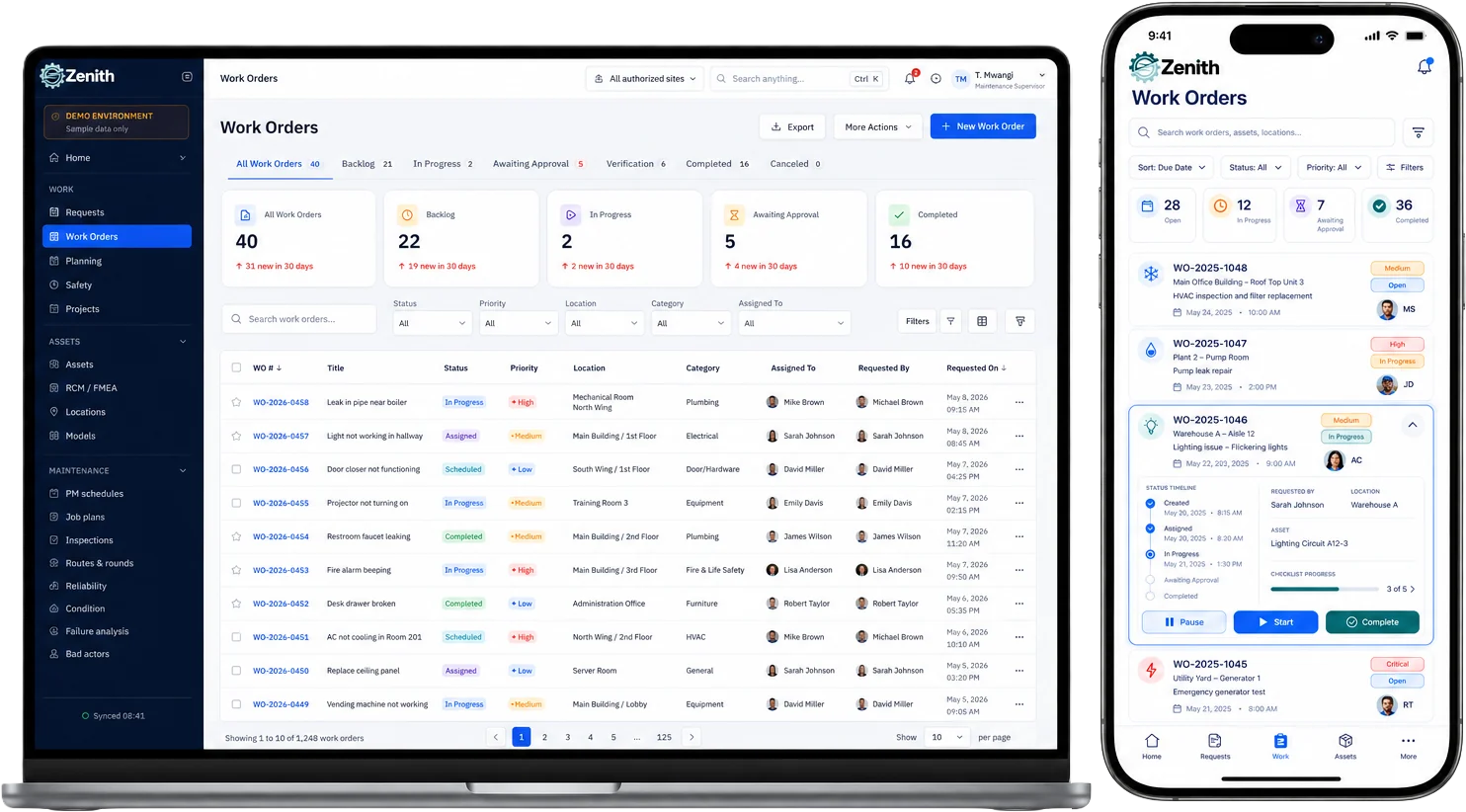
A CMMS is software that centralizes maintenance information, automates work orders, tracks assets, and schedules preventive tasks. It replaces paper- or spreadsheet-based systems, improving efficiency and data accuracy.
How does a CMMS work?
Users enter assets, parts, and work orders into the system. When maintenance is due or a failure occurs, the CMMS generates tasks, assigns technicians, tracks hours and materials, and records completion details for reporting.
Who typically uses a CMMS?
Maintenance managers, planners, technicians, storeroom staff, and operations teams all rely on CMMS. Executives also use CMMS dashboards to monitor key performance indicators (KPIs) like uptime and cost per repair.
What are key CMMS features?
Most CMMS solutions include work order management, preventive maintenance scheduling, inventory control, asset management, mobile access, and reporting dashboards.
Why implement a CMMS?
Organizations adopt CMMS to reduce downtime, extend equipment life, optimize spare-parts inventory, enforce safety compliance, and gain data-driven insights that guide continuous improvement.
Implementation & Setup
How long does implementation usually take?
Setup can range from a few weeks to several months depending on asset complexity, data volume, and integration needs. A phased rollout—starting with critical equipment—often accelerates adoption.
What data is needed to set up a CMMS?
You’ll need asset hierarchies (locations and equipment), maintenance procedures, parts lists, vendor contacts, and historical work logs. Accurate initial data speeds onboarding and boosts user confidence.
How do you migrate from spreadsheets or paper?
Clean and standardize existing records, export them into CSV or XML formats, then import into the CMMS. Validate imported entries with cross-checks to ensure accuracy before going live.
What are common setup challenges?
Challenges include incomplete data, inconsistent naming conventions, resistance to change, inadequate training, and unrealistic timelines. Strong leadership and clear communication mitigate most issues.
How do you customize CMMS workflows?
Most platforms let you tailor work order templates, approval processes, status codes, and notification rules. Workshops with stakeholders help define workflows that reflect real-world practices.
Who should be involved in implementation?
Include maintenance managers, planners, technicians, IT staff, and finance representatives. Cross-functional involvement ensures technical feasibility, data integrity, and alignment with budgetary goals.
Features & Functionality
What is work order management?
This feature tracks the lifecycle of maintenance requests—from submission and approval through scheduling, execution, and closure—ensuring visibility and accountability at every stage.
How does preventive maintenance scheduling work?
You define calendar- or usage-based triggers (e.g., every 90 days or every 1,000 operating hours). The CMMS then auto-generates and assigns work orders to keep equipment reliable.
What asset management capabilities exist?
CMMS catalogs asset details such as make, model, serial numbers, warranty information, and maintenance history, enabling informed decisions about repairs, refurbishments, or replacements.
How does inventory management function?
You set minimum and reorder thresholds, track parts usage against work orders, and automate purchase requests when stock dips below predefined levels.
Does CMMS support mobile access?
Modern CMMS offer mobile apps or responsive web interfaces so technicians can view, update, or close work orders, record meter readings, and upload photos directly from the field.
Can CMMS automate notifications?
Yes. You can configure email or SMS alerts for upcoming PM tasks, overdue work orders, low inventory levels, or critical equipment alarms.
Integration & Scalability
Can CMMS integrate with ERP systems?
Most leading CMMS platforms offer prebuilt connectors or APIs to share asset, purchase order, and financial data seamlessly with ERP solutions, avoiding double entry.
How scalable is a CMMS?
Cloud-based CMMS scale from small facilities to global enterprises. You can add users, assets, or locations on demand without investing in additional hardware.
Does CMMS integrate with IoT sensors?
Yes. When linked to vibration monitors, temperature sensors, or PLCs, a CMMS can trigger condition-based maintenance based on real-time equipment health metrics.
How do you integrate CMMS with other systems?
Use RESTful APIs, middleware, or custom scripts to push and pull data. IT involvement is essential to map fields, set up secure connections, and manage data flows.
Can multiple facilities use a single CMMS instance?
Absolutely. You can segment information by facility, department, or region, granting appropriate access while consolidating reporting at the corporate level.
Maintenance Strategies
What is preventive vs. predictive maintenance?
Preventive maintenance follows a fixed schedule, while predictive uses real-time data (vibration, oil analysis) to perform tasks only when indicators suggest impending failure.
Can CMMS support reliability-centered maintenance (RCM)?
Yes. RCM’s decision logic—categorizing failure modes and defining optimal tasks—can be embedded in CMMS workflows to standardize best-practice maintenance.
How does condition-based maintenance work?
Sensors feed live data into the CMMS, and when thresholds are breached (e.g., bearing temperature too high), the system auto-creates work orders for inspection or repair.
What role does CMMS play in compliance?
CMMS logs safety inspections, calibration tasks, and audit trails, generating reports that demonstrate adherence to industry regulations like OSHA, FDA, or ISO standards.
How do you track maintenance KPIs?
CMMS dashboards display metrics such as mean time between failures (MTBF), mean time to repair (MTTR), schedule compliance, and wrench time, guiding performance improvement.
Can CMMS handle corrective maintenance?
Yes. When unplanned breakdowns occur, users generate corrective work orders, document root causes and closure details, then analyze failures for long-term fixes.
Reporting & Analytics
What reports does CMMS offer out of the box?
Standard reports include work order backlog, PM compliance, parts usage, downtime analysis, labor hours, and asset history summaries.
How do you create custom reports?
Most CMMS feature built-in report writers where you select tables, fields, and filters, then design layouts or export data to BI tools for advanced analytics.
Does CMMS provide downtime analysis?
Yes. By categorizing downtime events (planned vs. unplanned, mechanical vs. operational), you can pinpoint root causes and target improvements.
What KPI dashboards are available?
Dashboards often display MTBF, MTTR, on-time PM completion rates, backlog trends, and budget variances, all updated in real time.
How can analytics drive continuous improvement?
Trend charts and Pareto analyses highlight recurring issues—like a problematic valve—so you can adjust maintenance intervals, train staff, or invest in higher-quality parts.
ROI & Business Value
How do you calculate CMMS ROI?
Compare pre- and post-implementation metrics such as reduced downtime costs, lower overtime expenses, optimized inventory levels, and avoided capital replacements.
What cost savings can CMMS deliver?
Organizations often see 10–30% reductions in maintenance costs via better planning, fewer emergency repairs, leaner spare parts, and data-driven decision making.
How does CMMS improve equipment uptime?
By automating preventive tasks, flagging emerging issues, and streamlining response workflows, CMMS can boost overall equipment effectiveness by 5–20%.
Can CMMS reduce inventory carrying costs?
Yes. Real-time usage tracking and automated reorder points prevent overstocking and obsolescence, trimming holding costs by up to 25%.
When do benefits typically materialize?
Basic gains in work order visibility and PM compliance often appear within 3–6 months. Deeper analytics-driven savings may take 12–18 months as data quality matures.
Security & Compliance
Is CMMS data secure?
Leading solutions use encryption at rest and in transit, role-based access, multi-factor authentication, and regular security audits to protect sensitive maintenance records.
How do you manage user permissions?
Define roles (technician, planner, manager) and assign granular rights—view, create, edit, or delete work orders—ensuring users only access relevant functions and data.
Does CMMS comply with industry standards?
Many CMMS are designed for ISO 55000 (asset management), FDA (21 CFR Part 11), or OSHA record-keeping requirements, offering audit trails and electronic signatures.
How do you ensure audit-ready records?
Configure your CMMS to automatically timestamp changes, retain historical versions, and lock closed work orders, providing tamper-proof documentation.
Support & Training
What training is needed for CMMS users?
Technicians need hands-on sessions for mobile work order updates; planners learn scheduling and reporting; managers focus on analytics dashboards and configuration.
How do you get vendor support?
Most vendors offer online knowledge bases, chat support, email tickets, and dedicated customer success managers. Premium plans often include 24/7 phone support.
Are there CMMS user communities?
Yes. Online forums, LinkedIn groups, and vendor-hosted user conferences foster best-practice sharing, peer troubleshooting, and early access to new features.
How often should training be refreshed?
Quarterly or semi-annual refreshers keep users current on system updates, reinforce data-entry standards, and introduce new modules or integrations.
Trends & the Future of CMMS
What is cloud-based CMMS?
Cloud CMMS is hosted off-premises, eliminating on-site servers, simplifying updates, supporting remote access, and offering flexible subscription pricing.
How is AI impacting CMMS?
AI and machine learning are emerging to predict failures, recommend optimal maintenance intervals, auto-prioritize work orders, and optimize spare parts stocking.
What mobile trends are driving CMMS adoption?
Voice-enabled work order entry, augmented reality for guided repairs, and offline-capable apps are making maintenance more responsive and user-friendly.
What does the future hold for CMMS?
Expect deeper IoT integration, tighter links with enterprise systems, advanced analytics suites, and more self-diagnosing assets that close the loop between data, decisions, and actions.