

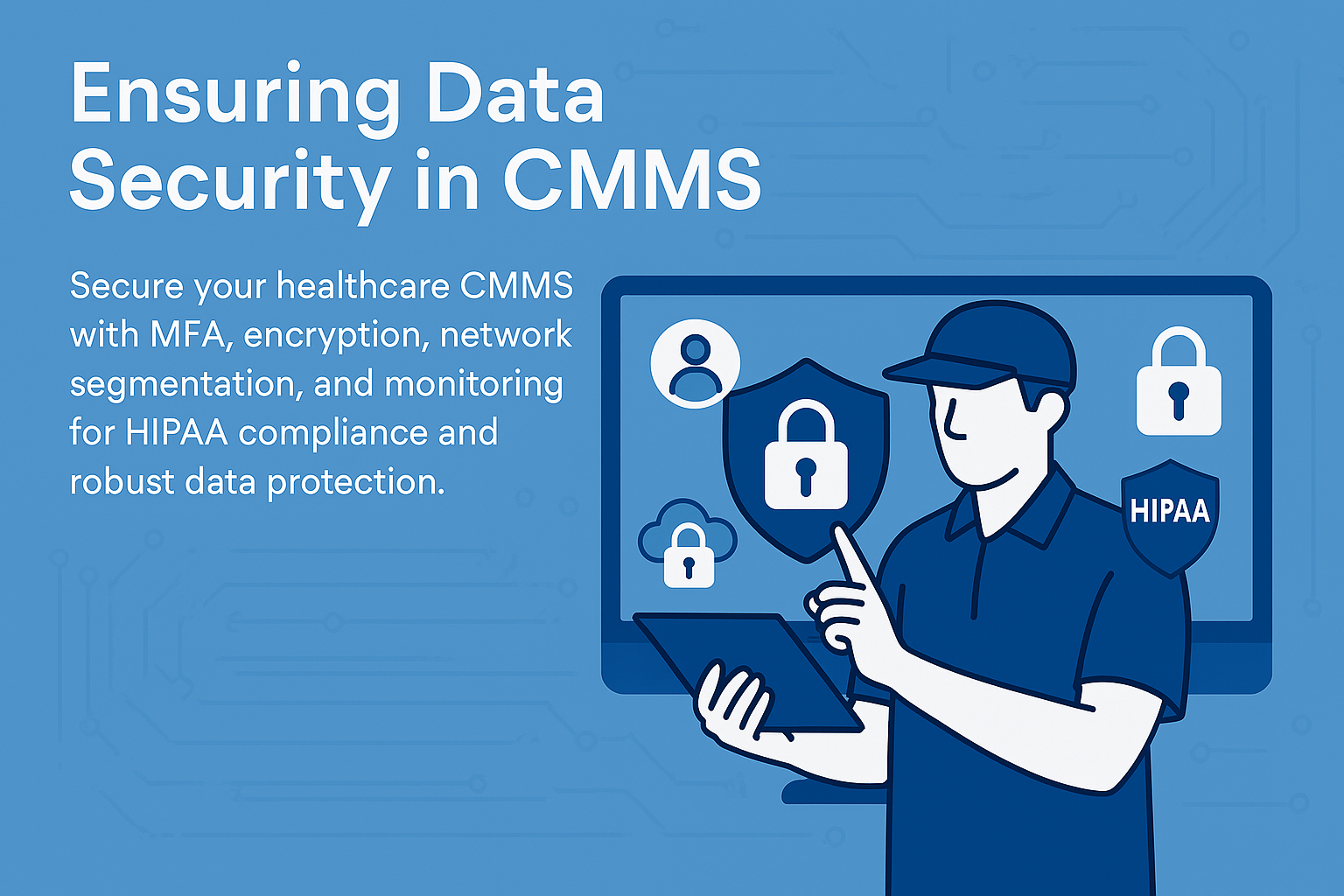
Healthcare organizations rely on computerized maintenance management systems (CMMS) to track equipment, schedule preventive work, and document regulatory compliance. These systems house sensitive information ranging from patient-facing device inventories to staff credentials. Protecting CMMS data isn’t optional—it’s essential to safeguard patient privacy, maintain operational continuity, and meet regulations like HIPAA.
The Stakes of CMMS Data Security
Healthcare CMMS platforms contain three critical categories of information:
- Asset details and maintenance histories that drive clinical uptime.
- Employee credentials, roles, and access logs that control who touches what.
- Audit trails and compliance records required by regulators and accreditation bodies.
A breach or data corruption can halt clinical workflows, expose patient data, and trigger hefty fines. IT teams must defend every layer of the CMMS infrastructure from network to application.
Top Threats to CMMS Integrity
- Unauthorized Access
Malicious actors or rogue insiders exploiting weak passwords or shared accounts. - Unpatched Vulnerabilities
Outdated CMMS modules or dependent libraries that cybercriminals target. - Insecure Integrations
Third-party connectors or IoT sensors lacking encryption or hardened APIs. - Ransomware & Malware
Malicious software that encrypts databases and demands payment to restore operations. - Configuration Drift
Ad hoc changes to firewalls, ACLs, or server settings that introduce loopholes.
Core Security Controls for Healthcare CMMS
- Access Control and Authentication
Implement single sign-on (SSO) with multi-factor authentication (MFA) and role-based access (RBAC). - Encryption In Transit and At Rest
Use TLS for all network connections and AES-256 for database storage. - Network Segmentation
Isolate CMMS servers and integrations on dedicated VLANs with strict firewall policies. - Secure API Gateways
Enforce token-based authentication, rate limiting, and input validation on every CMMS endpoint. - Patching and Vulnerability Management
Automate updates for operating systems, application stacks, and CMMS plug-ins. - Continuous Monitoring and Auditing
Feed logs into a SIEM platform to detect anomalies and trigger real-time alerts.
Implementing a Security-First CMMS Strategy
- Perform a Risk Assessment
Map data flows, classify information sensitivity, and identify critical assets. - Define Policies and Procedures
Document access reviews, change management, incident response, and backup routines. - Integrate with Enterprise Security Tools
Leverage your existing endpoint protection, data-loss prevention, and logging solutions. - Run Table-Top Exercises
Simulate a breach or ransomware event to test roles, communication plans, and recovery steps. - Train and Certify Staff
Educate administrators and technicians on phishing resistance, secure configuration, and audit readiness.
Security Controls at a Glance
| Security Layer | Control Description | Implementation Tip |
|---|---|---|
| Authentication & Access | MFA, RBAC, periodic access reviews | Sync with your IAM/SSO provider |
| Encryption | TLS 1.2+, AES-256 at rest | Use hardware security modules (HSMs) |
| Network & Perimeter | VLAN isolation, next-gen firewalls | Employ microsegmentation for critical hosts |
| API & Integration | OAuth2, API gateway, strict input validation | Limit third-party scopes to minimum needed |
| Monitoring & Auditing | SIEM ingestion, anomaly detection, audit trails | Automate alert workflows and dashboards |
| Backup & Recovery | Immutable backups, DR site, RTO/RPO testing | Follow 3-2-1 backup rule |
Compliance Considerations
Healthcare IT teams must align CMMS security with these frameworks:
- HIPAA Security Rule
Encryption, access controls, audit logging, and breach notification policies. - NIST SP 800-171 (for contractor facilities)
Detailed control requirements for protecting Controlled Unclassified Information (CUI). - Local Privacy Regulations
Provincial or state laws governing patient data residency, consent, and breach reporting.
An illustrative scenario: a community hospital
The scenario below is illustrative. It is not an account of a named customer, and the figures in it are indicative of what a maintenance programme can aim at rather than measured results we can attribute. Where we can publish real numbers with a client’s permission, we say so plainly.
the hospital overhauled its CMMS security after a near-miss ransomware incident. Key results within six months:
- Zero critical vulnerabilities in routine penetration tests.
- 100 percent of maintenance staff enrolled in annual security training.
- 40 percent faster incident response time by automating SIEM-to-ticket workflows.
These measures preserved clinical uptime and strengthened audit readiness for upcoming Joint Commission reviews.
Next Steps for Healthcare IT Teams
Securing your CMMS is an ongoing journey. Start by conducting a full risk assessment, then layer in the controls and processes outlined above. Engage stakeholders from clinical engineering, compliance, and executive leadership to sustain momentum. With a robust security posture, you’ll protect patient safety, ensure regulatory compliance, and keep critical equipment running smoothly.
Looking ahead, explore how integrating advanced analytics and artificial intelligence can further automate threat detection in your CMMS environment.