

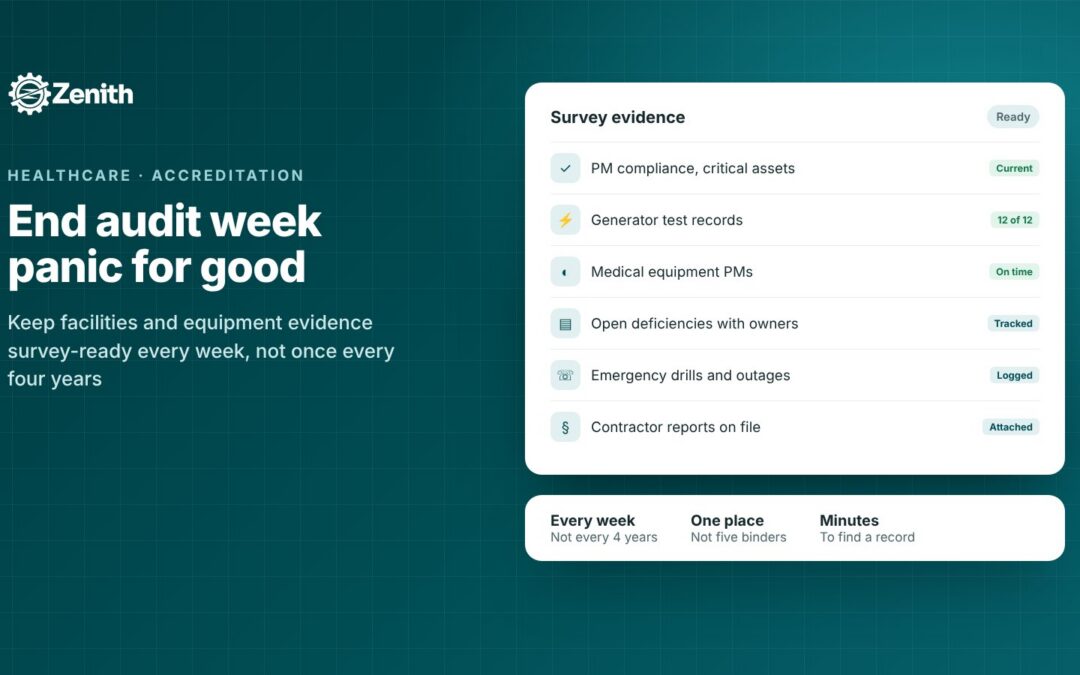
The survey dates are confirmed, and the facilities office goes quiet. For the next three weeks, the manager pulls binders off shelves, prints PM reports, chases contractor certificates and asks technicians to “tidy up” overdue work orders. Then a surveyor walks onto a unit and asks a nurse what safety checks of the physical environment are done in their area, and nobody in facilities is in the room to answer.
An Accreditation Canada survey isn’t only a clinical event. Surveyors look at whether the building, equipment and emergency systems support safe care, and hospital maintenance teams hold much of that evidence. This guide explains how the survey works, what surveyors typically look for from facilities, and how to keep evidence continuously so survey week becomes routine.
How does an Accreditation Canada survey work?
Accreditation in Canadian health care has two parts. The Health Standards Organization (HSO) develops the standards, and Accreditation Canada assesses organizations against them. Its current program for Canadian organizations is Qmentum Global, which it describes as co-designed with HSO and built around continuous assessment and action planning (Qmentum Global program page).
One provincial health authority’s survey materials give a clear picture of how it works in practice (Health PEI 2026–2027 Accreditation Information Toolkit):
- A four-year cycle. Qmentum is described as a four-year continuous cycle, and the accreditation decision covers that cycle.
- Core and service standards. Organizations are assessed on core standards such as Governance, Leadership, Infection Prevention and Control, Emergency and Disaster Management, Medication Management and Service Excellence, plus service standards such as Reprocessing of Reusable Medical Devices.
- Required Organizational Practices (ROPs). These are described as essential practices that organizations must have in place. High priority criteria rank just below them and relate to safety, ethics, risk management and quality improvement.
- Tracers. A tracer is the method surveyors use to evaluate priority processes on site: reviewing documents, talking with staff and patients, and observing care.
- Limited notice. Facilities may receive limited or no notice of the surveyor team’s schedule, so the survey reflects everyday conditions.
Long-term care is part of the same system. CAN/HSO 21001:2023, Long-Term Care Services, is a National Standard of Canada that the Qmentum program includes. A companion standard, CSA Z8004:22, covers long-term care home operations and infection prevention and control, including building systems (Standards Council of Canada).
What surveyors look for from facilities and maintenance
There is no single “facilities standard.” Physical environment and equipment requirements are spread across several standards and ROPs. These are the areas where maintenance evidence most often comes up.
The preventive maintenance ROP
Preventive Maintenance Program appears among the ROPs listed in recent provincial survey materials. A 2017 paper from biomedical engineers in BC summarized the ROP’s tests at the time as three things (CMBEC40 proceedings):
- A preventive maintenance program is in place for medical equipment.
- Preventive maintenance practice is documented.
- There is a process to evaluate the effectiveness of the preventive maintenance program.
The wording may have changed since, so check the current ROP handbook. But the three ideas are a good test for any maintenance program: is there a plan, is it recorded, and do you know whether it works? The ROP focuses on medical devices and equipment, so biomedical engineering usually leads it, but the same logic applies to building systems.
Leadership and the physical environment
Surveyor comments under the Leadership standard in published accreditation reports often address the physical environment directly, for example whether it is actively maintained to support patient and staff safety, and whether there is a scheduled PM program for equipment. Surveyors also tour facilities. One health authority’s preparation materials list “What safety checks of the physical environment are completed in your area/unit?” as a question staff may be asked.
Infection prevention and the building
Building systems show up inside clinical standards. Published reports from Canadian health authorities include unmet criteria such as operating rooms falling short of required air exchanges per hour, and a decontamination area without a handwashing sink. Expect questions about HVAC in critical rooms and how construction and maintenance work is controlled to protect patients (CSA Z317.13 covers that last area).
Emergency and disaster management
The Emergency and Disaster Management standard covers how organizations reduce risk, prepare for, respond to and recover from emergencies, working with internal and external partners (standard description). For facilities, that points to emergency power, utility failures and the plans that go with them. Your generator testing records under CSA C282 and CSA Z32 are part of this story.
Medical equipment safety
ROPs listed in recent provincial materials also include Infusion Pump Safety and Cleaning and Low-Level Disinfection of Medical Equipment. Biomedical engineering, environmental services and clinical teams usually share these, but the work orders and asset records often live in the same maintenance system.
| Area | Evidence a surveyor may ask for | Usually owned by |
|---|---|---|
| Preventive maintenance ROP | PM inventory, schedules, completion records, effectiveness review | Biomedical engineering, facilities |
| Physical environment | Inspection rounds, deficiency follow-up, response to staff reports | Facilities |
| Critical HVAC | Room pressure and air change verification, filter records, alarm response | Facilities, infection prevention |
| Emergency power | Generator and transfer switch tests, deficiencies and repairs | Facilities, electrical |
| Construction and maintenance risk | Risk assessments, precautions used, sign-offs | Facilities, infection prevention |
| Emergency and disaster plans | Utility failure procedures, exercise results, lessons learned | Emergency management, facilities |
Why audit week panic happens
Survey panic is usually a symptom of evidence that is created on demand instead of as the work happens. The common causes:
- Records live in too many places. Binders in mechanical rooms, contractor reports in email, readings in spreadsheets, PMs in a system nobody fully trusts.
- Completion isn’t the same as evidence. A PM is closed, but there are no readings, no checklist and no sign-off.
- Deficiencies go quiet. A problem found during a PM is noted but never becomes tracked work, so you can’t show it was fixed.
- Nobody measures effectiveness. You can list PMs done, but not whether they prevented failures, which is exactly what the ROP asks about.
- Front-line staff don’t know the process. A nurse doesn’t know how to report a facilities problem or what happens next.
How to keep evidence continuously
The method below works whether you use paper, spreadsheets or a CMMS. The idea is to make every routine task produce its own evidence, then review it on a schedule well before anyone asks.
Step 1: Build a crosswalk from standards to your assets
List each requirement that touches facilities, the assets or programs that satisfy it, and where the evidence lives.
| Requirement | Assets or program | Evidence and location | Owner | Review frequency |
|---|---|---|---|---|
| Preventive Maintenance Program ROP | Medical equipment inventory, PM schedules | PM history and compliance report | Biomedical lead | Mensuel |
| Emergency power (CSA C282 and Z32) | Generators, transfer switches, fuel | Test records and deficiency work orders | Electrical lead | Mensuel |
| Critical HVAC (CSA Z317.2) | ORs, isolation rooms, air handlers | Verification reports, check records | HVAC lead | Mensuel |
| Construction and maintenance risk (CSA Z317.13) | Projects and above-ceiling work | Risk assessments and sign-offs | Facilities manager, IPAC | Per project |
| Physical environment | Units and common areas | Inspection rounds and follow-up | Facilities supervisor | Mensuel |
This becomes your survey binder, except it’s kept up to date all the time.
Step 2: Make every PM produce its own evidence
Each PM should record what was done, the readings taken, who did it, when, and whether anything was found. A checklist with sign-off per task is better evidence than a single “complete” box. Attach contractor reports to the asset as they arrive, not in the month before the survey.
Step 3: Turn every deficiency into tracked work
Any problem found during a PM, inspection or round should become a work order with a priority, an owner and a due date. If it waits, record why. When surveyors ask “what happened next?”, the answer should take one search.
Step 4: Measure whether the program works
This is the part of the ROP most teams struggle with. Pick a small set of measures and review them every month:
- PM compliance: the share of scheduled PMs completed.
- On-time completion: the share completed within the allowed window.
- Overdue critical PMs: how many, and how long overdue.
- Breakdowns after PM: failures on assets that recently had a PM, which can signal a weak task list.
- Backlog: open corrective work by age and priority.
Write down what you changed as a result. A short note such as “added a belt tension check to AHU PMs after two failures” is strong evidence of evaluating effectiveness.
Step 5: Run facilities mock tracers
Mock tracers help teams practise and spot gaps. One provincial health authority describes them as learning opportunities, not tests. Pick a real asset or room and follow it:
| Start from | Ask |
|---|---|
| An operating room | When was the air change rate last verified? Show me the report and any follow-up. |
| A generator | Show me the last three monthly tests and how the last deficiency was fixed. |
| An infusion pump | When was its last PM? What happens if it’s overdue? |
| A unit nurse | How do you report a facilities problem? How do you know it was fixed? |
| A recent renovation | Show me the infection control risk assessment and who signed off. |
Step 6: Review quarterly, not once every four years
Set a quarterly review with facilities, biomedical engineering and infection prevention. Walk through the crosswalk, the measures and any open deficiencies. Fix gaps while they’re small, and the survey year looks like any other year.
Common mistakes to avoid
- Closing overdue work orders in bulk before the survey. It erases the evidence of what really happened and surveyors may notice.
- Relying on one person’s memory. If only one supervisor knows where the records are, the program is fragile.
- Treating contractors’ work as out of scope. Their reports are part of your evidence.
- Ignoring requests from clinical staff. How you respond to front-line reports is part of the physical environment story.
How Zenith helps
Zenith is a CMMS and facility management platform built and supported in Canada. It doesn’t prepare your survey for you, and it doesn’t make you accredited, but it helps your team schedule the work, keep the records and show the evidence surveyors look for, every day of the cycle.
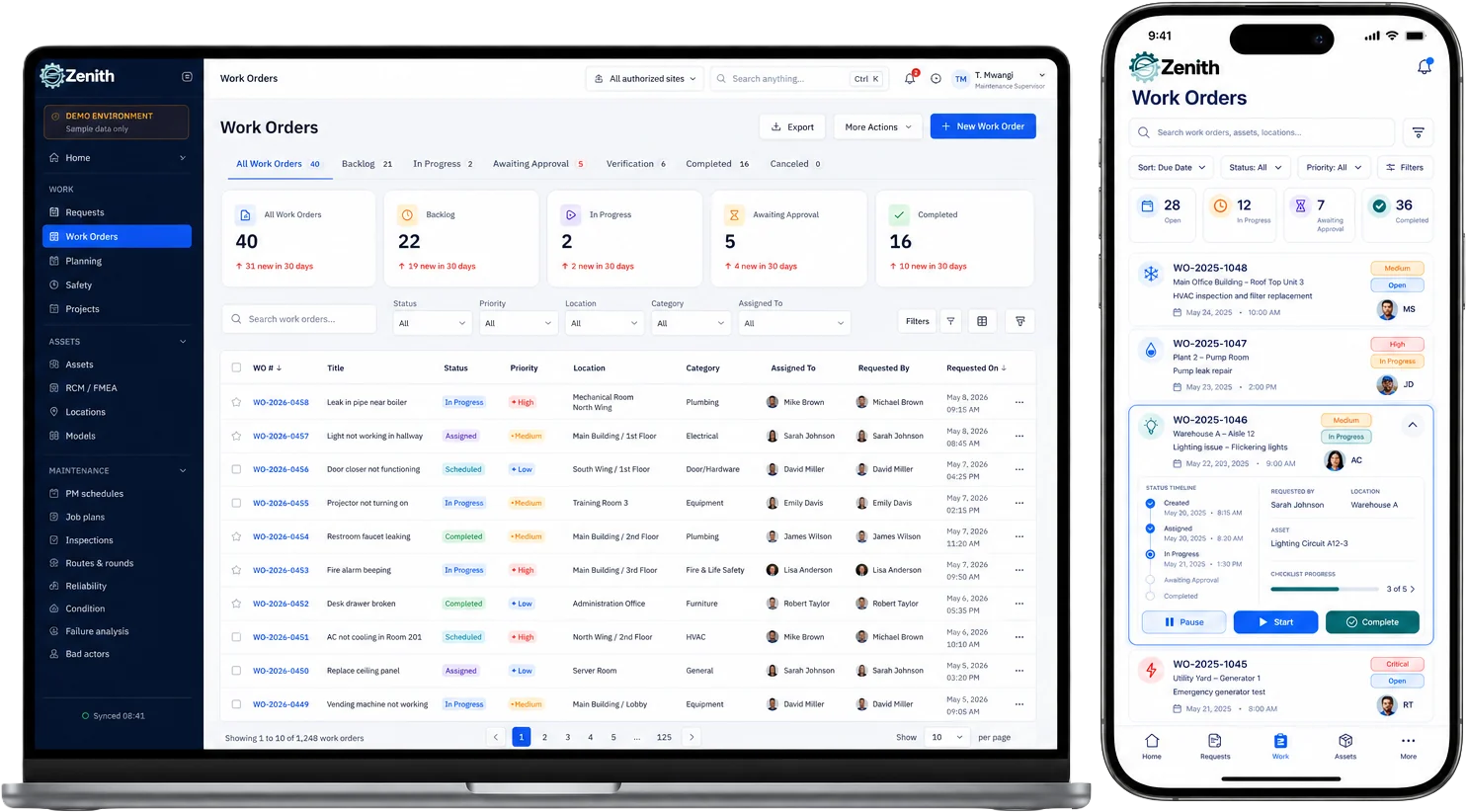
- A PM program you can show. PM schedules run on calendar, meter or whichever comes first, with job plans, task checklists and sign-off per task. The “What’s due” view looks ahead 4 weeks, 13 weeks or a year. See how entretien préventif works in Zenith.
- “Did it run, and did it work?” PM history shows the last occurrences, PM compliance %, how many ran on time and breakdowns since, which is the kind of effectiveness evidence the PM ROP asks for.
- Deficiencies that stay visible. Problems become work orders with priority, assets, location and due date. On Hold reasons come from a delay register, and every work order keeps a full history trail. Role-based access and a full audit history of changes show who changed what.
- Front-line requests. Clinical staff report problems through a simple request portal with photos and an urgent switch, and they’re told when the job is checked and closed.
- Evidence in one place. Assets carry documents and media, so contractor reports and verification results sit with the equipment they describe.
- Ready-made reporting. Dashboards and the report library cover KPIs such as PM compliance, on-time completion and planned work %. Schedule a monthly report to your quality committee by email, or export to Excel or CSV. Zenith Assist can answer questions such as “which critical PMs are overdue at the main site?”
- Bilingual and in Canada. Zenith is available in English and French and hosted in Canada on Microsoft Azure.
For more background, read how healthcare facilities use CMMS for compliance, see our healthcare maintenance management overview, or compare options on our CMMS software for Canada page.
Frequently asked questions
What is the difference between Accreditation Canada and HSO?
The Health Standards Organization develops the standards. The accreditation body uses them to assess and accredit health and social service organizations through its Qmentum Global program.
Do surveyors inspect the boiler room?
Surveyors focus on processes that support safe care, using tracers, interviews, document review and facility tours. They may not inspect plant equipment the way a boiler inspector would, but they can ask how equipment is maintained, how problems are fixed and how emergencies such as power failures are handled.
What is the preventive maintenance ROP?
It is a Required Organizational Practice about having a preventive maintenance program for medical devices and equipment. As summarized in 2017, its tests asked for a program in place, documented practice and a process to evaluate effectiveness. Check the current ROP handbook for today’s wording.
How much notice do we get before a survey?
Organizations know their survey period, but provincial materials note that teams may get limited or no notice of the surveyors’ schedule or which areas they will visit. Plan as though any area could be visited on any day.
Which facilities records should we have ready?
PM schedules and completion records, generator and transfer switch tests, HVAC verification for critical rooms, construction risk assessments, inspection rounds, deficiency follow-up and emergency plans for utility failures. A crosswalk like the one above shows where each lives.
Does accreditation apply to long-term care homes?
Yes, where the home takes part in accreditation. CAN/HSO 21001:2023, Long-Term Care Services, is included in the Qmentum program, and CSA Z8004:22 covers long-term care home operations, infection prevention and building systems. Check your provincial requirements and funding agreements to confirm whether accreditation applies to your home.
Are accreditation results public?
Many Canadian health authorities and hospitals publish their accreditation reports. Reading reports from similar organizations is a useful way to see which facilities issues surveyors raise.
Make survey readiness part of the routine
The best preparation for a survey is a maintenance program that produces evidence every week: PMs with readings and sign-off, deficiencies tracked to closure, and a monthly look at whether it all works. Start with the crosswalk table above and one quarterly review.
To see how Zenith keeps that evidence in one place, watch our short Zenith videos ou book a demo with your own asset list.