

The asset management plan went to council on time. It has an inventory, replacement values and a ten-year forecast. Then a councillor asks a simple question: “How do we know the arena roof is in fair condition?” The honest answer is that someone estimated it from the building’s age, because the condition data lives in a consultant’s report from years ago, a spreadsheet in public works and the memories of two senior operators.
That gap is what O. Reg. 588/17, Ontario’s asset management planning regulation, slowly exposes. The deadlines have now passed, so the question is no longer whether you have a plan. It’s whether the plan is believable, and whether you can keep it current every year. This guide explains what the regulation asks for, in plain language, and how everyday maintenance data turns a compliance document into a plan people can trust.
What is O. Reg. 588/17?
Its full title is Asset Management Planning for Municipal Infrastructure, and it is a regulation made under Ontario’s Infrastructure for Jobs and Prosperity Act, 2015. It took effect on January 1, 2018. The Province’s stated goal is to improve the way municipalities plan for their infrastructure and to bring more consistency to asset management plans across Ontario.
It applies to municipal infrastructure assets, which the regulation defines broadly. That includes assets a municipality owns directly or includes in its consolidated financial statements, and it includes green infrastructure such as parklands, street trees, urban forests and stormwater features. Arenas, pools, libraries, fire halls, fleet and community centres are all in scope, not only roads and pipes.
The regulation was amended in 2021 by O. Reg. 193/21, which pushed the later deadlines back by one year. The official text on e-Laws is the version to rely on.
What are the O. Reg. 588/17 deadlines?
The requirements were phased in. According to the Province’s municipal asset management planning page, the four phases are:
| Deadline | What municipalities needed in place |
|---|---|
| July 1, 2019 | A strategic asset management policy |
| July 1, 2022 | An asset management plan for core assets, with current levels of service and the cost of maintaining them |
| July 1, 2024 | An asset management plan for all municipal infrastructure assets, with current levels of service and the cost of maintaining them |
| July 1, 2025 | A plan for all assets that adds proposed levels of service, the lifecycle activities needed to deliver them, and a financial strategy |
Core assets are roads, bridges and culverts, and water, wastewater and stormwater management systems. Everything else, including buildings and facilities, is a non-core asset that had to be covered by the 2024 phase.
The obligations don’t stop after 2025. Council must review progress on the plan every year on or before July 1, starting the year after the full plan is completed. The plan must be reviewed and updated at least every five years, and the policy must be reviewed at least every five years too. Plans must be endorsed by the municipality’s executive lead, approved by a council resolution, and posted on the municipality’s website.
What the regulation actually asks for
A strategic asset management policy
The policy is separate from the plan. It sets out how asset management connects to the rest of the municipality’s work. Among other things, the regulation expects it to address:
- Alignment: which municipal goals, plans and policies the asset management plan supports.
- Budgeting: how the plan is considered in the annual budget and long-term financial planning.
- Water and wastewater: alignment with financial plans under the Safe Drinking Water Act, 2002 and with wastewater plans.
- Climate change: how vulnerabilities and mitigation are considered.
- Capitalization threshold: the threshold used to decide which assets go in the plan, and how it compares with the threshold used for tangible capital asset accounting.
- Roles: the executive lead, council’s involvement, and how the public can provide input.
An inventory of assets
For each asset category, the plan has to summarize the assets, their replacement cost, their average age, and information on their condition, along with a description of how the municipality assesses condition, based on recognized and generally accepted good engineering practices where appropriate. Average age is determined by looking at the components of the assets, not just the building as a whole. This is where many plans are weakest, because age is easy to calculate and condition is not.
Levels of service
Levels of service describe what residents experience and how well the assets perform. For core assets, the regulation provides required metrics in tables, such as the average pavement condition index for paved roads and the average bridge condition index for bridges. For non-core assets, each municipality sets its own metrics.
Current levels of service must be based on recent data. The Province’s guidance says the data should come from no more than the two calendar years before the year the levels are set. For the 2025 phase, municipalities also set proposed levels of service for each of the next ten years and explain why they are appropriate.
Lifecycle activities and a financial strategy
The regulation defines lifecycle activities as the work done over an asset’s service life, including construction, maintenance, renewal, operation and decommissioning. The full plan has to identify the lifecycle activities needed over ten years to deliver the proposed levels of service, considering the full lifecycle costs, the risks of each option, and which set of activities can deliver the proposed levels of service at the lowest cost.
The financial strategy then estimates the annual cost of those activities, the funding expected to be available, and how any shortfall will be managed. Municipalities with a population of 25,000 or more must also use growth forecasts and estimate growth-related costs; smaller municipalities document their own population and economic assumptions.
Why maintenance data decides whether a plan is credible
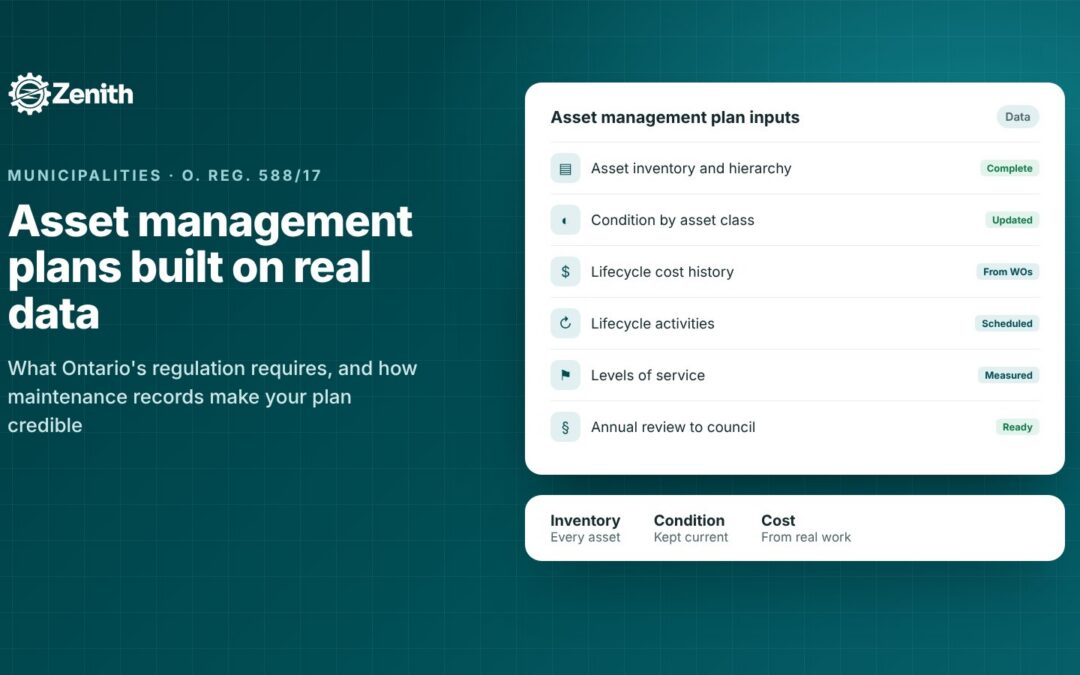
An asset management plan is a model. Its outputs are only as good as four inputs, and three of them come straight from maintenance.
| Plan input | What weak data looks like | What maintenance data adds |
|---|---|---|
| Inventaire | One line per building, no components | Asset hierarchy down to roofs, boilers, chillers, ice plants, pumps and vehicles |
| État | Estimated from age | Condition scores from inspections, updated when work is done |
| Lifecycle activities | Generic rule of thumb (for example, “replace roofs at 25 years”) | Actual PM, repair and renewal history per asset |
| Coûts | Budget lines with no link to assets | Labour, parts and contractor costs tied to each asset and work type |
When condition comes from age alone, the plan tends to replace good assets too early and miss failing ones. When costs aren’t tied to assets, nobody can tell whether a boiler is cheap to keep or quietly consuming the facilities budget. And when there’s no work history, the lifecycle strategy is a guess dressed up as a forecast.
Maintenance data also helps with levels of service for non-core assets, where municipalities choose their own measures. Facilities teams already track the things residents notice: unplanned closures, response times to urgent requests, and how often a service is interrupted.
How to build the maintenance side of your asset management plan
This method works whatever system you use, including spreadsheets. Start with one asset category, such as recreation facilities, and expand.
Step 1: Build an inventory that matches the plan
- Use the plan’s asset categories as the top of your hierarchy, so data rolls up cleanly.
- Break facilities into components that have different lives and costs: roof, envelope, HVAC, refrigeration, electrical, plumbing, life safety, elevators and site works.
- Give every asset a unique ID and a location. Tag high-value equipment with a QR code or barcode so technicians can find the record in the field.
- Reconcile with finance. Match your list against the tangible capital asset register so the plan and the financial statements describe the same assets.
Step 2: Choose a condition scale and use it consistently
A simple five-point scale is enough for most components. Write down what each score means, with examples, so two inspectors give the same asset the same score.
| Score | Meaning | Typical response |
|---|---|---|
| 5 | Very good: new or like new | Routine maintenance |
| 4 | Good: minor wear | Routine maintenance |
| 3 | Fair: some deterioration, still reliable | Monitor, plan renewal |
| 2 | Poor: frequent repairs, reduced reliability | Renewal within the plan period |
| 1 | Very poor: at or near failure | Immediate action or replacement |
This scale is an example, not a requirement. The regulation asks you to describe your approach to assessing condition, so document whichever scale you choose.
Step 3: Capture the right fields on every work order
Sample fields that make work history useful for planning:
- Asset ID (never leave it blank)
- Work type: preventive, corrective, emergency, inspection, renewal
- Failure or problem code, so repeat failures can be counted
- Labour hours, parts and contractor costs
- Downtime or service interruption (for example, hours the pool was closed)
- Condition score after the work, when a technician has assessed it
- Completion date and who signed off
Step 4: Turn history into planning numbers once a year
Before council’s annual review, pull a short summary for each asset category: maintenance cost per asset, cost trend over three years, number of unplanned failures, assets with falling condition scores, and the worst performers. These figures support the progress review and show where the lifecycle strategy needs to change.
Common mistakes
- Treating the plan as a one-time project. The annual review and five-year update mean the data has to be maintained.
- Age-based condition everywhere. It’s acceptable as a starting point, but say so and replace it with inspection data over time.
- Costs that can’t be traced to assets. Without asset IDs on work orders, you can’t defend a repair-or-replace decision.
- Non-core levels of service nobody measures. Pick measures you already collect, or can collect cheaply.
- Different asset lists in finance, operations and planning. One register, shared by all three.
Other provinces: the federal fund’s asset management expectations
Asset management expectations also come through the federal infrastructure fund formerly known as the Gas Tax Fund and then the Canada Community-Building Fund. The federal government has rebranded it as the Build Communities Strong Fund Community stream, and UBCM reports the new name took effect in June 2026 under the existing 2024–2034 agreements.
In Ontario, AMO administers the fund for most municipalities. Its asset management requirements page asks recipients to keep improving asset management data, including condition, and to show that plans guide infrastructure investment. In British Columbia, UBCM says the agreement includes commitments to improve asset management and to report on progress. Requirements differ by province and territory, so check with the organization that administers the fund where you are.
How Zenith helps
Zenith is a CMMS built in Canada. It doesn’t write your asset management plan or replace your financial systems, but it helps the facilities and public works teams keep the inventory, condition and cost data the plan depends on, and show the evidence behind it.
- Inventory with structure. Zenith’s asset management uses a hierarchy of organization, region, site, facility and location, so you can set it up to match your plan’s asset categories. Each asset carries criticality, a condition score, warranty, meters, spare parts, documents and its full work order and PM history.
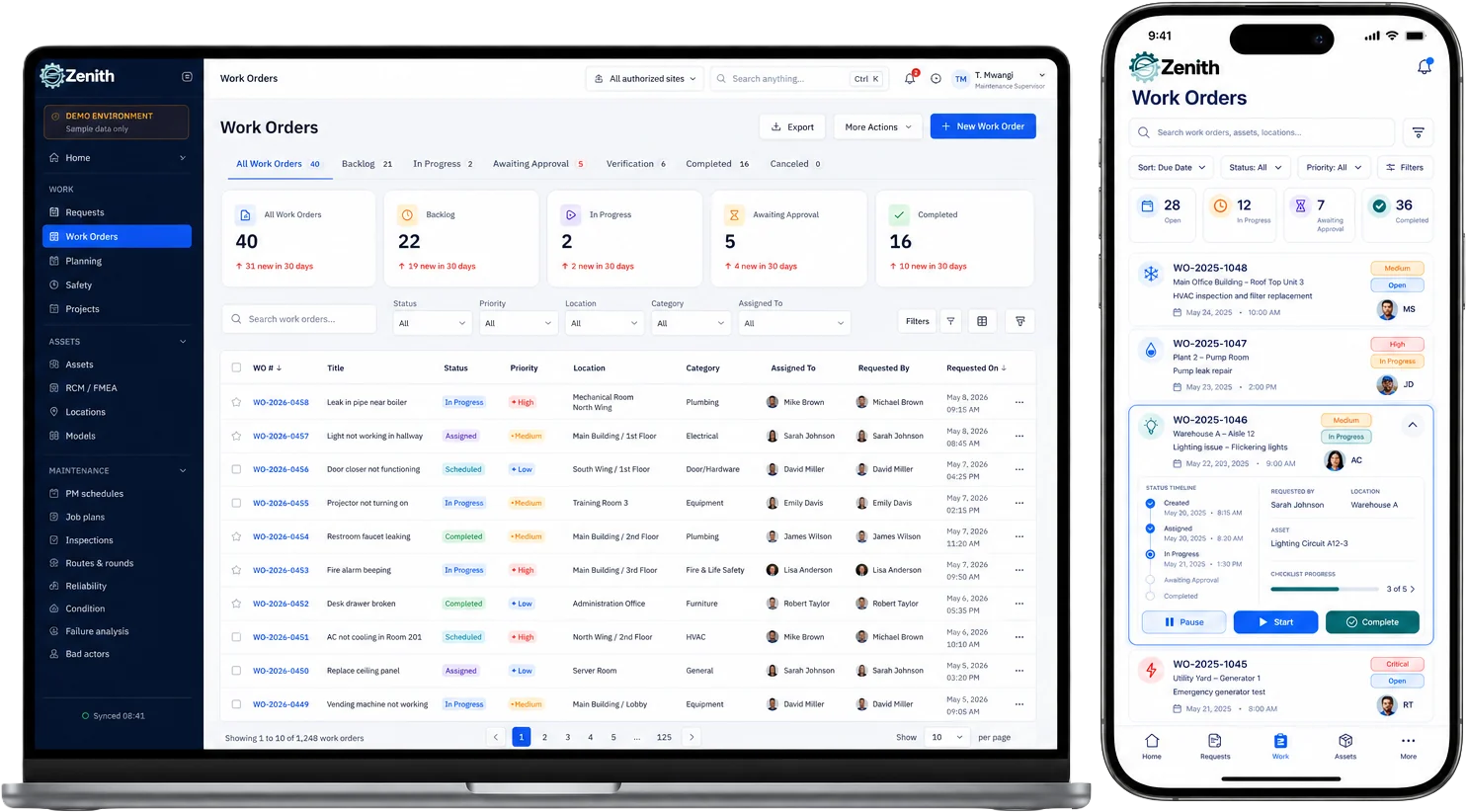
- Work history that’s tied to assets. Bons de travail record priority, type, asset, location and assignment, with a full history trail. Technicians use mobile, scan QR codes or barcodes and attach photos in the field.
- Lifecycle activities you can show. Entretien préventif schedules run by calendar, by meter or whichever comes first. PM history shows compliance %, how many ran on time, and breakdowns since the last PM.
- Inspections that keep condition current. Inspections, routes and rounds give your team a regular way to update condition scores between consultant assessments.
- Numbers for the annual review. Reports and analytics include dashboards, a report library, scheduled reports by email and export to Excel and CSV, with KPIs such as MTBF, MTTR, PM compliance and cost. Zenith Assist answers questions about your maintenance data in plain language, and “Analyse with AI” on an asset summarizes its history.
- Contractor work in the same record. Vendor and contractor tracking keeps outside work attached to the right asset.
- Built for public sector needs. English and French, hosted in Canada on Microsoft Azure, built to WCAG 2.2 AA, with single sign-on, role-based access and a full audit history. See how this fits municipalities and the public sector.
Questions people ask about O. Reg. 588/17
Who does O. Reg. 588/17 apply to?
It applies to Ontario municipalities and covers their municipal infrastructure assets. Check the regulation for the details of what counts, including assets reported in consolidated financial statements and the exclusion for assets of joint municipal water boards.
Are facilities like arenas and community centres covered?
Yes. They are non-core assets, which had to be included in an asset management plan by July 1, 2024, with proposed levels of service and a financial strategy by July 1, 2025.
What are core assets under the regulation?
Roads, bridges and culverts, and water, wastewater and stormwater management systems. The regulation sets out required levels of service metrics for each.
Does the regulation require a specific condition rating system?
The plan must include condition information and describe how the municipality assesses condition. Core asset tables use indexes such as the pavement condition index and bridge condition index. For other assets, choose a documented approach and apply it consistently.
How often does an asset management plan have to be updated?
Council reviews progress every year on or before July 1, starting the year after the full plan is completed. The plan itself must be reviewed and updated at least every five years.
Can we use our CMMS data in the asset management plan?
Yes, and you should. Work history, condition scores and asset-level costs from a CMMS are some of the best evidence for lifecycle activities and costs, as long as work orders are consistently tied to assets.
Where can we get help with the regulation?
The Province’s asset management planning page lists support programs and contacts. AMO, the Municipal Finance Officers’ Association of Ontario and Asset Management Ontario also publish guidance and tools.
Par où commencer
Pick one asset category, ideally facilities, where condition data is usually thinnest. Agree on a condition scale, make sure every work order names an asset, and plan one round of inspections before the next annual review. A year from now, your plan will rest on records, not estimates.
If you’d like to see how Zenith can hold that data for your municipality, book a demo and bring a list of your facilities.