

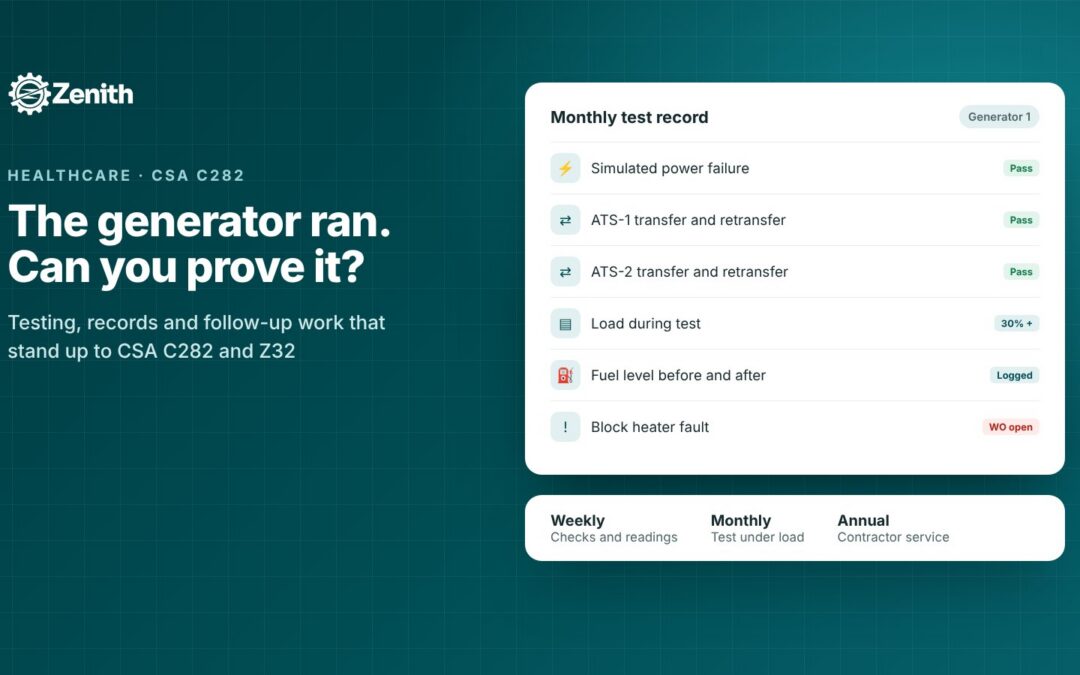
The fire inspector asks for twelve months of generator records. Your electrician is sure the generator ran every month. But the binder in the generator room skips August, the transfer switch test isn’t written down anywhere, and the block heater fault someone noted in March has no entry showing it was fixed. The emergency generator testing was done. The question is whether you can prove it.
That gap between doing the work and proving the work is where most hospital and long-term care teams get caught. This guide explains what CSA C282 and CSA Z32 expect, what a complete record looks like, and how to set up a program where the evidence builds itself every week instead of being reconstructed before an inspection or survey.
Which standards govern generators in a Canadian hospital?
Three documents do most of the work, and it helps to know how they fit together.
CSA C282:24, Emergency electrical power supply for buildings. This is the eighth edition, published by CSA Group in 2024 and superseding the 2019 edition. Its scope covers the design, installation, operation, maintenance and testing of generator sets and associated equipment that supply emergency power when the normal supply fails. It also covers essential electrical systems in health care facilities in accordance with Clause 6 of CSA Z32. It does not cover battery-based emergency power or uninterruptible power supplies. See the CSA C282:24 product page.
CSA Z32:21, Electrical safety and essential electrical systems in health care facilities. Clause 6 covers the design, installation, operation and maintenance of normal and emergency supply for areas where losing power could put patient care, staff or the public at risk. Emergency power aspects that Clause 6 doesn’t cover fall back to CSA C282. The standard applies to patient care areas in Class A, B and C health care facilities, and in 2026 CSA posted a notice to reaffirm the 2021 edition as part of its five-year review (SCC listing for CSA Z32:21).
Your provincial fire code. Fire codes are what make these standards enforceable in an existing building. For example, the 2018 British Columbia Fire Code, Section 6.5 requires emergency power systems to be inspected, tested and maintained in conformance with CSA C282, and requires emergency power for health care facilities to be inspected, tested and maintained in conformance with CSA Z32. It also says written records shall be maintained as required in CSA C282.
Two other standards come up in health care projects:
- CSA Z8000 (Canadian health care facilities) covers planning, design and construction of health care facilities. Its 2024 edition says it does not address operation and maintenance, so it shapes what you inherit after a project, not your monthly test.
- CSA Z8004:22 (Long-term care home operations and infection prevention and control) includes clauses on long-term care home building systems and catastrophic event management, according to the Standards Council of Canada announcement. Long-term care teams should read it alongside C282.
| Document | What it covers | Why maintenance cares |
|---|---|---|
| CSA C282:24 | Generator sets and associated equipment: design, installation, operation, maintenance, testing | Sets the routine testing and maintenance program and the records |
| CSA Z32:21 | Electrical safety and essential electrical systems in health care facilities | Defines the essential electrical system the generator serves |
| Provincial fire code | Enforcement in existing buildings | Makes C282 and Z32 testing and records mandatory, and names the edition |
| CSA Z8000 | Planning, design and construction of health care facilities | Shapes the system you will maintain after a project |
One practical warning: your fire code may reference an earlier edition of C282 than the latest one. Ask your authority having jurisdiction (the fire official, electrical inspector or health ministry, depending on the issue) which edition they enforce, and write the answer into your program.
What CSA C282 expects from emergency generator testing
CSA standards are paid documents, so what follows is drawn from CSA’s own published summaries and from regulators who reference the standard. Use it to organize your program, then confirm the details against the edition that applies to you.
A routine at fixed intervals
CSA publishes a companion maintenance logbook for C282. Its description lists record tables for weekly, monthly, semi-annual and annual inspections, plus tables for five-year inspections et unscheduled maintenance (CSA C282 LOGBOOK:19). That tells you the shape of the program the standard expects: frequent checks, a regular test under load, and deeper periodic maintenance.
A monthly test under load
The 2024 edition’s preface states that the minimum load required for monthly testing was corrected back to 30% (Table 3 of the standard). Check Table 3 for how that load is measured and how long the test must run.
As an example of how one Canadian regulator applies the standard, the College of Physicians and Surgeons of BC’s electrical accreditation standards for non-hospital surgical facilities call for a monthly test that simulates a normal power failure and runs the system under at least 30% of rated load for 60 minutes, and an annual program that includes a two-hour full-load test and fuel testing. Treat those as one regulator’s reading, not a substitute for your own copy of the current edition.
Transfer switches, load management and monitoring
A monthly test that simulates a power failure also exercises the automatic transfer switches (ATS). The 2024 edition adds several requirements that touch maintenance directly:
- Surge protection is now required for ATS control circuits.
- Monitoring was added for upstream disconnecting means that are not in the closed position.
- An automatic load management system is now required for multiple-generator installations, with new testing requirements for those systems.
Fuel and batteries
The 2024 edition clarifies diesel fuel treatment and testing requirements for annual maintenance, with new commentary on renewable diesel and diesel fuel maintenance in Annex B. Fire codes can add their own fuel rules: the 2018 BC Fire Code, for example, required liquid fuel storage tanks to be drained and refilled at intervals not greater than 12 months. Check what your current provincial code says.
Starting batteries and chargers belong in the frequent checks. The CPSBC standard, for example, lists batteries and charging equipment among its weekly checks, along with fuel, oil and coolant levels, leaks and the control panel.
Records
Records are where programs fail. The CPSBC guidance is a useful benchmark for content: records should show the date of the work, who did it, any unsatisfactory conditions found, and the corrective action taken. Notice the last two items. A record that says “monthly test complete” but is silent about the fault found and how it was fixed is half a record.
Why “the test was done” isn’t proof
Most record problems fall into a few patterns:
- Paper in the generator room, nowhere else. The logbook is the only copy, and nobody reviews it until someone asks.
- Readings without context. Numbers are written down, but nobody notes whether they were acceptable or what was done when they weren’t.
- The ATS is assumed. The generator test is logged, but the transfer switch operation, transfer time and retransfer are not recorded per switch.
- Deficiencies that disappear. A technician notes a coolant leak in the margin. There’s no work order, so nobody can show when or whether it was repaired.
- Contractor work in another binder. The annual service and load bank report live in the contractor’s files or an email inbox.
- No proof of timeliness. You can show 12 tests in a year, but not that they happened at the intervals the standard expects.
How to build a generator program you can prove
This method works with paper, a spreadsheet or a CMMS. The principle is the same: every scheduled task should produce its own evidence, and every problem should produce a tracked follow-up.
Step 1: Inventory everything in the emergency power chain
List each item as its own asset, with location and criticality:
- Generator sets, with run-hour meters
- Each automatic transfer switch and the branch it serves
- Main fuel tanks, day tanks and fuel transfer pumps
- Starting batteries and battery chargers
- Block heaters, radiators, ventilation louvres and exhaust
- Remote annunciators and alarm points
- Automatic load management systems, where installed
- Load bank connection points
Separate assets mean separate histories. When the second ATS fails a transfer, you want its record, not a note buried in the generator’s.
Step 2: Turn the standard into job plans
Write one job plan per interval, with task checklists drawn from your edition of C282, the manufacturer’s instructions and your fire code. A typical structure looks like this:
| Interval | Typical scope (confirm against your edition) | Done by | Evidence to keep |
|---|---|---|---|
| Hebdomadaire | Visual inspection, fluid and fuel levels, leaks, batteries and charger, control panel and alarms | In-house trades | Checklist with readings and sign-off |
| Mensuel | Simulated power failure, run under load, transfer switch operation, instrument readings | In-house with electrician | Load, run time, readings, transfer results per ATS |
| Semi-annual | Additional mechanical servicing per the standard and manufacturer | In-house or contractor | Completed checklist, parts used |
| Annuel | Full maintenance, fuel treatment and testing, load testing as the standard requires | Qualified contractor | Service report, fuel test results, load test report |
| Five-year | Periodic in-depth inspection per the standard | Qualified contractor | Report and any resulting work |
| Unscheduled | Repairs, failures, actual outages | Whoever responds | Work order with cause, action, return to service |
Don’t copy durations or load values into the job plan until you have checked them against the edition your authority enforces.
Step 3: Define the record fields
Whatever system you use, every completed test should capture the same fields:
| Field | Example |
|---|---|
| Asset and location | Generator 1, central plant, main campus |
| Date, start and stop times | Second Tuesday, 07:10 to 08:20 |
| Performed by | Name and trade |
| Test type | Monthly simulated power failure |
| Load during test | Percentage and kW |
| Relevés | Voltage, frequency, oil pressure, coolant temperature, battery voltage |
| ATS results | Each switch: transferred, retransferred, time noted |
| Fuel level before and after | Tank percentage or litres |
| Résultat | Pass, or fail with description |
| Deficiencies found | Description and photo |
| Follow-up work order | Number and status |
| Reviewed by | Supervisor sign-off and date |
Step 4: Close the loop on deficiencies
Every “fail” or abnormal reading should create a work order linked to the asset. That work order should carry the priority, the reason for any delay (waiting for parts, waiting for the contractor), the repair, and a retest. This is the evidence that answers an inspector’s second question: “And what did you do about it?”
Step 5: Coordinate tests with clinical areas
A monthly test that transfers load affects patient care areas. Agree on a standing day and time with clinical leaders, notify operating rooms, critical care and dialysis in advance, and record that notice was given. If part of the system is taken out of service, follow your fire code’s notification requirements and log when it was returned to service.
Step 6: Review every month, report every year
Once a month, a supervisor should check that every scheduled test was completed on time, every deficiency has an owner, and nothing has been on hold too long. Once a year, pull a summary by asset: tests completed, failures, repairs, and outstanding issues. That one-page summary is often what a director, inspector or accreditation surveyor wants first.
Common mistakes to avoid
- Logging the generator but not each transfer switch. Each ATS is a separate failure point.
- Testing at a convenient load instead of the required one. If the building can’t provide enough load, plan the alternative with your contractor and record it.
- Letting contractor reports live outside your records. Attach them to the asset as soon as they arrive.
- Ignoring real outages. An actual power failure is useful data. Record how the system performed.
- Treating the fire code edition as obvious. Confirm it in writing with your authority having jurisdiction.
How Zenith helps
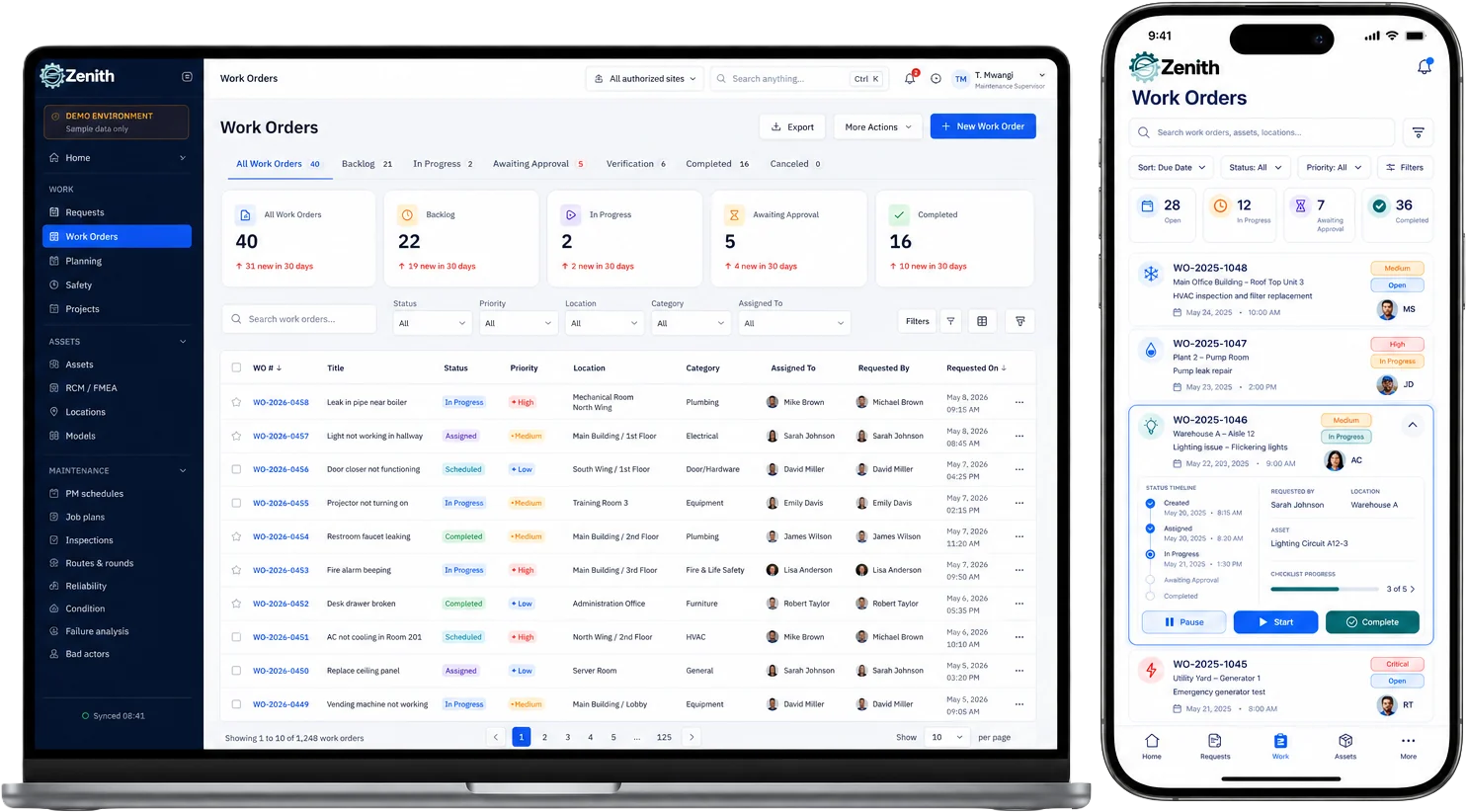
Zenith is a CMMS built in Canada. It doesn’t replace your copy of CSA C282 or your electrician’s judgment, but it helps you schedule the work, keep the records and show the evidence the standard expects.
- One asset per component. Set up generators, transfer switches, fuel tanks and battery chargers in the asset hierarchy with criticality, warranty, documents and a full work order and PM history for each one. Attach contractor reports and fuel test results to the asset they belong to.
- Schedules that match the standard. Entretien préventif schedules can be calendar-based, meter-based on run hours, or whichever comes first. An on-time tolerance window (for example ±2 days) shows whether each monthly test happened when it should have, and work orders are generated a set number of days before the due date.
- Checklists with sign-off. Job plans and task checklists record each step, the skill required and who signed it off. Technicians complete them on a phone at the generator, scanning a QR code on the unit and adding photos of the control panel.
- Deficiencies that can’t disappear. A failed step becomes a follow-up work order linked to the asset. If it waits, the On Hold reason comes from a delay register, so you can see why. Every work order keeps a full history trail.
- Contractor work in the same place. Vendor and contractor records let you track the annual service and five-year work alongside your own.
- Safe work. Hazards, permits and safety steps can be tied to the work, which helps when a test involves switching or isolation.
- Proof on demand. PM history shows the last occurrences, PM compliance %, how many ran on time, and breakdowns since. Rapports et tableaux de bord can be emailed monthly to your director and exported to Excel or CSV for an inspector. Zenith Assist can answer plain-language questions such as “which generator deficiencies are still open?”
For a wider view of how health care teams use a CMMS for code and standard requirements, see how healthcare facilities use CMMS for compliance and our healthcare maintenance management overview.
Frequently asked questions
How often should a hospital emergency generator be tested in Canada?
CSA C282 sets out a routine of frequent inspections, a regular test under load, and periodic deeper maintenance. CSA’s companion logbook includes weekly, monthly, semi-annual, annual and five-year tables. Confirm the exact tasks and intervals in the edition your provincial fire code and authority having jurisdiction enforce.
What load is required for the monthly generator test?
The preface to CSA C282:24 states that the minimum load for monthly testing was corrected back to 30%, with details in Table 3. Check the table for how the load is measured and the required run time.
What is the difference between CSA C282 and CSA Z32?
CSA C282 covers emergency generator sets and associated equipment in buildings generally. CSA Z32 covers electrical safety and essential electrical systems in health care facilities. For hospitals, Z32’s Clause 6 defines the essential electrical system, and C282 applies to emergency power aspects that Z32 doesn’t cover.
Do transfer switches need their own test records?
Every transfer switch is a separate failure point, and the monthly simulated power failure exercises them. Record each switch’s result separately, so a problem with one is visible and traceable to a repair.
How long should we keep generator test records?
Retention periods vary by province and organization. Check your fire code, the edition of C282 it references and your organization’s records policy. Many teams keep records for the life of the equipment, because the history is useful for reliability decisions too.
Can our contractor’s service report replace our own records?
A contractor report is good evidence for the work the contractor did. It doesn’t cover the weekly and monthly work your own staff perform, and it doesn’t show that deficiencies were followed up. Keep both, linked to the same asset.
Does emergency generator testing apply to long-term care homes?
Most long-term care homes with emergency generators fall under their provincial fire code and CSA C282, and Z32 may apply depending on the facility and the care provided. CSA Z8004:22 also addresses long-term care building systems. Ask your authority having jurisdiction which requirements apply to your home.
Make the next inspection a five-minute conversation
The goal isn’t more paperwork. It’s a program where every test, reading and repair is recorded once, in the right place, at the time the work is done. Start with the asset list and the record fields above, even in a spreadsheet, and review them monthly.
If you’d like to see how Zenith schedules generator PMs, captures readings on a phone and turns failures into tracked work, book a demo and we’ll walk through it with your own equipment list. For more on how this fits your wider program, see our safety and compliance features.