


Canadian businesses face a unique blend of operational hurdles: vast distances between sites, extreme seasonal shifts, bilingual workforces and stringent regulatory requirements. Traditional maintenance approaches, reliant on spreadsheets and ad hoc scheduling, often lead to downtime, safety risks and inflated costs. Computerized Maintenance Management Systems (CMMS) transform this landscape by centralizing maintenance data, automating workflows and delivering real‐time insights. This blog post explores why CMMS software has become indispensable for Canadian organizations, from coast to coast.
Understanding Canada’s Maintenance Landscape
Canadian enterprises—whether in manufacturing, utilities, mining or facility management—grapple with four core challenges:
- Geographical Scale
Remote sites in northern regions or sparsely populated provinces complicate on-site visits, spare-parts logistics and technician deployment. - Seasonal Extremes
Arctic-level winters and scorching summers accelerate equipment wear and disrupt maintenance windows. - Regulatory Complexity
Adherence to provincial safety codes (e.g., WorkSafeBC), federal standards (CSA) and environmental rules demands meticulous record-keeping. - Bilingual Workforce Needs
English-French requirements apply not only to customer communications but also to software interfaces, maintenance manuals and safety signage.
CMMS software directly addresses each of these factors by providing a centralized, cloud-enabled platform that keeps teams aligned, compliant and proactive.
What Is CMMS Software?
A Computerized Maintenance Management System is an integrated suite that handles every facet of maintenance:
- Asset Register
Digitally catalog equipment details, warranties and maintenance histories. - Gestion des bons de travail
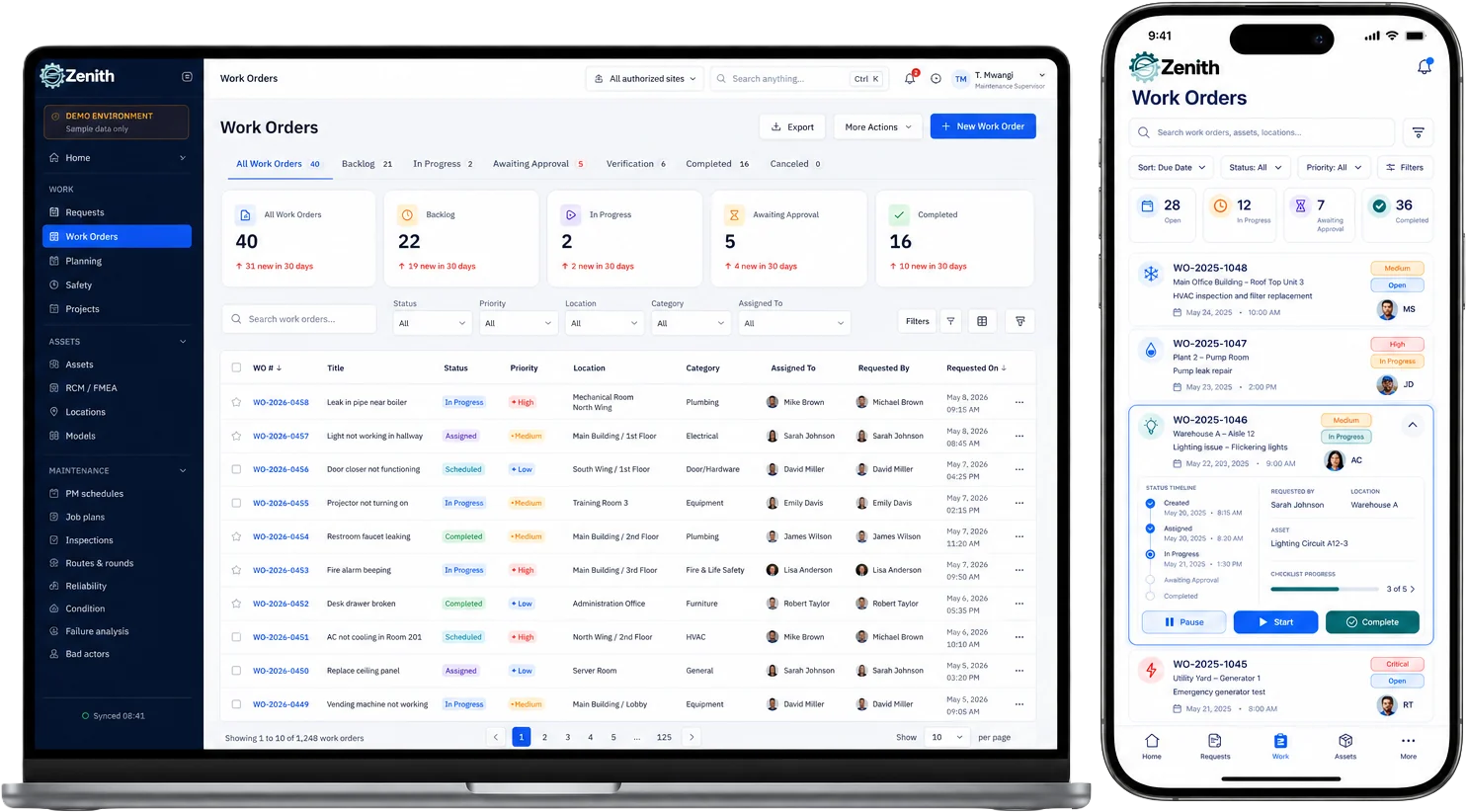
Generate, assign and track work orders with status updates, photos and technician notes. - Preventive Maintenance Scheduling
Automate recurring tasks based on runtime, calendar intervals or regulatory timelines. - Inventory Control
Monitor spare-parts levels, reorder thresholds and supplier lead times. - Reporting and Analytics
Visualize key metrics like mean time between failures (MTBF), downtime costs and technician productivity.
Deployable on-premises or via cloud, bilingual CMMS platforms let Canadian firms unify their data, reduce paperwork and accelerate decision-making.
Looking for a CMMS made here? See how Zenith works as logiciel GMAO conçu au Canada.
Key Benefits for Canadian Operations
Implementing CMMS software yields measurable improvements across operational, financial and safety dimensions. Below is a snapshot of “before and after” CMMS adoption.
| Metric | Before CMMS | After CMMS |
|---|---|---|
| Unplanned Downtime | 10–15% of total production | 3–5% of total production |
| Average Repair Time | 8–12 hours | 2–4 hours |
| Inventory Carrying Costs | 15–20% of parts value | 7–10% of parts value |
| Regulatory Compliance | Manual audits, risk of fines | Automated logs, audit ready |
| Technician Utilization | 50–60% | 75–85% |
- Reduce Unplanned Downtime
Automated alerts for preventive tasks keep machinery running through Canada’s harsh winters and busy summers. - Boost Technician Efficiency
Mobile CMMS apps let field crews update work orders in real time, eliminating duplicate data entry. - Optimize Spare-Parts Spending
Just-in-time reordering and usage analytics shrink inventory holding costs. - Strengthen Compliance Posture
Digital maintenance histories and timestamped logs streamline audits under provincial and federal regulations. - Enhance Safety Culture
Standardized checklists and immediate reporting of hazards cut workplace incidents.
Quantifying the ROI
Canada’s maintenance budgets often exceed 15% of total operating expenses. By slashing downtime and extending asset life, CMMS users typically see payback within 6–12 months. Consider these conservative estimates for a mid-sized manufacturing facility:
- 25% reduction in emergency repairs saves CAD 120,000 annually.
- 30% fewer inventory write-offs frees up CAD 80,000 in working capital.
- 20% faster regulatory audits avoid CAD 20,000 in consulting fees.
Total annual benefit: CAD 220,000. If subscription and implementation costs are CAD 100,000 per year, the net benefit exceeds CAD 120,000. These figures scale for larger operations, making CMMS a compelling investment.
Illustrative Canadian scenarios
The scenario below is illustrative. It is not an account of a named customer, and the figures in it are indicative of what a maintenance programme can aim at rather than measured results we can attribute. Where we can publish real numbers with a client’s permission, we say so plainly.
- Ontario Automotive Parts Manufacturer
After deploying a bilingual cloud CMMS, this plant cut unplanned downtime by 60% and reduced overtime costs by CAD 75,000 in the first year. - Alberta Oil & Gas Service Provider
With mobile-enabled work orders and IoT sensor integrations, the company improved preventive maintenance compliance from 40% to 92%, enhancing equipment uptime in remote wellsites. - British Columbia Municipal Utilities
Unified water-treatment asset records and automated safety inspections enabled the city to pass its CSA audit without a single finding, saving CAD 30,000 in remediation.
These examples underscore the versatility of CMMS across industries and regions.
Best Practices for Successful CMMS Adoption
Selecting and rolling out CMMS software in Canada requires thoughtful planning:
- Define Objectives and KPIs
Pinpoint key pain points—downtime, safety, parts shortages—and set specific targets. - Evaluate Bilingual Capabilities
Ensure the user interface, reports and help materials support both English and French. - Prioritize Mobile Access and Offline Mode
Technicians working in remote or low-connectivity sites need offline data capture and sync. - Integrate with IoT and ERP Systems
Leverage sensor data for condition-based maintenance and align financials in your ERP. - Invest in Training and Change Management
Secure leadership buy-in, assign CMMS champions and deliver role-based training sessions. - Start with a Pilot Program
Roll out CMMS in one department or site, refine workflows, then scale across the organization.
Conclusion
For Canadian businesses striving to optimize assets, comply with complex regulations and empower a geographically dispersed workforce, CMMS software is more than a tool—it’s a strategic enabler. By automating preventive maintenance, centralizing data and delivering actionable insights, CMMS transforms maintenance from a cost center into a value driver. Whether you operate in manufacturing, utilities, natural resources or municipal services, modern maintenance management will keep your operations running smoothly, profitably and safely in every province and season.
Next Steps and Additional Resources
Interested in exploring CMMS further? Consider these resources:
- Whitepaper: “Choosing the Right CMMS for Canadian Regulations”
- Webinar: “Maximizing Asset Lifespan with Predictive Maintenance”
- Checklist: “10 Questions to Ask Your CMMS Vendor”
Want to see a live demo tailored to your region and industry? Reach out today to discover how maintenance excellence can propel your business forward.
Looking ahead, maintenance technologies are evolving rapidly. Keep an eye on:
- Artificial intelligence for predictive failure analysis
- Augmented reality (AR) for remote technician support
- Blockchain for immutable maintenance records
These innovations promise to further streamline maintenance workflows and unlock new efficiencies for Canadian enterprises.