


Contractor compliance in Canada begins with a liability most organisations never see until it lands. If the contractor you hired is behind on their workers’ compensation premiums, the board can come to you for the money. Not to the contractor. To you, the company that hired them.
The protection against that is a clearance certificate, and almost everyone gets it slightly wrong — not by failing to ask for one, but by treating it as a piece of onboarding paperwork rather than what it actually is: a document with an expiry date that has to be valid on the day the work happens.
This guide covers what these documents are, what they protect you from, how contractor compliance requirements differ across the provinces, and why a folder of PDFs is the wrong place to keep them.
The liability you take on when you hire a contractor
Employer premiums fund Canadian workers’ compensation. When a contractor doesn’t pay theirs, the legislation in most jurisdictions lets the board recover from the business that hired them. The reasoning is straightforward: you benefited from the labour, so you carry the exposure if the premiums behind that labour went unpaid.
The scale of the exposure varies by province, and it is not trivial.
In Ontario, if a principal doesn’t obtain a clearance certificate, the WSIB states the principal “may be liable for the contractor’s payment obligations to the WSIB, up to the value of the labour portion of the contract(s).” On a $200,000 contract with $120,000 of labour in it, that is the number you are exposed to.
British Columbia is blunter still. WorkSafeBC puts it plainly: “If you hire a registered subcontractor who is not making required payments to WorkSafeBC, you could be liable for insurance premiums relating to the work or service they provided to you.”
Alberta takes the same position. WCB-Alberta’s guidance matches it in substance — without a clearance letter, if the contractor hasn’t paid their premiums, you may become responsible for those unpaid amounts.
Quebec frames it in its own terms. The CNESST runs a specific process for the payment of contributions owed by another employer — the same principle, different vocabulary.
Ontario goes further than financial exposure. Under the WSIB’s construction policy, failing to obtain or renew a clearance, or permitting work to proceed without one, is an offence — and the contractor commits an offence too, both by working without a clearance and by failing to tell the principal that theirs has been revoked.
What a clearance certificate actually is — and what it is not
A clearance certificate confirms one narrow thing: that a specific contractor is registered with the board and in good standing on their account on the day the board issued it.
It is worth being precise about what it does not tell you, because a lot of organisations treat it as a general safety credential:
- It is not proof of insurance. Workers’ compensation coverage and commercial general liability insurance are separate things: separate organisations issue them, and they expire on separate dates. A clearance certificate says nothing about whether the contractor carries $5 million of CGL.
- It is not a safety record. An account in good standing tells you nothing about the contractor’s incident history, training, or competence.
- It is not a qualification. Trade licensing, ticketing and any prequalification your organisation requires are all separate again.
- It is not permanent. This is the one that catches people, and it deserves its own section.
The clearance document, province by province
There are twelve workers’ compensation boards covering Canada’s thirteen provinces and territories — the Northwest Territories and Nunavut share one. If you operate across provincial lines, contractor compliance means dealing with more than one system, more than one portal, and more than one piece of terminology.
| Province / Territory | Board |
|---|---|
| Alberta | Workers’ Compensation Board of Alberta (WCB-Alberta) |
| British Columbia | Workers’ Compensation Board of British Columbia (WorkSafeBC) |
| Manitoba | Workers Compensation Board of Manitoba |
| New Brunswick | Workplace Health, Safety and Compensation Commission of New Brunswick (WorkSafeNB) |
| Newfoundland and Labrador | Workplace Health and Safety Compensation Commission (WorkplaceNL) |
| Northwest Territories & Nunavut | Workers’ Safety and Compensation Commission (WSCC) |
| Nova Scotia | Workers’ Compensation Board of Nova Scotia |
| Ontario | Workplace Safety and Insurance Board (WSIB) |
| Prince Edward Island | Workers Compensation Board of Prince Edward Island |
| Quebec | Commission des normes, de l’équité, de la santé et de la sécurité du travail (CNESST) |
| Saskatchewan | Saskatchewan Workers’ Compensation Board |
| Yukon | Yukon Workers’ Compensation Health and Safety Board |
Terminology varies. Ontario issues a clearance certificate. British Columbia and Alberta issue a clearance letter. Quebec issues an attestation de conformité through the CNESST’s compliance verification service. The underlying idea is the same everywhere, but the document name, the validity rules and the request process are not — confirm the specifics with the board in the province where the work is actually performed, not where your head office happens to be.
The 90-day problem
Here is the detail that turns contractor compliance from a filing task into an operational one.
It is also the reason most organisations believe they are compliant when they are not.
In Ontario, a WSIB clearance is valid for up to 90 calendar days from issue, and is renewable. Ninety days. A clearance you pulled when you onboarded a contractor in January has been worthless since roughly the start of April.
British Columbia frames the same problem differently and arguably more demandingly. WorkSafeBC’s guidance is to obtain clearance before and after you receive the services, and to confirm the subcontractor was active and in good standing for the entire period of the contract. A single letter at the start of a twelve-month service agreement does not establish that.
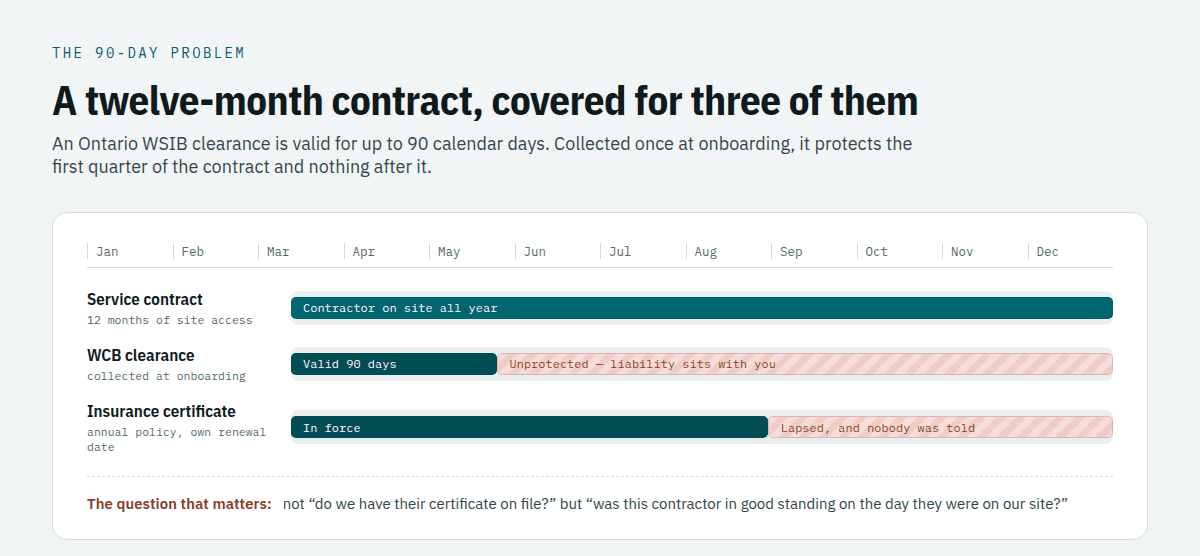
Put those two together and the shape of the obligation becomes clear. Clearance is not a credential a contractor holds. It is an answer to a question about a specific date:
Was this contractor in good standing on the day they were on our site?
That is a different question from “do we have their certificate on file,” and most compliance folders answer only the second one. The gap between them is where the liability lives.
The second document: certificates of insurance
Running alongside the clearance certificate is the certificate of insurance — usually commercial general liability, often with additional-insured status naming your organisation, and frequently with an owner-specified minimum limit.
This document has all the same properties and one extra difficulty:
- Its own expiry date, which almost never lines up with the clearance certificate’s.
- Its own renewal cycle, driven by the contractor’s insurer rather than a provincial board.
- It can lapse silently. A policy cancelled mid-term for non-payment reaches you only if you hold additional-insured status and the cancellation clause obliges the insurer to tell you. The certificate in your folder still looks perfectly valid.
So a contractor who is genuinely clear to work needs at minimum: workers’ compensation clearance valid on the work date, insurance in force on the work date at the limit your contract requires, and whatever trade licensing or prequalification the job demands. Three documents, three expiry dates, none of them aligned, on every contractor you use.
Multiply that by forty vendors and you can see why the spreadsheet stops working.
Why the folder-of-PDFs approach to contractor compliance fails
Nearly every organisation starts the same way: a shared drive folder per contractor, scanned certificates dropped in, someone in procurement or facilities nominally responsible for keeping it current.
It fails for four reasons, and they are structural rather than a matter of discipline:
- Nothing in a folder has an expiry date the system understands. A PDF is an image of a fact, not the fact itself. Nothing can sort by it, filter on it, or warn on it.
- Nobody looks at the folder at the moment of decision. The person raising the purchase order or booking the site visit is not the person who maintains the folder, and they are working to a deadline.
- It answers “today” at best. If you are scheduling work for six weeks from now, “are they compliant?” is the wrong question. “Will they be compliant on the 14th?” is the right one, and a folder cannot answer it.
- It has no refusal. A folder can be wrong without anything happening. There is no point at which the system declines to proceed, so the check is advisory — and people skip advisory checks when the plant is down.
What contractor compliance has to mean to be useful
The fix is not a better folder. It is changing what the compliance record is, from a stored document into a question the system can answer on a date.
Practically, that means the register holds the structured facts rather than the scan: the document type, its reference number, the issue date, the expiry date, and what it actually covers — which sites, which classes of work. Once those are fields rather than pixels, the system can answer “can this contractor be engaged for this work, at this site, on this date” and give a reason when the answer is no.
And critically, the question has to get asked at the points where it changes something. Checking compliance on a compliance screen is close to useless, because the person about to book an uninsured roofer is not on the compliance screen. The check has to sit in front of the actions: raising the purchase order, scheduling the site visit, opening the contractor’s record.
A practical checklist
Whatever system you use, these are the questions worth being able to answer without a phone call:
- Which contractors have a clearance or insurance document expiring in the next 30, 60 and 90 days?
- For a job scheduled six weeks out, which of our approved contractors will still be compliant on that date?
- Which contractors are approved for this site, as opposed to approved in general?
- Which are qualified for this class of asset — the elevator contractor is not the roofing contractor?
- When a contractor is refused, does the system say why, and does it name the document and the date?
- Can we produce the compliance position as it stood on a past date, for an audit or an incident investigation?
That last one is the one auditors ask and almost nobody can answer.
Where software helps — and where it doesn’t
We build contractor and vendor management into Zenith, so treat this section as interested rather than neutral. In the spirit of the rest of this article, here is precisely what it does and does not do.
What it does
The vendor register holds compliance documents as structured records — a closed list of document types, each with a reference, an issue date, an expiry date, and the sites and asset classes it covers. One rule decides whether a vendor can be engaged, and that rule is asked at three places: when a purchase order is raised, when a site visit is scheduled, and on the contractor’s own record. It answers for the date of the work, not the date the page loaded, so a visit booked six weeks out checks against the expiry that will apply then. When the answer is no, it returns a specific reason — the vendor is retired, suspended, their paperwork has lapsed, they don’t serve that site, or they aren’t covered for that class of asset — rather than a generic error.
What it doesn’t do
Being straight about this matters more than the pitch:
- It doesn’t store the certificate file. The record holds the document’s details, not a scan of it. If you need the PDF itself for an audit, that lives elsewhere for now.
- It doesn’t email you expiry reminders. The expiring-soon query exists, but nothing pushes it to you. You see an expiry when you look, or when the gate refuses the work.
- There is no contractor portal. Vendors cannot log in and upload their own renewed certificates. Somebody on your side records the renewal.
- It is not a scorecard. Zenith records and displays a promised response time, but never compares it against what actually happened.
If those gaps are dealbreakers for your organisation, better to know now than in month four of an implementation. If what you need is that the question gets asked at the right moment and answered honestly for the right date, that part is real.
Contractor compliance: frequently asked questions
Do I need a clearance certificate for every contractor, or only construction?
It depends on the province and the work. Ontario’s requirement is explicit for construction: a principal who directly retains a contractor to perform construction work must obtain one. Outside construction and outside Ontario, the liability principle generally still applies even where the mandatory-certificate rule is narrower — which is why most organisations obtain clearance for any contractor whose workers set foot on their property, regardless of trade. Check the rule for the province where the work is performed.
How long is a clearance certificate valid?
In Ontario, up to 90 calendar days depending on the issue date, and it is renewable. Other provinces set their own terms, and British Columbia’s guidance emphasises covering the entire period of the contract rather than relying on a single letter. Treat 90 days as a reasonable planning assumption and verify against the issuing board.
What happens if my contractor’s clearance expires mid-project?
The protection lapses with the certificate. In Ontario you must obtain a new clearance once the original expires or the board revokes it, and permitting work to continue without one is an offence for the principal. On any contract longer than about three months, renewal needs to be scheduled rather than remembered.
Is a certificate of insurance the same as a clearance certificate?
No, and confusing them is common. A clearance certificate concerns the contractor’s workers’ compensation account with a provincial board. A certificate of insurance concerns a commercial policy from a private insurer, usually general liability. Different issuers, different renewal cycles, different expiry dates. You generally need both.
Can I just ask the contractor to send their certificates once a year?
You can, and many organisations do, but it does not match the obligation. An annual collection cycle against a 90-day validity window leaves most of the year uncovered. It also puts the check on the wrong side of the transaction — you find out a contractor has lapsed when you go looking, rather than when someone tries to send them to a job.
We work across several provinces. Does one clearance cover us?
No. Workers’ compensation is provincial, and coverage follows where the work is performed. A contractor operating in Ontario and Alberta has an account with each board and needs clearance from each. If you operate nationally, your compliance register needs to hold documents per jurisdiction rather than one per contractor.
This article is general information about compliance practice in Canada, not legal advice. Requirements differ by province, by industry and by the specifics of a contract. Confirm your obligations with the workers’ compensation board in the jurisdiction where the work is performed, and with your own legal and insurance advisors.
If you want to see how a contractor register answers “can this vendor be engaged on the 14th of next month” with the document and the date rather than a shrug, book a walkthrough — bring one real contractor and their real expiry dates and we will build the record in front of you.