


When people hear “predictive maintenance,” they often imagine a production floor filled with connected devices — IoT sensors tracking vibration, temperature, and performance in real time. While that setup is powerful, it’s not the only route to accurate forecasting. Many organizations, particularly small to mid‑sized ones, lack the budget, technical expertise, or infrastructure to invest heavily in IoT. That doesn’t mean they can’t reap the benefits.
The essence of predictive maintenance is simple: use data, patterns, and early warning signs to prevent failures before they happen. You don’t necessarily need a network of automated monitors to achieve that. With a disciplined approach to collecting and analyzing the right information, supported by consistent training and processes, you can achieve significant uptime improvements — often at a fraction of the cost of a full IoT rollout.
1️⃣ Leverage the Data You Already Have
Most businesses are sitting on valuable datasets without realizing it. Historical maintenance logs, for example, can tell a compelling story about which components fail most often and under what conditions. Usage records like operating hours or production cycles can help establish a baseline for normal wear and tear, while parts ordering history might reveal seasonal or workload‑related spikes in failure. You can combine these insights into a simple predictive model without buying a single new device.
Environmental data, too, can be a goldmine. You might not have IoT climate sensors on your shop floor, but you can still reference publicly available weather records to see how temperature or humidity correlate with failures. If you notice that certain equipment tends to fail during hot, humid months, you can proactively adjust inspection and maintenance schedules in those periods — all without streaming real‑time data from smart devices.
2️⃣ Adopt Manual Condition Monitoring Practices
Manual inspections aren’t “old‑fashioned” — they’re proven, reliable, and, with the right discipline, can be just as effective as automated systems in many situations. Portable vibration meters, for example, are affordable tools that trained technicians can use during routine checks to detect early mechanical issues. Similarly, handheld infrared thermometers or thermal cameras can quickly flag overheating motors, bearings, or electrical panels.
Fluid analysis is another under‑used but highly effective tactic. By sending oil or lubricant samples for laboratory testing, you can identify metal particles, contamination, or viscosity changes that signal component wear long before a breakdown occurs. Visual inspections, if guided by a structured checklist, ensure that nothing is overlooked — making them a low‑cost but high‑impact part of a predictive maintenance strategy without IoT.
3️⃣ Apply Statistical & Rule‑Based Models
You don’t need advanced AI algorithms to create useful prediction models. Start with a Failure Modes and Effects Analysis (FMEA) to understand which components are most critical and how they typically fail. Assign risk priorities and inspection intervals accordingly. Even a well‑structured spreadsheet can turn maintenance records into actionable forecasts by showing average time‑to‑failure and highlighting assets due for checks.
Regression models, created in Excel or other basic analytics tools, can help you map the relationship between operational workload and failure probability. Pair these models with simple threshold‑based triggers — such as “inspect after 500 hours” — to create a structured, semi‑predictive schedule. Over time, you can refine these thresholds as more data is collected, making the approach increasingly accurate without the need for constant sensor feeds.
4️⃣ Empower Your Operators
Operators interact with machinery daily, making them the most reliable early warning system you have. Training them to notice subtle changes — a slightly different hum in a motor, a faint smell of overheating, or a shift in operating speed — can be as valuable as a sensor reading. Regular workshops and refresher training ensure this observational skill stays sharp.
To make this work, reporting must be easy and encouraged. Whether it’s a quick entry in a CMMS, a shared spreadsheet, or even a dedicated WhatsApp group, the faster anomalies are recorded, the faster they can be addressed. Recognizing and rewarding early detection reinforces the behavior, turning predictive maintenance into a shared responsibility instead of just a management directive.
5️⃣ Blend Preventive & Predictive Approaches
Preventive maintenance and predictive maintenance work best together. While preventive schedules provide a consistent baseline for servicing equipment, predictive methods allow you to fine‑tune those schedules. This reduces waste — you’re not replacing parts too early — and prevents unexpected failures by catching warning signs before they escalate.
For example, if preventive maintenance calls for a bearing replacement every 12 months, but your data and inspections suggest wear actually occurs closer to 14 months, you can adjust. Over time, this hybrid approach saves both money and time while maintaining or even improving asset reliability.
6️⃣ How CMMS Software Supercharges Predictive Maintenance Without IoT
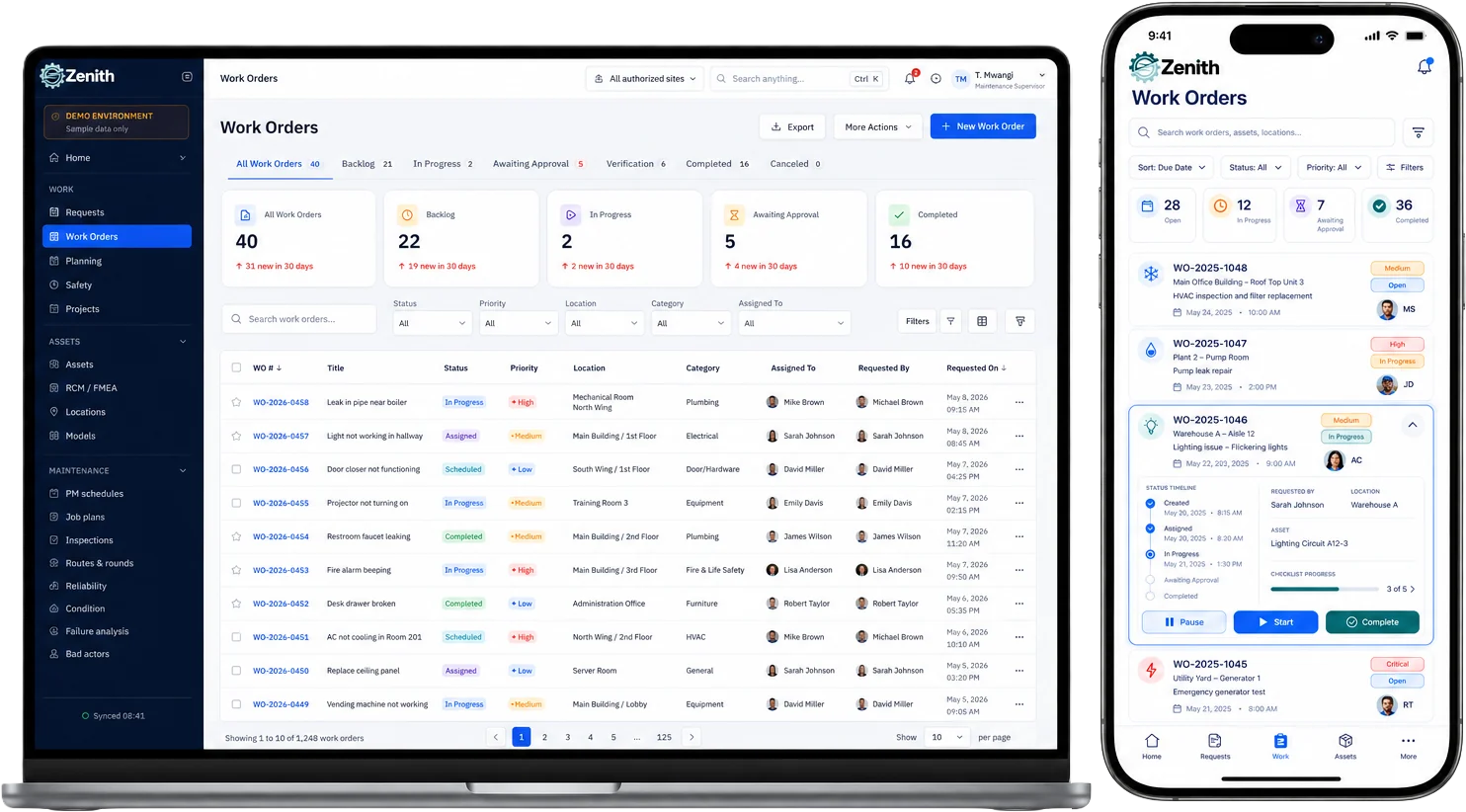
A Computerized Maintenance Management System (CMMS) is often seen as the backbone of modern maintenance operations — and it’s just as valuable when you’re running predictive maintenance without IoT. Think of CMMS software as the command center where all your data, inspections, and schedules come together. Even without live sensor feeds, it centralizes every maintenance log, inspection checklist, and repair history in one accessible hub, making it easier to spot patterns and forecast needs.
For example, when your team conducts manual condition checks — whether it’s vibration readings, lubricant tests, or visual inspections — those results can be entered directly into the CMMS. Over time, the software can generate reports highlighting recurring issues, seasonal trends, and the most failure‑prone assets. That means you can still make data‑driven, predictive decisions without streaming IoT data in real time. Plus, with built‑in scheduling features, CMMS platforms ensure that no inspection or follow‑up ever slips through the cracks.
A good CMMS also fosters collaboration. Operators can log issues as soon as they notice them, technicians can update work orders on the go, and managers can track progress from a dashboard. This transparency tightens the feedback loop, so problems are flagged and acted on faster. And because many CMMS systems allow you to attach photos, upload test results, and generate automated reminders, you get a lightweight but highly effective predictive maintenance ecosystem — all without buying a single connected sensor.
💡 Key Takeaway
Predictive maintenance isn’t about the latest tech — it’s about a proactive mindset. By making smart use of existing data, committing to disciplined inspections, and involving your team, you can unlock significant performance gains without a single IoT sensor. Think of it as building the muscle memory of a predictive system now, so that if you choose to integrate IoT later, you’re already ahead of the curve.
This approach also makes predictive maintenance accessible to any organization, regardless of budget. Start small, measure results, and improve step‑by‑step — that’s how you build reliability into your operations sustainably.
❓ Frequently Asked Questions
Q1: How accurate is predictive maintenance without IoT?
Without real‑time data, accuracy depends on the quality of your historical records and inspection discipline. Many common failure patterns can still be anticipated through consistent monitoring and analysis, making the approach surprisingly effective.
Q2: What’s the minimum data I need to start?
You’ll want at least one to two years of repair logs, usage stats, and inspection results. Even if incomplete, start recording systematically now — your predictions will improve as your dataset grows.
Q3: Isn’t manual inspection too slow for critical assets?
For mission‑critical equipment, increase inspection frequency or supplement with low‑cost, stand‑alone data loggers. This hybrid approach improves speed without the full cost of IoT.
Q4: How do I convince management this is worth doing without IoT?
Show them downtime costs vs. the modest investment required for manual predictive methods. Real‑world case studies demonstrating cost savings help build the business case.
Q5: Can I integrate this approach with a CMMS?
Absolutely. Most CMMS platforms can schedule inspections, store readings, and identify trends over time. This adds structure and consistency to your predictive process without requiring a connected sensor network.
Absolutely, Iman — let’s expand that FAQ so your readers walk away with every doubt cleared and see you as a true authority on the subject. I’ll add extra, high‑value questions that touch on practical scenarios, common hesitations, and implementation tips.
Q6: What types of businesses benefit most from predictive maintenance without IoT?
Small to medium‑sized manufacturing plants, facilities with aging equipment, and organizations in developing regions often see the biggest gains. They can adopt a low‑cost, high‑impact strategy without overhauling their infrastructure.
Q7: How do I track results to prove it’s working?
Track KPIs like Mean Time Between Failures (MTBF), Mean Time To Repair (MTTR), and total maintenance cost per asset. Compare results over a 6‑ to 12‑month period to show reduced downtime and repair expenses.
Q8: Can predictive maintenance without IoT scale for large enterprises?
Yes — start with a pilot program on critical assets, refine your processes, and then scale to other plants or sites. The same inspection and data principles work company‑wide with the right coordination.
Q9: What training should my team have to make this effective?
Basic equipment operation training, plus targeted sessions on condition monitoring techniques, data logging, and early‑warning symptom recognition. Adding periodic refresher courses keeps the skills sharp.
Q10: What’s the difference between this and pure preventive maintenance?
Preventive maintenance works on fixed schedules regardless of actual wear, while predictive maintenance adjusts those schedules based on observed conditions and patterns — meaning you maintain only when needed, avoiding unnecessary work.
Q11: Is specialized software necessary?
Not strictly. While a CMMS makes scheduling and data analysis easier, you can start with spreadsheets or paper logs — just ensure the process is consistent and accessible to all stakeholders.
Q12: How do I choose which assets to focus on first?
Prioritize based on criticality (impact on production), downtime cost, and historical failure frequency. Start with high‑impact machines to prove ROI quickly.
Q13: Are there industries where IoT‑free predictive maintenance isn’t ideal?
Highly regulated environments that require constant, certified monitoring (e.g., aerospace, nuclear power) may still need real‑time IoT solutions for compliance, though elements of manual predictive work can still help.
Q14: Can this approach help extend the lifespan of aging assets?
Absolutely. Manual checks, targeted part replacements, and better scheduling based on wear trends can add years to the operational life of older machinery.
Q15: How can CMMS software support predictive maintenance without IoT? By consolidating inspection results, historical data, and work orders, a CMMS helps you track patterns and anticipate failures even without live sensor inputs. Its reporting tools can highlight maintenance trends, while scheduling features keep predictive checks timely and consistent.
Conclusion: Start Your Predictive Maintenance Journey Today
Predictive maintenance without IoT is no longer just a “workaround” for businesses that can’t invest in sensor networks — it’s a legitimate, scalable strategy for cutting downtime, saving costs, and extending equipment life. By combining historical data, disciplined manual inspections, team training, and smart scheduling, you can achieve many of the same gains as IoT‑driven setups — and build a solid foundation for future digital upgrades.
The key is consistency. Every log you fill out, every inspection you document, and every minor anomaly you catch early strengthens your predictive capabilities. Over time, this becomes a cultural shift: maintenance stops being reactive firefighting and becomes a proactive, strategic advantage.
If you’re ready to put these principles into action but want a central hub to manage inspections, schedules, and historical data, consider using Evole FM. Their CMMS platform makes it simple to track manual condition readings, store service history, and generate reports — all in one place. It’s the perfect partner for organizations looking to implement or enhance predictive maintenance without the complexity or cost of IoT from day one.
One Canadian regulation that requires trending, not just recording
The case above is about getting value without sensors. Canadian regulation supplies an additional reason, and it is a legal one rather than a commercial one.
The federal pipeline regulations require an operator’s management system to include a data management system for monitoring and analysing trends in hazards, incidents and near-misses. Read that carefully: the requirement is to trend, not merely to record. You cannot trend a filing cabinet, and you cannot trend a folder of PDFs. That is predictive work mandated by regulation, achievable from records you already generate. See CMMS for Canadian mining and pipelines.
The same pattern appears elsewhere. Failure history against a named asset, with dates and technicians, is what turns a maintenance log into an early-warning signal — no sensors required. More at CMMS software in Canada.