

In today’s dynamic work environments, understanding the difference between space management vs facility management is essential—where hybrid models, flexible offices, and smart buildings are rapidly reshaping how organizations operate—two terms often surface together yet carry distinct meanings: space management and facility management. Both aim to optimize physical environments, but they do so from different angles. Understanding their unique scopes, responsibilities, tools, and metrics is crucial for facility directors, real estate teams, workplace strategists, and C-suite leaders striving to drive efficiency, cut costs, and boost occupant satisfaction.
1. Defining the Two Disciplines
1.1 What Is Space Management?
Space management focuses on how physical square footage is allocated, utilized, and reconfigured to meet evolving business needs. It zeroes in on:
- Occupancy Planning: Tracking who sits where, from individual desks to team neighborhoods.
- Space Allocation: Assigning areas for teams, departments, or functions based on headcount forecasts and workstyles.
- Utilization Analysis: Measuring how often meeting rooms, hot desks, and collaboration zones are actually used.
- Reconfiguration and Move Management: Designing floor plans, coordinating office moves, and updating seating charts.
The ultimate goal is to squeeze maximum value from each square foot—often expressed in metrics such as square feet per employee, desk utilization percentage, and real estate cost per occupant.
1.2 What Is Facility Management?
Facility management operates at a broader operational level, ensuring that buildings and their systems (HVAC, electrical, plumbing, security, cleaning) run smoothly, safely, and cost-efficiently. Core responsibilities include:
- Operations & Maintenance (O&M): Routine inspections, preventive maintenance, repairs, and vendor management.
- Health, Safety & Compliance: Fire drills, OSHA/EHS regulations, accessibility standards, and emergency preparedness.
- Energy & Sustainability: Monitoring consumption, optimizing HVAC schedules, integrating renewable energy solutions.
- Service Delivery & Occupant Experience: Cleaning, catering, mail services, front-desk reception, and help-desk support.
According to the International Facility Management Association (IFMA), facility management encompasses a wide range of services that support the functionality of the built environment.
Facility managers wield metrics like mean time between failures (MTBF), work order turnaround, energy use intensity (EUI), and occupant satisfaction scores.
2. Scope and Stakeholders
| Aspect | Space Management | Facility Management |
|---|---|---|
| Primary Focus | How space is assigned & used | How building systems function & support people |
| Key Stakeholders | Real Estate; Workplace Strategy; HR; Finance | Maintenance teams; Security; Environmental Health & Safety (EHS) |
| Time Horizon | Short- to medium-term (quarterly to annual) | Ongoing operations (daily to multi-year) |
| Core Data Sources | Sensor data; occupancy surveys; seating charts | Building management systems; maintenance logs |
| Typical Tools | IWMS; space planning software; CAD/BIM | CAFM; CMMS; building automation systems |
3. What Is Space Management vs Facility Management?
One of the most common misconceptions in workplace strategy is confusing space management vs facility management.
- Objective
- Space management aims to optimize the use of space.
- Facility management ensures the performance of space and its systems.
- Primary Metrics
- Space: Utilization rate, density (ft²/person), move frequency.
- Facility: Response time, system uptime, energy consumption.
- Project vs. Process
- Space management often runs as projects (new office rollout, departmental moves).
- Facility management is a continuous process (daily maintenance, compliance checks).
- Design vs. Delivery
- Space managers shape floor plate design, seating arrangements, and workplace experience.
- Facility managers deliver services—cleaning, repairs, security—to keep that design functional.
4. Where They Overlap
Although distinct, the two disciplines intertwine:
- A space change (new team neighborhood) triggers facility tasks (network cabling, lighting adjustments).
- Energy optimization projects require both spatial scheduling (turning off meeting rooms when vacant) and system controls (adjusting HVAC setpoints).
- Emergency evacuation plans need space drawings (egress routes) and facility safety systems (alarms, fire doors).
Cross-functional collaboration and integrated technology (like an Integrated Workplace Management System, IWMS) break down silos, ensuring that space changes automatically generate relevant facility work orders.
5. Why the Distinction Matters
- Strategic Resource Allocation
Leaders can budget separately for real estate (rent, moves) and operations (maintenance, utilities), avoiding cost overruns. - Specialized Expertise
Space planners focus on workforce dynamics and culture, while facility managers excel at technical building systems and compliance. - Technology Implementation
Choosing the right platform—IWMS for space analytics or CMMS for maintenance workflows—delivers clearer ROI and user satisfaction. - Performance Accountability
Clear KPIs let each team measure its own impact: Did space densification reduce rent per employee? Did preventive maintenance lower breakdown incidents?
6. Tools That Support Space and Facility Management
- Integrated Workplace Management System (IWMS)
Centralizes real estate, space, and maintenance data, enabling scenario modeling, move automation, and lease management. Tools like IWMS and CMMS help bridge the gap between space management and facility management. - Computerized Maintenance Management System (CMMS)
Tracks maintenance requests, schedules preventive work, and logs asset histories. - Building Information Modeling (BIM)
3D digital twins that inform both space layouts and system details (duct runs, electrical risers). - IoT Sensors & Analytics
Motion, CO₂, and desk-occupancy sensors feed real-time utilization dashboards and trigger automated HVAC adjustments.
| Technology | Space Management Use | Facility Management Use |
|---|---|---|
| IWMS | Move planning; utilization reporting | Service request integration |
| CMMS | — | Work order management; asset tracking |
| BIM | Floor-plan accuracy; change impact | System maintenance mapping |
| IoT Dashboards | Real-time seat/room occupancy | Predictive maintenance triggers |
7. Implementing Best Practices
- Establish Clear Ownership
Define roles: Who approves seating changes? Who coordinates service vendors? - Build Integrated Data Flows
Connect CAD drawings, occupancy sensors, and maintenance logs so a move request auto-creates electrical, network, and cleaning tasks. - Measure Continuously
Use dashboards to monitor utilization and preventive maintenance metrics. Hold monthly reviews to course-correct. - Engage Occupants
Conduct regular surveys. Empower employees with self-service room-booking and move-request portals. - Leverage Automation
Automate routine tasks: alert facilities when a hot desk plate shows zero occupancy for more than a week, flag rooms for deep cleaning after high utilization.
8. Real-World Examples
- Tech Headquarters
A rapidly growing company used space management analytics to boost desk utilization from 40% to 75%, delaying a costly floor lease renewal. Facility management teams then downsized HVAC zones and saved 12% on annual energy expenses. - Healthcare Facility
Space managers reconfigured nurse-station layouts to reduce response times by 20%. Facility managers integrated nurse-call systems with HVAC and lighting controls to ensure comfort and safety in high-traffic wards. - University Campus
Campus planners optimized classroom assignments using space booking patterns. The facilities department aligned cleaning schedules with academic calendars, reducing overtime by 30%.
9. Emerging Trends and the Future
- Digital Twins
High-fidelity virtual replicas of buildings that simulate both space reconfigurations and system performance under different scenarios. - AI-Powered Optimization
Machine learning models that predict future headcount, recommend right-sized space needs, and forecast equipment failures. - Activity-Based Working
Designing spaces around activities—focus pods, social hubs, wellness zones—requires fluid space management and responsive facility services. - Sustainability Integration
Space usage insights combined with energy-management data yield green certifications and meet ESG goals.
10. How Zenith Bridges Space Management and Facility Operations
Zenith offers a single, integrated platform that brings together space management and facility management under one roof. By unifying data, automating workflows, and delivering real-time insights, Zenith empowers your team to optimize every square foot and every system—so you spend less time firefighting and more time on strategic improvements. When evaluating software solutions, consider how they support both space management vs facility management functions.
- Space Planning & Move Management
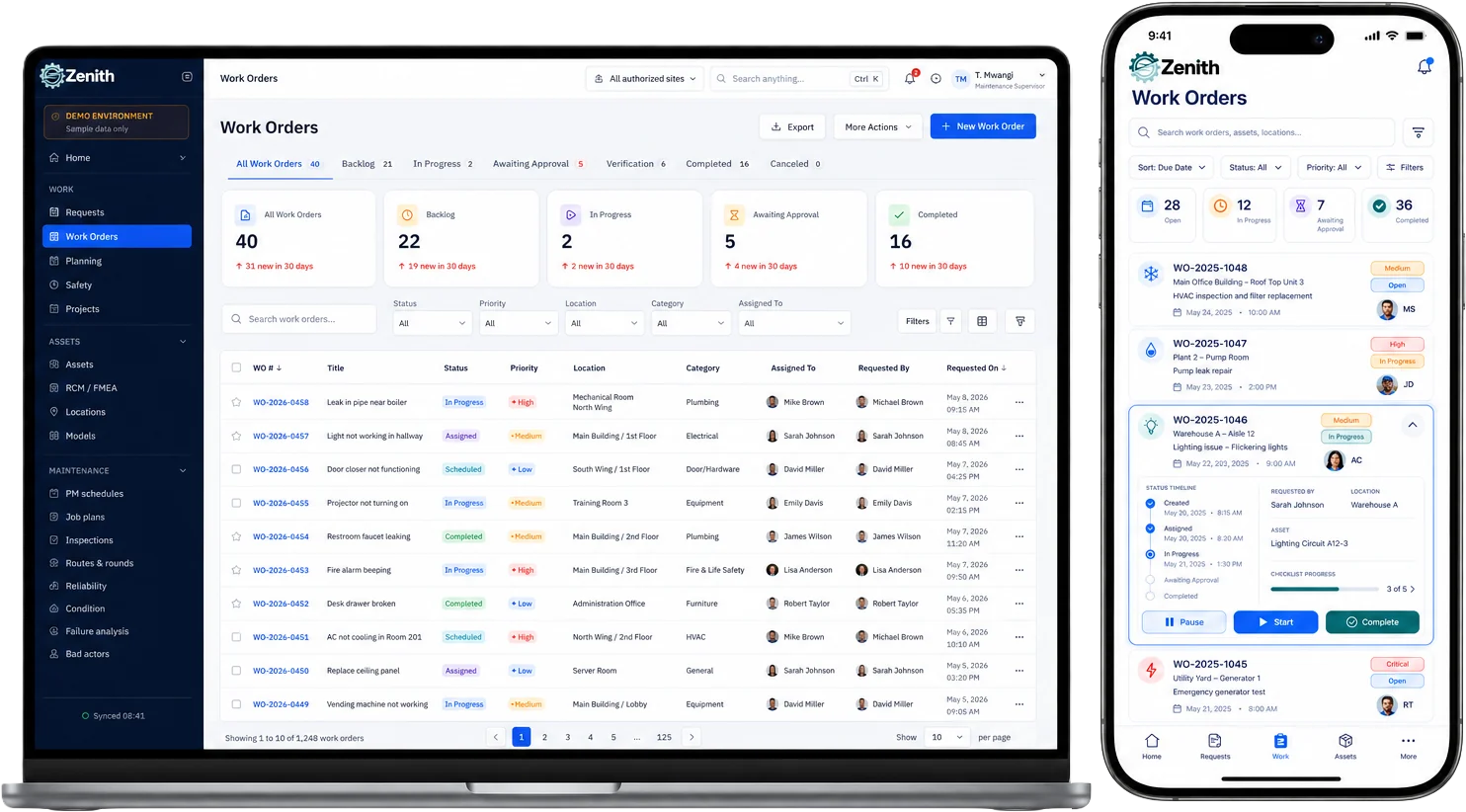
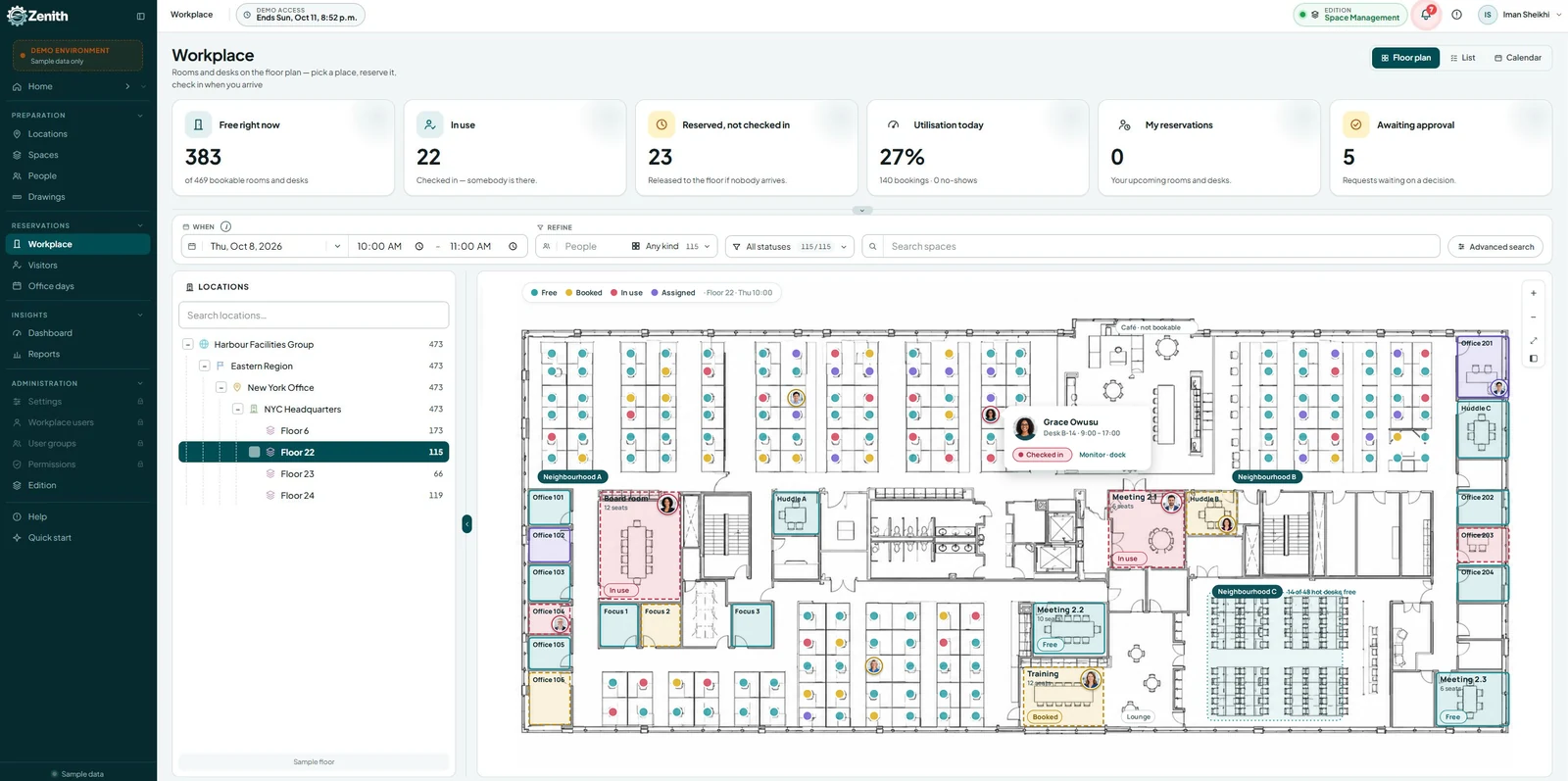
Zenith’s space module lets you model multiple “what-if” scenarios in a few clicks. You can visualize seating charts in 2D or 3D, forecast headcount changes, and automate move requests. When a reconfiguration is approved, work orders for network cabling, furniture delivery, and cleaning are generated automatically. - Maintenance Management & Automated Work Orders
The built-in CMMS engine tracks assets from HVAC units to fire alarms. Preventive maintenance schedules trigger reminders before equipment fails, and mobile technicians receive service calls instantly. Historical maintenance data feeds back into your space planning to highlight high-usage zones that may need more frequent inspections. - Energy & Sustainability Analytics
Zenith integrates with your building automation system (BAS) and IoT sensors to measure energy use intensity (EUI), carbon emissions, and indoor environmental quality. You can set up rules that shut down lighting and HVAC in unoccupied zones, run peak-demand alerts, and track improvements against sustainability targets. - Real-Time Occupancy Sensing
By tapping into desk-occupancy and room-utilization sensors, Zenith paints an accurate picture of how space is used hour by hour. Dashboards update live, so you can identify under-utilized areas, reassign desks to teams in need, and balance headcount without guesswork. - Self-Service Employee Portal
Employees can book desks, reserve meeting rooms, and submit move or service requests via a mobile app or web portal. This self-service layer reduces administrative overhead, speeds up approvals, and gives your workforce transparency into space availability and maintenance status. - Advanced Reporting & Dashboards
Customizable dashboards surface the metrics that matter most—utilization rates, work order turnaround times, energy trends—and allow you to slice data by building, floor, department, or date range. Scheduled reports keep stakeholders informed and support data-driven decision making at every level.
Real-World Impact
A mid-size tech firm using Zenith reduced unused desks by 30 percent, delaying a major lease expansion. At the same time, preventive maintenance automation cut unplanned downtime by 25 percent and lowered maintenance costs by 12 percent. These gains translated directly into millions of dollars saved and a more agile, employee-friendly workplace.
By leveraging Zenith’s unified solution, you break down the silos between space planners and facility teams. The result is streamlined operations, measurable cost savings, and a workplace that adapts as quickly as your business needs evolve.
11. Conclusion
While space management and facility management share the common ambition of making workplaces more efficient and responsive, they tackle that ambition from complementary vantage points. Space management optimizes “where people work,” while facility management ensures “how the building works.” By recognizing their distinct roles, integrating data flows, and investing in the right technology—like Zenith—organizations can unlock synergy, achieving lower real estate costs, higher occupant satisfaction, and more sustainable operations.
Whether you’re a corporate real estate director planning the next office redesign or a facility manager striving to cut downtime, appreciating the nuances between these disciplines—and choosing a partner that bridges them—will be the first step toward a truly intelligent, agile workplace.